Written and reviewed by Susumu
Born and raised in Japan · Checked against Japanese law and ministry guidance
What counts as a fever in Japan, which warning signs need urgent attention, and how to find a doctor outside regular clinic hours — all drawn from Japan's official pediatric sources.
Affiliate Disclosure: This article contains affiliate links. If you click a link and make a purchase, we may earn a small commission at no extra cost to you. We only recommend products we genuinely believe are helpful. See our Terms of Use for full details.
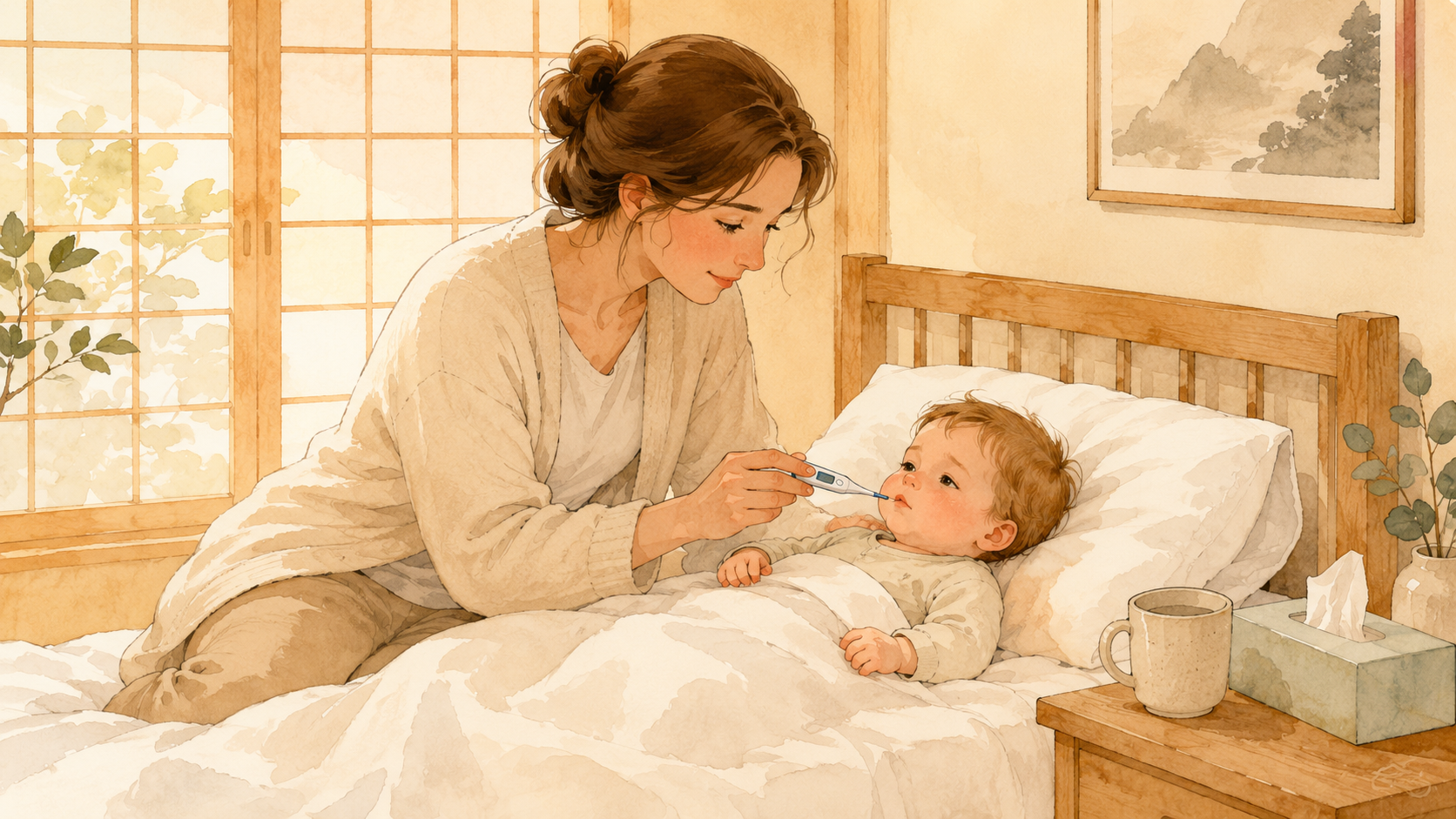
A baby with a fever is one of the most unsettling things a new parent faces. This guide explains what counts as a fever in Japan, which signs to watch for, and how to find the right medical care — including outside regular clinic hours. All guidance is drawn from Japan's official pediatric sources.
For information only. This article introduces official Japanese resources and explains how to navigate the healthcare system. It does not provide medical advice. Always consult a qualified medical professional for concerns about your child's health.
What Counts as a Fever in Japan
In Japanese pediatrics, a fever is defined as a body temperature of 38°C or above. This is the threshold used by the 日本小児科学会 (Japan Pediatric Society) and applies across all age groups from one month onwards.
A reading of 37.5°C is considered borderline by many Japanese pediatricians and may be described as 微熱 (binetsu — low-grade fever). The standard Japanese advice is to take the temperature in the armpit (わきの下で測る), holding the thermometer in place for about one minute. Rectal or ear measurements are less common in everyday home use here.
Japanese thermometers sold at pharmacies typically display in Celsius. If your thermometer reads in Fahrenheit, 38°C is approximately 100.4°F.
Under 3 Months: A Different Situation
If your baby is under 3 months old and has a temperature of 38°C or above, this is treated as a medical emergency in Japan. According to こどもの救急, age under 3 months (生後3か月未満) is listed alongside the most serious warning signs — it is a reason to go straight to hospital, regardless of how the baby otherwise appears.
Young babies cannot regulate temperature well and are more vulnerable to serious infection. Japanese pediatricians do not use a wait-and-see approach for this age group. Go to hospital and do not wait until morning.
生後3か月未満の発熱は病院へ。 If your baby is under 3 months old and has a fever, go to a hospital immediately — this is the guidance from Japan's official pediatric sources. Do not call #8000 first; go directly.
Signs That Need Urgent Attention
The こどもの救急 guide lists these as indicators that a child with fever needs medical attention urgently — not at the next available appointment, but the same night if needed:
- Listless or lethargic — 元気がなく、ぐったりしている (genki ga naku, guttari shite iru). The child has no energy, is floppy, and does not respond as usual.
- Breathing is labored — 呼吸があらく、苦しそう (kokyū ga araku, kurushisō). The child appears to be struggling to breathe or is breathing unusually fast.
- Poor color — 顔色・皮膚色が悪い (kaoiro / hifuiro ga warui). The face or skin looks pale, gray, or mottled.
- Persistently drowsy — ずっとうとうとしている (zutto utouto shite iru). Difficult to keep awake; unusually hard to rouse.
- Under 3 months old — 生後3か月未満 (seigo sankagetsu miman). See above.
If any of these are present, do not wait for the clinic to open. Call #8000 to speak with a pediatric nurse, or go directly to a hospital emergency department. If the child is clearly in serious distress — not breathing normally, unconscious, or having a seizure — call 119 immediately.
Signs That Suggest You Can Monitor at Home
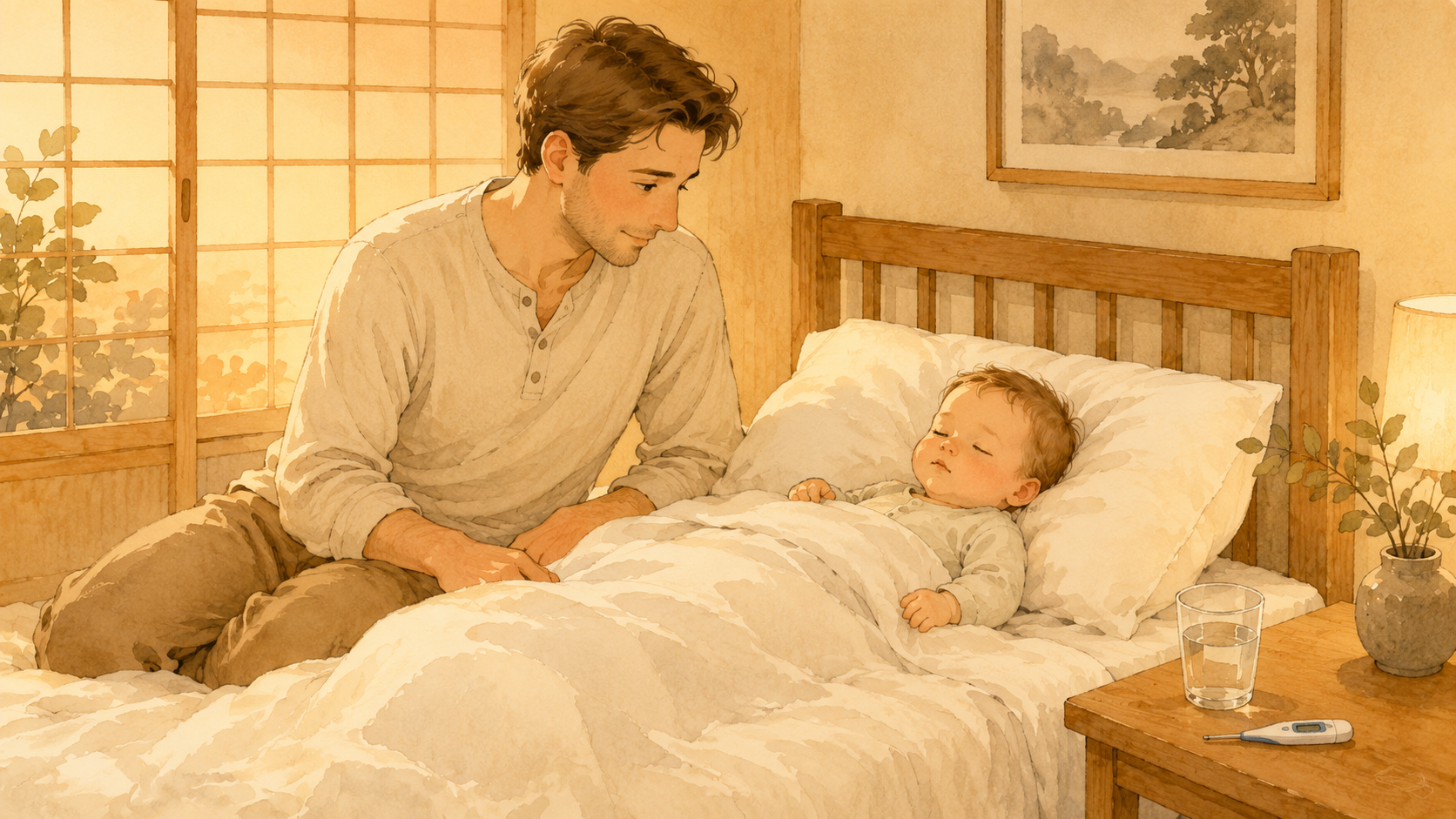
Japan's official pediatric guidance lists these as signs that a child with fever is coping reasonably well and may be able to wait until the clinic opens:
- Alert and engaged — 元気がある (genki ga aru). The child is responsive and not unusually subdued.
- Drinking fluids — 水分は取れている (suibun wa torete iru). Able to take breast milk, formula, water, or oral rehydration fluid.
- Smiles when comforted — あやすと笑う (ayasu to warau). Responds to a familiar voice or face.
- Normal wet diapers — おむつがいつもの通り濡れている (omutu ga itsumo no tōri nurete iru). Urinating roughly as usual.
These are general indicators, not a diagnosis. If you are unsure, call #8000 to speak with a pediatric nurse.
Finding a Doctor Outside Regular Hours
Most small clinics (クリニック) in Japan are closed in the evenings and on weekends. When your child is unwell outside those hours, you have a few options.
休日診療 / 夜間診療 — Holiday and Night Clinics
Municipal authorities maintain a system of on-call clinics that open on weekends, public holidays, and evenings. These rotate among local practices (当番医, tōban-i — on-call doctor). To find the clinic currently on duty in your area, search 「[your city/ward name] 子ども 夜間診療」 or 「[city] 休日診療」 online. Your prefecture's official website usually has a searchable list.
大きな病院の救急外来 — Hospital Emergency Department
Larger hospitals with a pediatric department (小児科, shōnika) usually have an emergency outpatient service (救急外来, kyūkyū gairai) that operates outside regular hours. These can be busy on weekends and public holidays — expect a wait. If you arrive without a referral letter (紹介状), a surcharge (選定療養費) may apply.
Look up the nearest 小児科 now and find out their after-hours arrangements before your baby actually gets sick. Having that information ready makes a late-night situation considerably less stressful.
At the Clinic: What to Prepare and Say
Japanese doctors will ask a predictable set of questions. Having the answers ready — even written on paper — removes a lot of the language barrier in one go.
What to note down before you go
- Current temperature, and the highest reading so far
- When the fever started (date and time)
- Any other symptoms — vomiting, diarrhea, cough, rash, runny nose
- Whether the child has eaten and drunk anything today
- Any medication given, including dosage and timing
- Recent vaccinations (your 母子健康手帳 has this record)
- Whether anyone else at home is unwell
Bring your 母子健康手帳 (Maternal and Child Health Handbook) and your health insurance documentation. Japan moved to the マイナ保険証 (My Number Card used as health insurance) on December 2, 2024. If you have not set this up, your insurer should have issued a 資格確認書 (shikaku kakunin-sho — eligibility confirmation document) instead — bring whichever you have. The handbook contains your child's vaccination record, birth measurements, and health check history — all of which a doctor may ask about.
At the reception desk, you can say: 「子どもに熱があります」 (kodomo ni netsu ga arimasu — My child has a fever). Then show the thermometer reading and your written notes. Most reception staff will take it from there.
Tips for Non-Japanese Speakers
- Google Translate camera — pointing your phone camera at a prescription bag, medicine label, or discharge summary gives a rough but usable translation in real time. Install it before you need it.
- #8000 — Japan's nationwide pediatric phone consultation line. Dial from any mobile or landline. The service is in Japanese, but you can say 「英語が話せる方はいますか?」 (Is there someone who speaks English?). Hours vary by prefecture — check in advance at mhlw.go.jp. Our guide to deciding when a sick child needs a doctor explains how the line works alongside 119.
- AMDA International Medical Information Center — multilingual telephone support for international residents seeking medical care in Japan. Available Monday through Friday 10:00–16:00. Languages include English, Chinese, Korean, Spanish, Portuguese, Thai, Tagalog, Vietnamese, and Indonesian.
- Your ward or city office international affairs desk — many municipalities have multilingual support staff (国際交流協会, kokusai kōryū kyōkai) who can help with interpretation or finding an English-speaking facility.
Japanese Vocabulary
| Japanese | Reading | Meaning |
|---|---|---|
| 発熱 | hatsunetsu | Fever |
| 微熱 | binetsu | Low-grade fever |
| 体温 | taion | Body temperature |
| 体温計 | taionkei | Thermometer |
| ぐったりしている | guttari shite iru | Listless, lethargic |
| 元気がない | genki ga nai | No energy, unwell in manner |
| 水分補給 | suibun hōkyū | Fluid intake / hydration |
| 熱性けいれん | nessei keiren | Febrile seizure |
| 小児科 | shōnika | Pediatric clinic / department |
| 休日診療 | kyūjitsu shinryō | Holiday clinic |
| 夜間診療 | yakan shinryō | Night-time clinic |
| 当番医 | tōban-i | On-call doctor |
| 解熱剤 | genetsuzai | Fever-reducing medicine |
| 保険証 | hoken-shō | Health insurance card |