
Written and reviewed by Susumu
Born and raised in Japan · Checked against Japanese law and ministry guidance
From the naming ceremony on day 7 to the first birthday rice cake, Japan marks a baby's first year with a rich set of traditions. This guide explains each celebration — お七夜, お宮参り, お食い初め, 初節句, and more — so you know what to expect and how to take part.
Affiliate Disclosure: This article contains affiliate links. If you click a link and make a purchase, we may earn a small commission at no extra cost to you. We only recommend products we genuinely believe are helpful. See our Terms of Use for full details.
Japan has a rich calendar of milestones marking a baby's first year. These traditions carry meaning — some centuries old — and even if you're not Japanese, you'll likely find yourself caught up in them. This guide walks you through each celebration, what it involves, and what to expect as a family living in Japan.
Quick-Reference Timeline
| When | Celebration | What Happens |
|---|---|---|
| Day 7 | お七夜 | Name revealed; 命名書 displayed |
| Day 30–33 | お宮参り | First visit to a Shinto shrine |
| Day 100 | お食い初め | Symbolic first meal ceremony |
| March 3 / May 5 | 初節句 | First seasonal festival (girls / boys) |
| 6 months | ハーフバースデー | Informal half-birthday celebration |
| 1 year | 一歳の誕生日 | First birthday; 一升餅 tradition |
The exact date of each event can shift slightly depending on your family's schedule or how you feel after the birth — that flexibility is perfectly normal, and no one expects rigid adherence.
お七夜 — Day 7 Naming Ceremony
お七夜 (oshichiya) falls on the seventh night after birth and marks the moment the baby's name is officially shared with the family. Historically this was significant: the first week of life was uncertain, and surviving it was cause for celebration. Today the tradition continues as a warm, low-key gathering centered on the 命名式 (meimei-shiki) — the naming ceremony.
命名書 — The Naming Scroll
The centerpiece of お七夜 is the 命名書 (meimei-sho), a handwritten or printed card bearing the baby's name. It is typically displayed on a 神棚 (family altar) or somewhere prominent in the home. Traditionally written in calligraphy on washi paper, ready-made 命名書 kits are widely sold at baby goods stores and are just as common today.
The layout usually shows the full name, the date of birth, and the parents' names. Once displayed, it is kept for a period — some families leave it up for about one month.
What the Day Looks Like
There is no set script. Some families order a special meal including お祝い膳 (celebration dishes) such as red rice (赤飯) and sea bream (鯛). Others simply gather close family at home. Hospitals typically discharge mothers before day 7, so the celebration often happens at home. Grandparents — especially the maternal grandmother, who traditionally helps with postnatal support — may attend, but the size of the gathering is entirely up to you.
お宮参り — First Shrine Visit
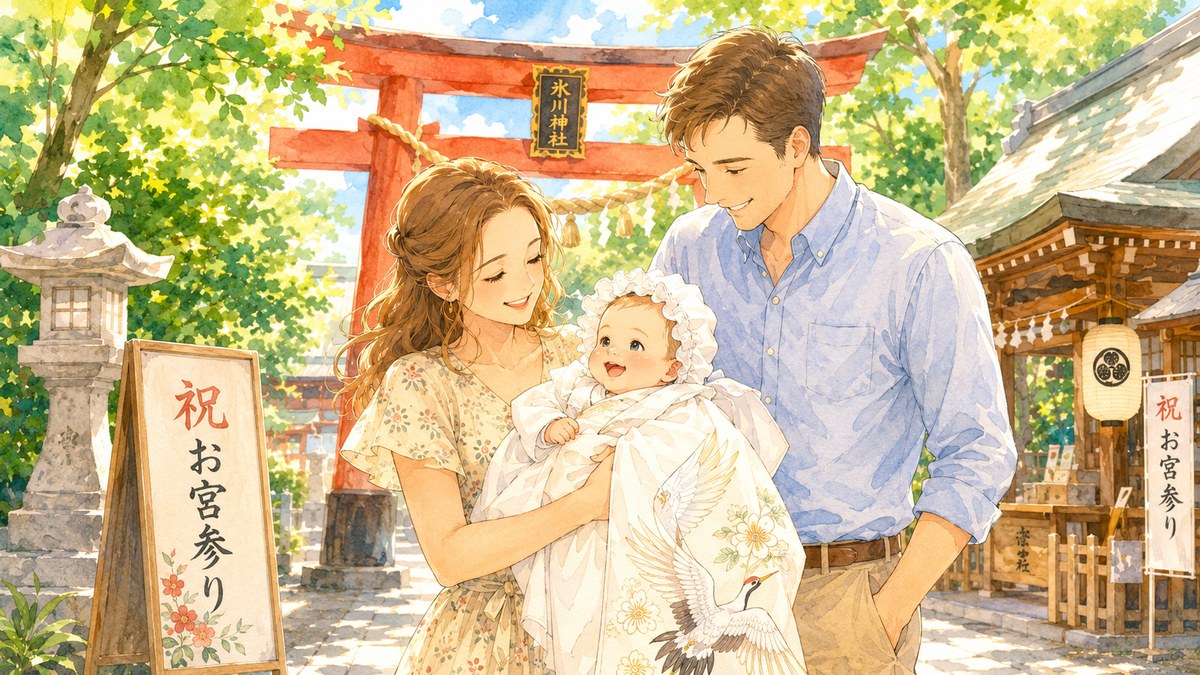
お宮参り (omiyamairi) is a visit to a Shinto shrine to report the baby's birth to the local deity and pray for the child's health. It traditionally takes place around day 30 to 33, though there is room to adjust based on the mother's recovery and the weather.
When to Go
- Boys — traditionally around day 31–32
- Girls — traditionally around day 32–33
In practice, many families choose a convenient day within the first month or two. There is no hard deadline. Cold weather, illness, or a difficult recovery are all good reasons to postpone slightly.
What to Wear
The baby is traditionally dressed in a white inner garment and draped with an embroidered outer robe called a 掛け着 (kakegi). This robe — often white with crane or pine motifs — is held over the baby by the grandmother (or the parent carrying the child) rather than worn directly. Regular baby clothes are also perfectly acceptable, and many families dress their baby in something smart but practical.
Parents and grandparents typically dress in formal or semi-formal attire, but there are no strict requirements. A neat, respectful outfit is enough.
At the Shrine
You can simply visit the shrine and offer a prayer without any formal ceremony. If you want a dedicated blessing (御祈願, gokigan), you go to the shrine office (社務所, shamusho) and request a prayer from a priest. The standard offering for this is called 初穂料 (hatsuhoryo), which typically ranges from 5,000 to 10,000 yen. You place it in a white envelope beforehand — stationery stores sell envelopes labeled 初穂料.
The blessing ceremony takes about 20 to 30 minutes and is conducted inside the shrine's ritual hall. You will receive an amulet (お守り) for the baby. Photography is sometimes allowed inside; check with the shrine.
Which Shrine to Visit
Tradition says you should visit the 氏神様 (ujigami-sama), the local guardian shrine of the area where you live. In practice, most families choose a larger or more convenient shrine. There is no rule against this.
お食い初め — Symbolic First Meal
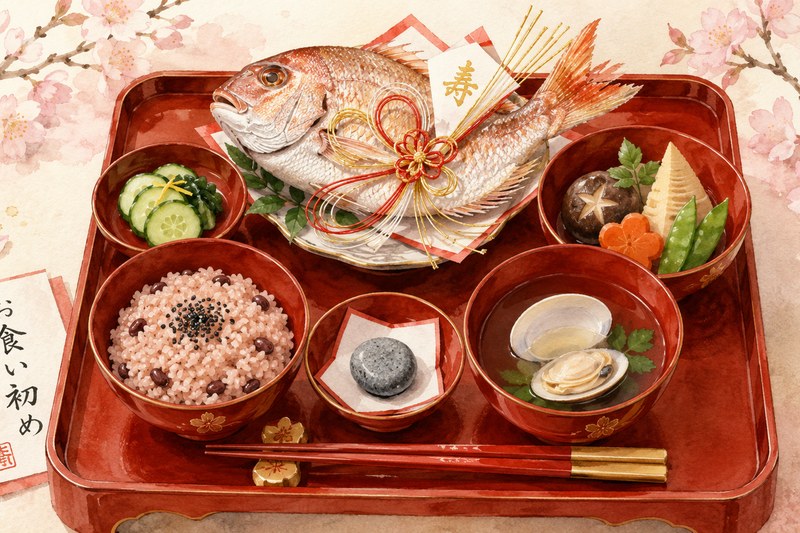
お食い初め (okuizome) is a ceremony that dates back to Japan's Heian period, roughly 1,200 years ago. It is traditionally held around day 100, a timing traditionally associated with the coming of a baby's first teeth. The occasion carries two layers of meaning: gratitude that the baby has grown safely through the first hundred days, and a prayer for continued health in the years ahead.
The baby does not actually eat — a parent or grandparent symbolically brings each dish close to the baby's lips, repeating the gesture three times. The wish behind it is simple: that this child will never go hungry throughout their life.
The Traditional Menu
The お食い初め meal follows a set structure. It is served on lacquerware (traditionally red for girls, black for boys, though this varies by region and family).
| Dish | Meaning |
|---|---|
| 鯛 (sea bream) | Celebration and good fortune (めでたい, "auspicious," ends with the same sound as 鯛) |
| 赤飯 (red rice) | Auspicious; marks special occasions |
| 汁物 (clear soup) | Clear broth (お吸い物), typically with clam (蛤) |
| 煮物 (simmered vegetables) | Seasonal ingredients |
| 香の物 (pickles) | Accompaniment |
| 歯固め石 (small stone) | Wish for strong teeth; touched to baby's gums (not given to eat) |
The 歯固め石 (hagatame-ishi) is a small smooth pebble placed on the tray. It symbolizes a wish for the baby to grow strong teeth. Some families borrow a stone from a shrine; purpose-made sets with a ceremonial stone are also sold at baby stores.
Where to Do It
You can prepare the meal at home or order a set from a department store food hall or a Japanese restaurant. Many family restaurants and hotels offer お食い初め packages, which include the full set delivered to a private room — useful if cooking feels like too much at this stage.
初節句 — First Seasonal Festival
節句 (sekku) are Japan's traditional seasonal festivals. The first one a baby experiences — 初節句 (hatsuzekku) — is considered especially meaningful.
Girls — 桃の節句 (March 3)
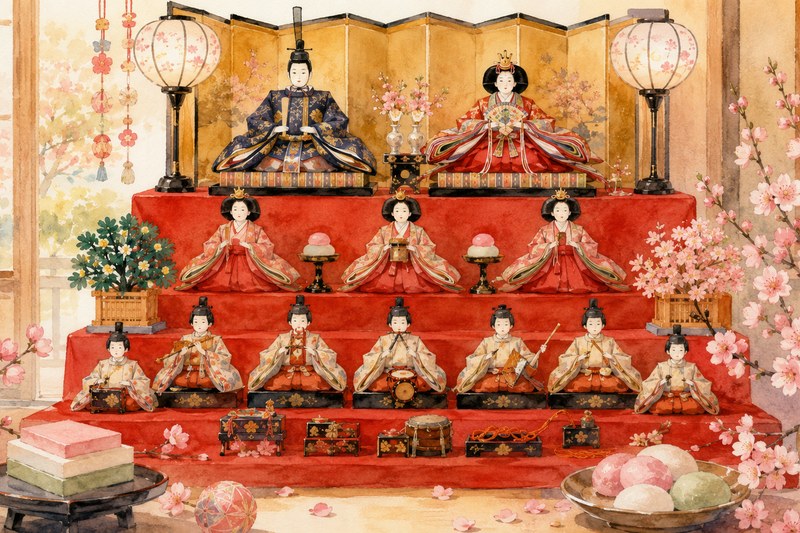
Also known as ひな祭り (Hinamatsuri or Doll Festival). Families display a set of ornamental dolls (雛人形, hina-ningyo) representing a Heian-era imperial court. The display is traditionally set up in February and put away promptly after March 3 — leaving it out longer is said to delay marriage, though few take this literally today. Families may celebrate with chirashizushi, clam soup, and hishimochi (diamond-shaped rice cakes).
Boys — 端午の節句 (May 5)
Children's Day (子どもの日, Kodomo no Hi), a national holiday. Families fly 鯉のぼり (koinobori — carp streamers) outdoors, symbolizing strength and perseverance. Inside, many display a 兜 (kabuto — miniature samurai helmet) or 五月人形 (gogatsu-ningyo, warrior dolls), both associated with courage and protection. The kabuto (兜) in particular is one of the most recognized symbols of the day. Kashiwamochi (oak-leaf rice cakes) or chimaki are traditional foods for this day.
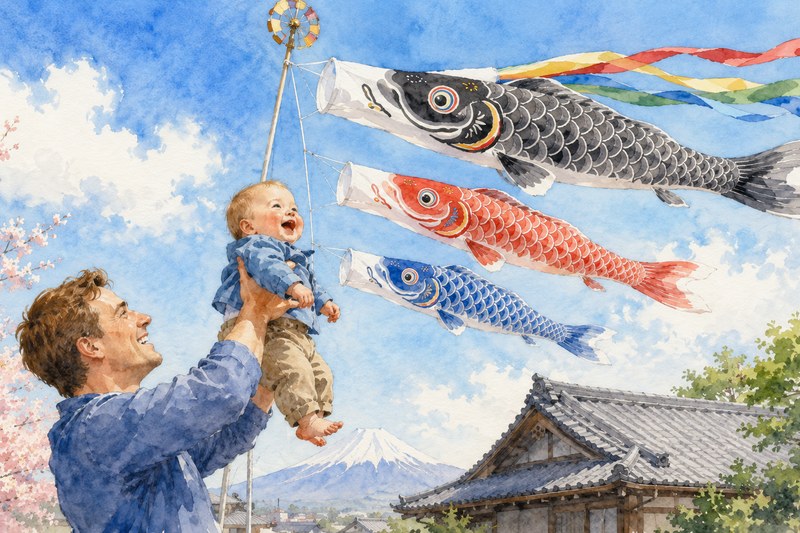
If your baby is born very close to the festival date, it is common to wait until the following year for the main celebration — the dolls or decorations are often gifted by grandparents, and there may not be enough time to prepare.
ハーフバースデー — Six-Month Milestone
ハーフバースデー (half-birthday) at the six-month mark is a newer tradition — not traditional Japanese culture, but widely embraced. It is primarily a chance for a photo session, often with a small 0.5 or ½ decoration and a fake cake made from materials the baby cannot eat. Baby photography studios (赤ちゃん撮影スタジオ) offer half-birthday packages, and the concept is well-recognized in Japanese baby culture.
There is no ceremony or ritual — it is simply a moment to mark how quickly the first six months have passed.
一歳の誕生日 — The First Birthday
The first birthday is the most widely celebrated milestone, and Japan has its own tradition for the occasion: the 一升餅 (issho-mochi).
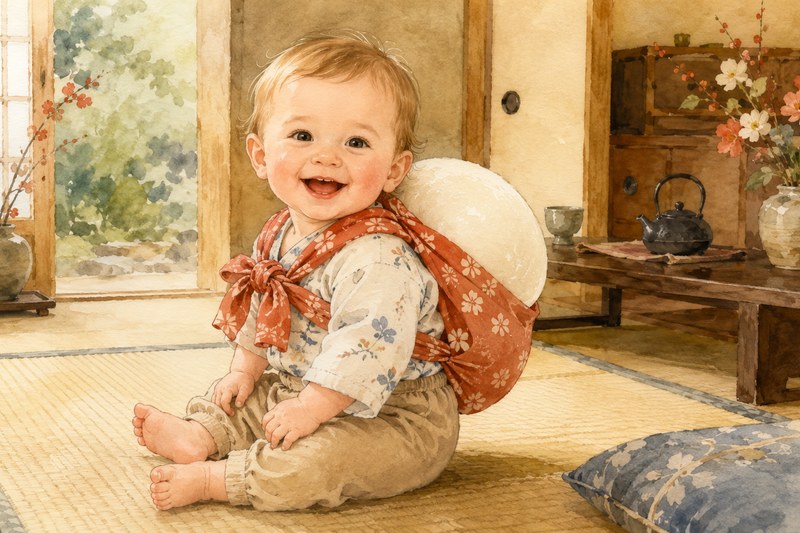
一升餅
一升 refers to about 1.8 kg of rice — a full measure. The 一升餅 is a round rice cake weighing roughly 1.8 kg (about 4 lb), prepared specially for the occasion. The child wears it on their back in a cloth and is encouraged to walk or crawl, carrying the weight. The idea behind it is a wish that the child will never go without food throughout their life (一生食べ物に困らないように), and that they carry the blessing of a full measure from the start.
Most babies cannot walk steadily at 12 months and end up sitting or falling — this is considered charming rather than a problem. Some families also practice えらび取り (erabitori), placing objects in front of the baby (a pen, a coin, a book, an abacus) and seeing which one the baby reaches for first, as a playful way of guessing what path the child might take in life.
Birthday Cake
Western-style birthday cakes are standard at first birthday parties in Japan. Baby-friendly versions using cream cheese frosting, plain sponge, and fruit — avoiding sugar, salt, and honey — are sold at some bakeries and easily found as recipes online. The smash cake concept (putting the cake in front of the baby and letting them dig in) has become popular in Japan too.
Notes for International Families
None of these celebrations are obligatory. Many international families living in Japan pick the ones that resonate and quietly skip others — and Japanese society expects nothing different. A few things that help:
- Shrines welcome everyone. Shinto shrines do not require any religious affiliation to visit. You do not need to be Japanese or Buddhist to participate in お宮参り. Priests are generally used to families from abroad and will proceed through the ceremony the same way regardless of background.
- Language at the shrine. The ceremony is conducted entirely in Japanese. You do not need to say anything — bow when instructed, accept the amulet with both hands, and follow the priest's lead. Having a few words written on your phone to show staff is enough to get started: 赤ちゃんの御祈願をお願いしたいのですが (Akachan no gokigan wo onegai shitai no desu ga — "I would like to request a blessing for my baby").
- Doll sets are a long-term commitment. Hina-ningyo (雛人形) is traditionally gifted by the maternal grandparents. Gogatsu-ningyo (五月人形) and koinobori follow similar traditions, though which family provides them varies by region and family. If your family is overseas, this tradition may simply not apply, and that is fine. Many families choose a small, single-tier display or a modern design rather than the full traditional set.
- Combining your own traditions. Nothing stops you from layering your family's own cultural celebrations alongside Japanese ones. A christening alongside お七夜, or a Western-style birthday party plus 一升餅, is completely normal in international families in Japan.
Japanese Vocabulary
| Japanese | Reading | Meaning |
|---|---|---|
| お七夜 | oshichiya | Day-7 naming celebration |
| 命名書 | meimei-sho | Naming scroll / card |
| お宮参り | omiyamairi | First shrine visit |
| 初穂料 | hatsuhoryo | Shrine offering fee |
| 掛け着 | kakegi | Ceremonial outer robe for baby |
| お食い初め | okuizome | 100-day symbolic meal |
| 歯固め石 | hagatame-ishi | Stone on the お食い初め tray |
| 初節句 | hatsuzekku | Baby's first seasonal festival |
| 雛人形 | hina-ningyo | Hinamatsuri doll set |
| 鯉のぼり | koinobori | Carp streamers (Children's Day) |
| 兜 | kabuto | Miniature samurai helmet (Children's Day) |
| 一升餅 | issho-mochi | First-birthday rice cake carried on the back |
| えらび取り | erabitori | Object-choosing tradition at first birthday |