

Written and reviewed by Susumu
Born and raised in Japan · Checked against Japanese law and ministry guidance
A practical guide to 立ち会い出産 — who can attend the delivery room in Japan, what birth companions do during labor, how to prepare, and how to check your hospital's policy.
Affiliate Disclosure: This article contains affiliate links. If you click a link and make a purchase, we may earn a small commission at no extra cost to you. We only recommend products we genuinely believe are helpful. See our Terms of Use for full details.

Having a birth companion is now a standard option at most Japanese maternity facilities. Whether you are planning to have your partner beside you throughout, or you are still weighing up the decision, understanding how it works in Japan — and how to confirm your facility's arrangements in advance — will help you prepare with confidence.
For information only. This article explains how birth companions work in Japan to help you prepare and ask the right questions. It is not medical or legal advice. Every facility has its own rules — always confirm the arrangements directly with your hospital, clinic, or midwifery center.
What is 立ち会い出産?
The term 立ち会い出産 (tachiai shussan) means having a named person — a birth companion — present in the delivery room during labor and birth. The companion is most commonly a partner or husband, though the definition of who qualifies varies from facility to facility.
The practice began spreading across Japan from the 1960s as part of broader changes in maternity care philosophy, and has become firmly established over the following decades. Today it is offered as a standard option at the great majority of hospitals, clinics (クリニック), and midwifery centers (助産院) that handle vaginal births.
The Ministry of Health, Labour and Welfare lists 立ち会い出産実施(経腟分娩の場合) — whether a facility permits birth companions for vaginal deliveries — as a publicly searchable item on its national facility information site, 出産なび. This reflects the degree to which the practice is now considered a routine feature of maternity care to be communicated openly, rather than an exception.
Who Can Attend?
At most facilities, one companion is permitted in the delivery room. Some hospitals allow two. The companion is typically a partner or spouse, though siblings, a parent, or a close friend may be accepted depending on the facility.
Japan's clinical guidelines for obstetrics and gynaecology, published by the 日本産科婦人科学会 (Japan Society of Obstetrics and Gynaecology, JAOG), specifically refer to the husband or family member (夫や家族) as the birth companion — the same language used in the recommendation supporting family-attended birth.
Sibling attendance (きょうだい立ち会い) has traditionally been uncommon, but some facilities are beginning to accommodate it, particularly in LDR rooms (Labor, Delivery, and Recovery rooms), where the birthing person remains in the same room throughout. Where it is permitted, the child is generally expected to be accompanied by a second adult, and age restrictions or preparatory requirements may apply.
Companions are typically expected to stay for the duration of active labor and birth rather than coming and going. Some facilities ask companions to wait outside during specific medical procedures. If the birth moves to an operating room — for an emergency cesarean section, for example — companion access is rarely permitted in Japanese hospitals.
Rules differ significantly between facilities. Some require companions to have attended a preparatory class (両親学級 or 父親学級). Others do not. Some place restrictions during busy delivery periods or infectious disease outbreaks. Always confirm the current policy with your facility — ideally at your 36–37 week appointment or earlier.
What to Expect in the Delivery Room
Birth companions in Japan are observers and supporters, not decision-makers. Medical decisions remain with the midwife and obstetrician. The companion's role is to provide physical and emotional support to the birthing person throughout labor — and this, in practice, is considerable.
In a typical labor, the companion may:
- Offer physical comfort — holding hands, applying light pressure to the lower back during contractions, helping with position changes
- Encourage and talk through contractions, particularly during transition when labor is most intense
- Keep track of the time between contractions in the early stages
- Pass water or ice chips, adjust pillows and supports
- Communicate with the midwife on behalf of the birthing person if she cannot speak during a contraction
- Be present at the moment of birth and, if the facility permits and the companion wishes, cut the umbilical cord (へその緒を切る)

Labor can last many hours. The companion should eat before admission, bring snacks and drinks for themselves, and wear comfortable clothes — delivery rooms are kept cool and the companion may be standing or crouching for extended periods. Some facilities have a chair or stool available; others do not.
There is no obligation to watch every procedure. It is entirely acceptable to look away, step out briefly if needed, or focus entirely on the birthing person rather than on what is happening medically. The midwife will indicate when the companion's presence is particularly important — usually as birth approaches — and will guide them in where to stand.
If the companion is not comfortable seeing medical procedures — blood, instruments, or the mechanics of birth — this is worth acknowledging honestly in advance. Fainting is rare but not unheard of. A companion who has thought through this, and spoken with the midwife about it, is better placed than one who discovers it unexpectedly at the critical moment.
The Clinical Recommendation
Japan's obstetric clinical practice guidelines — 産婦人科診療ガイドライン産科編, published by the Japan Society of Obstetrics and Gynaecology — carry a Recommendation Level B statement on birth companions. It states that it is desirable to arrange the birth environment so that the husband or family can accept 立ち会い分娩, enabling the mother and child to experience a birth that is physically and emotionally comfortable and satisfying.
The guideline notes, based on available evidence, that the presence of the father alone did not show a statistically significant effect on maternal satisfaction in studies reviewed. Sibling presence, by contrast, was associated with higher maternal satisfaction, while grandparent attendance was associated with lower satisfaction. The guideline also notes that companion presence is associated with increased provision of supportive care and a reduction in medical interventions during labor.
The Recommendation Level B classification — equivalent to a moderately strong recommendation supported by evidence — means that the clinical community endorses the practice, while acknowledging that outcomes depend on the specific companion and their preparation.
Preparing Together: 両親学級 and 父親学級
The most effective way to prepare for being a birth companion is to attend a 両親学級 (ryōshin gakkyū) — a joint antenatal preparation class for both the pregnant person and their partner — or a 父親学級 (chichioya gakkyū), a class specifically designed for fathers and partners.
These classes are run by municipal health centers, hospitals, and some clinics, typically from around 28 weeks of pregnancy. The Ministry of Health, Labour and Welfare has actively promoted father participation in antenatal classes as a public health policy and established dedicated subsidy programs for local authorities to expand access.
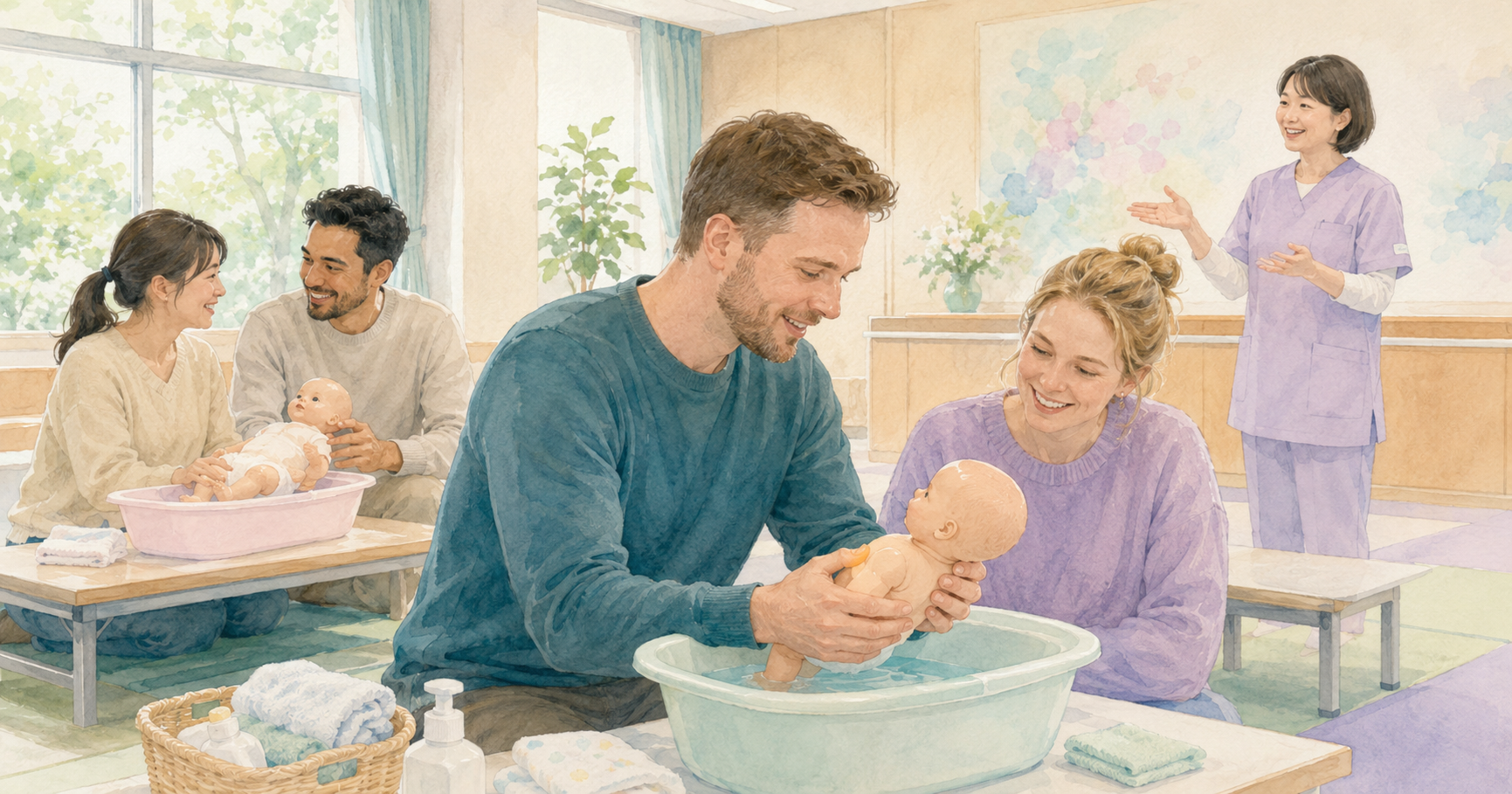
A typical 両親学級 covers:
- The progress of labor — what happens in each stage, what the birthing person will be experiencing, and what is likely to be happening medically
- Support techniques — back massage, breathing guidance, positioning, verbal encouragement through contractions
- Bathing practice (沐浴実習) — hands-on practice bathing a doll-sized newborn, one of the main practical components of most classes
- Postnatal life — how daily life changes after the birth, the division of household and childcare tasks, and postnatal mental health
Some hospitals require companions to have attended a preparatory class as a condition of being admitted to the delivery room. Even where it is not required, attending significantly improves the companion's ability to provide meaningful support — and their confidence on the day.
Classes at municipal health centers are often free or subsidized. Hospital-run classes may have a fee. Online formats became available at many providers during the COVID-19 period and some continue to offer them. Contact your local 保健センター (health center) or the hospital where you plan to give birth to find out what is available and when to register.
Checking Your Facility's Policy
There is no single national standard governing which family members may attend, how many companions are permitted, or what conditions apply. Each facility sets its own policy, and rules can change — often in response to infectious disease conditions, staffing levels at busy periods, or physical constraints of the delivery suite.
The Ministry of Health, Labour and Welfare's 出産なび website (mhlw.go.jp/stf/birth-navi/) lists whether each of the 2,112 registered facilities nationwide permits birth companions for vaginal deliveries. You can search by area, filter by 立ち会い出産, and access each facility's information page — which also covers costs, cesarean rates, midwife numbers, and postnatal care services.
Once you know your facility permits 立ち会い出産, confirm the following directly with the hospital or clinic:
- How many companions are permitted
- Whether a preparatory class is required or recommended
- Whether the companion may be present during all stages of labor or only from a certain point
- What happens if a cesarean section becomes necessary — companions are rarely permitted in operating rooms in Japan
- Whether there are any current restrictions related to illness or seasonal infectious disease
The best time to have this conversation is at your 36–37 week prenatal appointment (後期健診), or at any point in the third trimester when your birth plan discussion takes place. Some facilities have a printed leaflet covering their 立ち会い出産 policy; asking for one in advance of the admission date is entirely reasonable.

If Your Companion Cannot Be Present
There are circumstances in which a companion may be unable to attend — work constraints that make an unplanned early labor impossible to react to quickly, a partner who is overseas, or facility restrictions during a local infectious disease outbreak. This is worth thinking through in advance rather than discovering on the day.
Midwives in Japanese facilities provide continuous support throughout active labor. While the role is primarily clinical, midwives are trained to provide emotional support and encouragement, and many are experienced at supporting women who are laboring without a companion. If you anticipate being alone, let the midwife know at admission — a brief note in your birth plan to this effect helps the team understand your situation from the outset.
Some women choose to hire a ドゥーラ (dūra, doula) — a trained non-medical birth support person — though this is not yet widely established in Japan and availability varies considerably by region. If this is something you are considering, research options early in your third trimester, as experienced practitioners in Japan may have limited availability.
Japanese Vocabulary
| Japanese | Reading | Meaning |
|---|---|---|
| 立ち会い出産 | tachiai shussan | Birth with a companion present |
| 立ち会い分娩 | tachiai bunben | Companion-attended delivery (clinical term) |
| 両親学級 | ryōshin gakkyū | Joint antenatal class for both parents |
| 父親学級 | chichioya gakkyū | Antenatal class for fathers/partners |
| 沐浴実習 | mokuyoku jisshū | Newborn bathing practice |
| バースプラン | bāsu puran | Birth plan |
| LDR室 | LDR shitsu | Labor, Delivery, Recovery room |
| へその緒を切る | heso no o wo kiru | To cut the umbilical cord |
| きょうだい立ち会い | kyōdai tachiai | Sibling attendance at birth |
| 保健センター | hoken sentā | Municipal health center |