

Written and reviewed by Susumu
Born and raised in Japan · Checked against Japanese law and ministry guidance
How to submit Japan's birth registration form (Shusseitodoke) at your city or ward office — what to bring, how to fill it out, and what to do after.
Affiliate Disclosure: This article contains affiliate links. If you click a link and make a purchase, we may earn a small commission at no extra cost to you. We only recommend products we genuinely believe are helpful. See our Terms of Use for full details.
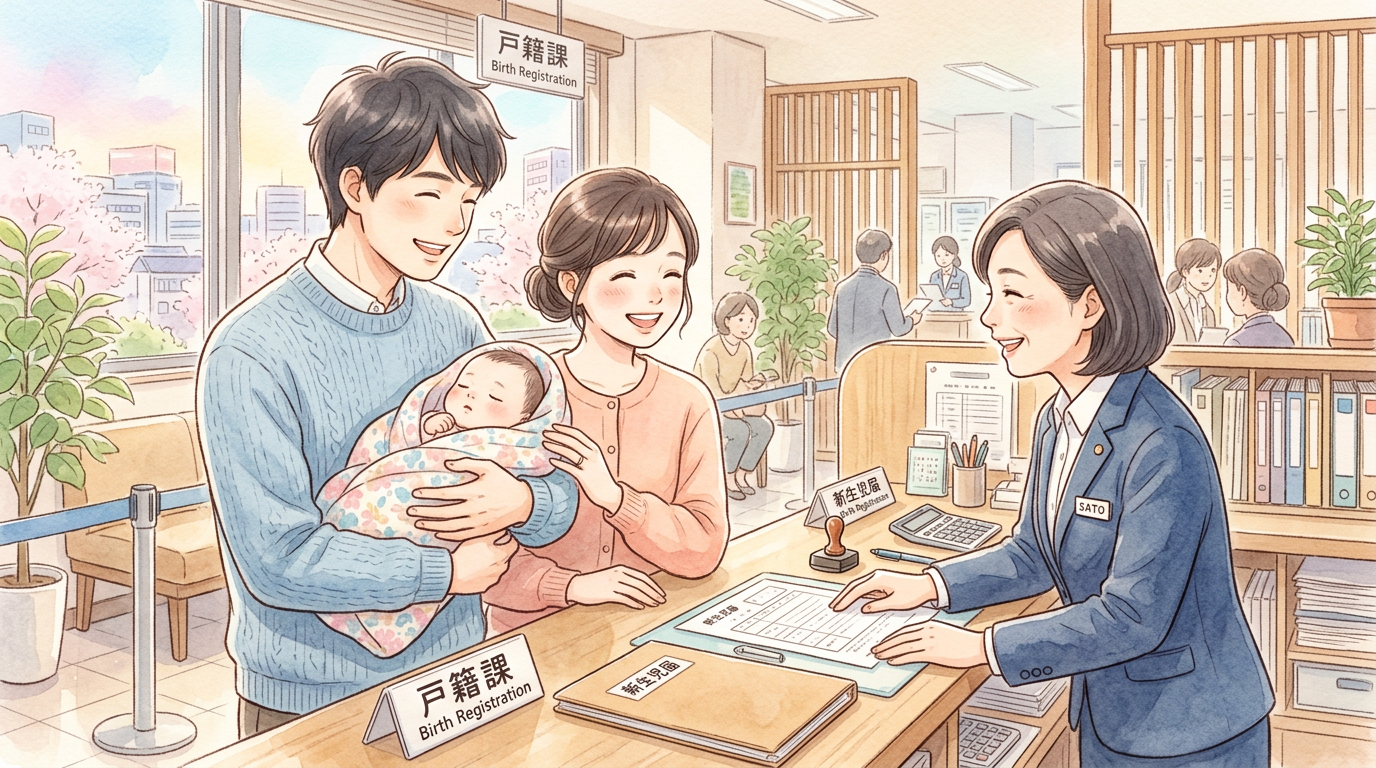
What Is the Birth Registration?
The birth registration (出生届 — shusseitodoke) is a legal requirement in Japan. It officially records your child's birth in the family registry (戸籍 — koseki) and is the first step to obtaining a residence certificate (住民票), health insurance card, and other official documents for your baby. Without it, your child has no legal status in Japan.
Deadline
You must submit the birth registration within 14 days of birth. The day of birth counts as day one. If the deadline falls on a weekend or public holiday, you may submit the following business day. Many families use the same city hall visit to apply for the child allowance, which also has a deadline tied to the birth date.
📌 Tip: Since the mother is usually still recovering in the hospital, it is common for the father to submit the form. With a typical hospital stay of 5–6 days, there is still plenty of time after discharge. Aim to submit within the first week home.
What You Need
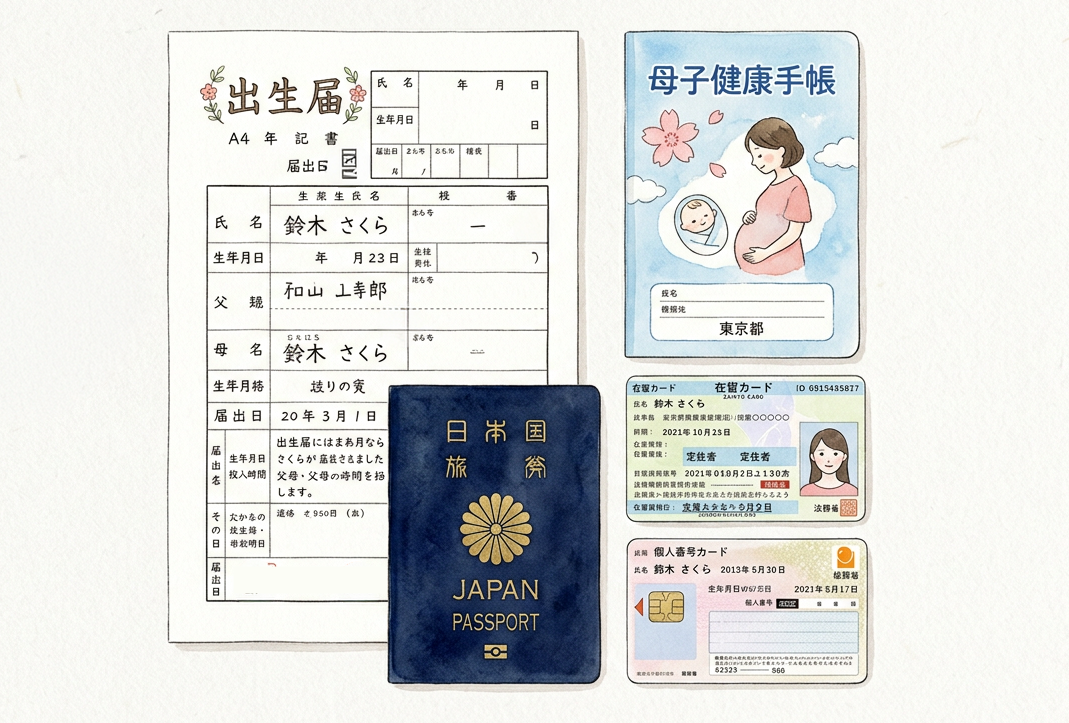
- Birth notification form (出生届): Provided by the hospital after delivery — it comes attached to the birth certificate (出生証明書), which the doctor fills in. Do not separate them.
- Maternal and Child Health Handbook (母子健康手帳): Bring the full handbook — the office will stamp a section recording the birth. Some municipalities now offer a digital version accessible via smartphone app, but the physical handbook is still required at the city hall window.
- ID of the person submitting: Your My Number Card (マイナンバーカード), residence card (在留カード), or passport.
No seal required: Since September 2021, a personal seal (印鑑) is no longer required for the birth registration form. A signature is sufficient.
Where and How to Submit
Submit the form in person at the registry window (戸籍課) of your local city hall (市役所) or ward office (区役所). Most offices accept submissions 24 hours a day at a night-duty counter for after-hours or holiday submissions, though the full record update will be processed the next business day.
Either parent can submit — it does not need to be the mother. A grandparent or other family member may also submit on your behalf if needed.
Online submission: An online option became available in August 2024 for Japanese nationals, but it is not currently available to foreign nationals. International residents must submit in person.
How to Fill Out the Form
📌 Not sure how to fill in a field? Leave it blank and ask the staff at the city hall counter when you arrive. The staff are experienced in helping international residents and can guide you through each section. It is better to ask than to write something incorrect.
The birth notification form (出生届) is A3 size and has two sides. The hospital fills in the right side before giving you the form — do not write anything on the right side. You fill in the left side at home before visiting the city hall.
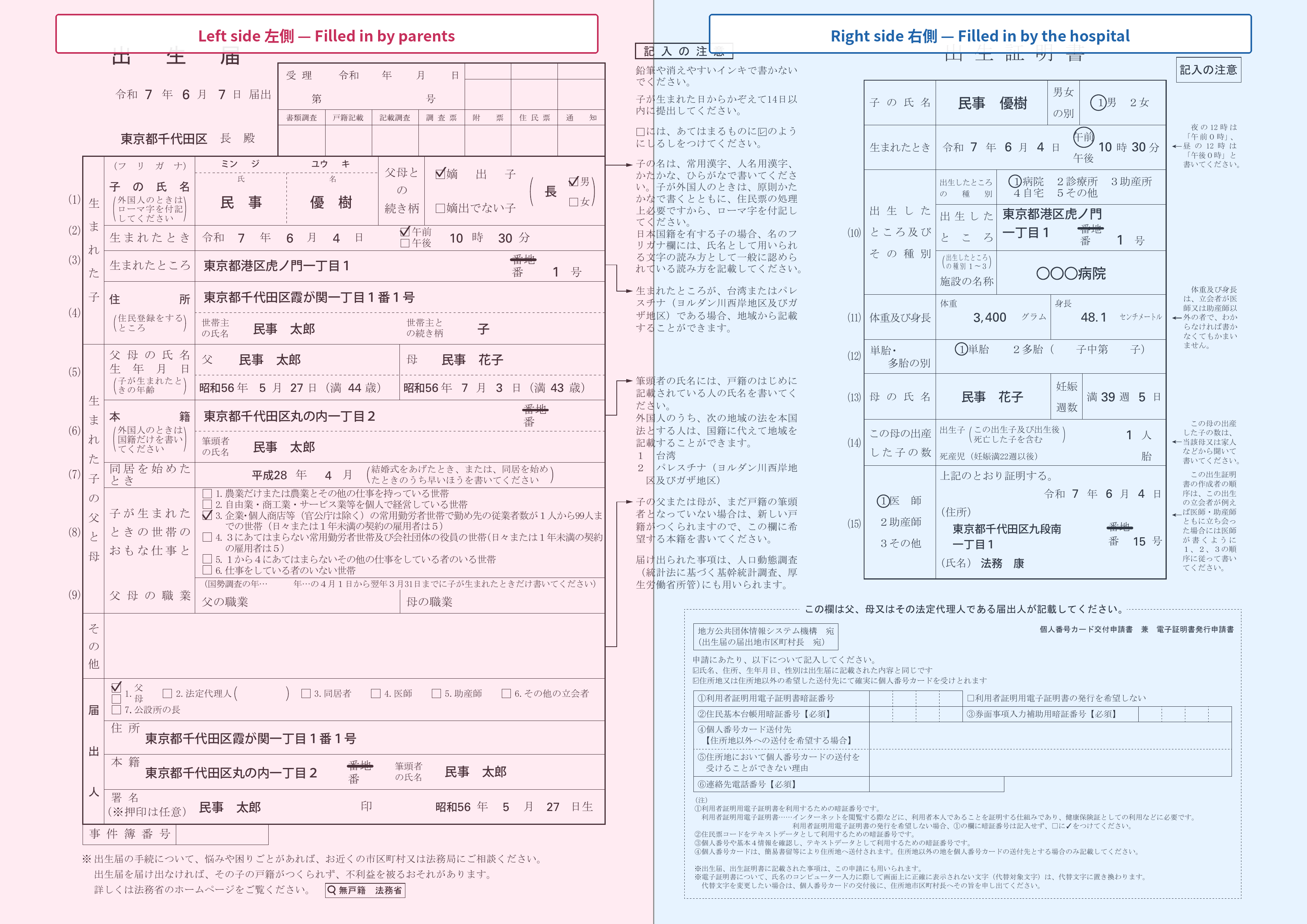
Sample form based on the official template — Ministry of Justice
Filled in by the parents
Complete at home before your visit
Filled in by the hospital
Do not write in this section
① 子の氏名 — Child's name
Kanji or katakana + hiragana reading (ふりがな). Foreign nationals: also add name in roman letters.
② 父母との続き柄 — Legitimacy & birth order
Check 嫡出子 (born in wedlock) or 嫡出でない子. Check 男/女. Write 長 (first), 二, 三 before 男/女.
③ 生まれたとき・生まれたところ — Date, time & place of birth
Copy directly from the right side (hospital section). Midnight = 午前0時, noon = 午後0時.
④ 住所・世帯主の氏名 — Address & head of household
The address where the child will be registered. Write the name of the registered head of household (世帯主).
⑤ 父母の氏名・生年月日 — Parents' names & dates of birth
Both father's and mother's full name and date of birth. Write name as shown on residence card.
⑥ 本籍・筆頭者の氏名 — Registered domicile
Foreign nationals: write your nationality only (e.g. アメリカ, イギリス) — do not write your address here.
⑦ 同居を始めたとき — When you started living together
Date of marriage ceremony or start of cohabitation — whichever is earlier. Leave blank if unknown. Write 未 if never married or never cohabited.
⑧ 世帯のおもな仕事・父母の職業 — Household occupation
Only required if the child was born during a national census year (国勢調査). The current census period is April 2025 – March 2026.
⑨ その他 — Other
Leave blank in most cases. Used for special situations such as non-marital births or if the name on the birth certificate differs.
届出人 — Person submitting
⑩ Check 父 (father) or 母 (mother)
⑪ 住所・本籍 — Submitter's own address and registered domicile (foreign nationals: nationality only)
⑫ 署名・生年月日 — Signature and date of birth (seal optional since Sept 2021)
子の氏名 — Child's name
Completed by the doctor
生まれたとき — Date and time of birth
Recorded by the hospital
生まれたところ — Place of birth
Hospital name and address
体重及び身長 — Weight and height
Recorded by the hospital at birth
Name tip: Once the birth registration is submitted, the child's name cannot be changed except through a court process. Double-check the spelling and characters carefully before submitting.
For Foreign Nationals
International residents have two additional steps that Japanese nationals do not. These are separate from the birth registration itself and must not be overlooked.
1. Apply for a residence status for the child (在留資格取得)
If your child is born in Japan and is not a Japanese national, you must apply for a residence status (在留資格取得申請) at your regional Immigration Services Bureau within 30 days of birth. Without this, the child has no legal immigration status in Japan.
Bring the following to the Immigration Bureau:
- Application form for acquisition of residence status (在留資格取得許可申請書)
- Child's birth certificate (出生証明書) — the original and a copy
- Both parents' residence cards (在留カード)
- Both parents' passports
- Residence certificate (住民票) — obtained after submitting the birth registration
30-day deadline: The application for 在留資格取得 must be submitted within 30 days of birth. If you miss this window, you will need to apply for a visa separately, which is a more complex and time-consuming process. Complete the birth registration first, then go to the Immigration Bureau as soon as possible.
2. Register the birth with your home country
Most countries require you to register your child's birth at your home country's embassy or consulate in Japan. Deadlines and required documents vary by nationality — contact your embassy as soon as possible after the birth.
After Submitting
Once the birth registration is processed, apply for the following at the same city hall visit:
- Residence certificate for the child (住民票): Issued once the birth registration is processed — usually the same day.
- My Number (マイナンバー): A notification with your child's My Number is mailed to your registered address within a few weeks.
- Child health insurance enrollment: Enroll your child in health insurance at the same office. Once enrolled, your insurer will issue a 資格確認書 (Health Insurance Eligibility Certificate) for your child — the replacement for the old 健康保険証. You can also apply for a My Number Card for your child and register it as マイナ保険証.
- Child allowance (児童手当): Apply at the same office. Monthly payments are available to all residents regardless of nationality. As of October 2024, payments continue until the child finishes middle school (age 15), with amounts of up to 15,000–30,000 yen per month depending on the child's age and household income.
Tip: Bring your Maternal and Child Health Handbook, both parents' IDs, and your residence card to the city hall. You can often complete the birth registration, health insurance enrollment, and child allowance application in a single visit.