
Written and reviewed by Susumu
Born and raised in Japan · Checked against Japanese law and ministry guidance
Hand, Foot and Mouth Disease (手足口病) is one of the most common summer illnesses in Japan, spreading quickly through hoikuen and yochien. This guide covers symptoms, how it spreads, when to worry, and when your child can go back to daycare.
Affiliate Disclosure: This article contains affiliate links. If you click a link and make a purchase, we may earn a small commission at no extra cost to you. We only recommend products we genuinely believe are helpful. See our Terms of Use for full details.
Hand, Foot and Mouth Disease — known in Japan as 手足口病 (teashi kuchi byō) — is one of the most common summer illnesses affecting young children here. Most cases are mild and pass within a week, but knowing what to look for makes a real difference.
For information only. This article is based on guidance from Japan's Ministry of Health, Labour and Welfare (厚生労働省) and the Japan Institute for Health Security (JIHS). If your child is unwell, consult a doctor.
What Is Hand, Foot and Mouth Disease?
Hand, Foot and Mouth Disease (HFMD) is a viral illness caused by a group of enteroviruses — most commonly Coxsackievirus A6 (CA6), Coxsackievirus A16 (CA16), and Coxsackievirus A10 (CA10). A more serious strain, Enterovirus 71 (EV71), can occasionally cause neurological complications, though it is less common.
It primarily affects children under five, and spreads quickly in childcare settings. Most children recover on their own within 3–7 days with rest and plenty of fluids.
When Does It Peak in Japan?
HFMD is a summer disease in Japan. Cases typically rise from June, peak in late July, and taper off through August. If your child is in hoikuen or yochien during summer, exposure is almost inevitable at some point.
2024 outbreak — the largest in a decade
According to the Japan Institute for Health Security (JIHS), the 2024 HFMD season was the worst Japan had seen in ten years. In a single week in early July 2024, nearly 36,000 cases were reported from sentinel pediatric clinics across all 47 prefectures. The Ministry of Health issued a national alert in August 2024. Children aged 1 and 2 accounted for more than half of all cases.
Symptoms
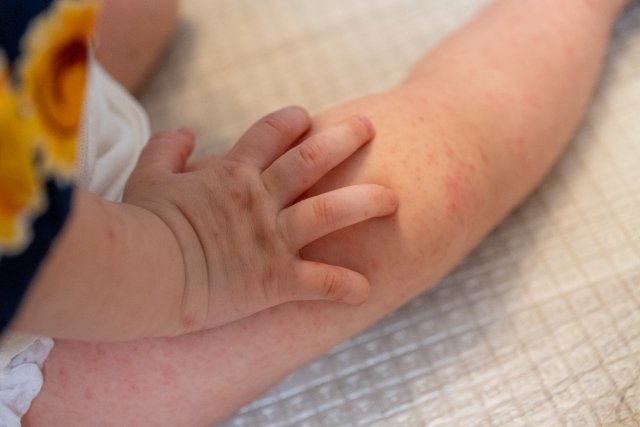
After an incubation period of 3–5 days, the typical signs appear. The rash is the most recognizable feature — small blisters of around 2–3mm that appear on the hands, feet, and inside the mouth.
Typical symptoms
- Small blisters on the palms of the hands, soles of the feet, and tops of the feet
- Sores or blisters inside the mouth — these can be painful and may put children off eating or drinking
- Mild fever (usually 38°C or below) — only around one in three children develops a fever at all
- General malaise — the child may seem quieter or more irritable than usual
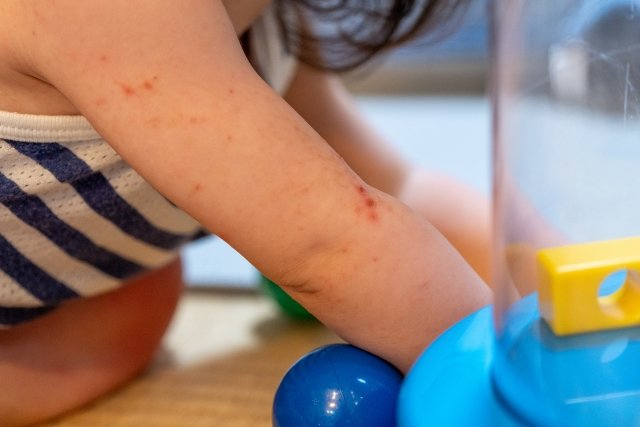
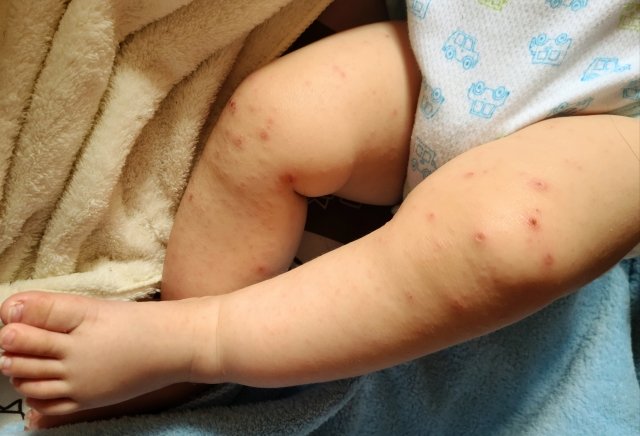
The rash does not always appear in all three locations. Some children only develop mouth sores, others only the rash on hands and feet. The pattern can vary.
How It Spreads
HFMD spreads easily, which is why hoikuen and yochien are common settings for outbreaks. There are three main routes of transmission:
Three routes of transmission
- Droplets — from coughing or sneezing
- Direct contact — touching blisters or contaminated surfaces
- Faecal-oral — the virus is shed in stool, so diaper changes are a key transmission point if hands are not washed thoroughly afterward
One important thing to know: the virus continues to be shed in stool for some time after the child has recovered and looks completely well. This means a child can still spread HFMD to others even after symptoms have gone.
Treatment
No specific treatment exists
According to both the Ministry of Health and JIHS, there is no antiviral treatment for HFMD and no approved vaccine in Japan. Care is supportive — rest, fluids, and managing discomfort. Most children recover fully within 3–7 days.
What helps at home
- Keep your child well hydrated — mouth sores can make drinking painful, so try cool, soft foods and drinks
- Rest at home away from other children
- Avoid acidic or spicy foods that may irritate mouth sores
- Monitor closely for the warning signs listed below
Warning Signs — When to See a Doctor
Most cases of HFMD are mild and resolve without medical intervention. However, the Ministry of Health advises seeking medical attention if your child shows any of the following:
See a doctor if your child has:
- A high fever lasting two or more days
- Vomiting
- Complaints of headache
- Eyes not making contact, or a vacant stare
- Not responding when called
- Fast breathing or appearing to struggle to breathe
- Unable to keep fluids down, or not producing urine
- Listless or limp
These can be signs of rare but serious complications such as meningitis or encephalitis, which are more commonly associated with the EV71 strain.
Not sure whether to go to the doctor?
Call #8000 — Japan's free child medical telephone consultation service, staffed by nurses and available in every prefecture including evenings and holidays.
Returning to Hoikuen or Yochien
This is one of the questions parents ask most often — and the answer in Japan is less straightforward than you might expect.
No fixed exclusion period under Japanese law
Under Japan's School Health and Safety Act (学校保健安全法), HFMD may be treated as a third-category infectious disease — but only under certain conditions and at the discretion of the facility director. Unlike many other illnesses, there is no mandatory fixed absence period. The decision is made based on the child's condition and the situation at the facility.
In practice, most hoikuen and yochien ask parents to keep children home until the fever has gone, mouth sores have healed enough for the child to eat and drink normally, and the rash blisters have dried. Because the virus continues to shed in stool after recovery, it is impossible to declare a child fully non-contagious — but these are the practical markers most facilities use.
When in doubt, contact your hoikuen or yochien directly. Policies vary between facilities.
Prevention
What the Ministry of Health recommends
- Wash hands thoroughly with soap and running water — after diaper changes, after contact with an unwell child, before meals
- Do not share towels between children
- Dispose of diapers carefully and wash hands immediately afterward
- Avoid close contact — kissing, sharing cups or utensils — with infected children
There is no vaccine against HFMD available in Japan. Handwashing remains the most effective prevention.
Useful Phrases
To tell the doctor what you think it is
手足口病にかかったようです
Teashi kuchi byō ni kakatta yō desu
"It seems my child has Hand, Foot and Mouth Disease."
To ask when your child can return to daycare
いつ保育園に戻れますか
Itsu hoikuen ni modoremasu ka
"When can my child return to daycare?"
To ask if you should bring your child in
病院に連れて行くべきですか
Byōin ni tsurete iku beki desu ka
"Should I bring my child to the doctor?"
Japanese Vocabulary
| Japanese | Reading | Meaning |
|---|---|---|
| 手足口病 | teashi kuchi byō | Hand, Foot and Mouth Disease |
| 水疱 | suihō | Blister |
| 発疹 | hosshin | Rash |
| 口内炎 | kōnaien | Mouth sore / ulcer |
| 潜伏期間 | senpuku kikan | Incubation period |
| 飛沫感染 | himatsu kansen | Droplet transmission |
| 接触感染 | sesshoku kansen | Contact transmission |
| 対症療法 | taishō ryōhō | Supportive / symptomatic treatment |
| 髄膜炎 | zuimakuen | Meningitis |
| 脳炎 | nōen | Encephalitis |
| 登園 | tōen | Attending daycare / kindergarten |