
Written and reviewed by Susumu
Born and raised in Japan · Checked against Japanese law and ministry guidance
How to enroll your child in a Japanese public elementary school — required documents, the enrollment process, and what to expect on the first day.
Affiliate Disclosure: This article contains affiliate links. If you click a link and make a purchase, we may earn a small commission at no extra cost to you. We only recommend products we genuinely believe are helpful. See our Terms of Use for full details.
📌 Note: Enrollment procedures vary by municipality. Contact your local city hall or board of education for the exact process in your area.
What Is Japanese Public Elementary School?
Japanese public elementary school (小学校 — shougakkou) covers six years, from Grade 1 to Grade 6. Children typically start at age 6 and finish at 12. The school year runs from April to March, with three terms separated by summer, winter, and spring breaks.
Public elementary school is free of charge and open to all children registered as residents in Japan, regardless of nationality. For most international families, it's the most practical option — and many children thrive in the environment, picking up Japanese quickly through daily immersion.
Who Can Enroll
Any child registered in the Japanese resident registry (住民基本台帳 — juumin kihon daichou) is entitled to attend the local public elementary school. This includes children of international residents on long-term visas. Nationality makes no difference.
Your child's assigned school is determined by your home address. Each neighborhood falls within a specific school catchment area (学区 — gakku). If you want to know which school your address belongs to, contact your local city or ward office.
Under 6 or over 6? Children who turn 6 between April 2 and April 1 of the following year will enter Grade 1 together that April. If your child has already completed some schooling abroad, contact the board of education — they can advise on which grade is appropriate.
The Enrollment Timeline
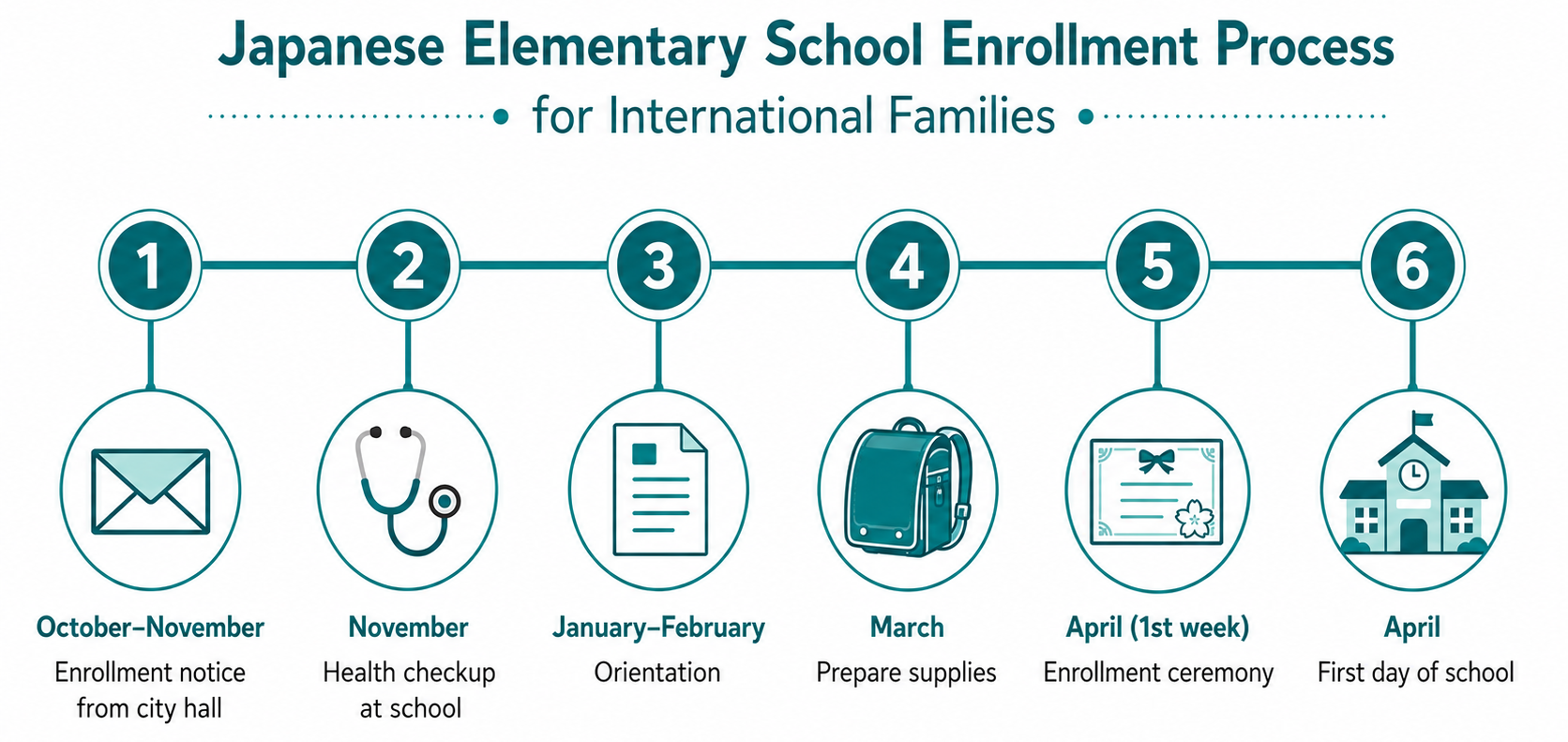
| When | What Happens |
|---|---|
| October – November | City hall sends the enrollment notice (就学通知書) to your home. This names your child's assigned school. |
| November | School health checkup (就学時健康診断) at the assigned school — vision, hearing, and general health check. |
| January – February | School orientation (説明会) — receive the supplies list and school rules. Ask questions here. |
| February – March | Buy the randoseru and other supplies. Attend any additional preparation sessions the school arranges. |
| Early April | Enrollment ceremony (入学式 — nyuugakushiki). Parents attend with the child. A formal and memorable occasion. |
| Mid-April onwards | Regular school days begin. |
Didn't receive the notice?
If your child is approaching school age and you haven't received the enrollment notice by November, contact your city or ward office. Notices sometimes go astray if you've recently moved or if your child's registration details need updating.
The Enrollment Process
The process is largely handled for you — city hall identifies eligible children from the resident registry and sends notices automatically. Here's what you'll need to do:
- Receive the enrollment notice (就学通知書) — this arrives by mail in October or November. It confirms your child's assigned school. Keep it safe — you'll need it at the school health checkup.
- Attend the school health checkup (就学時健康診断) — held at the school in November. Bring the enrollment notice and your child's Boshi Techou (母子健康手帳). The checkup covers vision, hearing, teeth, and general health.
- Attend the school orientation (説明会) — usually in January or February. The school will explain daily routines, the supplies list, school lunch, and rules. This is a good opportunity to ask about Japanese language support if your child needs it.
- Submit enrollment documents — typically at the orientation or shortly after. You'll need the enrollment notice and proof of address (住民票 or マイナンバーカード).
- Prepare supplies — buy the randoseru and items on the school's list before April.
- Attend the enrollment ceremony (入学式) — held in early April. Dress smartly — it's a formal event, and parents are expected to attend.
Transferring Mid-Year
If you're moving to Japan during the school year — not at the start of April — the process is a little different. You'll need to contact your local board of education (教育委員会 — kyouiku iinkai) directly rather than waiting for a notice.
What to bring to the board of education:
- 住民票 (juuminhyou) — residence certificate, obtained from city hall after registering your address
- 在学証明書 (zaigaku shoumeisho) — certificate of enrollment from your child's previous school
- 成績証明書 (seiseki shoumeisho) — academic record (if available)
If your child's previous school is overseas, bring whatever records you have. Japanese schools are generally flexible and understanding — the main goal is to get your child into the right grade and settled as quickly as possible.
Language Support
Most Japanese public schools are taught entirely in Japanese. If your child doesn't speak Japanese yet, this is understandably a concern — but children often pick up the language faster than parents expect through daily immersion.
The level of support available depends heavily on where you live. Cities with large international populations — such as Tokyo, Osaka, Nagoya, and Hamamatsu — tend to have much more structured support in place. In rural areas, there may be little or no dedicated language support at all.
That said, schools and municipalities vary significantly in the support they offer:
- Japanese language instruction (日本語指導) — some schools have teachers trained to support non-native Japanese speakers. Your child may be withdrawn for small-group Japanese lessons.
- Interpreter support — larger cities sometimes provide interpreters for parent meetings and important communications. Ask your board of education what's available.
- Buddy system — some schools pair new international students with a classmate to help them settle in.
Ask early. Contact the board of education before enrollment to ask what Japanese language support the school offers. In some municipalities, dedicated support teachers can be arranged — but it takes time to set up, so the earlier you ask, the better.
Costs
Public elementary school tuition is free. But there are still costs involved:
| Item | Approximate Cost |
|---|---|
| Randoseru (school bag) | ¥30,000 – ¥80,000 |
| Gym clothes, indoor shoes, other supplies | ¥10,000 – ¥20,000 |
| School lunch (給食) — monthly | Free (from April 2026) |
| School activity fees (遠足, 学習材料 etc.) | Varies by school |
| Tuition | Free |
From April 2026, the national government introduced a subsidy of ¥5,200 per child per month for school lunch at public elementary schools — making it effectively free for most families, with no application required. In some areas where lunch costs exceed this amount, a small difference may still apply.
The biggest one-time cost is the randoseru. Many families buy it in late summer or autumn of the year before school starts — popular colors and styles can sell out. There's no rule that it has to be the traditional black or red; most schools accept any color.
What Your Child Will Need
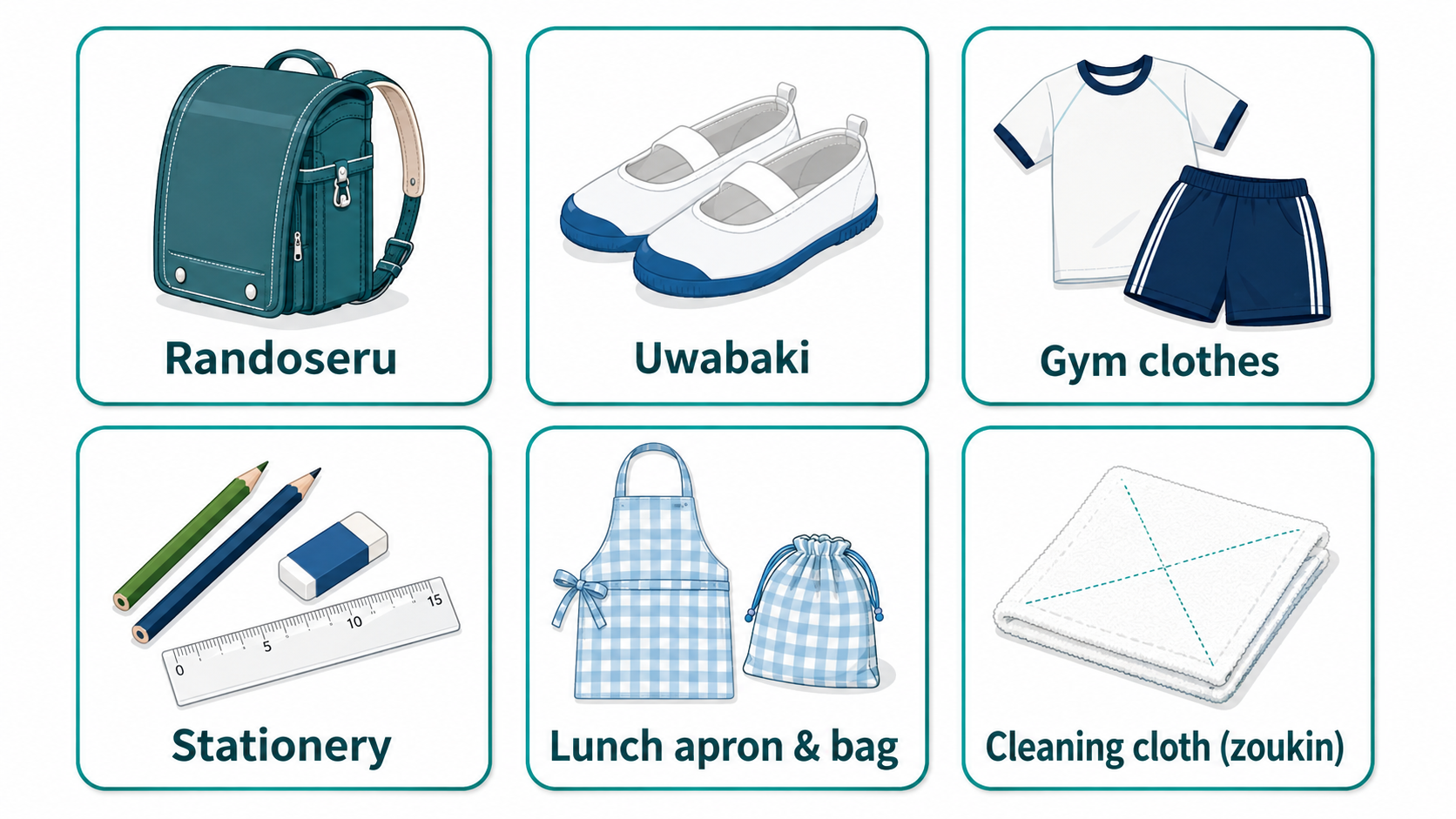
The school will give you a full supplies list at orientation. Almost everything except the randoseru is school-specified, so don't buy items in advance. Here's what most children will need:
- Randoseru (ランドセル) — the traditional hard-frame school backpack. Required at almost all public elementary schools.
- Indoor shoes (上履き — uwabaki) — plain white canvas shoes worn inside the school building. Outdoor shoes are left at the entrance.
- Gym clothes (体操服 — taisoufuku) — the school will specify the style. Usually a white T-shirt and navy or dark shorts.
- Stationery — pencils (HB or B), eraser, ruler, scissors, glue. A pencil case is fine.
- Lunch apron and bag (給食エプロン・給食袋) — children take turns serving lunch to classmates. A white apron and hat are needed.
- Cleaning cloths (雑巾 — zoukin) — children clean their own classroom every day. Two cloths are usually needed.
- Name labels — everything needs your child's name on it. Japanese name stickers (お名前シール) are widely available and make this much easier.
Wait for the supplies list.
Almost everything except the randoseru is school-specified — indoor shoes, gym clothes, notebooks, and more. Don't buy anything in advance. The orientation in January or February will give you the full list with exactly what to get and where to buy it.
📖 Japanese Vocabulary
Useful terms for the elementary school enrollment process.
| 日本語 | ひらがな | English |
|---|---|---|
| 小学校 | しょうがっこう | Public elementary school |
| 就学通知書 | しゅうがくつうちしょ | Enrollment notice (from city hall) |
| 就学時健康診断 | しゅうがくじけんこうしんだん | Pre-enrollment health checkup |
| 入学式 | にゅうがくしき | Enrollment ceremony (first day) |
| 学区 | がっく | School catchment area |
| 教育委員会 | きょういくいいんかい | Board of education |
| 日本語指導 | にほんごしどう | Japanese language instruction support |
| ランドセル | らんどせる | Traditional hard-frame school backpack |
| 上履き | うわばき | Indoor shoes |
| 給食 | きゅうしょく | School lunch |
| 在学証明書 | ざいがくしょうめいしょ | Certificate of enrollment (from previous school) |
| 雑巾 | ぞうきん | Cleaning cloth |