

Written and reviewed by Susumu
Born and raised in Japan · Checked against Japanese law and ministry guidance
Japan's health insurance includes a monthly cap on what you pay out of pocket. For pregnant women and new parents, knowing how it works — and when it applies — can mean saving tens of thousands of yen on a C-section, a pregnancy complication, or a NICU stay.
Affiliate Disclosure: This article contains affiliate links. If you click a link and make a purchase, we may earn a small commission at no extra cost to you. We only recommend products we genuinely believe are helpful. See our Terms of Use for full details.

What Is 高額療養費?
Japan's health insurance covers 70% of most medical costs — but it goes further than that. There is also a monthly ceiling on what you pay out of pocket, no matter how large the bill. This ceiling is called 高額療養費 (kougaku ryouyouhi), literally "high-cost medical expense benefit." If your share of insured medical costs in a single calendar month exceeds a set limit based on your income, everything above that limit is refunded by your health insurer.
For pregnant women and new parents, this matters more than it might seem. A C-section, a hospital stay for pregnancy complications, or a premature baby in the NICU can quickly push monthly medical costs into the hundreds of thousands of yen. The 高額療養費 system means your actual out-of-pocket exposure has a hard ceiling — and in many cases, it is far lower than the initial bill suggests.
To use this benefit, you must be enrolled in Japanese health insurance — either company health insurance (社会保険) through your employer, or national health insurance (国民健康保険) through your municipal office. All registered residents of Japan are legally required to be enrolled in one of these. Short-term visitors on tourist or business visas are not enrolled and cannot access this benefit.
What It Covers During Pregnancy and Birth
What 高額療養費 covers
The benefit only applies to costs that fall under Japan's health insurance coverage. When insurance covers a treatment, you pay 30% and insurance pays 70% — and then 高額療養費 caps that 30% at your monthly limit. The situations below are all covered by insurance, which means 高額療養費 applies.
During pregnancy:
- Severe morning sickness requiring hospitalization (重症妊娠悪阻)
- Threatened miscarriage or actual miscarriage (切迫流産・流産)
- Threatened preterm labor (切迫早産)
- Cervical insufficiency (子宮頸管無力症)
- Gestational hypertension (妊娠高血圧症候群)
- Preterm premature rupture of membranes (前期破水)
- Ultrasound for breech or placenta previa
- X-ray for suspected cephalopelvic disproportion
- Other medical conditions that arise during pregnancy
During labor and delivery:
- Cesarean section (帝王切開) — one of the most common situations where 高額療養費 applies
- Use of labor-inducing medication for weak contractions
- Assisted delivery with vacuum or forceps
- Epidural anesthesia when medically indicated (such as for a mother with heart disease)
- Stillbirth treatment
- Your baby being admitted to the NICU (新生児集中治療室) — once your baby is enrolled in their own health insurance
What is NOT covered
Normal vaginal delivery (自然分娩) is not covered by Japan's health insurance. Childbirth without complications is treated as a natural event rather than a medical condition, so the 30/70 insurance split does not apply — and neither does 高額療養費. This is why the separate 出産育児一時金 (lump-sum birth allowance of ¥500,000) exists: it is a fixed payment specifically designed to offset birth costs that fall outside health insurance.
Other costs that do not count toward 高額療養費 include private room upgrades, hospital meal charges, and any treatments or services explicitly excluded from insurance coverage.
Your Monthly Cap: Income Brackets Explained
Your monthly ceiling is determined by your income bracket. Japan uses five brackets, labeled ア through オ, based on your standard monthly remuneration (標準報酬月額) if you are on company insurance, or your household income if you are on national health insurance (国保).
| Bracket | Monthly income (approx.) | Monthly ceiling |
|---|---|---|
| ア | ¥830,000+ | ¥252,600 + (total medical cost − ¥842,000) × 1% |
| イ | ¥530,000–¥790,000 | ¥167,400 + (total medical cost − ¥558,000) × 1% |
| ウ | ¥280,000–¥500,000 | ¥80,100 + (total medical cost − ¥267,000) × 1% |
| エ | Up to ¥260,000 | ¥57,600 (flat) |
| オ | Non-taxable household | ¥35,400 (flat) |
The "total medical cost" in the formula refers to the full cost of treatment before insurance — the 10-割 (100%) amount. Your insurer uses this figure to calculate the ceiling, then applies it to your 30% share.
Worked example: C-section in bracket ウ
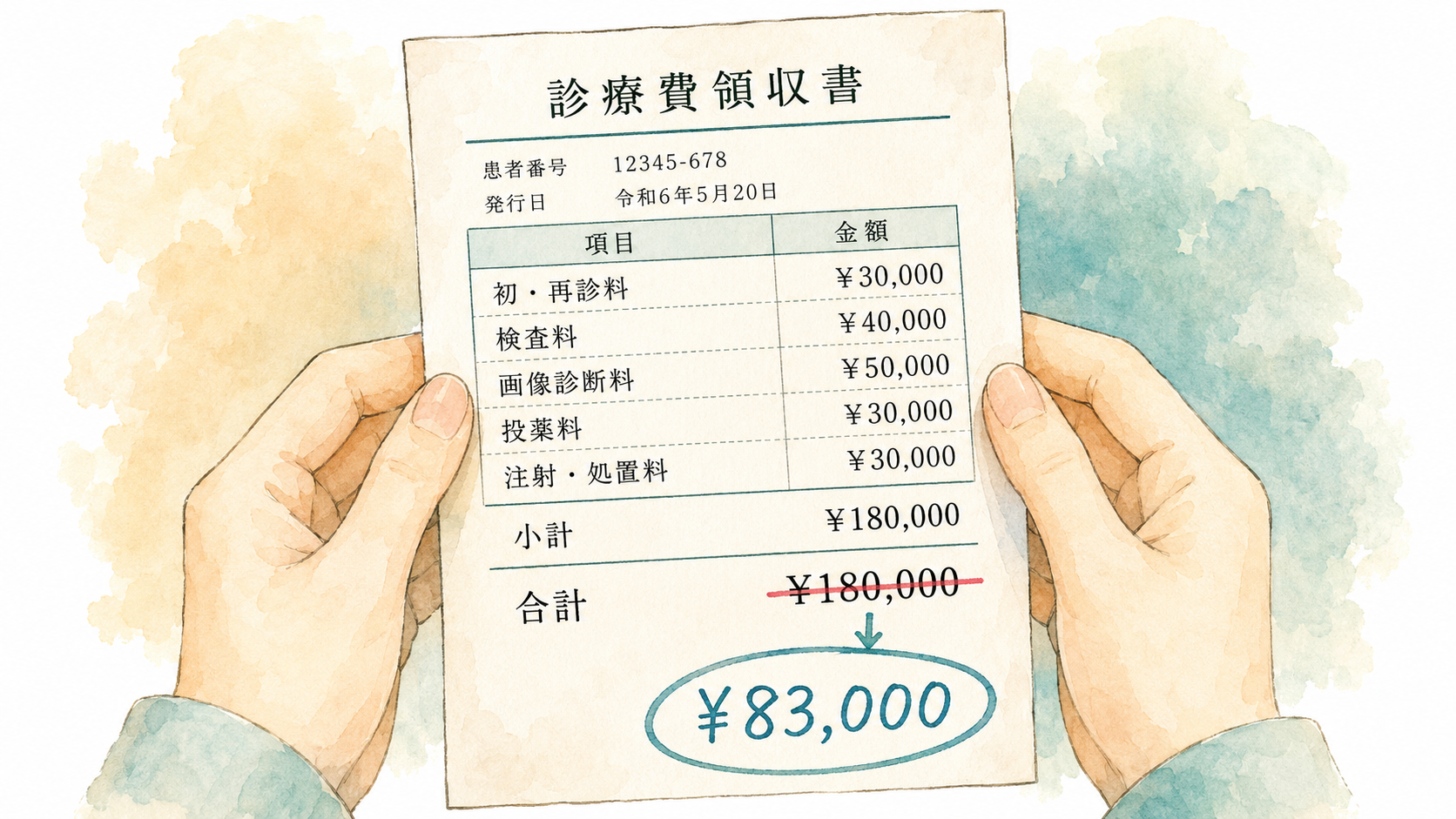
Say the insured portion of a C-section totals ¥600,000 (at full cost). You would normally pay 30% = ¥180,000. With 高額療養費, your ceiling is: ¥80,100 + (¥600,000 − ¥267,000) × 1% = ¥83,430. You pay roughly ¥83,000 instead of ¥180,000 — a saving of nearly ¥100,000. The ¥500,000 birth allowance (出産育児一時金) is applied separately to cover the non-insured portion of the birth.
Three Ways to Access the Benefit
Method 1: マイナ保険証 — no paperwork needed
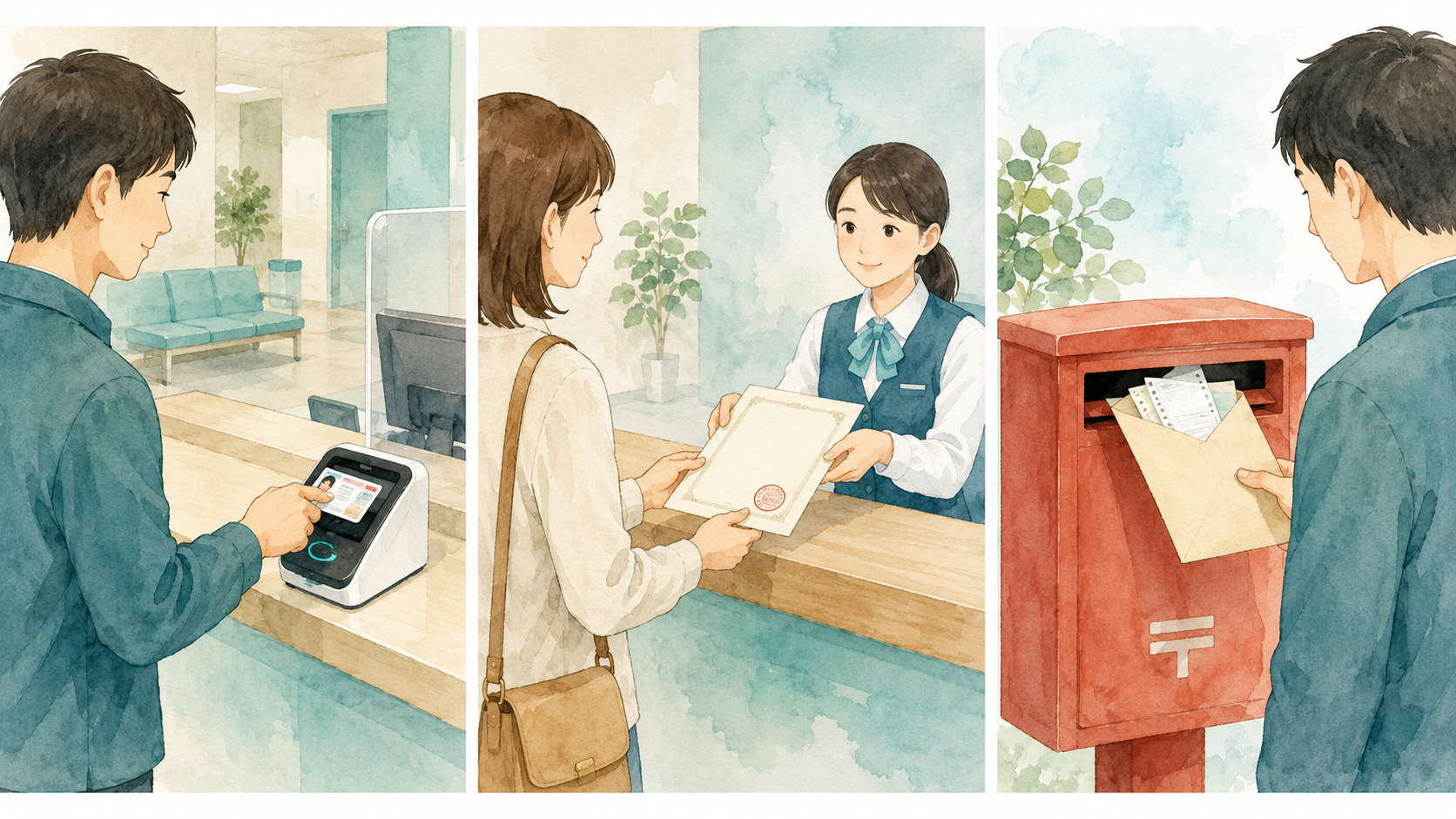
If you use your My Number Card as your health insurance credential (マイナ保険証), the system automatically applies your monthly ceiling at discharge. You simply pay your capped amount at the hospital window — no forms, no advance certificate, no waiting for a refund. This is the most convenient option and is available at any hospital or clinic that uses online eligibility verification (オンライン資格確認), which is now mandatory for the vast majority of medical facilities in Japan.
Method 2: 限度額適用認定証 — advance certificate
If you don't use マイナ保険証, you can apply in advance for a 限度額適用認定証 (gendogaku tekiyou ninteisho), an expense limit certificate. Present this at the hospital when you are admitted, and the billing desk will apply the ceiling directly — so you pay the capped amount at checkout rather than the full 30%.
To get this certificate, contact your health insurer (your employer's health insurance association, 協会けんぽ, or your municipal office if you are on 国保) before hospitalization. The certificate is valid from the first day of the month it is issued, for up to one year. It cannot be backdated, so apply as soon as you know you will be hospitalized.
Method 3: 事後申請 — retroactive claim
If you didn't use マイナ保険証 and didn't obtain the advance certificate in time, you can still claim a refund after the fact. Pay the full 30% at the hospital, then submit a 高額療養費支給申請書 (application for reimbursement) to your health insurer along with receipts and your insurance details. The excess amount above your ceiling will be refunded, typically within two to three months.
You have two years from the first day of the month following your treatment to make this claim. Don't let receipts sit forgotten — it's a meaningful amount of money.
| Method | When to use | Pay upfront? |
|---|---|---|
| マイナ保険証 | Always available if your card is registered | No — pay the capped amount directly |
| 限度額適用認定証 | Apply before admission | No — pay the capped amount at checkout |
| 事後申請 | After the fact, within 2 years | Yes — pay 30% upfront, receive refund later |
Combining Costs Across Your Household
If multiple members of the same household are covered by the same health insurer, you can combine your out-of-pocket costs in the same calendar month — a rule called 世帯合算 (setai gassan). If the combined total exceeds your household ceiling, the excess is reimbursed.
There is one important condition for people under 70: only costs from a single medical facility that reach ¥21,000 or more in a month can be included in the combined total. Smaller amounts from individual visits don't count toward the threshold. If your baby is hospitalized at a different facility in the same month you are recovering from a C-section, both sets of costs (each above ¥21,000) can be combined.
If You Hit the Limit Multiple Months in a Row
If you reach the high-cost threshold in three or more months within a rolling 12-month period, the fourth month onward qualifies as 多数回該当 (tasuukai gaitou) — "multiple-count applicable." Your monthly ceiling drops further to the amounts below.
| Bracket | Reduced monthly ceiling (4th month+) |
|---|---|
| ア | ¥140,100 |
| イ | ¥93,000 |
| ウ | ¥44,400 |
| エ | ¥44,400 |
| オ | ¥24,600 |
This can matter when a pregnancy complication leads to an extended hospital stay that spans several months, or when your own recovery overlaps with your baby's NICU admission across multiple billing months. Note that the count is tracked within the same health insurer — if you change jobs and change insurers, the count resets.
August 2026 Changes
Note: From August 2026, the monthly ceiling amounts in all five brackets will be revised upward, in line with the growth in per-person medical costs. The figures in this article reflect the amounts in effect before August 2026. The reduced 多数回該当 amounts are expected to remain unchanged. Check the 厚生労働省 website for the current official figures after August 2026.
For International Residents
If you are living in Japan on a valid visa and enrolled in Japanese health insurance — which is a legal requirement for all registered residents — you are entitled to the exact same 高額療養費 benefits as anyone else. There are no additional requirements or restrictions based on nationality.
One practical point: for the retroactive claim (事後申請), you will need a Japanese bank account to receive the refund. If you are on your employer's social insurance (社会保険), the claim goes through your company's HR or health insurer. If you are on national health insurance (国民健康保険), go to your municipal office.
If you are unsure which bracket applies to your household, your insurer or municipal office can tell you — bring your health insurance card or マイナ保険証 and they can look it up.
Japanese Vocabulary
| Japanese | Reading | Meaning |
|---|---|---|
| 高額療養費 | kougaku ryouyouhi | High-cost medical expense benefit — monthly cap on out-of-pocket costs |
| 自己負担限度額 | jiko futan gendogaku | Monthly out-of-pocket ceiling |
| 限度額適用認定証 | gendogaku tekiyou ninteisho | Expense limit certificate — advance document that applies the ceiling at the hospital window |
| 世帯合算 | setai gassan | Household combining — merging eligible costs across family members in the same month |
| 多数回該当 | tasuukai gaitou | Multiple-count applicable — further reduced ceiling after 3+ months in a 12-month period |
| 帝王切開 | teiou sekkai | Cesarean section |
| 切迫早産 | seppaku souzan | Threatened preterm labor |
| NICU | en-ai-shii-yuu | Neonatal intensive care unit (新生児集中治療室) |
| 高額療養費支給申請書 | kougaku ryouyouhi shikyuu shinseisho | Application form for retroactive reimbursement |
| 標準報酬月額 | hyoujun houshu getsugaku | Standard monthly remuneration — the income figure used to determine your bracket under company health insurance |