

Written and reviewed by Susumu
Born and raised in Japan · Checked against Japanese law and ministry guidance
What to expect during labor in Japan — CTG monitoring, internal examinations, IV drip, oxytocin, episiotomy, vacuum and forceps delivery explained, with incidence data from official government sources.
Affiliate Disclosure: This article contains affiliate links. If you click a link and make a purchase, we may earn a small commission at no extra cost to you. We only recommend products we genuinely believe are helpful. See our Terms of Use for full details.
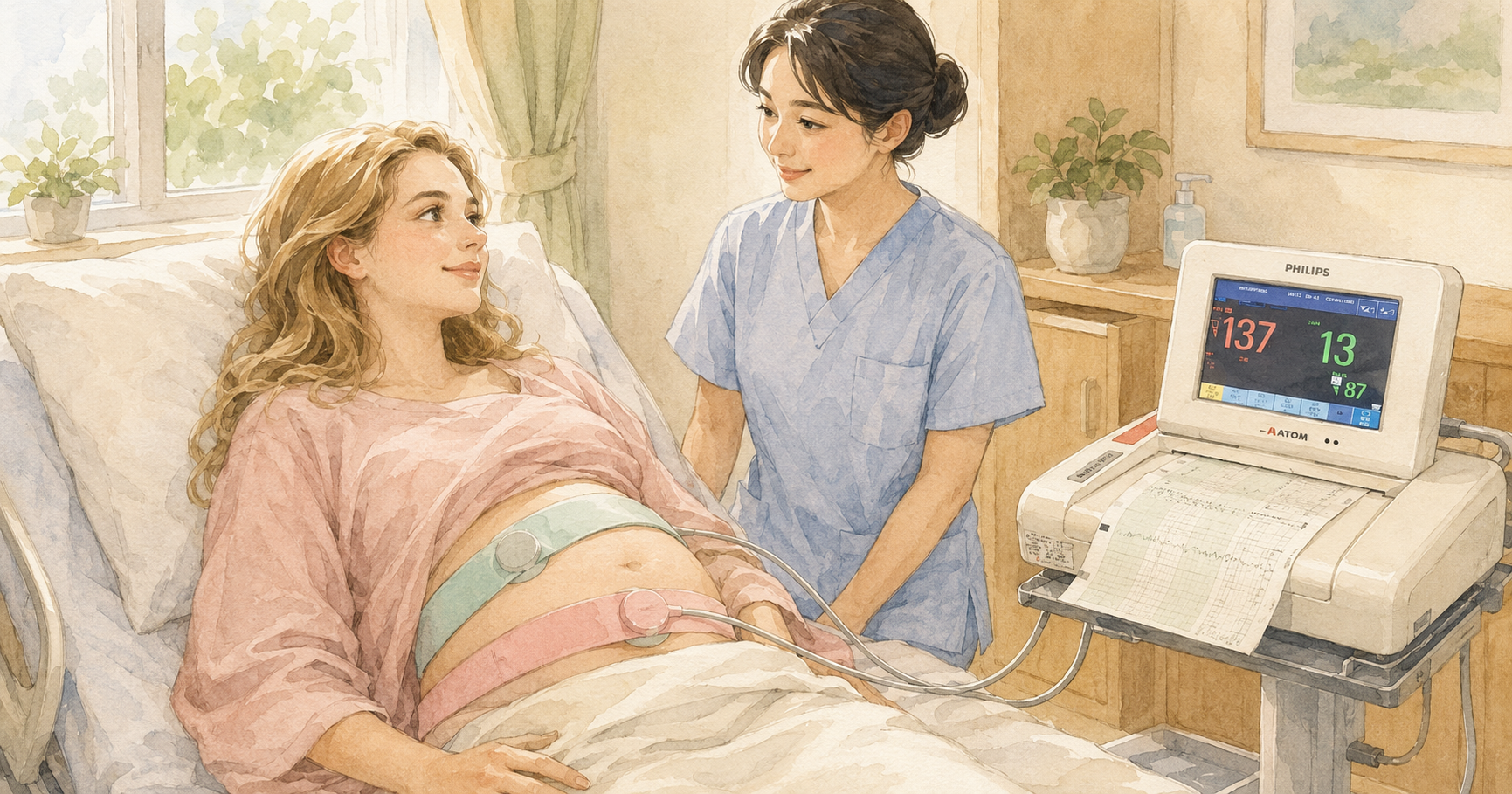
Most labors in Japan involve at least one procedure. Whether it is continuous CTG monitoring, an IV line, or an episiotomy, these interventions are routine and do not mean something has gone wrong. Knowing what each one involves — and why it might be used — makes it easier to follow what is happening and ask questions along the way.
For information only. This article explains common labor procedures to help you understand what may happen and prepare questions for your care team. It is not medical advice. Every birth is different — always discuss your individual circumstances with your midwife or obstetrician.
CTG Monitoring (分娩監視装置)
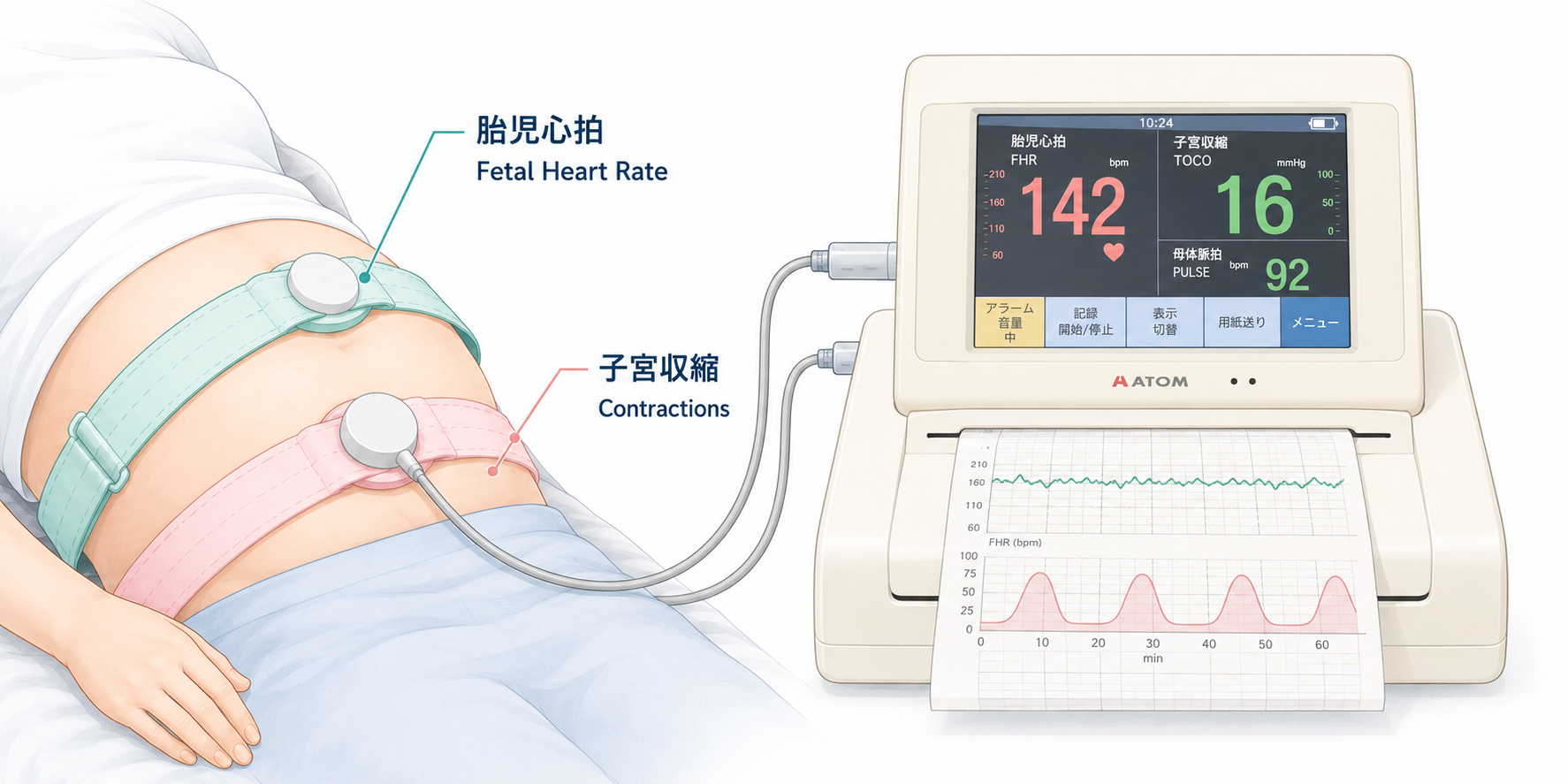
The most common procedure encountered during labor in Japan is cardiotocography — CTG monitoring, known here as 分娩監視装置 (bunben kanshi sōchi). Two belts are placed around the abdomen: one to record the baby's heartbeat, and one to measure contractions. The combined trace is called 胎児心拍モニタリング. According to a 2024 Ministry of Health, Labour and Welfare working group survey, around 69% of women had continuous CTG monitoring during labor.
In most hospital settings, monitoring begins on admission and runs continuously. Some midwifery-led clinics use intermittent auscultation instead — checking the heartbeat for a set period every 30–60 minutes — but hospitals generally keep the monitor running so that any change in the baby's condition is caught immediately. The trace appears on a screen beside the bed and is reviewed regularly by the midwife and obstetrician. During epidural analgesia, continuous monitoring is standard practice.
In Japan, two flat sensor pads are secured around the abdomen with elastic belts — one for the baby's heartbeat, one for contractions. The style varies by hospital: some use thin elastic straps with flat white pads, others use wider colored fabric bands. Either way, the midwife fits them at the start of labor and adjusts them as needed. They are comfortable to wear and easy to reposition.
Internal Examinations (内診)
Internal examinations — 内診 (naishin) — are carried out to assess how far the cervix has dilated (子宮口の開き具合), the baby's position, and how far down the baby has descended. They are the most frequently reported procedure in the MHLW survey: around 78% of women had at least one internal examination during labor. In practice, most will have several — particularly during active labor when the midwife needs to gauge progress before encouraging pushing.
The examination takes a few seconds and can be uncomfortable, especially during a contraction. If the timing feels distressing, it is reasonable to ask whether it can wait until the contraction has passed, or to ask how many examinations are genuinely needed at that stage.
IV Drip (点滴)
An intravenous line — 点滴 (tenteki) — is placed in the back of the hand or forearm in around 50% of labors. Many hospitals fit one routinely on admission, even when no medication is immediately needed, so that access is already established if oxytocin, antibiotics, or emergency medication becomes necessary quickly.
Having a line in place does not indicate that anything is wrong — it is largely a preparedness measure. It restricts movement slightly, though most modern labor rooms have wheeled drip stands and long enough tubing to allow position changes. If you are planning an active or mobile labor, mention this during a prenatal visit; in some settings the line can be capped off (ヘパリンロック) between uses rather than connected to a running drip throughout.
Membrane Sweep (卵膜剥離)
A membrane sweep — 卵膜剥離 (ranmaku hakuri) — involves the midwife or obstetrician inserting a finger through the cervix and gently separating the amniotic membranes from the lower uterine segment. The aim is to stimulate prostaglandin release and encourage labor to start, or to help move things along when progress has slowed. Around 22% of women in the MHLW survey had this procedure.
It is quicker than it sounds — more an extension of an internal examination than a separate procedure — but it can cause cramping and light spotting afterward. It does not break the waters; the membranes remain intact. It is sometimes offered near the due date during a prenatal clinic visit, or early in the admission process.
Induction and Augmentation (陣痛促進剤)
Oxytocin or prostaglandin preparations — collectively called 陣痛促進剤 (jintsū sokushin-zai, literally "contraction-promoting agent") — are used either to start labor (誘発, yūhatsu — induction) or to strengthen contractions that have become infrequent or ineffective (促進, sokushin — augmentation). A 2024 MHLW working group survey recorded the figure at around 25%; a separate large MHLW-commissioned survey of 8,677 vaginal births found 32.4% received labor-promoting medication. The difference likely reflects different study populations and periods, but both surveys point to roughly one in four to one in three births involving oxytocin or a similar agent.
Common reasons for induction include going past the estimated due date, pregnancy-induced hypertension, or a clinical assessment that delivery should not be delayed. Augmentation is often started when contractions slow after an epidural, or when labor has been proceeding for a long time without sufficient progress. Oxytocin is given through the IV drip and titrated to achieve effective contractions; CTG monitoring is intensified once it is running.
Informed consent is required. Japanese guidelines require written informed consent (説明と同意) before 陣痛促進剤 is started. You should be told the reason it is being proposed, the method, and the associated risks before agreeing. If no clear explanation has been given, it is entirely appropriate to ask for one before signing.
Episiotomy (会陰切開)
An episiotomy — 会陰切開 (ein sekkai) — is a surgical incision made to the perineum (the tissue between the vaginal opening and the anus) to widen the birth outlet. It is one of the most common procedures in Japanese obstetric practice: around 42–44% of women giving birth vaginally receive one, across two independent MHLW surveys.
Japan's episiotomy rate is considerably higher than in countries such as the United Kingdom and Australia, where evidence has shifted practice decisively toward a selective approach — performing the cut only when clinically indicated. The evidence is clear: routine episiotomy does not reduce severe perineal tears and in fact tends to increase them, and is associated with higher rates of long-term complications including anal incontinence. Japan's own obstetric clinical practice guidelines (産婦人科診療ガイドライン) carry a Grade A recommendation against routine episiotomy, stating that the procedure should only be performed when there is a clinical indication — such as facilitating vacuum or forceps delivery, or preventing a severe tear in specific circumstances. Patient satisfaction is not improved by routine episiotomy. Despite this guidance, practice varies widely across facilities, and a genuinely selective approach is not yet universal.
When performed, an episiotomy is done under local anaesthetic (局所麻酔) and sutured after delivery with dissolvable stitches. Recovery typically takes one to three weeks. Some women experience discomfort or tightness at the site for weeks or months afterward.
Can you decline an episiotomy? In most settings, yes — unless the midwife or doctor considers it clinically necessary in the moment (for example, if the baby's condition requires very rapid delivery). Raise your preferences during a prenatal appointment rather than waiting until you are in the delivery room. Asking 「会陰切開はできるだけ避けたいのですが」 (I would prefer to avoid an episiotomy if possible) opens the conversation without confrontation.
Vacuum and Forceps Delivery (吸引・鉗子分娩)
When the baby needs to be delivered quickly and cesarean is not immediately warranted — or when the mother is too exhausted to push effectively — the obstetrician may use instruments to guide the baby out. In Japan, vacuum delivery (吸引分娩, kyūin bunben) accounts for about 11.2% of all births, while forceps delivery (鉗子分娩, kanshi bunben) is used in around 1.3%. Combined figures from a separate MHLW survey record an assisted delivery rate of approximately 12% of births.
Vacuum extraction uses a soft or rigid cup placed on the baby's head and connected to a suction device. The obstetrician applies gentle traction in coordination with contractions and maternal pushing. The cup sometimes leaves a temporary swelling on the baby's head (産瘤, sanryū) that resolves within a day or two.
Forceps are curved metal blades placed alongside the baby's head to guide it through the birth canal. They require more skill and are used less often than vacuum. An episiotomy is usually performed alongside forceps delivery. Both methods carry a small risk of bruising or superficial trauma to the baby's scalp or face, which typically resolves without lasting effect.
The decision to use instruments is made quickly, and there may not be time for detailed discussion in the moment. If this concerns you, raise it during a prenatal visit so that you understand the circumstances in which it might be proposed and what the alternatives are.
The Kristeller Maneuver (クリステレル法)
The Kristeller maneuver — クリステレル胎児圧出法 (Kurisutēreru taiji appushutsu-hō) — involves applying manual pressure to the top of the uterus (the fundus) during contractions to help push the baby downward. Around 12% of women in the MHLW survey reported experiencing this. It is typically used in the second stage of labor when the baby is close to delivery but not descending.
According to the World Health Organization, this procedure is not recommended for routine use. In Japan, the 産婦人科診療ガイドライン (Japan Society of Obstetrics and Gynecology clinical practice guidelines) identifies two situations in which it may be applied: as an adjunct during vacuum or forceps delivery, or when 急速遂娩 (emergency expedited delivery) is indicated. Japan's 産科医療補償制度 — the national obstetric compensation program — has noted in published case analysis reports that instances of prolonged or poorly timed application have been associated with adverse neonatal outcomes, including cerebral palsy.
If you have questions about this procedure, raising them during a prenatal appointment gives you time to understand your hospital's approach and the circumstances in which it might be considered.
Discussing Your Preferences
Japanese hospitals and clinics increasingly accept a バースプラン (birth plan) — a written document in which you set out your preferences for labor and delivery. A birth plan does not guarantee any particular outcome, since labor is unpredictable and clinical decisions may need to change quickly. What it does do is give the midwife and obstetrician a clear sense of what matters to you before anything urgent arises.
Points worth including:
- Whether you would prefer to avoid an episiotomy unless clinically necessary
- Your preferences around oxytocin (whether you want to discuss it before it is started)
- Whether you would like to decline the Kristeller maneuver
- Your pain relief preferences
- Who your birth partner is, and whether they should be present throughout
- Any language support needs, if Japanese is not your first language
One page works best — clinical staff are more likely to read and remember a focused plan than a lengthy one. If you are not confident writing in Japanese, most clinics serving international patients will accept an English plan, though having a Japanese translation alongside it is always appreciated.
About the figures in this article. The procedure rates come from two Ministry of Health, Labour and Welfare sources: a survey of 2,551 women presented to the Fifth MHLW Working Group on Maternal Support (November 2024), and a 2022 MHLW-commissioned scientific research project covering 10,807 births across Japan. Rates vary by facility type, region, and individual practice.
Japanese Vocabulary
| Japanese | Reading | Meaning |
|---|---|---|
| 分娩監視装置 | bunben kanshi sōchi | CTG monitor / electronic fetal monitor |
| 胎児心拍モニタリング | taiji shinpaku monitoringu | Fetal heart rate monitoring |
| 内診 | naishin | Internal (pelvic) examination |
| 子宮口 | shikyūkō | Cervix / cervical opening |
| 点滴 | tenteki | IV drip / intravenous line |
| 卵膜剥離 | ranmaku hakuri | Membrane sweep |
| 陣痛促進剤 | jintsū sokushin-zai | Oxytocin / labor-stimulating medication |
| 誘発 | yūhatsu | Induction of labor |
| 説明と同意 | setsumei to dōi | Informed consent |
| 会陰切開 | ein sekkai | Episiotomy |
| 会陰裂傷 | ein resshō | Perineal tear |
| 吸引分娩 | kyūin bunben | Vacuum-assisted delivery |
| 鉗子分娩 | kanshi bunben | Forceps delivery |
| 産瘤 | sanryū | Caput succedaneum (scalp swelling after vacuum) |
| クリステレル法 | Kurisutēreru-hō | Kristeller maneuver (fundal pressure) |
| バースプラン | bāsu puran | Birth plan |