

Written and reviewed by Susumu
Born and raised in Japan · Checked against Japanese law and ministry guidance
Japan pays ¥500,000 per birth to cover delivery costs — available to all residents. How the direct payment system works and how to claim it.
Affiliate Disclosure: This article contains affiliate links. If you click a link and make a purchase, we may earn a small commission at no extra cost to you. We only recommend products we genuinely believe are helpful. See our Terms of Use for full details.
📌 Note: Benefit amounts and procedures may change — always confirm the latest details with your health insurance provider or local city hall.
What Is the Lump-Sum Birth Allowance?
The lump-sum birth allowance (出産育児一時金 — しゅっさんいくじいちじきん / shussan ikuji ichijikin) is a payment provided by Japan's public health insurance system to help cover the cost of childbirth. Because natural childbirth is not covered by health insurance in Japan, this allowance exists to ease the financial burden on families.
It is available to anyone enrolled in Japanese public health insurance — including international families on National Health Insurance (国民健康保険 — こくみんけんこうほけん) or employer-sponsored insurance (社会保険 — しゃかいほけん). Nationality does not affect eligibility.
How Much Do You Receive?
| Situation | Amount |
|---|---|
| Hospital enrolled in the obstetric compensation scheme (産科医療補償制度 — さんかいりょうほしょうせいど) | ¥500,000 per baby |
| Hospital not enrolled in the obstetric compensation scheme | ¥488,000 per baby |
| Twins | Amount × 2 babies |
Tip: Almost all hospitals and clinics in Japan are enrolled in the obstetric compensation scheme. You can confirm with your hospital at your prenatal checkups. The ¥500,000 amount applies from April 2023 — it was increased from the previous ¥420,000.
Who Qualifies?
You are eligible if you meet all of the following:
- You are enrolled in Japanese public health insurance at the time of birth
- Your pregnancy was at least 4 months (85 days) along
This includes:
- Employees on shakai hoken (社会保険 — しゃかいほけん — employer health insurance)
- Residents on kokumin kenko hoken (国民健康保険 — こくみんけんこうほけん — National Health Insurance)
- International families enrolled in either of the above
Recently retired? If you left a job but had been enrolled in shakai hoken for 1 year or more and give birth within 6 months of leaving, you may still be eligible through your former employer's insurance. Contact your former HR department or insurer to confirm.
3 Ways to Receive the Payment
There are three methods for receiving the allowance. The right method for you depends on your hospital and situation.
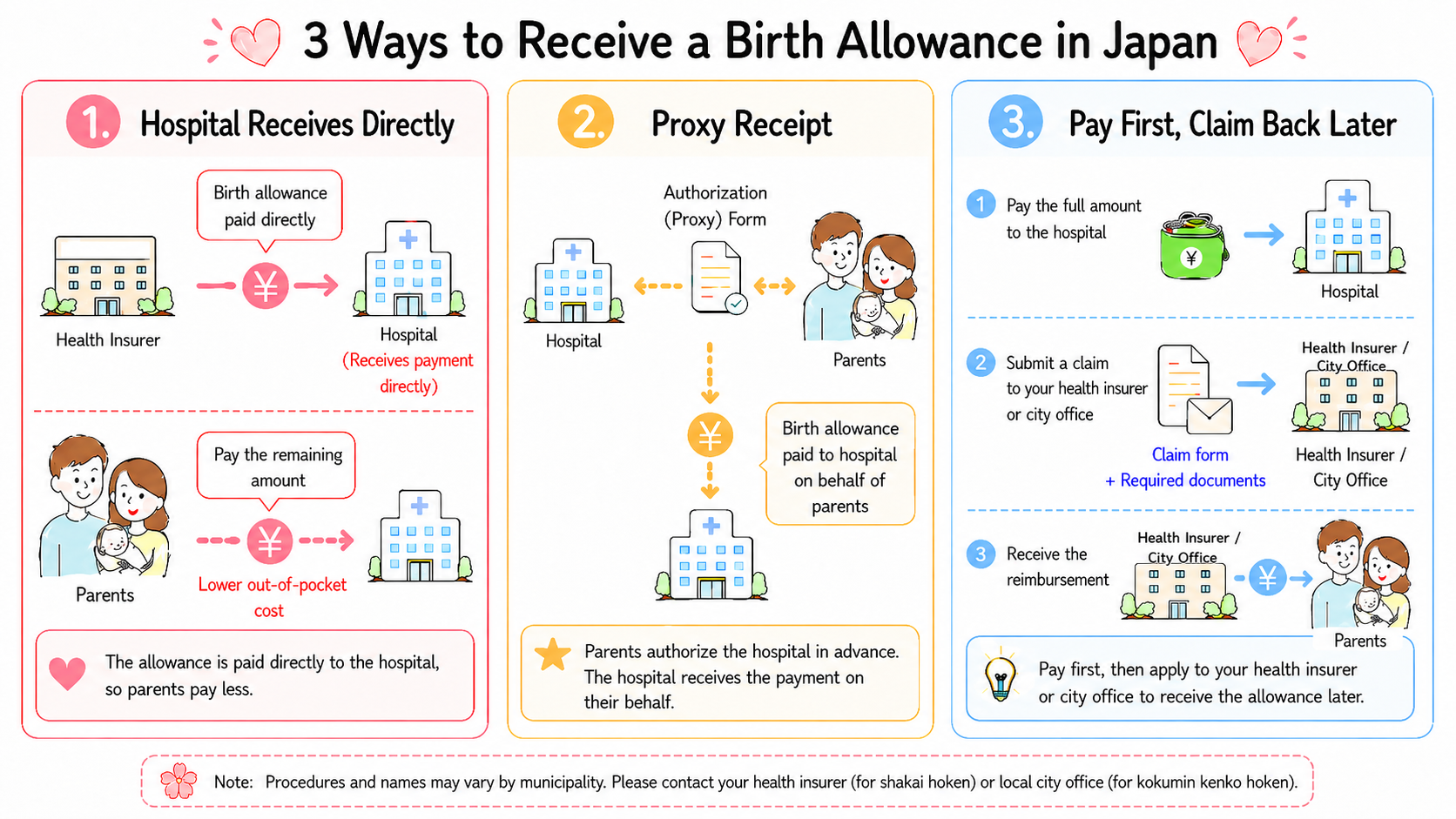
① Direct payment system (直接支払制度 — ちょくせつしはらいせいど) — Used by about 90% of parents
The hospital applies to your insurer on your behalf and receives the ¥500,000 directly. You only pay the difference at discharge.
- If the total bill is more than ¥500,000 — you pay the difference at the hospital
- If the total bill is less than ¥500,000 — the remaining balance is paid to you by your insurer after discharge
You sign a consent form at the hospital — no additional paperwork is required from you.
② Proxy receipt system (受取代理制度 — うけとりだいりせいど)
Used mainly at smaller clinics that are not set up for the direct payment system. You apply to your insurer before birth, naming the hospital as your representative. The process and outcome are similar to the direct payment system.
③ Postnatal claim (産後申請方式 — さんごしんせいほうしき)
You pay the full delivery costs at the hospital, then claim the allowance back from your insurer afterward. This is used for home births or overseas births, or when the hospital does not offer the other methods.
If your bill is under ¥500,000: You must apply separately to receive the remaining balance. After discharge, your insurer will send you a notice (差額支給のお知らせ — さがくしきゅうのおしらせ). Follow the instructions to claim the difference — it does not arrive automatically.
Step-by-Step: What to Do
Using the direct payment system (most common)
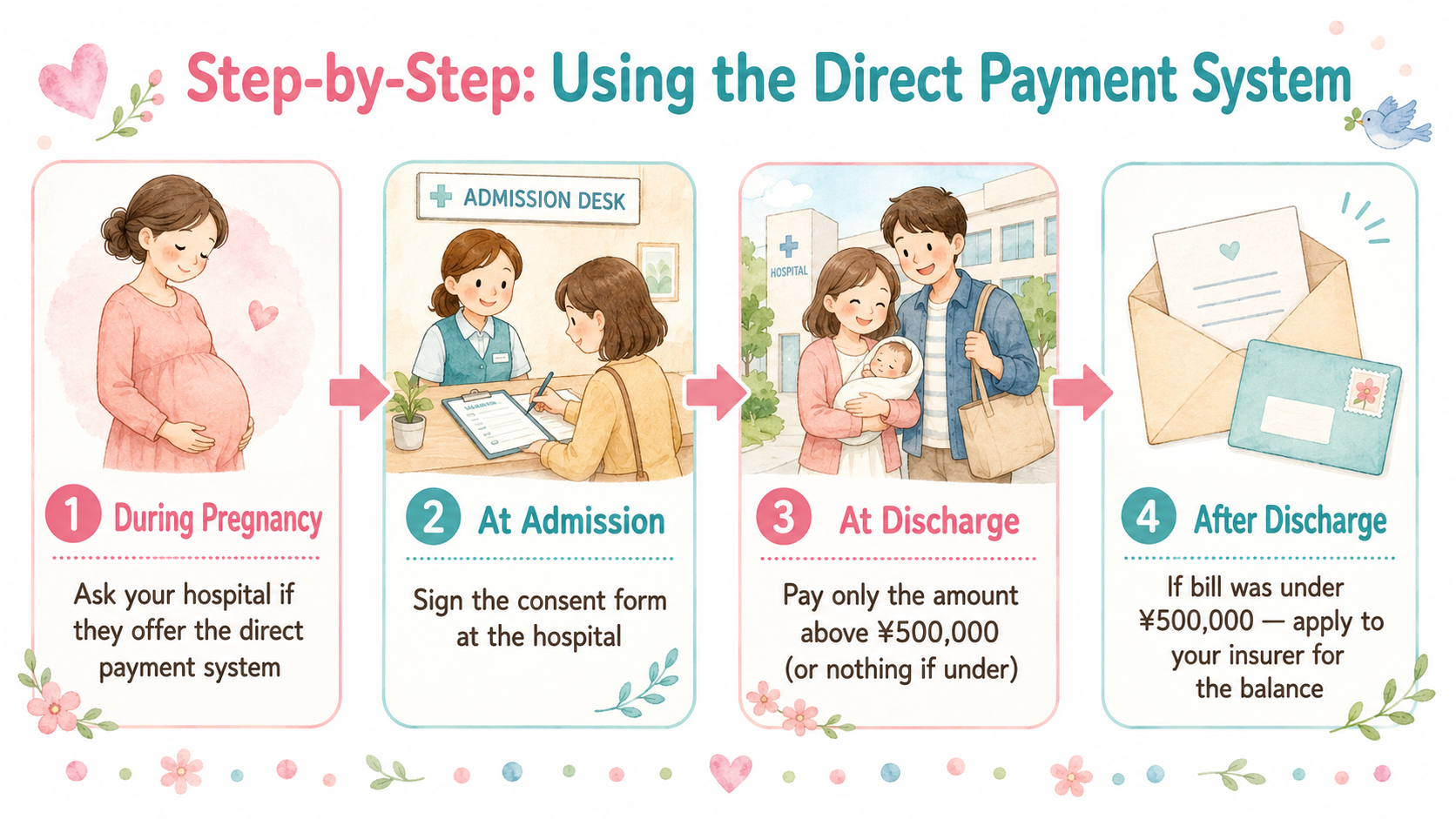
- During pregnancy — Ask your hospital whether they offer the direct payment system. Almost all do.
- At hospital admission — Sign the consent form (意思確認書 — いしかくにんしょ) that the hospital provides. This authorizes the hospital to claim on your behalf.
- At discharge — Pay only the amount above ¥500,000. If the total was under ¥500,000, you pay nothing and apply separately for the balance.
- After discharge (if bill was under ¥500,000) — Your insurer will contact you. Submit the balance claim form to receive the remaining amount.
Using the postnatal claim method
- Pay the full delivery cost at the hospital and keep the receipt (領収書 — りょうしゅうしょ).
- Download or collect the application form (出産育児一時金支給申請書 — しゅっさんいくじいちじきんしきゅうしんせいしょ) from your insurer.
- Submit the form with your receipt, hospital birth certificate, and bank account details.
- The allowance is paid to your bank account — usually within 10 business days of approval.
Application Deadline
You must apply within 2 years from the day after the birth. After this deadline, the benefit cannot be claimed.
Important: If you used the direct payment system, no action is usually needed — but if your bill was under ¥500,000, you must claim the balance yourself. Many parents miss this step. Watch for the notice from your insurer.
Where to contact: For shakai hoken, contact your employer's HR department or the Japan Health Insurance Association (協会けんぽ — きょうかいけんぽ). For kokumin kenko hoken, contact your local city or ward office (市役所・区役所 — しやくしょ・くやくしょ).
📖 Japanese Vocabulary
Key terms used in this article — useful if you need to speak with a hospital or government office in Japan.
| 日本語 | ひらがな | English |
|---|---|---|
| 出産育児一時金 | しゅっさんいくじいちじきん | Lump-sum birth allowance |
| 直接支払制度 | ちょくせつしはらいせいど | Direct payment system |
| 受取代理制度 | うけとりだいりせいど | Proxy receipt system |
| 産後申請方式 | さんごしんせいほうしき | Postnatal claim method |
| 産科医療補償制度 | さんかいりょうほしょうせいど | Obstetric medical compensation scheme |
| 社会保険 | しゃかいほけん | Employer-sponsored health insurance |
| 国民健康保険 | こくみんけんこうほけん | National Health Insurance |
| 協会けんぽ | きょうかいけんぽ | Japan Health Insurance Association |
| 意思確認書 | いしかくにんしょ | Consent form (signed at hospital admission) |
| 差額支給のお知らせ | さがくしきゅうのおしらせ | Balance payment notice (from insurer) |
| 出産育児一時金支給申請書 | しゅっさんいくじいちじきんしきゅうしんせいしょ | Benefit application form |
| 領収書 | りょうしゅうしょ | Receipt |
| 市役所・区役所 | しやくしょ・くやくしょ | City office / Ward office |