Written and reviewed by Susumu
Born and raised in Japan · Checked against Japanese law and ministry guidance
Before your child's first day at a Japanese preschool or daycare, everything they own needs a name on it — every crayon, every diaper, every sock. This is a guide to what gets labeled, where the name goes, and which method works best for each item.
Affiliate Disclosure: This article contains affiliate links. If you click a link and make a purchase, we may earn a small commission at no extra cost to you. We only recommend products we genuinely believe are helpful. See our Terms of Use for full details.
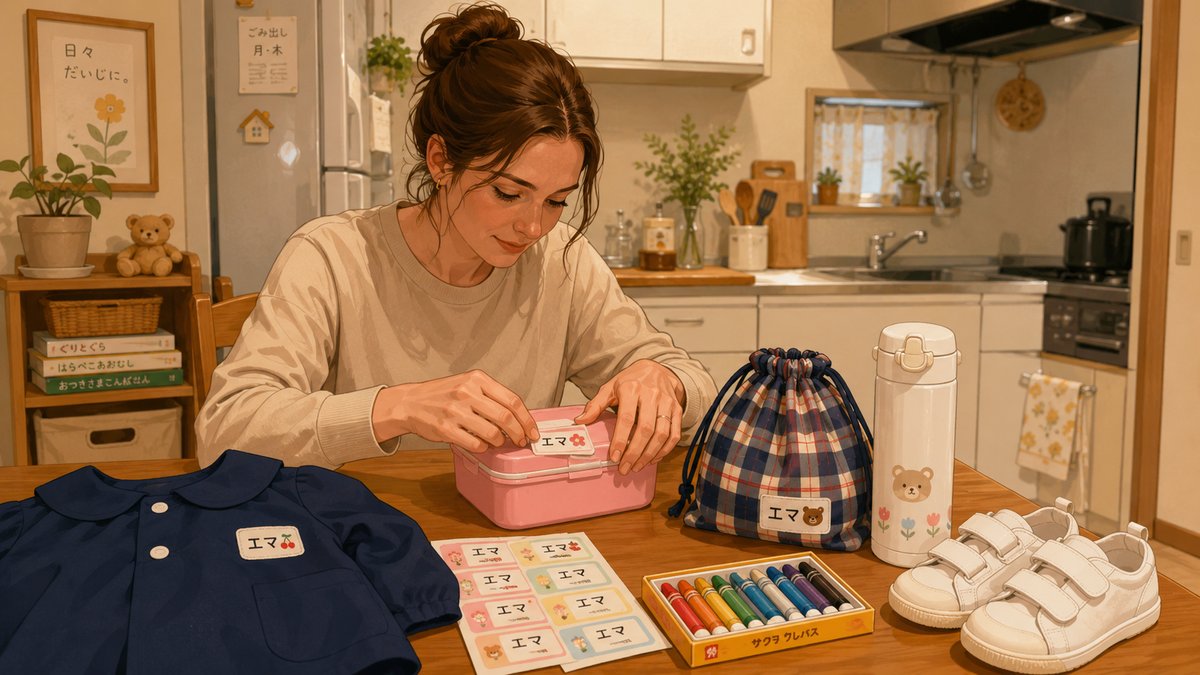
One of the first surprises of Japanese preschool life is the sheer scope of the name-writing task. It is not just the lunchbox and the bag. It is the lunchbox, the bag, the water bottle, the smock, the gym clothes, the hat, the indoor shoes, the outdoor shoes, the handkerchief, the crayons — each individual crayon — and, for children still in diapers, every single diaper. Japan's approach to labeling children's belongings is thorough in a way that catches most international families off guard.
Why Everything Needs a Name
A class of twenty or thirty children arrives each morning wearing near-identical smocks, carrying near-identical drawstring bags, holding near-identical water bottles. The staff are responsible for every item — knowing whose shoes are whose, returning the right lunchbox to the right child, reuniting a stray hat with its owner. Without a name on everything, that task becomes impossible.
The expectation is not a label on the main bag and a rough marker on the lunchbox. It is every item, legibly named, in a place where it can be found quickly — ideally before the child even starts. Facilities will generally remind families of this at the pre-enrollment explanation session (入園説明会), where the specific rules for your facility are explained.
What Needs to Be Labeled
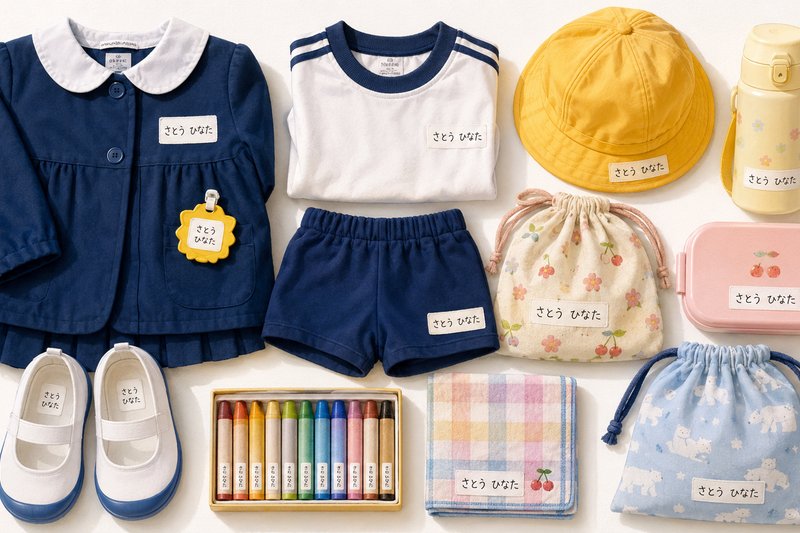
The list is longer than most families expect. As a general guide, anything that leaves the house with your child needs a name on it.
Clothing
Smock (スモック), uniform pieces, gym shirt, gym shorts or pants, cardigan, hat, socks, and underwear.
Shoes
Both outdoor shoes (上靴 or sneakers) and indoor shoes (上履き / uwabaki). The name goes inside, where it is visible but not readable from the street — a small privacy consideration that most facilities follow.
Bags and fabric items
通園バッグ (commuting bag), drawstring bags (for gym clothes, shoes, and lunch items), and handkerchief.
Lunchbox, water bottle, and food items
The lunchbox itself, its lid, any inner containers, the water bottle, and the drawstring bag they travel in.
Stationery and art supplies
Each individual crayon, each colored pencil, scissors, glue stick, and sketchbook. The box they come in gets a name too, but so does every item inside it. For crayons specifically, stickers tend to peel off with use — writing directly with an oil-based marker is the more reliable option.
Diapers
For children not yet toilet-trained, each diaper needs a name. A name stamp is the most practical approach here — it lets you work through a large stack quickly.
The Four Main Labeling Methods
Parents in Japan typically use a combination of methods depending on the item. Each has its strengths.
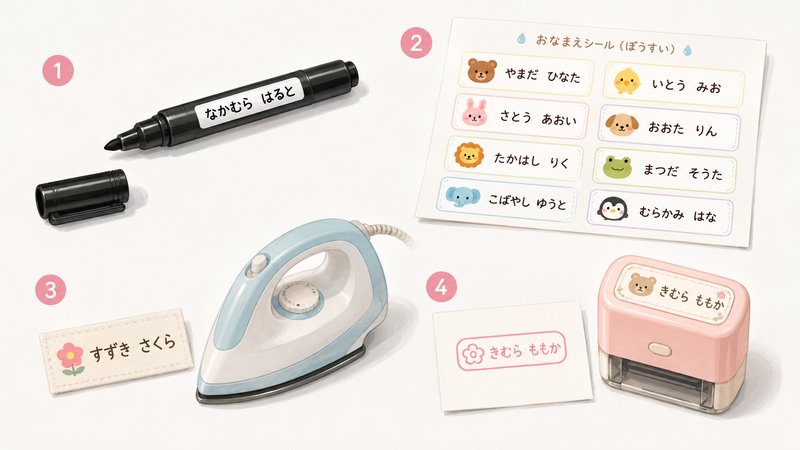
Oil-based marker (油性ペン) — the everyday workhorse
Works on almost any surface: clothing tags, shoe insoles, crayons, the inside of a hat brim. Parents with experience consistently describe this as the most reliable option — waterproof, permanent, and available at any convenience store. A fabric-specific marker (布書き用ペン) gives a cleaner result on textiles and resists washing better than a standard marker.
Waterproof name stickers (防水名前シール)
Ideal for smooth surfaces: lunchboxes, water bottles, and plastic stationery. Pre-printed sheets with your child's name in hiragana are widely available online, in baby goods shops, and at 100-yen stores — the 100-yen shop waterproof stickers are particularly popular for cups and lunch boxes. They peel off cleanly for passing items on to a younger child. The main caveat: regular dishwasher use will loosen them over time, so hand-washing items with stickers extends their life considerably.
Iron-on name labels (アイロンシール / フロッキーネーム)
Bond directly to fabric with heat. Well-suited to towels, socks, and stretchy gym clothes where a sticker would not hold. The adhesion is strong — but so is the permanence. A label applied to the wrong place leaves a mark. Many parents reinforce the edges with a few stitches for items that go through heavy washing.
Name stamp (お名前スタンプ)
Most useful for diapers, where volume makes other methods impractical — a stamp lets you mark many at once. One caveat before you buy one: many parents find stamps harder to use than expected. On curved or textured surfaces — crayons, clothing tags, shoe insoles — the impression smears or comes out uneven. Stamps are best kept for flat items like diapers and paper.
Where to Put the Name
Position matters almost as much as the name itself. Staff learn to look in specific places, and a name in an unexpected location can be just as unhelpful as no name at all.
| Item | Where to write |
|---|---|
| Clothing | Inside the collar tag or the hem — never on the outside where it is visible in public |
| Outdoor shoes | Inside, on the insole or heel lining |
| Indoor shoes (uwabaki) | The heel — visible from the shoe rack, which is how staff find them |
| Lunchbox and lid | The side and the bottom — two spots, since lids get separated |
| Water bottle | The side, near the base |
| Hat | Inside the brim — not on the outside panel |
| Socks | The arch of the foot or the folded-over cuff — both are common; check what your facility prefers |
| Crayons and pencils | Along the side of each one — an oil-based marker is more reliable than a sticker, which tends to peel off with use |
The general rule behind most of these positions is the same: inside where possible, for both privacy and practicality. A child's name visible on the outside of their clothing or bag can be read by anyone, and most facilities guide families toward internal labeling for that reason.
The Writing Rules: Hiragana, Full Name, Size
Most preschools and daycare facilities specify not just that items must be named, but how. The details are usually covered at the pre-enrollment session, but the most common expectations are:
Hiragana (ひらがな), not kanji
Young children cannot yet read kanji, so facilities ask for hiragana so children can begin to recognize their own name in print. Katakana is sometimes accepted; check with your specific facility.
Full name (フルネーム)
First name alone is not sufficient when multiple children in a class share common given names. Surname and given name, in that order, is the standard.
Large and legible
The name needs to be read quickly by a staff member scanning a row of identical shoes or a pile of hats. Small, faint writing defeats the purpose. Bold and clear is the expectation.
Check and refresh regularly
Names fade, stickers peel, iron-on labels lift at the corners. A quick check at the start of each term keeps everything identifiable throughout the year.
What International Parents Need to Know
The labeling task is the same regardless of where your family is from, but a few practical points will save you time before you start.
- Non-Japanese names in katakana are fine. If your child's name does not have a standard hiragana rendering, katakana is the natural alternative and is accepted at most facilities. Confirm at the 入園説明会 if you are unsure.
- The pre-enrollment session is where the specifics are given. Many facilities distribute a printed checklist of every item that needs a name, along with instructions for where and how to write it. Bring someone who can help you read it if needed — the detail matters.
- Plan for the volume. The full labeling task before a child's first day is larger than it looks — the item list is longer than most families expect.
- If items will be passed on to younger siblings, use removable methods where possible. Waterproof stickers peel off cleanly. An oil-based marker on clothing is essentially permanent — a consideration if hand-me-downs matter to your family.
- Consumables such as diapers need names too. Items that stay at the facility rather than coming home each day are sometimes overlooked. Check with your facility what stays there and make sure those items are labeled.
Useful Japanese Vocabulary
Words that come up when dealing with name labeling in Japan.
| Japanese | Reading | Meaning |
|---|---|---|
| お名前シール | onamae shīru | name sticker / name label |
| 油性ペン | yusei pen | oil-based (permanent) marker |
| 布書きペン | nunogaki pen | fabric marker — designed to write on cloth without bleeding |
| アイロンシール | airon shīru | iron-on name label |
| お名前スタンプ | onamae sutanpu | name stamp — used for high-volume labeling such as diapers |
| フルネーム | furu nēmu | full name — surname and given name, as required by most facilities |
| 上履き | uwabaki | indoor shoes worn inside the school building |
| スモック | sumokku | smock — the standard loose over-garment worn at hoikuen and yochien |
| 入園説明会 | nyūen setsumeikai | pre-enrollment information session — where labeling rules are explained |
| 記名 | kimei | name inscription / labeling — the act of writing a name on an item |