

Written and reviewed by Susumu
Born and raised in Japan · Checked against Japanese law and ministry guidance
Babies cannot blow their own nose — and in Japan, a nasal aspirator (鼻水吸引器) is considered a basic baby essential. This guide covers the three main types available in Japanese shops, how to use one safely, and where to buy.
Affiliate Disclosure: This article contains affiliate links. If you click a link and make a purchase, we may earn a small commission at no extra cost to you. We only recommend products we genuinely believe are helpful. See our Terms of Use for full details.

Babies cannot blow their own nose — and in Japan, a nasal aspirator (鼻水吸引器 / hanamizu kyūin-ki) is considered an everyday baby essential. This guide covers the main types available in Japanese shops, how to use one, and where to buy.
For information only. Always follow the product instructions and consult a pediatrician if your baby's symptoms are severe or prolonged.
Why Nasal Aspirators Are So Common in Japan
Walk into any baby shop in Japan and you will find a dedicated shelf — sometimes an entire display stand — devoted to nasal aspirators. They are recommended by pediatricians, demonstrated at baby health clinics, and considered as basic as a thermometer.
The reason is straightforward: babies cannot blow their nose. Mucus that sits in the nasal passages makes breathing difficult, disrupts feeding and sleep, and can travel down to cause ear infections or lower respiratory problems. Removing it regularly keeps babies more comfortable and can reduce complications.
Japan's cold, dry winters mean colds and runny noses are a constant from autumn through spring. Most families end up using a nasal aspirator several times a week during this period.
The Three Main Types
Japanese baby shops divide nasal aspirators into three broad categories. You will see these labels on the display stands:
① 口吸いタイプ — Mouth-suction type
A flexible tube connects a soft nozzle to a mouthpiece that the parent holds. You provide the suction by gently inhaling. A small reservoir catches the mucus before it reaches your mouth. These are inexpensive and widely available, though suction can sometimes be difficult to get quite right.
No batteries needed · Compact · Inexpensive
② 手動ポンプタイプ — Manual pump type
A squeeze-bulb or piston mechanism generates suction. You compress and release a rubber bulb or push a small piston with your thumb. No mouth contact is needed. These are a step up from mouth-suction types and work well for light to moderate congestion.
No batteries needed · Easy to clean · Mid-range price
③ 電動タイプ — Electric type
Battery-powered or rechargeable, electric aspirators generate consistent suction at the press of a button. They come in two sizes: a compact handheld model (電動ハンディタイプ) and a larger tabletop unit (電動拡大タイプ). The tabletop version produces stronger suction and is what ENT departments typically use or recommend for children with frequent ear infections or chronic congestion.
One-handed operation · More expensive than manual types · Tabletop models are the most powerful
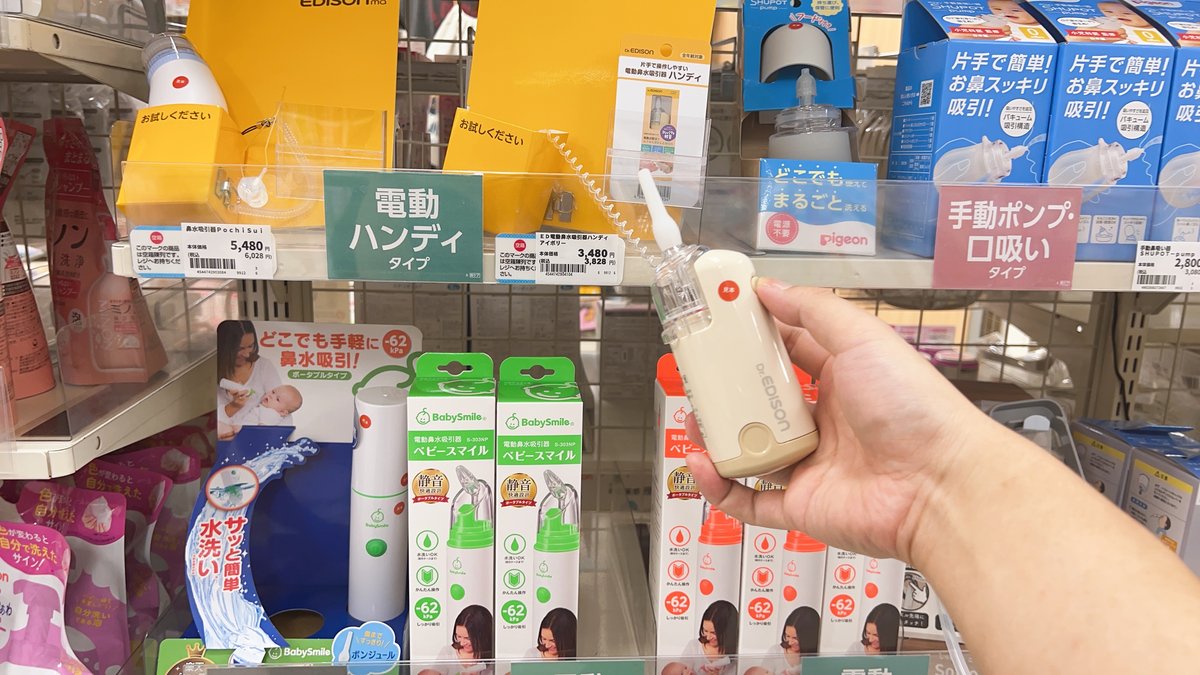
Electric handy type (電動ハンディタイプ) on display at a Japanese baby shop
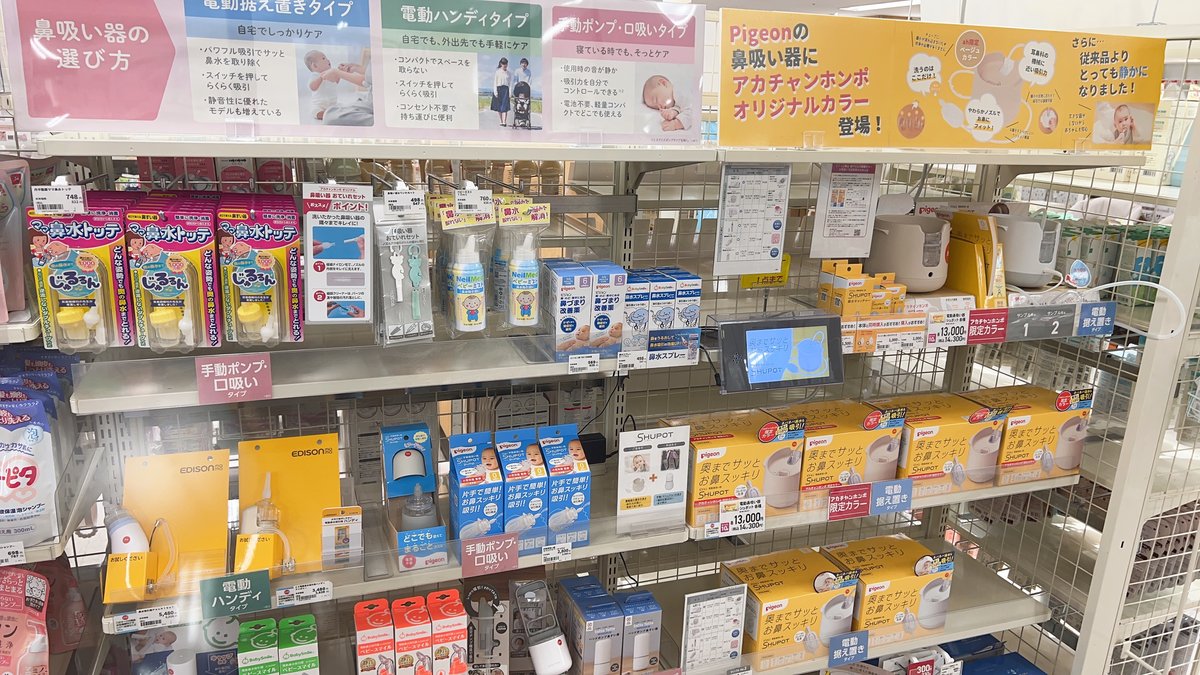
Nasal aspirator section at a baby shop in Japan, with shelves labeled by type
Which Type Is Right for You
For most families, an electric aspirator is the practical choice. Suction is consistent, it can be operated with one hand, and there is no risk of passing the baby's cold on to yourself. The handheld electric type is a reasonable starting point — it handles everyday congestion well and is compact enough for travel.
A manual pump type is a decent middle ground if you prefer something simpler and less expensive than electric. It requires no batteries and is easy to clean.
The mouth-suction type is widely available and inexpensive, though getting the suction just right can take some practice. A pump or electric model tends to be the longer-term choice for most families.
If your baby has frequent ear infections or chronic congestion, ask your pediatrician or ENT whether they recommend the larger tabletop electric type — it produces the strongest suction and is what clinics themselves typically use.
How to Use One
The general approach is the same across all types:
- Soften the mucus first if it is dry or thick. Sitting in a steamy bathroom for a few minutes, or using a few drops of saline nasal spray, makes extraction much easier.
- Hold the baby securely — lying across your lap or held in an upright cuddle. Having a second person hold the baby steady is helpful with younger infants.
- Insert the nozzle gently just inside the nostril opening. Do not push it in deeply — a light seal at the entrance is enough.
- Apply suction briefly — around three to four seconds per nostril, and no longer than ten seconds at a time. Alternate sides and repeat in short bursts rather than trying to clear everything in one go. This protects the nasal lining and is more effective overall.
- Wipe and reassure your baby afterward. Most babies find the process unpleasant at first; it usually becomes routine within a few uses.
Good moments to try are before sleep, on waking, after a bath, and before a feed — mucus tends to accumulate or soften at these times, making removal easier.
If a small nosebleed occurs, stop immediately and wait several hours before trying again. Do not use the aspirator right after a feed, as the suction can trigger a gag reflex.
Cleaning and Hygiene
All nasal aspirator parts that come into contact with mucus should be rinsed and cleaned after every use. Most products sold in Japan are designed so that the suction nozzle, reservoir, and tubing can be fully disassembled for washing. Follow the product instructions for the recommended cleaning method, and check whether parts are compatible with the sterilizer you already use for bottles.
The nozzle tips that touch the nostrils are personal and should not be shared between children.
Where to Buy in Japan
Nasal aspirators are widely available across Japan. The easiest places to find a full range are:
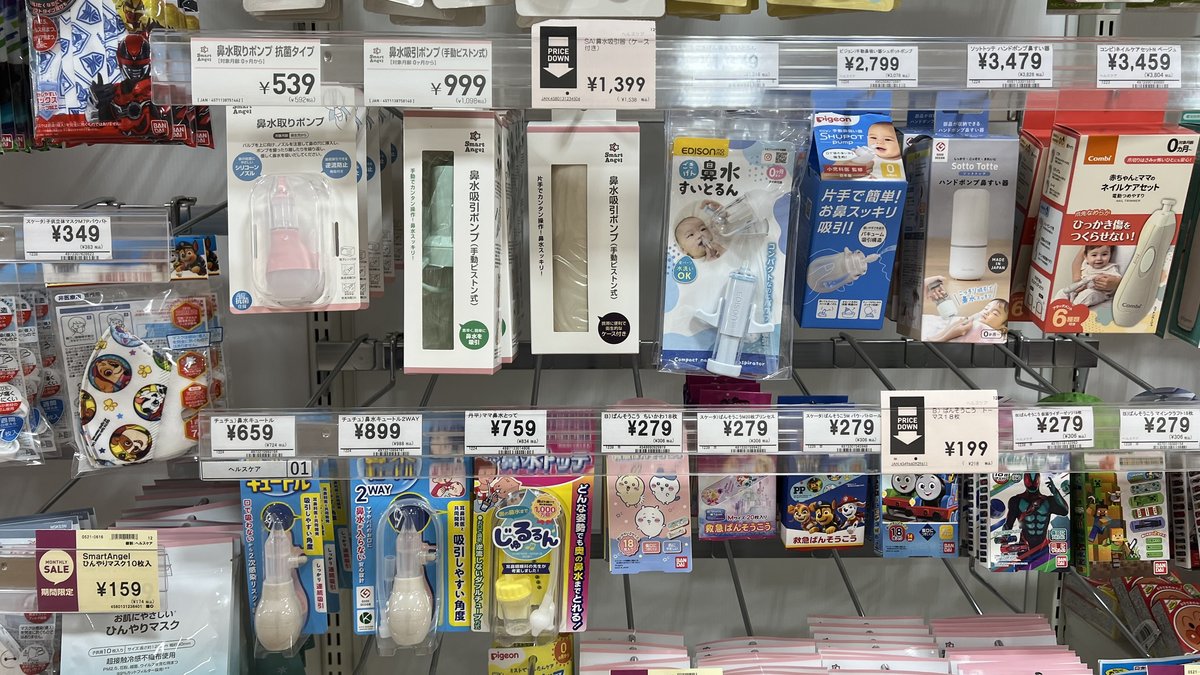
A typical baby shop shelf in Japan — nasal aspirators sit alongside other infant care products
Baby and children's specialist shops
Large baby retailers stock all three types in one place, often with a dedicated display that labels each category clearly. Staff can answer questions about the differences. This is the best first stop if you want to compare options in person.
Drugstores (ドラッグストア)
Most large drugstore chains stock at least the mouth-suction and manual pump types in the baby care aisle. Electric models are less common here but occasionally available.
Online
The full range of models — including tabletop electric units — is available through Japanese online retailers. Useful if you want to read reviews before buying or need a specific model that is out of stock locally.
Two That Japanese Families Actually Buy
The two links below are Amazon affiliate links. If you buy after clicking one, we earn a small commission at no extra cost to you. These are the two models Japanese parents buy most — not the two that pay most.
Electric — PIGEON SHUPOT (ピジョン シュポット)

Rechargeable and worked with one thumb, which matters when your other hand is holding a baby who does not want this done. Currently the best-selling electric aspirator on Amazon Japan, from the brand whose baby goods fill every drugstore shelf here.
View the Pigeon SHUPOT on Amazon.co.jp →Manual pump — CHIBOJI (ちぼじ)

A hand pump at roughly a quarter of an electric model’s price, with more customer reviews than any other aspirator sold in Japan by a wide margin. Every part comes off for washing, and there is nothing to charge.
View the CHIBOJI on Amazon.co.jp →Neither is the tabletop unit. If your pediatrician or ENT has suggested one of those, buy the model they name rather than one you found online.
Tap 🔊 Play to hear the phrase spoken aloud in Japanese.
To ask where the nasal aspirators are
鼻水吸引器はどこにありますか
Hanamizu kyūin-ki wa doko ni arimasu ka
"Where are the nasal aspirators?"
To ask which type a staff member recommends
どのタイプがおすすめですか
Dono taipu ga osusume desu ka
"Which type do you recommend?"
If a doctor recommends an electric model
電動の鼻水吸引器を探しています
Dendō no hanamizu kyūin-ki wo sagashite imasu
"I am looking for an electric nasal aspirator."
Japanese Vocabulary
| Japanese | Reading | Meaning |
|---|---|---|
| 鼻水吸引器 | hanamizu kyūin-ki | Nasal aspirator |
| 鼻水 | hanamizu | Nasal mucus / runny nose |
| 口吸いタイプ | kuchisui taipu | Mouth-suction type |
| 手動ポンプタイプ | shudō ponpu taipu | Manual pump type |
| 電動タイプ | dendō taipu | Electric type |
| 電動ハンディタイプ | dendō handi taipu | Portable electric type |
| 電動拡大タイプ | dendō kakudai taipu | Large tabletop electric type |
| 鼻づまり | hana-zumari | Nasal congestion / blocked nose |
| 生理食塩水 | seiri shokuensui | Saline solution (nasal spray) |
| 小児科 | shōnika | Pediatrics / pediatric clinic |