

Written and reviewed by Susumu
Born and raised in Japan · Checked against Japanese law and ministry guidance
Most nurseries in Japan hold a nursery school outing called 親子遠足 (oyako ensoku) — a field trip where parents and children go together. Here's what to expect, what to bring, and how to navigate it as an international parent.
Affiliate Disclosure: This article contains affiliate links. If you click a link and make a purchase, we may earn a small commission at no extra cost to you. We only recommend products we genuinely believe are helpful. See our Terms of Use for full details.

What Is Oyako Ensoku?
親子遠足 (oyako ensoku) is a nursery school outing where parents and children go on a field trip together. Unlike the regular day-to-day drop-off routine, this is an event where you stay with your child for the whole trip — exploring a park, zoo, or other nearby destination as a family, alongside the teachers and other families from your child's class.
It gives parents and children a chance to spend time together outside the nursery's usual routine — and it's also one of the few occasions where parents get to properly meet each other and the teachers in a relaxed setting.
This is a parent-participation event
Unlike most nursery days, you don't drop your child off and leave. You attend together for the entire outing. One parent typically comes — check your nursery's notice to confirm who should attend and whether siblings are welcome.
When Does It Happen?
Most nurseries hold oyako ensoku once or twice a year, typically in spring (May–June) or autumn (September–October). Spring is the most common time — May in particular, once the new school year has settled down after the April enrollment period.
Summer and winter are generally avoided: summer because of heat and humidity, winter because of cold weather and illness season.
Your nursery will announce the date in advance — usually through the 連絡帳 (renrakucho, the daily communication notebook) or a printed notice sent home. Some nurseries post notices on a bulletin board near the entrance. If you're unsure how notices are distributed at your nursery, ask at drop-off.
Where Do They Go?
Destinations are chosen with young children in mind — typically within 30 to 40 minutes of the nursery. Common choices include:
- Large parks — open space for running around, picnic areas for lunch
- Zoos and aquariums — popular for younger children who can observe animals up close
- Botanical gardens and nature parks — seasonal flowers, walking paths
- Science museums and planetariums — common for older preschool classes
- Athletic parks with climbing structures — good for active toddlers
The nursery chooses a location suited to the ages of the children in your class, so the destination will be appropriate for your child's age group. If you're curious about where you're going, it will be on the notice.
What to Expect on the Day
A typical oyako ensoku runs from mid-morning to early afternoon — something like 9:30 a.m. to 2:00 p.m., though this varies. You'll usually meet at the nursery or directly at the destination, travel together or make your own way there, spend time exploring, have lunch together, and then head home.
The general flow:
- Meet at the nursery or designated meeting point
- Travel to the destination (on foot, by bus, or train — the notice will specify)
- Free time for exploring with your child
- Group lunch on picnic mats — everyone eats their bento together
- A little more free time or a brief group activity
- Return and dismiss — the day usually ends before your child's normal pick-up time
The pace is relaxed. There's no formal program or scored event — it's closer to a family picnic than a school sports day.
What to Bring
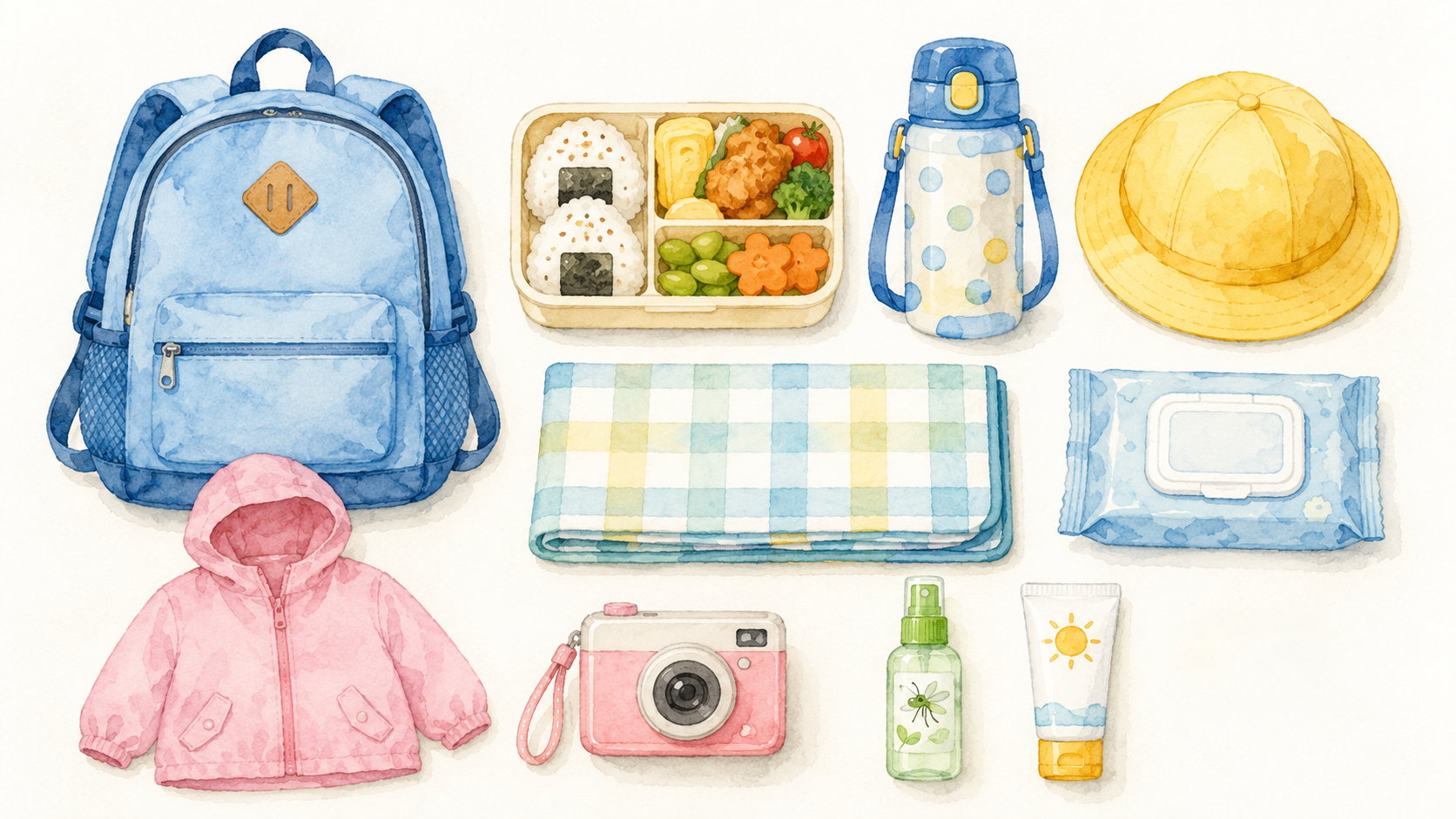
Pack everything in a backpack so both hands are free — you'll be managing your child, especially with toddlers. A standard packing list:
- Bento box — a packed lunch from home (see note below)
- Water bottle — enough for the whole day
- Snacks — if the notice says these are allowed
- Leisure sheet (レジャーシート) — a picnic mat large enough for your family; a 3–4 person size works well
- Hat — required for outdoor events at most nurseries
- Towel and wet wipes
- Plastic bags — bring at least 3 for sorting trash (燃えるゴミ, 燃えないゴミ, etc.)
- Change of clothes — a full spare set for your child, including socks and underwear; diapers if applicable
- Rain jacket — even on a forecast-clear day
- Insect repellent and sunscreen
- Camera or smartphone
- First aid basics — bandages, antiseptic wipes
About the bento
Bringing a homemade bento is standard at most nurseries. It doesn't need to be elaborate — something simple is perfectly fine. Your nursery's notice will confirm whether a bento is required or if food is provided.
Photos and Social Media
Taking photos of your own child is generally fine. However, many nurseries ask parents not to post photos from nursery events — including oyako ensoku — to social media. The reason is other children's privacy: a photo of your child at the park may include other families' children in the background.
Some nurseries have a blanket rule against posting any photos taken at nursery events. Others ask only that you avoid posting photos where other children are clearly visible. The policy will typically be in the nursery's parent handbook (保護者のしおり) or announced before the event.
If you're unsure, the safe default is: don't post photos that include other children, even in the background.
Meeting Other Parents
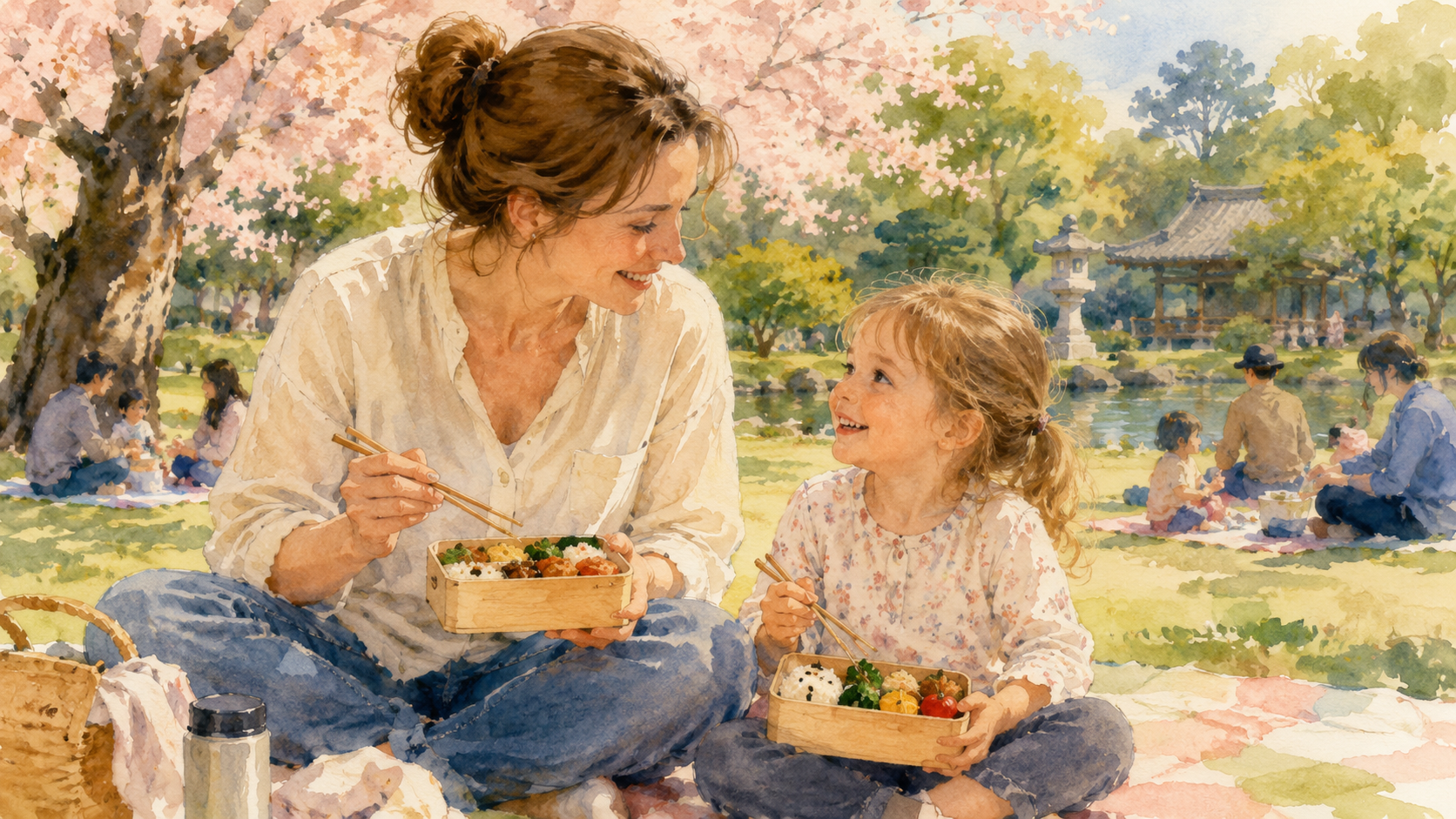
Oyako ensoku is one of the few nursery events where parents spend extended time together, and many families do use it as a chance to get to know each other. The lunch portion in particular — everyone sitting on picnic mats in the same area — tends to be when conversations happen naturally.
That said, there's no obligation to socialize beyond a friendly greeting. Japanese parents at these events are often just as focused on their own children as you are. A simple 「よろしくお願いします」(yoroshiku onegaishimasu) when you arrive is perfectly appropriate.
If your Japanese is limited, most parents will be understanding. A smile and basic phrases go a long way. Some nurseries in urban areas with international families will have other non-Japanese parents at the event — worth looking out for if you'd like someone to talk to.
Tips for International Parents
- Read the notice carefully. The 案内 (announcement) will specify the meeting place, time, what to bring, whether siblings can come, and how to get to the destination. If you can't read Japanese, use a translation app or ask a teacher at drop-off.
- Confirm the weather plan. Many nurseries will announce whether the event goes ahead as planned or is postponed if the weather is bad. Check for a 雨天時 (rainy day) note on the announcement — it will say either 決行 (going ahead regardless) or 順延 (postponed to a backup date).
- Dress practically. Comfortable clothes you don't mind getting dirty, and flat shoes or sneakers. Avoid heels or sandals — you'll be walking and possibly sitting on the ground.
- Trash sorting matters. Public parks in Japan often have strict waste separation rules, and the nursery may have its own guidelines. Bring separate bags for burnable and non-burnable waste and take your trash home if there are no bins available.
- Ask about attendance if you can't make it. Policies vary by nursery — some handle attendance on the day differently when a parent can't come. Check with your nursery directly if you're unsure what to do in that situation.
Japanese Vocabulary
| Japanese | Reading | Meaning |
|---|---|---|
| 親子遠足 | oyako ensoku | Parent-child field trip — a nursery outing where parents attend with their children |
| 案内 | annai | Notice or announcement — the printed sheet with event details |
| レジャーシート | rejā shīto | Picnic mat / leisure sheet — brought for sitting on the ground at lunch |
| お弁当 | obentō | Packed lunch — brought from home in a bento box |
| 雨天時 | uten ji | In case of rain — look for this on the notice to find the rainy-day plan |
| 決行 | kekkō | Going ahead regardless of weather |
| 順延 | jun'en | Postponed to the backup date |
| 保護者のしおり | hogoshanoshiori | Parent handbook — given at enrollment, contains nursery rules and policies |
| よろしくお願いします | yoroshiku onegaishimasu | A standard greeting — appropriate when meeting other parents for the first time |