
Written and reviewed by Susumu
Born and raised in Japan · Checked against Japanese law and ministry guidance
Every hoikuen in Japan uses a 連絡帳 — a small handwritten notebook that travels between home and the childcare facility every day. Here is what parents write, what teachers write back, useful phrases to copy, and key vocabulary for the renrakucho.
Affiliate Disclosure: This article contains affiliate links. If you click a link and make a purchase, we may earn a small commission at no extra cost to you. We only recommend products we genuinely believe are helpful. See our Terms of Use for full details.

On your child's first day at hoikuen, you will most likely be handed a small notebook. This is the 連絡帳 (renrakucho) — and filling it in every morning is part of daily life for parents in Japan. It has no real equivalent in most other countries.
What Is a Renrakucho?
The 連絡帳 (renrakucho — literally "communication notebook") is a small handwritten notebook that travels between home and the childcare facility every day. Parents fill in their section each morning before drop-off. Teachers fill in their section during or after the day, and the notebook comes home in your child's bag each evening.
It is used at almost every 保育園 (hoikuen / licensed daycare) in Japan. Some 幼稚園 (yochien / kindergarten) use a renrakucho too, though the format is often simpler, and some have moved to apps or printed newsletters instead. Some hoikuen now also offer a digital version through an app, but handwritten notebooks remain the norm at many places.
Why does it exist?
The renrakucho is how parents and teachers stay connected about a child's daily condition — sleep, appetite, mood, health — without needing to have a long conversation at the door during a busy drop-off. For the facility, it is also a record of the child's health and development over time.
What Parents Write Each Morning
The format varies slightly between facilities, but most renrakucho include the same basic sections. You fill these in before leaving the house — or at least before drop-off.
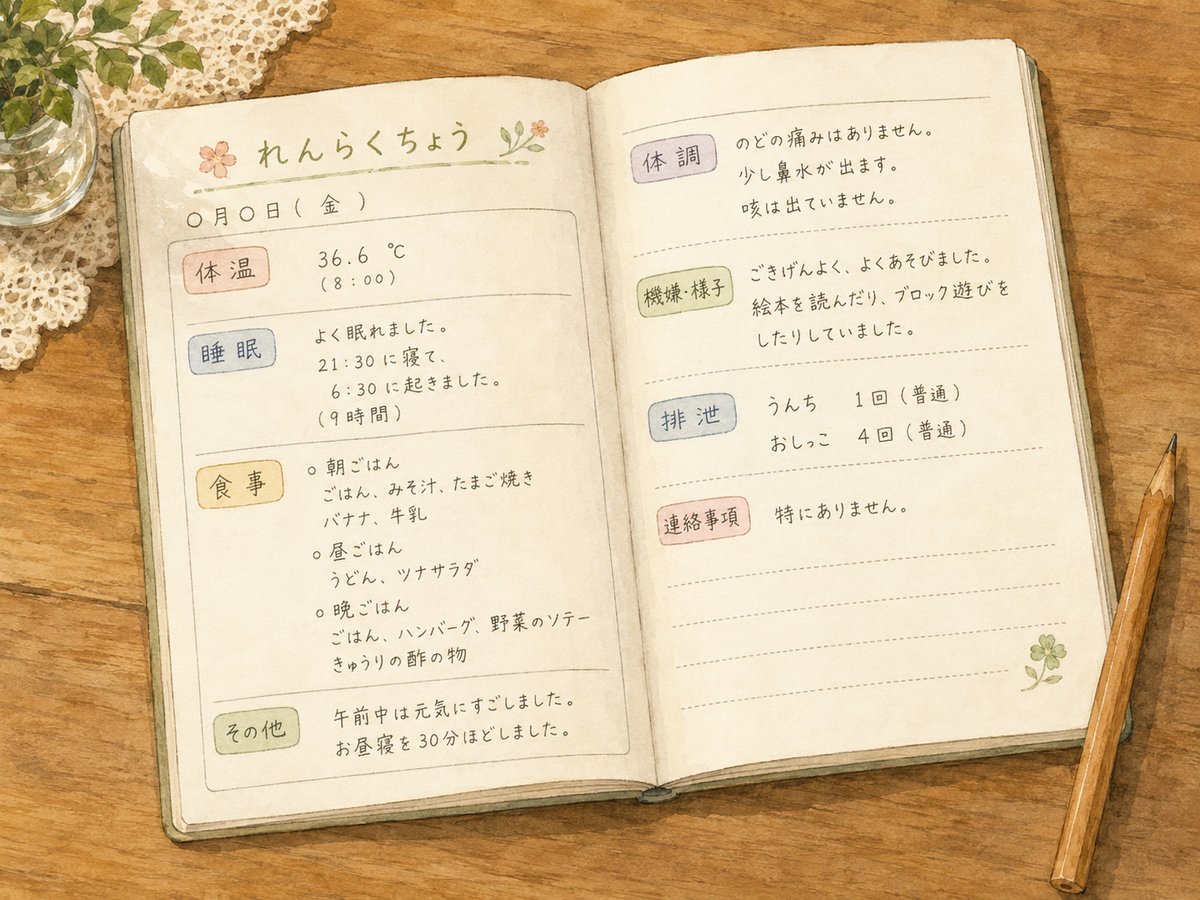
Typical sections parents fill in
- 体温 (taion) — Morning temperature, taken before leaving home
- 睡眠 (suimin) — What time your child went to sleep and woke up
- 食事 (shokuji) — Whether they ate breakfast, and how much (often marked as よく食べた / 普通 / 少し食べた)
- 排便 (haiben) — Whether they had a bowel movement that morning
- 家での様子 (ie de no yōsu) — A short note about how your child seemed at home — happy, tired, a bit sniffly, and so on
- 連絡事項 (renraku jikō) — Anything the teacher needs to know: an early pick-up, a doctor's appointment, a rash you noticed
Temperature is taken every morning
Most hoikuen require you to take your child's temperature before drop-off and record it in the renrakucho. If your child has a fever, you will generally be asked to keep them home — the exact threshold varies by facility, but 37.5°C is commonly used as a guideline. Keep a thermometer by the front door so this becomes habit.
🌡️ How to write and say temperatures in Japanese
All three formats are used and understood. 36.7°C is what your thermometer displays; 36.7度 and 36度7分 are both common Japanese written forms — any of the three is fine in the renrakucho.
| Thermometer | Japanese (decimal) | Japanese (traditional) | Reading |
|---|---|---|---|
| 36.5°C | 36.5度 | 36度5分 | sanjūroku-do go-fun |
| 36.7°C | 36.7度 | 36度7分 | sanjūroku-do nana-fun |
| 37.0°C | 37.0度 | 37度0分 | sanjūshichi-do zero-fun |
| 37.5°C | 37.5度 | 37度5分 | sanjūshichi-do go-fun — fever threshold |
| 38.0°C | 38.0度 | 38度0分 | sanjūhachi-do zero-fun |
What Teachers Write Back
At the end of the day, the teacher adds their own notes — and this section is one of the things international parents look forward to most, once they can read it.
What teachers typically include
- What your child ate at lunch and how much
- Whether they slept during nap time (午睡, gosui) and for how long
- Something your child did or said during the day — a moment the teacher noticed
- How your child seemed: happy, tired, unsettled, playing well with others
- Any health observations during the day
- Notices or reminders about upcoming events
The teacher's entry is often warm and personal. Over time, the renrakucho becomes a genuine record of your child's days at the facility — many parents keep them as keepsakes.
Tips for Non-Japanese Speaking Parents
Ask for a blank copy to study
On your first day, ask the teacher if you can take a photo of a completed example renrakucho, or if they have a sample to show you. Seeing a filled-in version makes the format much clearer than any explanation.
Keep your entries short and simple
Teachers do not expect long essays. A single sentence about your child's morning is enough. You can rotate between a small set of phrases — see the section below.
Use a translation app for the teacher's notes
Teacher entries are handwritten, which can be harder to read than printed text. A translation app with a camera function works well — hold it over the page and it will translate in real time.
It is fine to write in the renrakucho about language concerns
Many teachers appreciate a simple note such as 「日本語が得意ではありません」(I am not confident in Japanese). It helps them understand your situation and they will often try to keep their notes clear and simple.
Useful Phrases to Copy
These phrases cover the situations you are most likely to encounter. Copy them directly into your renrakucho — mix and match as needed. No Japanese typing required: you can handwrite the characters by tracing this page.
General
Nothing special to report today
本日もよろしくお願いいたします
Honjitsu mo yoroshiku onegai itashimasu
"Please take good care of my child today."
Child slept well
よく眠れました
Yoku nemuremashita
"Slept well."
Child is in a good mood
今朝は機嫌がよいです
Kesa wa kigen ga yoi desu
"In a good mood this morning."
Sleep & Morning Routine
Child woke up earlier than usual
いつもより早く起きました
Itsumo yori hayaku okimashita
"Woke up earlier than usual."
Child has been crying at night
夜泣きが続いています
Yonaki ga tsuzuite imasu
"Has been crying at night."
Child didn't eat much breakfast
朝ご飯をあまり食べませんでした
Asagohan o amari tabemasen deshita
"Didn't eat much breakfast."
Health & Symptoms
Child has had a fever since last night
昨夜から熱があります
Sakuya kara netsu ga arimasu
"Has had a fever since last night."
Child has a runny nose but no fever
鼻水が出ていますが、熱はありません
Hanamizu ga dete imasu ga, netsu wa arimasen
"Has a runny nose but no fever."
Child has a slight cough
少し咳が出ています
Sukoshi seki ga dete imasu
"Has a slight cough."
Child has loose stools
下痢気味です
Geri gimi desu
"Has loose stools."
Child has had no appetite since yesterday
昨日から食欲がありません
Kinō kara shokuyoku ga arimasen
"Has had no appetite since yesterday."
I have sent medicine with my child
薬を持たせています
Kusuri o motasete imasu
"I have sent medicine with my child."
Pick-up & Absence
Early pick-up today
本日は早めにお迎えに伺います
Honjitsu wa hayame ni omukae ni ukagaimasu
"I will pick up my child a little early today."
Grandmother will pick up today
本日は祖母がお迎えに参ります
Honjitsu wa sobo ga omukae ni mairimasu
"Grandmother will pick up my child today."
Absent today due to fever
本日は発熱のためお休みします
Honjitsu wa hatsunetsu no tame oyasumi shimasu
"Absent today due to fever."
Recovered — returning tomorrow
回復しましたので、明日から登園します
Kaifuku shimashita node, ashita kara tōen shimasu
"Has recovered — will return tomorrow."
Japanese Vocabulary
Key words you are likely to encounter in the renrakucho — both in your own entries and in the teacher's notes.
| Japanese | Reading | Meaning |
|---|---|---|
| 連絡帳 | renrakuchō | Communication notebook |
| 体温 | taion | Body temperature |
| 平熱 | heinetsu | Normal (baseline) temperature |
| 発熱 | hatsunetsu | Fever |
| 睡眠 | suimin | Sleep |
| 夜泣き | yonaki | Night crying |
| 午睡 | gosui | Nap time (at daycare) |
| 食事 | shokuji | Meal / eating |
| 食欲 | shokuyoku | Appetite |
| 排便 | haiben | Bowel movement |
| 下痢 | geri | Diarrhea |
| 嘔吐 | ōto | Vomiting |
| 鼻水 | hanamizu | Runny nose |
| 咳 | seki | Cough |
| 薬 | kusuri | Medicine / medication |
| 入浴 | nyūyoku | Bath |
| 機嫌 | kigen | Mood / temperament |
| 様子 | yōsu | Condition / how someone seems |
| 連絡事項 | renraku jikō | Notice / message for the teacher |
| 欠席 | kesseki | Absence |
| 早退 | sōtai | Early pick-up / leaving early |
| お迎え | omukae | Pick-up (collecting your child) |
| お迎えの人 | omukae no hito | Person collecting the child |
| 保護者 | hogosha | Parent / guardian |
| 担任 | tannin | Class teacher |