

Written and reviewed by Susumu
Born and raised in Japan · Checked against Japanese law and ministry guidance
Japan's DT booster is a single free injection given at age 11, refreshing protection against diphtheria and tetanus about a decade after the primary series. Here's what international families need to know about the schedule, cost, and how it fits into Japan's vaccination program.
Affiliate Disclosure: This article contains affiliate links. If you click a link and make a purchase, we may earn a small commission at no extra cost to you. We only recommend products we genuinely believe are helpful. See our Terms of Use for full details.
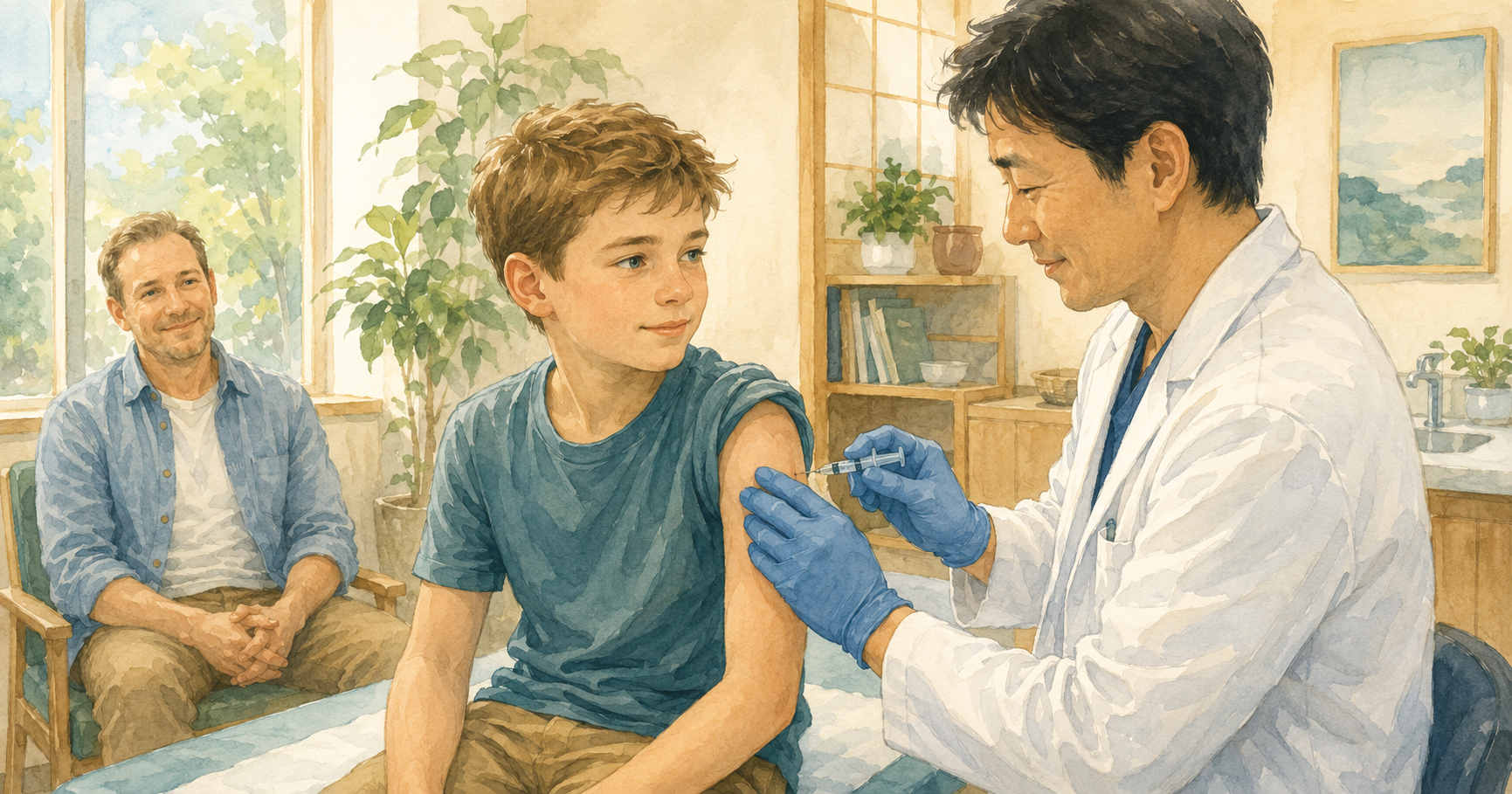
One injection at age 11, free of charge. The DT vaccine is a routine booster given once to children aged 11 — a single subcutaneous injection that tops up protection against diphtheria and tetanus, roughly a decade after the primary series in infancy. No extra doses, no complicated schedule.
What Are Diphtheria and Tetanus?
Diphtheria (ジフテリア)
Diphtheria is a bacterial infection caused by Corynebacterium diphtheriae. The bacteria produce a toxin that damages the heart, nerves, and kidneys. A thick gray membrane can form in the throat, blocking the airway. Today, diphtheria is extremely rare in Japan, with no cases reported since 2000 — a direct result of high vaccination coverage maintained over decades.
Tetanus (破傷風)
Tetanus is not spread from person to person. It enters the body through wounds — cuts, scrapes, or punctures — contaminated with soil or dust containing Clostridium tetani spores. The bacteria produce a toxin that causes painful muscle stiffening, starting in the jaw and spreading to the whole body, including the muscles needed to breathe. Maintaining up-to-date vaccination is the most reliable protection against tetanus.
About the DT Vaccine
The DT vaccine (沈降ジフテリア破傷風混合トキソイド) is a toxoid vaccine — it contains inactivated versions of the two bacterial toxins, not live or killed bacteria. The immune system responds to these harmless toxoids by building antibodies, which remain ready to neutralize the real toxins if exposure occurs.
It is called 2種混合 (2-type combined) because it covers two diseases: diphtheria (D) and tetanus (T). It does not include pertussis (百日せき / whooping cough), which was part of the 5-in-1 vaccine given in infancy. The DT booster's purpose is specifically to restore diphtheria and tetanus immunity, which wanes over time.
The vaccine is given as a single subcutaneous injection (皮下接種 — injected just under the skin, not into the muscle) into the outer upper arm.
No pertussis at age 11? Japan's routine schedule does not include a pertussis booster at age 11 — the DT second-period vaccination covers diphtheria and tetanus only. Some countries, including the United States and the United Kingdom, use a Tdap booster (diphtheria, tetanus, and pertussis) at this age. If you have questions about pertussis protection for your older child, speak to a pediatrician.
How It Connects to the Primary Series
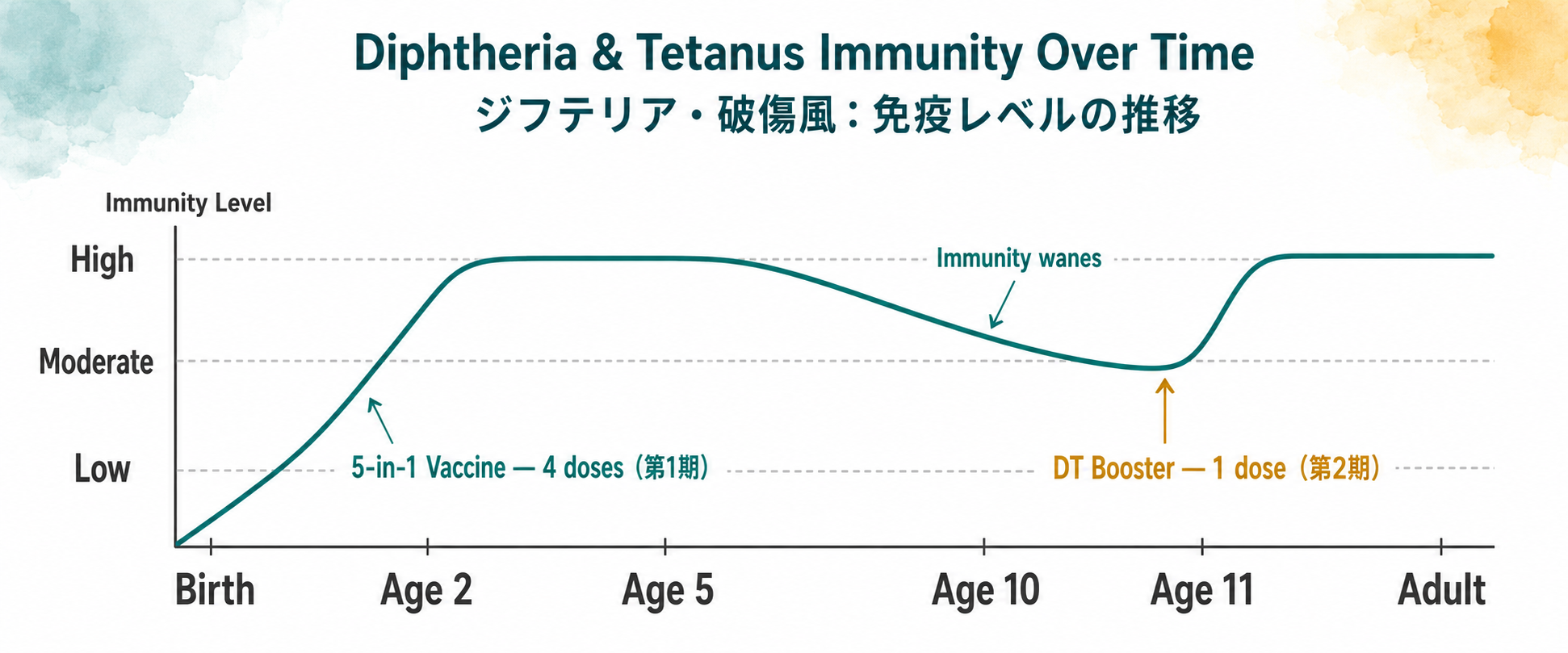
The DT 第2期 (second-period vaccination) is a booster that follows the 第1期 primary series completed in infancy and early childhood.
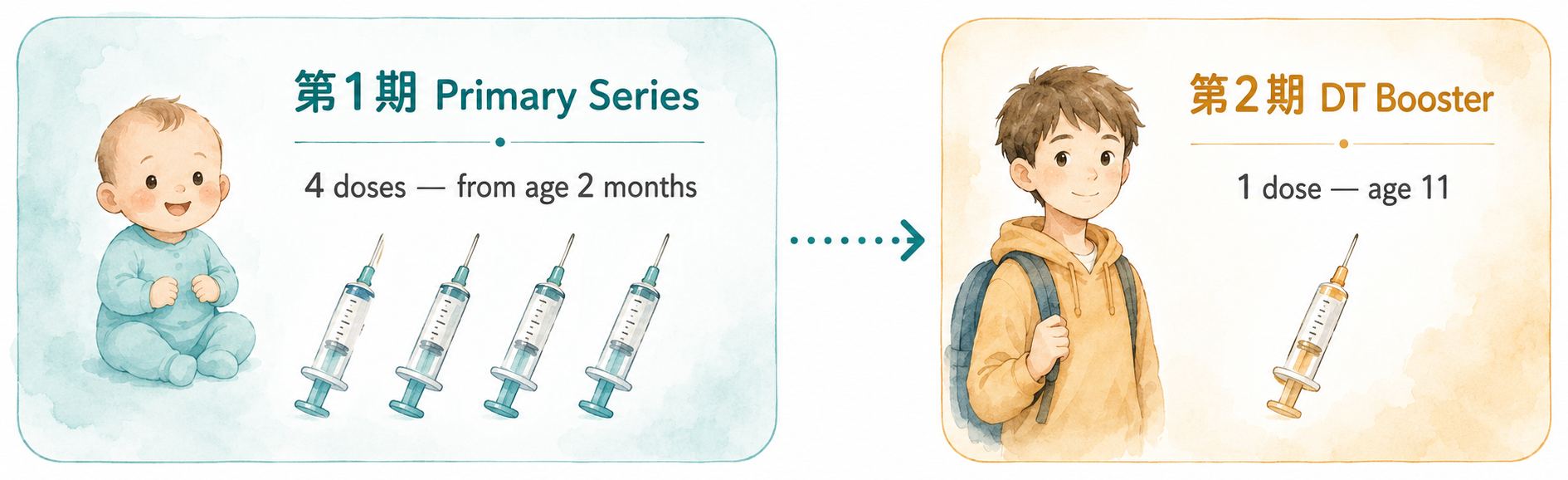
The 第1期 primary series uses the 5-in-1 vaccine (5種混合 / DTaP-IPV-Hib), protecting against diphtheria, tetanus, pertussis, polio, and Hib. It consists of four doses: three initial injections starting from two months of age, plus a booster dose six to eighteen months later. Most children complete the primary series by around age two.
Immunity from the early doses is strong — but it does not last forever. By around age 11, protection against diphtheria and tetanus begins to wane. The DT 第2期 booster restores that protection with a single injection at just the right time, carrying immunity forward through adolescence and into adulthood.
Schedule
| Detail | Information |
|---|---|
| Vaccine name | DT vaccine (2種混合) — 第2期 |
| Standard age | Age 11 — from the child's 11th birthday until reaching age 12 |
| Number of doses | 1 dose |
| Method | Subcutaneous injection (皮下接種) into the outer upper arm |
| School year | Typically 小学校6年生 (6th grade of elementary school) |
Look out for the vaccination notice. Most municipalities send a notification (接種のお知らせ) with a vaccination voucher (接種券) around the time your child turns 11. Take this to a participating clinic to book the appointment — it is all that is needed for the booster to be free of charge.
Cost
The DT 第2期 is a 定期接種 (routine vaccination), funded by your municipality and free of charge within the standard age window (from age 11 until reaching age 12). Eligibility is based on resident registration (住民登録), not nationality — children living in Japan on a valid residence card are entitled to the same routine vaccinations as Japanese nationals.
Missed the window? If your child did not receive the DT booster at age 11 — due to an overseas move, illness, or simply not being aware of the schedule — contact your local municipal health office (市区町村の保健センター). Once outside the eligible age window, the vaccine becomes self-funded (自費) as a 任意接種. Prices vary by clinic.
Side Effects
The DT vaccine is generally well tolerated. Most reactions are mild and resolve within two to three days.
Local reactions at the injection site — redness (発赤), swelling (腫脹), tenderness (疼痛), and skin hardening (硬結) — are a normal immune response and not a cause for concern.
Systemic reactions may include mild fever, chills, headache, fatigue, dizziness, joint pain, or loose stools. These typically pass within a day or two without treatment.
Rare but serious reactions: As with any injectable vaccine, anaphylaxis (a severe, sudden allergic reaction) can occur. Clinics ask patients to wait 15–30 minutes after the injection. If your child develops difficulty breathing, facial swelling, or severe dizziness shortly after vaccination, seek immediate medical attention.
Notes for International Families
Vaccination records from abroad. If your child received diphtheria and tetanus-containing vaccines in another country, bring the records (in any language) to a pediatrician in Japan. They can assess whether the DT 第2期 is still recommended, or whether prior doses are sufficient. In most cases, the booster is still advisable even if earlier doses were given overseas.
Japan does not offer Tdap as a routine vaccination. Countries such as the United States, the United Kingdom, and Australia routinely give a Tdap booster at age 11–12 — which includes pertussis alongside diphtheria and tetanus. Japan's 第2期 covers diphtheria and tetanus only. If you would like a pertussis booster for your older child, this is available as a 任意接種 at clinics that stock the relevant vaccine; ask a pediatrician for guidance.
Adults and tetanus. In many countries, adults are recommended a tetanus booster every ten years. Japan's routine immunization schedule does not include a regular adult tetanus booster. If you have not had a booster in ten or more years, adult tetanus vaccination is available privately (自費) at most general clinics and internal medicine practices.
What to Bring
- 母子手帳 (boshi techou) — the Mother and Child Health Handbook. Even for an 11-year-old, this remains the standard vaccination record in Japan.
- 接種券 (sesshu-ken) — the vaccination voucher sent by your municipality. If you have not received one, contact your local ward or municipal office.
- 予診票 (yoshin hyō) — the pre-vaccination health questionnaire. Some clinics send this in advance; others provide it on the day.
- マイナ保険証 — your My Number health insurance card. If you don't have one, bring your 資格確認書 (shikaku kakunin-sho). The old health insurance card (健康保険証) was abolished in December 2024.
- 在留カード (zairyū kādo) — your residence card.
The DT booster is the last routine shot on a schedule that started in your child's first weeks. For the full picture of what came before it and what stays optional, see our guide to Japan's childhood vaccination schedule.
Japanese Vocabulary
| Japanese | Reading | Meaning |
|---|---|---|
| ジフテリア | jifuteria | Diphtheria |
| 破傷風 | hashōfū | Tetanus |
| 2種混合ワクチン | nishu kongō wakuchin | DT vaccine (2-type combined) |
| トキソイド | tokisoido | Toxoid (inactivated bacterial toxin) |
| 第2期 | dai ni ki | Second period (booster phase) |
| 定期接種 | teiki sesshu | Routine vaccination (publicly funded) |
| 皮下接種 | hika sesshu | Subcutaneous injection |
| 接種券 | sesshu-ken | Vaccination voucher |
| 硬結 | kōketsu | Skin hardening / induration (side effect) |
| 任意接種 | nin-i sesshu | Voluntary vaccination (self-funded) |