
Written and reviewed by Susumu
Born and raised in Japan · Checked against Japanese law and ministry guidance
The complete 2026 guide to childhood vaccines in Japan — routine vs optional vaccines, how the free voucher system works, the 2024 five-in-one vaccine update, and practical tips for international families.
Affiliate Disclosure: This article contains affiliate links. If you click a link and make a purchase, we may earn a small commission at no extra cost to you. We only recommend products we genuinely believe are helpful. See our Terms of Use for full details.
📌 Note: This article is for informational purposes only. Always consult your pediatrician for personalized advice. Vaccine schedules and costs are subject to change — check with your local ward office for the latest information.
Introduction
Japan has one of the most structured childhood vaccination programs in the world. This guide reflects the schedule as of 2026, including the 2024 updates to the routine program. Vaccinations begin at two months old and continue through to secondary school age. As an international resident, navigating the system — the vouchers, the clinics, the terminology — can be confusing at first. This guide explains how everything works, what vaccines your child needs, and what to do if you have just arrived in Japan with a child who needs to catch up.
Two Types of Vaccine: Routine and Optional
Every vaccine in Japan falls into one of two categories, and understanding the difference will save you both money and confusion.
| Type | Japanese | Cost |
|---|---|---|
| Routine (定期接種) Legally mandated, free within age window |
定期接種 teiki sesshu |
Free |
| Optional (任意接種) Recommended but self-funded; some municipalities subsidize |
任意接種 ninki sesshu |
Self-pay (¥3,000–¥20,000 per dose) |
⚠️ Missing the age window means paying out of pocket
Routine vaccines are free only within the designated age window. If your child misses it, the same vaccine becomes self-funded. Age windows for some vaccines — particularly rotavirus — are very strict.
How the Voucher System Works
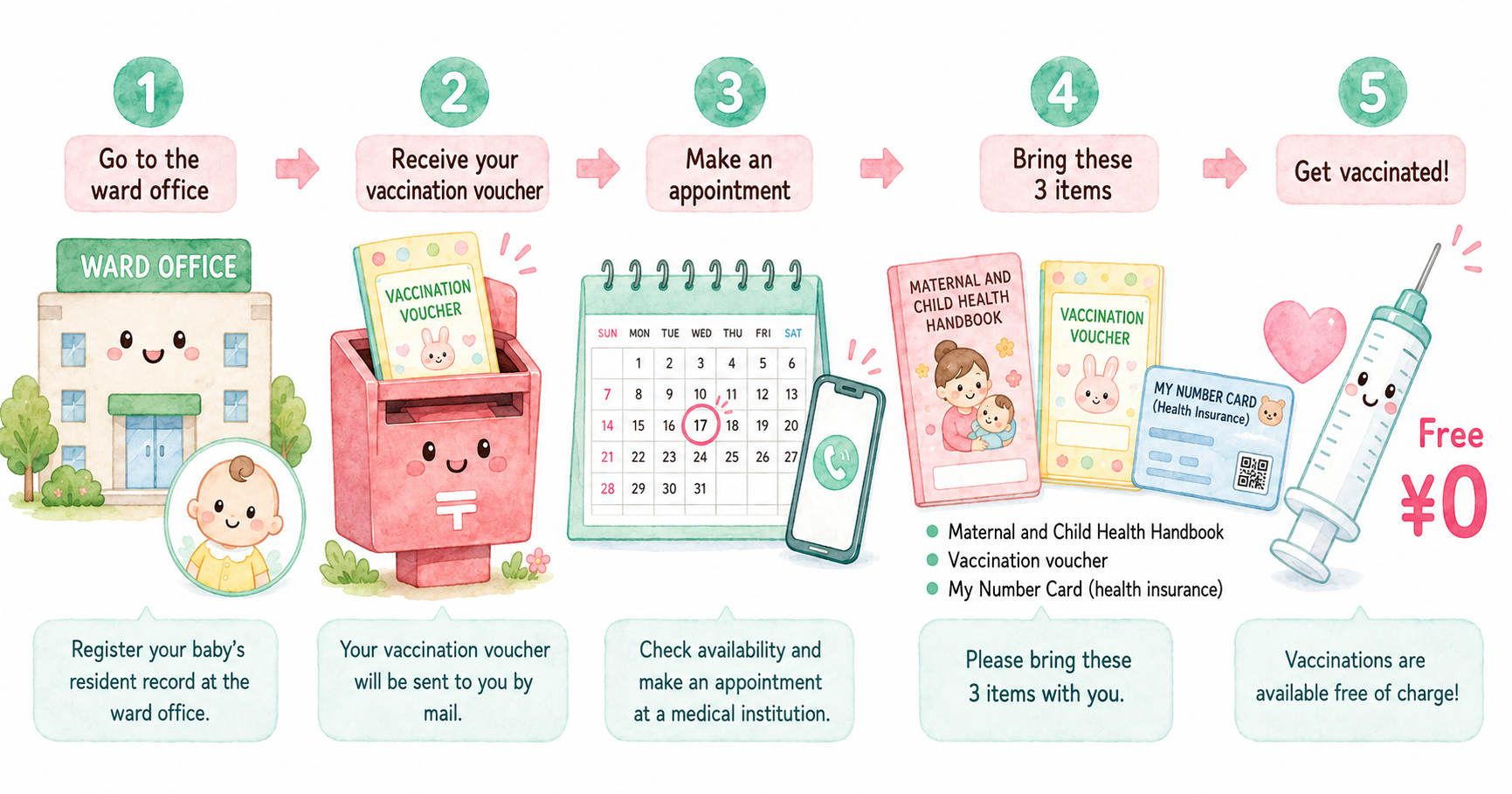
Routine vaccinations in Japan are managed at the municipal level. When your child is registered in the local residence register (住民票), your ward or city office will mail you a vaccination voucher booklet (接種券). This booklet contains individual vouchers for each routine vaccine, specifying the eligible age window.
Step by step
- Register your child at the ward office (区役所) as soon as possible after birth
- The municipality mails your vaccination voucher booklet — usually before your baby turns 2 months old
- Book an appointment at a participating clinic (委託医療機関) that has a contract with your municipality
- Bring the voucher, your child's Maternal and Child Health Handbook (母子健康手帳), and your health insurance card
- The clinic bills the municipality directly — you pay nothing for routine vaccines within the age window
💡 Tip: same-day multiple vaccines
Japan actively encourages simultaneous vaccination (同時接種) — receiving multiple vaccines in the same visit. This is safe, recommended, and reduces the number of clinic trips. Do not be surprised if your baby receives three or four injections at once.
Routine Vaccines (定期接種)
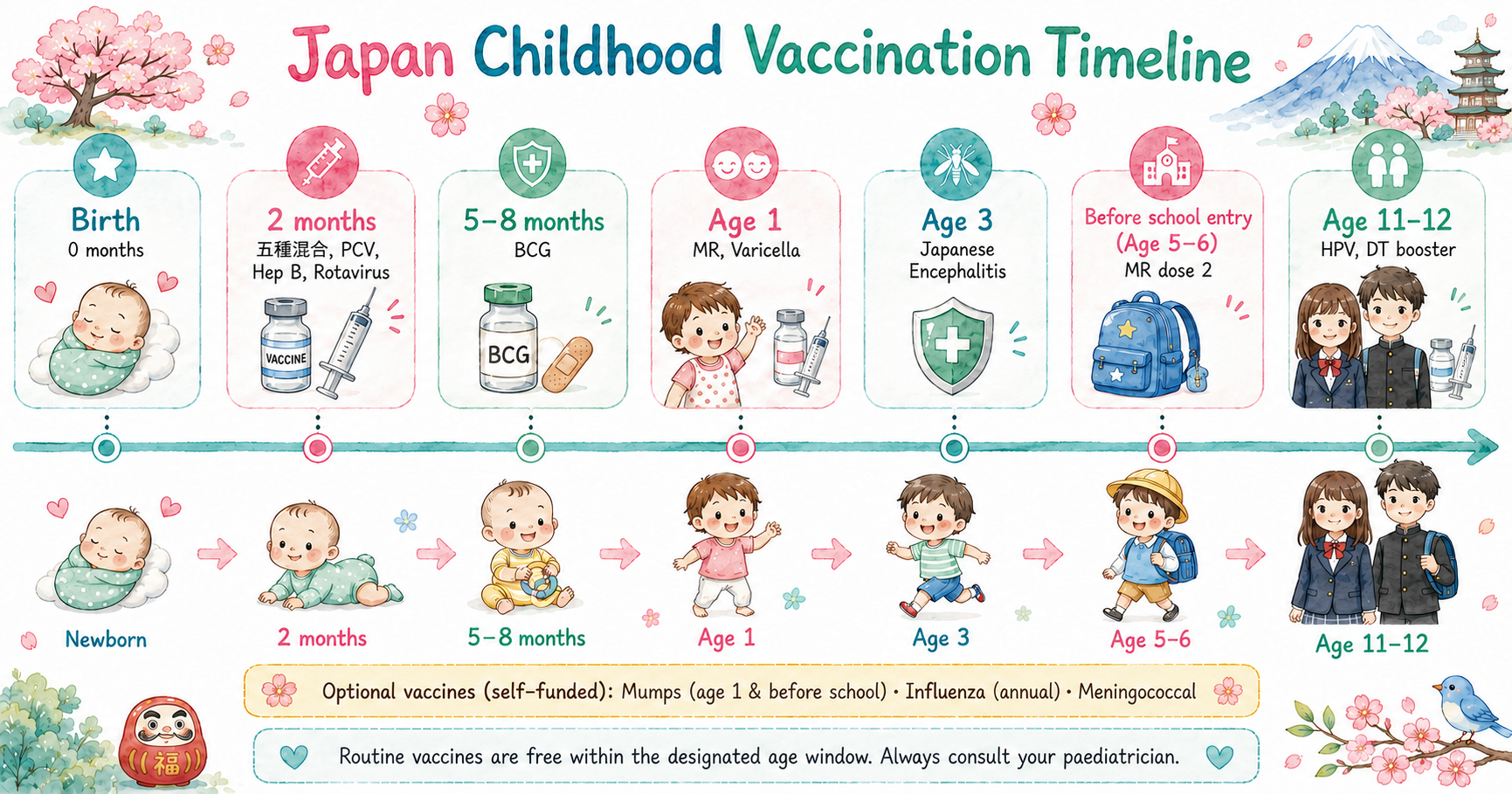
The following vaccines are provided free of charge during the designated age window. The schedule below reflects the current program as of April 2025.
| Vaccine | Diseases | Doses | Age window |
|---|---|---|---|
| 五種混合 DPT-IPV-Hib |
Diphtheria, pertussis, tetanus, polio, Hib | 4 | From 2 months; booster 6–18 months after dose 3 |
| 小児用肺炎球菌 Pneumococcal (PCV) |
Pneumococcal meningitis, pneumonia | 4 | 3 primary doses from 2 months; booster at 12–15 months |
| B型肝炎 Hepatitis B |
Hepatitis B, liver disease | 3 | From 2 months; complete before age 1 |
| ロタウイルス Rotavirus |
Rotavirus gastroenteritis | 2 or 3 | First dose must start by 14 weeks 6 days; complete by 24 weeks (2-dose) or 32 weeks (3-dose) |
| BCG | Tuberculosis | 1 | Recommended at 5–8 months; must be given before age 1 |
| MR Measles-Rubella |
Measles, rubella | 2 | Dose 1: from age 1. Dose 2: the April–June before elementary school entry |
| 水痘 Varicella (chickenpox) |
Chickenpox, shingles | 2 | Dose 1: from age 1. Dose 2: 3–6 months after dose 1 |
| 日本脳炎 Japanese Encephalitis |
Japanese encephalitis | 4 | Standard: 3 doses at age 3, booster at age 9–12. Can start from 6 months |
| HPV | Cervical cancer, HPV-related cancers | 2 or 3 | Girls: grades 6–10 (ages ~11–16). 2 doses if starting before age 15 |
| DT Diphtheria-Tetanus booster |
Diphtheria, tetanus | 1 | Ages 11–12 |
⚠️ Rotavirus: the strictest deadline
The first dose of the rotavirus vaccine must be given by 14 weeks and 6 days of age — no exceptions. After this point, the vaccine cannot be given at all (even privately), as the risk of intussusception increases with age. Do not delay the 2-month appointment.
Optional Vaccines (任意接種)
Optional vaccines are not publicly funded as standard, but many are strongly recommended by pediatricians. Some municipalities subsidize one or more of these — check with your local ward office before assuming full out-of-pocket cost.
| Vaccine | Diseases | Doses | Approx. cost |
|---|---|---|---|
| おたふくかぜ Mumps |
Mumps, meningitis, deafness | 2 | ¥5,000–¥8,000/dose |
| インフルエンザ Influenza |
Flu | 2 (under 13); 1 (13+) | ¥3,000–¥4,500/dose |
| 髄膜炎菌 Meningococcal |
Meningococcal meningitis | 1 | ¥15,000–¥20,000 |
| A型肝炎 Hepatitis A |
Hepatitis A | 3 | ¥5,000–¥10,000/dose |
| RSV Nirsevimab / maternal vaccine |
RSV bronchiolitis in infants | 1 | Varies; some municipalities subsidize |
💡 Mumps vaccine — check your municipality
Mumps is optional nationally, but a growing number of municipalities — including parts of Tokyo — now subsidize one or both doses. Ask at your ward office before paying full price. The recommended schedule is dose 1 at age 1 (alongside MR and varicella), and dose 2 before elementary school entry.
What Changed in 2024
Two significant changes to Japan's routine vaccination program took effect in 2024.
五種混合 — the new 5-in-1 vaccine (April 2024)
The biggest change in years. Japan previously gave the Hib vaccine (ヒブワクチン) and the DPT-IPV 4-in-1 (四種混合) as separate injections. From April 2024, these were combined into a single 五種混合 (go-shu-kongou) — a 5-in-1 vaccine covering diphtheria, pertussis, tetanus, polio, and Hib in one shot.
The total number of doses (4) remains the same. The practical benefit is fewer injections per visit. If your child started the 四種混合 series before April 2024, your pediatrician will advise on how to complete the schedule.
Pneumococcal vaccine upgrade (October 2024)
The 13-valent pneumococcal vaccine (PCV13/Prevenar 13) was replaced by higher-valency versions — PCV15 and PCV20 — offering protection against more strains of the bacteria. If your child already completed the PCV13 series, no additional doses are needed.
For International Residents
Am I eligible for free routine vaccines?
Yes — as long as your child is registered in the Japanese residence register (住民票). Foreign nationals on long-term visas (work, spouse, permanent resident, student) who are registered at a ward or city office are fully eligible for the routine vaccination program, on the same terms as Japanese citizens.
Short-stay tourists without residence registration are not eligible for the free program.
We just moved to Japan — how do we catch up?
If your child has already received some vaccines in another country, Japan has catch-up protocols. Contact your local ward office and a pediatric clinic as soon as possible. Bring your child's vaccination records from home — the clinic will work out which vaccines are still needed and at what age they can be given. Note that some vaccines have strict upper age limits.
Schedule in other languages
The know-vpd.jp NPO publishes the full vaccination schedule in 15 languages including English, Chinese, Spanish, Portuguese, Filipino, Vietnamese, Indonesian, and more. Download it at know-vpd.jp.
Practical Tips for Clinic Visits
- Book early. Popular pediatric clinics fill up quickly, especially around the 2-month mark when multiple vaccines are due at once.
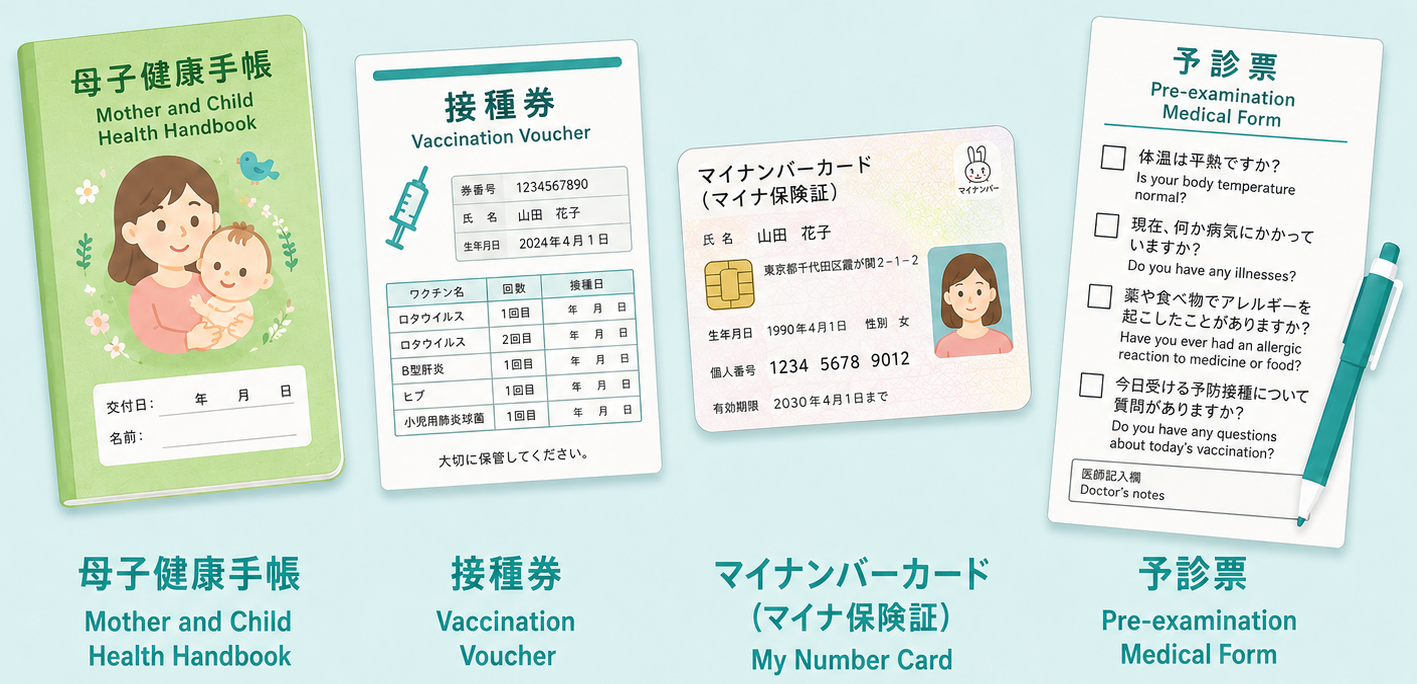
- Bring the right documents. You will need your vaccination voucher booklet (接種券), the Maternal and Child Health Handbook (母子健康手帳), and your health insurance card (マイナ保険証 or 資格確認書).
- Fill in the pre-screening form (予診票) at home. Most clinics ask parents to complete a health questionnaire before the injection. It asks about recent illness, allergies, and current medications.
- Do not give fever medication beforehand. Some studies suggest pre-medicating with acetaminophen may slightly reduce the vaccine's effectiveness. Ask your pediatrician if you are unsure.
- Plan to stay for 15–30 minutes after. Clinics ask you to wait after vaccination to monitor for any immediate reactions.
- If your child has a fever, reschedule. Vaccines are generally not given when a child is unwell.
For a closer look at what actually happens on the day — the order things run in, how long you wait, and which reactions are normal in the hours afterward — see our walkthrough of a vaccination visit in Japan.
Vocabulary
| Japanese | Reading | Meaning |
|---|---|---|
| 予防接種 | yobou sesshu | Vaccination / immunization |
| 定期接種 | teiki sesshu | Routine (publicly funded) vaccination |
| 任意接種 | nin-i sesshu | Optional (self-funded) vaccination |
| 接種券 | sesshu-ken | Vaccination voucher |
| 予診票 | yoshin-hyou | Pre-vaccination screening form |
| 同時接種 | douji sesshu | Simultaneous vaccination (multiple vaccines in one visit) |
| 委託医療機関 | itaku iryou kikan | Contracted clinic (participates in municipality's free vaccination program) |
| 五種混合 | go-shu kongou | 5-in-1 vaccine (DPT-IPV-Hib), introduced April 2024 |
| 副反応 | fuku hannou | Side effect / adverse reaction |
| 住民票 | juuminhyou | Residence register (required to access free vaccinations) |