Written and reviewed by Susumu
Born and raised in Japan · Checked against Japanese law and ministry guidance
Four free doses from two months, using the PCV20 vaccine adopted in late 2024. The schedule, what changed from PCV13, and how catch-up works if your child started late.
Affiliate Disclosure: This article contains affiliate links. If you click a link and make a purchase, we may earn a small commission at no extra cost to you. We only recommend products we genuinely believe are helpful. See our Terms of Use for full details.
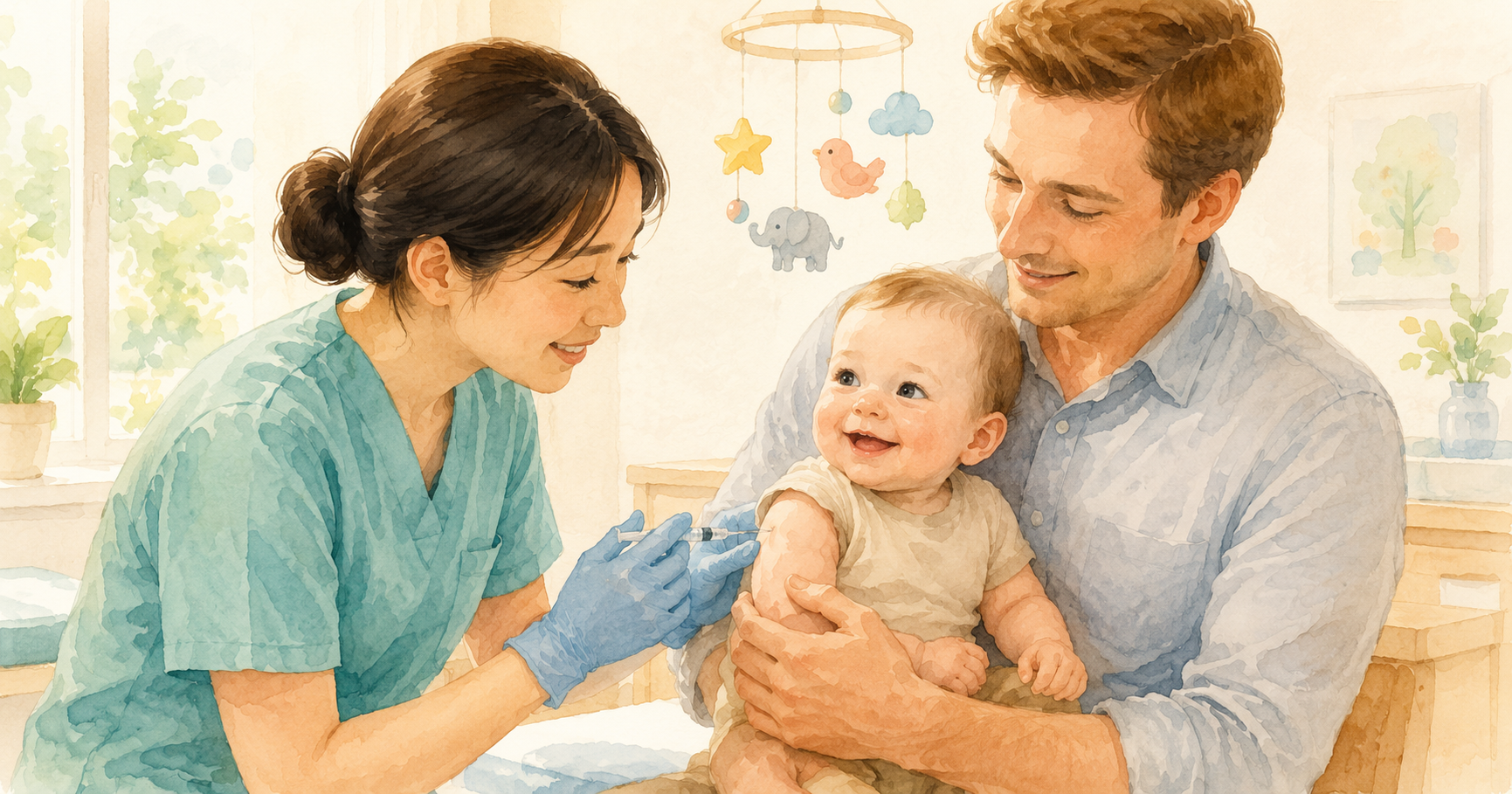
Updated October 2024: Japan moved from PCV13 to PCV15 in April 2024, then added PCV20 (20-valent pneumococcal conjugate vaccine) as the principal option in October 2024. The schedule and the free vaccination window remain the same — four doses, starting at 2 months, free for all children registered with a Japanese municipality before their fifth birthday.
What Is Pneumococcal Disease?
Streptococcus pneumoniae — the pneumococcus — is a type of bacteria that lives harmlessly in the nose and throat of many healthy people. In young children, it can spread to other parts of the body and cause serious illness.
The infections it causes range from common to life-threatening:
- Acute otitis media (急性中耳炎) — middle ear infection; the most frequent cause of ear infections in young children
- Pneumonia (肺炎) — infection of the lungs
- Bacteremia (菌血症) — bacteria in the bloodstream
- Bacterial meningitis (細菌性髄膜炎) — infection of the membranes surrounding the brain and spinal cord; the most serious complication
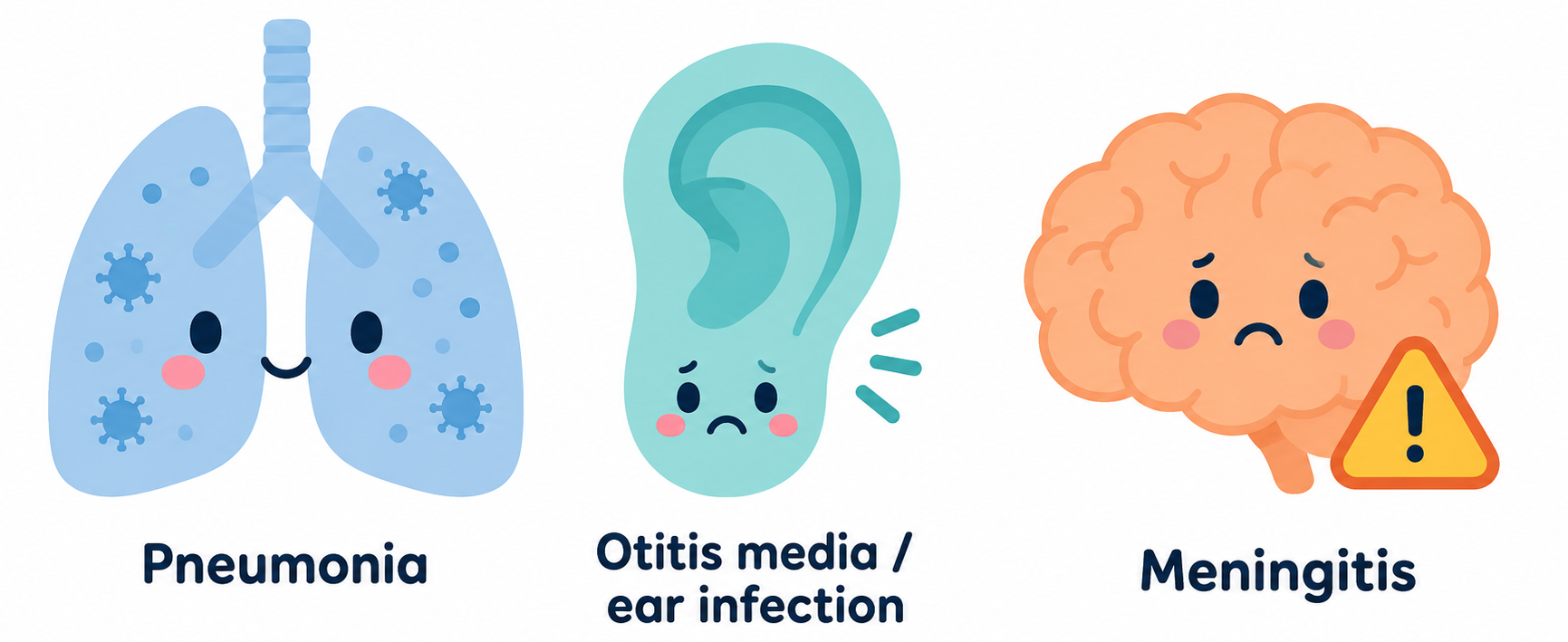
Bacterial meningitis is the main reason early vaccination matters. Around 10–12% of children who develop it do not survive. Of those who recover, around 20–30% are left with lasting effects — hearing loss, developmental delay, seizures, or nerve damage — that may not become apparent until months later.
Children under 2 are at highest risk. Their immune systems cannot yet mount a strong response to the bacteria's outer coating without the help of a conjugate vaccine, which is why the series begins at 2 months.
About the Vaccine
The pneumococcal conjugate vaccine works by priming the immune system to recognize the outer surface of the pneumococcus bacteria. "Conjugate" means the bacterial coating is chemically linked to a carrier protein — this makes it recognizable to infants' still-developing immune systems, something earlier vaccine types could not achieve.
Japan currently uses PCV20, a 20-valent vaccine covering 20 different strains (serotypes) of Streptococcus pneumoniae — the more strains covered, the broader the protection. Japan's routine schedule moved from PCV13 to PCV15 in April 2024, then added PCV20 as the principal option in October 2024 — adding 7 more strains over PCV13 for broader protection. Both PCV15 and PCV20 remain available under the routine program.
The vaccine is given as an injection. Both subcutaneous (under the skin) and intramuscular (into the muscle) administration are permitted. In practice, most Japanese clinics give it subcutaneously for young infants.
Vaccination Schedule
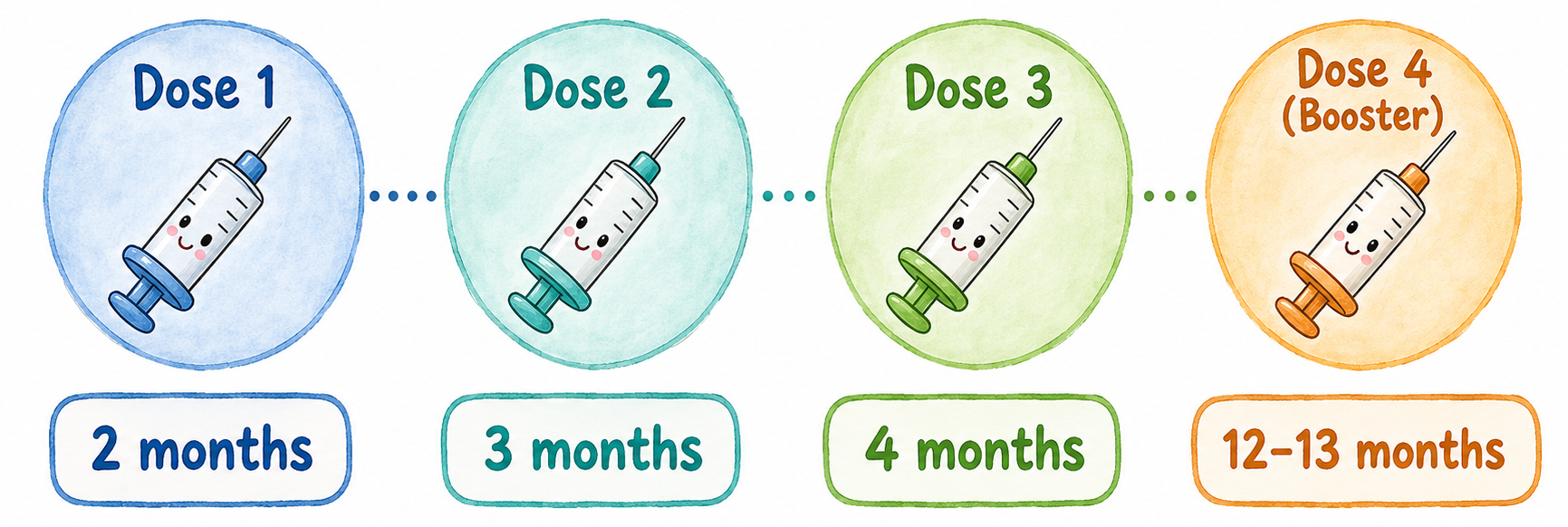
The number of doses your child needs depends on their age at the first injection. Babies who start at 2 months follow the standard four-dose schedule. All ages below refer to your baby's age from birth.
| Dose | When | Notes |
|---|---|---|
| Dose 1 | From 2 months of age | Given at the same visit as the five-in-one, rotavirus, and hepatitis B vaccines |
| Dose 2 | At least 27 days after Dose 1 | Standard: around 3 months of age |
| Dose 3 | At least 27 days after Dose 2 | Standard: around 4 months of age |
| Dose 4 (booster) | At least 60 days after Dose 3, at 12 months or older | Standard: 12–13 months of age |
The booster dose reinforces the protection built by the three primary doses and extends immunity into the toddler years — when pneumococcal ear infections are most common.
Catch-Up Schedule
If your child didn't start at 2 months, the number of doses they need depends on their age at the first injection. Fewer doses are needed the older the child is when the series begins.
| Age at Dose 1 | Total Doses | Notes |
|---|---|---|
| 2–6 months | 4 | 3 primary doses (27 days apart) + booster at 12 months or older (min. 60 days after Dose 3) |
| 7–11 months | 3 | 2 primary doses (27 days apart) + booster at 12 months or older (min. 60 days after Dose 2) |
| 12–23 months | 2 | 2 doses, at least 60 days apart |
| 24 months – 4 years | 1 | Single dose |
The Under-5 Deadline
All doses must be completed before your child's fifth birthday (60 months of age). This is the outer age limit for free routine vaccination — after that date, the vaccine is still available but is no longer covered under 定期接種.
Even a child who starts late has time to complete the series well within the free window. A 12-month-old with no prior doses needs only 2 injections; a 2-year-old needs just one. The deadline is rarely a constraint unless vaccination has been delayed by several years.
⚠️ If your child hasn't started yet: Speak with your pediatrician as soon as possible. The catch-up schedule above shows how many doses are needed based on your child's current age — and the free window extends all the way to the fifth birthday.
Is It Free?
Yes — the pneumococcal vaccine is a 定期接種 (teiki sesshu), meaning it's part of Japan's national routine vaccination program. All doses under the applicable schedule are fully covered at no cost.
Eligibility is based on 住民登録 (juumin tooroku), not nationality. If your child is registered at your local city or ward office, they're entitled to the same free routine vaccines as any Japanese child. Your municipality will send vaccination vouchers (接種券, sesshuken) by mail, typically around the time your baby turns 2 months.
If you haven't received anything and your baby is approaching 2 months, contact your local health center (保健センター, hoken sentaa) to ask.
What Happens at the Appointment
Before the injection, the doctor will go through a pre-vaccination questionnaire (予診票, yoshinhyou) and give your baby a brief check-over. The vaccine is given as a small injection — usually in the outer thigh for young infants. After all vaccines are given, you'll be asked to wait at the clinic for 15–30 minutes before leaving.
At the 2-month appointment, your baby will typically receive four vaccines in the same visit: pneumococcal, the five-in-one (五種混合), rotavirus (oral drops), and hepatitis B. Receiving several vaccines at once is completely normal in Japan — your baby may have three or four injections plus the oral rotavirus drops, all in the same appointment.
Side Effects
The pneumococcal vaccine has a higher rate of fever than some other routine vaccines. Around 40–50% of recipients develop a fever of 38°C or above, typically settling within a day or two. Injection site reactions — redness, swelling, or a firm lump — are common and usually resolve within a few days. Some babies are more irritable or sleepy than usual for 24–48 hours.
These reactions are more noticeable when the pneumococcal vaccine is given alongside the five-in-one, as both can cause fever. This is expected and not a reason to delay vaccination.
Serious reactions are rare. Anaphylaxis (a severe allergic reaction) can occur with any vaccine, which is why clinics ask you to wait 15–30 minutes after vaccination. In very rare cases, febrile seizures (convulsions triggered by a high fever) or thrombocytopenic purpura (a condition where platelet levels drop, causing unusual bruising or a rash of small red or purple spots under the skin) have been reported. If you notice unusual bruising or a rash with small red or purple spots in the days after vaccination, contact your doctor.
Notes for International Families
If your child received doses in another country, bring the overseas vaccination records to your pediatrician. Doses of PCV13 given abroad count toward the Japanese schedule — your doctor can advise on how many more doses are needed and which catch-up schedule applies based on your child's age. Doses of PCV15 given abroad should ideally be completed with PCV15 in Japan — switching to PCV20 mid-series is permitted if PCV15 is unavailable, but PCV15 is the preferred option for continuity.
Japan now uses PCV20. If your home country uses PCV13 or PCV15, be aware that Japan switched to the 20-valent vaccine in October 2024. The schedules and intervals are the same, but the vaccine covers more serotypes. Switching from PCV13 to PCV20 to complete a series has been confirmed as safe and effective by the Japan Pediatric Society.
There is no birth dose. The pneumococcal vaccine is not given at birth anywhere in the world — the series always starts at 2 months. No catch-up is needed for a newborn.
Note for parents of premature babies: If your baby was born prematurely, discuss the vaccination schedule with your pediatrician early. Very small or early babies may need the timing adjusted, though the pneumococcal series is generally started at the same chronological age (2 months from birth) rather than corrected age.
What to Bring
- 母子手帳 (boshi techou) — your Mother and Child Health Handbook. The clinic records every vaccination in here.
- 接種券 (sesshuken) — the vaccination voucher sent by your municipality. Without this, you may be charged.
- 予診票 (yoshinhyou) — the pre-vaccination health questionnaire. Some municipalities send this with the voucher; others provide it at the clinic.
- マイナ保険証 — your My Number health insurance card. If you don't have one, bring your 資格確認書 (shikaku kakunin-sho), the alternative certificate issued by your insurer. The old health insurance card (健康保険証) was abolished in December 2024.
- A spare set of clothes for your baby — just in case.
The pneumococcal course runs alongside several other shots in the first year, and the spacing matters. Our complete guide to Japan's childhood vaccination schedule shows the whole first-year sequence.
Japanese Vocabulary
| Japanese | Reading | Meaning |
|---|---|---|
| 小児用肺炎球菌ワクチン | shouniyou haienkyuukin wakuchin | Pneumococcal vaccine for children |
| 定期接種 | teiki sesshu | Routine (free) vaccination |
| 細菌性髄膜炎 | saikinsei zuimakuen | Bacterial meningitis |
| 肺炎 | haien | Pneumonia |
| 急性中耳炎 | kyuusei chuujien | Acute otitis media (middle ear infection) |
| 菌血症 | kinketsushou | Bacteremia (bacteria in the bloodstream) |
| 結合型ワクチン | ketsugougata wakuchin | Conjugate vaccine |
| 接種券 | sesshuken | Vaccination voucher |
| 予診票 | yoshinhyou | Pre-vaccination questionnaire |
| 同時接種 | douji sesshu | Simultaneous vaccination |