

Written and reviewed by Susumu
Born and raised in Japan · Checked against Japanese law and ministry guidance
Four free doses spread from age 3 to age 9 — an unusually long course that is easy to lose track of. The schedule, the reason for the gaps, and the side effects to expect.
Affiliate Disclosure: This article contains affiliate links. If you click a link and make a purchase, we may earn a small commission at no extra cost to you. We only recommend products we genuinely believe are helpful. See our Terms of Use for full details.
Four doses, free until the schedule is complete: Japan's Japanese encephalitis vaccine is a routine free vaccination given in four doses across childhood — two at age 3, one at age 4, and one between ages 9 and 10. The disease is rare in Japan today, but the vaccination program is the reason why.
What Is Japanese Encephalitis?
Japanese encephalitis — 日本脳炎 (nihon nōen) — is a viral brain infection caused by the Japanese encephalitis virus (JEV), which belongs to the same family as dengue and Zika. Despite the name, it is found across much of Asia, not only Japan.
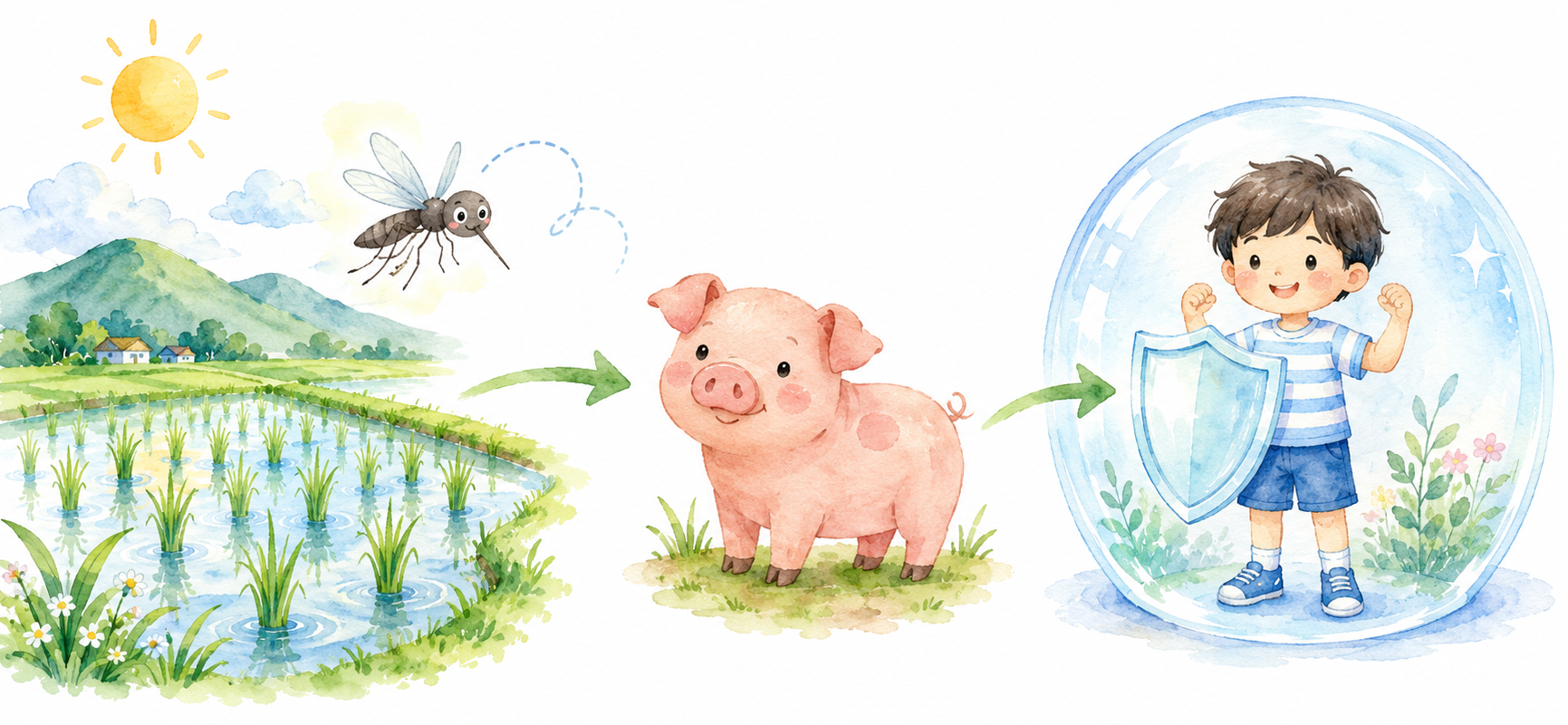
The virus does not spread between people. It circulates in pigs and certain birds, and is passed to humans through the bite of an infected Culex mosquito — particularly Culex tritaeniorhynchus, which breeds in flooded rice paddies and similar bodies of standing water. The mosquito picks up the virus by biting an infected pig, and can then transmit it when it bites a person. After a bite, symptoms appear within 6 to 16 days.
How serious is it?
Most people infected with JEV have no symptoms at all, or only mild ones. Between 1 in 100 and 1 in 1,000 infected people develop encephalitis — inflammation of the brain. When that happens, the consequences can be severe: the case fatality rate (the proportion of symptomatic patients who die) is 20–40%, and among those who survive, 45–70% are left with lasting neurological or mental health problems.
Japanese encephalitis is now extremely rare in Japan — the direct result of decades of vaccination and mosquito control. Since 1992, fewer than 10 cases have been reported per year. In 2024, 9 cases were confirmed across eight prefectures — Tochigi, Gunma, Saitama, Chiba, Tokyo, Shizuoka, Aichi, and Kumamoto. Critically, most or all of the confirmed cases in 2021–2024 had no documented vaccination history — those who developed JE were either unvaccinated or had an unknown vaccination record.
⚠️ 2024 update: The 2024 cases included prefectures in Kanto — Tokyo, Saitama, Chiba — alongside Tochigi and Gunma in the north, and Shizuoka, Aichi, and Kumamoto further west and south. This suggests that the geographic range of confirmed transmission is no longer limited to western Japan. Pig antibody surveillance in 2025 continues to confirm active virus circulation across multiple regions of Japan (JIHS, 2025).
Where and when is the risk highest?
In Japan, the risk is greatest in western regions — particularly Kyushu, Okinawa, Chugoku, and Shikoku — where rice agriculture and pig farming create conditions favorable for the mosquito. In Hokkaido and Tohoku, the risk is very low. The mosquito is most active in summer through autumn, broadly July to October.
Note for rural families: If you live in western Japan near rice paddies or agricultural areas, keeping your child's vaccination up to date is especially important. The risk in central urban areas (Tokyo, Osaka city centers) is low but not zero.
About the Vaccine
The vaccine used in Japan today is an inactivated vaccine — it contains killed virus particles, not a live or weakened virus. Because it is inactivated, it can be given alongside other vaccines without the timing restrictions that apply to live vaccines (such as the MR or varicella vaccines). There are two approved products in Japan: JEBIK V (ジェービックV) and Encevac SC (エンセバック皮下注用), both introduced from 2009 onwards.
The vaccine provides 75–95% protection against infection. Two doses in the initial series build the foundation of immunity; the booster doses at age 4 and 9 extend that protection through childhood and into adolescence.
Vaccination Schedule
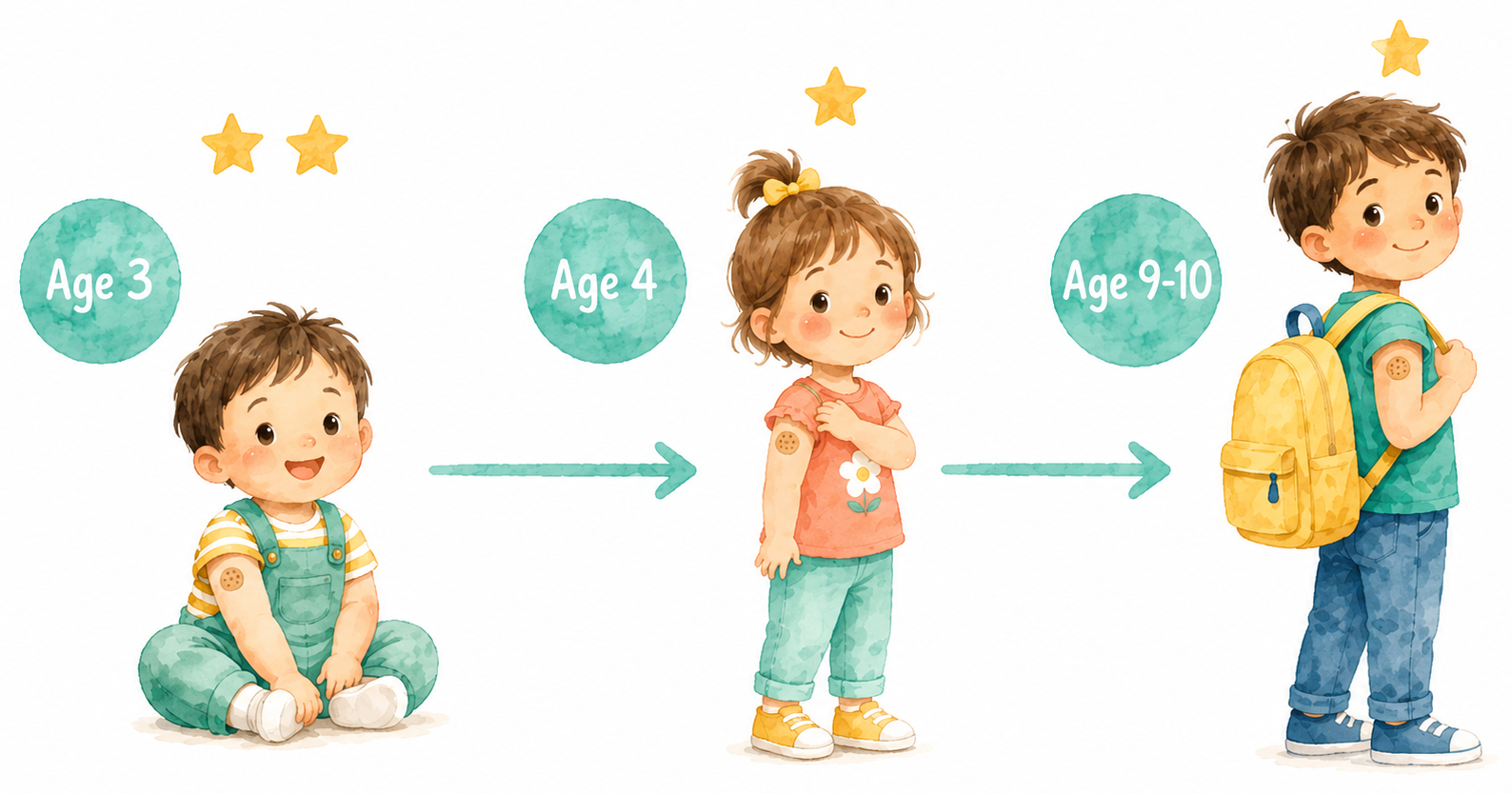
Four doses are given across childhood: two at age 3 (given 6–28 days apart), one at age 4, and one between ages 9 and 10. The schedule is more spread out than most routine vaccines, starting at age 3 and completing in early elementary school.
| Stage | Japanese term | Age | Details |
|---|---|---|---|
| Primary series Doses 1 & 2 |
第1期初回 | 3 years old | 2 doses given 6–28 days apart |
| Primary booster Dose 3 |
第1期追加 | 4 years old | 1 dose, approximately 1 year after Dose 2 |
| Secondary Dose 4 |
第2期 | Ages 9–10 | 1 dose |
High-risk children may start earlier. The Japan Pediatric Society recommends that children living in or traveling to JE-endemic areas — including parts of western Japan — may begin vaccination from 6 months of age. Discuss this with your pediatrician if you live in a high-risk area or plan extended travel within Asia.
Is It Free?
Yes — all four doses are part of Japan's 定期接種 (teiki sesshu) routine vaccination program, fully covered at no cost. Eligibility is based on 住民登録 (juumin touroku — resident registration), not nationality. If your child is registered with your local municipality, they are entitled to the same free vaccines as any child in Japan.
Your municipality will send vaccination vouchers (接種券, sesshuken) by mail. If your child is approaching their third birthday and you haven't received anything, contact your local health center (保健センター, hoken sentaa).
The 2005–2009 Suspension — What Happened?
In 2005, Japan suspended the active recommendation for the then-current Japanese encephalitis vaccine after reports of rare serious side effects — specifically ADEM (acute disseminated encephalomyelitis / 急性散在性脳脊髄炎), a condition involving inflammation of the brain and spinal cord. The suspension was precautionary; a causal link was not firmly established. During this period, vaccination continued to be available but was not actively promoted.
A new cell-culture-derived inactivated vaccine was developed and approved in 2009, and active recommendation resumed. The ADEM rate for the current vaccine is approximately 1 in 1.53 million doses — a very rare event.
Were you born between April 2, 1995 and April 1, 2007? Children born during this period may have received an incomplete vaccination series — or none at all — due to the suspension. Japan offers a free catch-up program for this cohort until age 20. If you are in this age group and unsure of your vaccination history, contact your local health center.
Side Effects
The Japanese encephalitis vaccine is generally well handled. The most common reactions are mild and resolve within a few days.
Local redness, swelling, or tenderness at the injection site are the most frequently reported effects. Some children develop a mild fever, runny nose, or rash in the days following vaccination. These are signs that the immune system is responding and are not a cause for concern.
Serious reactions are rare. ADEM (inflammation of the brain and spinal cord) has been reported at a rate of approximately 1 in 1.53 million doses with the current vaccine. Anaphylaxis (a severe, sudden whole-body allergic reaction) can occur with any vaccine, which is why clinics ask you to wait 15–30 minutes after vaccination. If your child develops unusual neurological symptoms — such as difficulty walking, vision changes, or confusion — in the weeks after vaccination, seek medical attention promptly.
Notes for International Families
Is this vaccine given in your home country? In most Western countries — including the US, UK, and Australia — a Japanese encephalitis vaccine exists but is licensed only as a travel vaccine, not as part of routine childhood immunization. Children arriving in Japan from abroad are unlikely to have received it. Starting the routine schedule promptly after registering with your municipality is recommended.
The JE vaccine is inactivated, which means it can be given at any time alongside or in combination with other vaccines — including live vaccines such as MR or varicella — without requiring a waiting period between doses.
Where you live in Japan matters. Families in western Japan (Kyushu, Okinawa, Shikoku, Chugoku) or in rural areas near rice farming should be particularly diligent about keeping their child's schedule on track. Families in major urban centers face lower — but not zero — risk.
Traveling within Asia. Japanese encephalitis is present across much of South and Southeast Asia. If your family travels to rural areas of countries such as Thailand, Vietnam, India, or the Philippines, the Japan Pediatric Society recommends that children in high-risk situations may begin vaccination from as early as 6 months of age. Discuss this with your pediatrician before travel.
What to Bring
- 母子手帳 (boshi techou) — your Mother and Child Health Handbook. The clinic records every vaccination here.
- 接種券 (sesshuken) — the vaccination voucher from your municipality. Without this, you may be charged.
- 予診票 (yoshinhyou) — the pre-vaccination health questionnaire. Some municipalities send this with the voucher; others provide it at the clinic.
- マイナ保険証 — your My Number health insurance card. If you don't have one, bring your 資格確認書 (shikaku kakunin-sho), the alternative certificate issued by your insurer. The old health insurance card (健康保険証) was abolished in December 2024.
Japanese encephalitis is one of the routine vaccines with an unusually long course, spread over several years. Our complete guide to Japan's childhood vaccination schedule shows how it overlaps with everything else.
Japanese Vocabulary
| Japanese | Reading | Meaning |
|---|---|---|
| 日本脳炎 | nihon nōen | Japanese encephalitis |
| 日本脳炎ワクチン | nihon nōen wakuchin | Japanese encephalitis vaccine |
| 脳炎 | nōen | Encephalitis (brain inflammation) |
| 不活化ワクチン | fukatsuka wakuchin | Inactivated vaccine |
| 第1期初回 | daiikki shokai | Primary series (doses 1 & 2) |
| 第1期追加 | daiikki tsuika | Primary booster (dose 3) |
| 第2期 | dainiki | Secondary series (dose 4, age 9) |
| 定期接種 | teiki sesshu | Routine (free) vaccination |
| 急性散在性脳脊髄炎 | kyūsei sanzaisei nōsekizuien | ADEM — acute disseminated encephalomyelitis |
| コガタアカイエカ | kogata akaieika | Culex tritaeniorhynchus (the mosquito vector) |