
Written and reviewed by Susumu
Born and raised in Japan · Checked against Japanese law and ministry guidance
Japan's mumps vaccine is voluntary — not part of the government-funded routine schedule. Two doses are recommended by the Japan Pediatric Society: one at age 1, one before school entry. Here's the full schedule, cost, municipal subsidies, complications, and what international families (including MMR recipients) need to know.
Affiliate Disclosure: This article contains affiliate links. If you click a link and make a purchase, we may earn a small commission at no extra cost to you. We only recommend products we genuinely believe are helpful. See our Terms of Use for full details.
Not in Japan's routine schedule — but strongly recommended. Japan is one of the few high-income countries that does not include the mumps vaccine in its government-funded routine program. Two doses are recommended by the Japan Pediatric Society, and many municipalities offer a subsidy. Without vaccination, catching mumps is very likely at some point in childhood.
What Is Mumps?
Mumps — 流行性耳下腺炎 (ryūkōsei jikasenen) or おたふくかぜ (otafuku kaze) in everyday Japanese — is a viral infection caused by the mumps virus. It spreads through respiratory droplets and direct contact with saliva from an infected person. The incubation period is 12 to 24 days, with a peak of around 17 to 18 days, which means a child can be infectious before any symptoms appear.
The most recognizable sign is swelling of the salivary glands on one or both sides of the face — the parotid glands, just below and in front of the ears — giving the characteristic puffy-cheeked appearance. This is usually accompanied by fever and discomfort when swallowing. Symptoms typically resolve within one to two weeks.
Under Japan's School Health and Safety Act (学校保健安全法), mumps is a Category II infectious disease. Children with mumps must stay home from school or nursery until the swelling has fully resolved — usually around five days after it first appears.
Epidemic pattern: Mumps occurs in cycles of roughly three to five years in Japan. Cases are most common in children aged 3 to 7. Because vaccination rates remain lower than in many other countries, outbreaks continue to occur.
Why Isn't It in Japan's Routine Schedule?
This is one of the first questions international parents ask, and the history behind it is important to understand.
Japan introduced a combined MMR vaccine (measles, mumps, and rubella) in 1989 — the same vaccine used in most Western countries. However, the mumps component used in the Japanese version contained the Urabe strain, which in rare cases caused aseptic meningitis (無菌性髄膜炎). Following a cluster of these cases, Japan withdrew the MMR vaccine in 1993 — making Japan one of the only high-income countries to do so.
Since then, measles and rubella have been covered by a separate MR combined vaccine (which remains in the routine schedule), while mumps has been left as a voluntary vaccination. The development and approval of a new mumps vaccine did eventually occur, but the political and regulatory environment means mumps has not been reintegrated into the routine program. Efforts to do so have been ongoing for years.
In short: The absence of mumps from Japan's routine schedule is a legacy of a 1993 policy decision, not a reflection of the vaccine's current safety profile. The Japan Pediatric Society (日本小児科学会) recommends that all children receive two doses.
About the Vaccine
The mumps vaccine available in Japan today is a live attenuated vaccine (生ワクチン, nama wakuchin) — it uses a weakened, non-disease-causing form of the mumps virus to trigger an immune response. Because it is a live vaccine, timing relative to other live vaccines matters: if two live vaccines are not given on the same day, a gap of at least 27 days is required between them.
The good news is that the recommended timing of the second mumps dose aligns with the second dose of the MR (measles-rubella) vaccine, which is also given around age 5 to 6. The Japan Pediatric Society recommends giving both during the same time window, which can simplify scheduling into fewer clinic visits.
Recommended Schedule
The Japan Pediatric Society recommends two doses of the mumps vaccine, timed to coincide with the live vaccine schedule already in place.
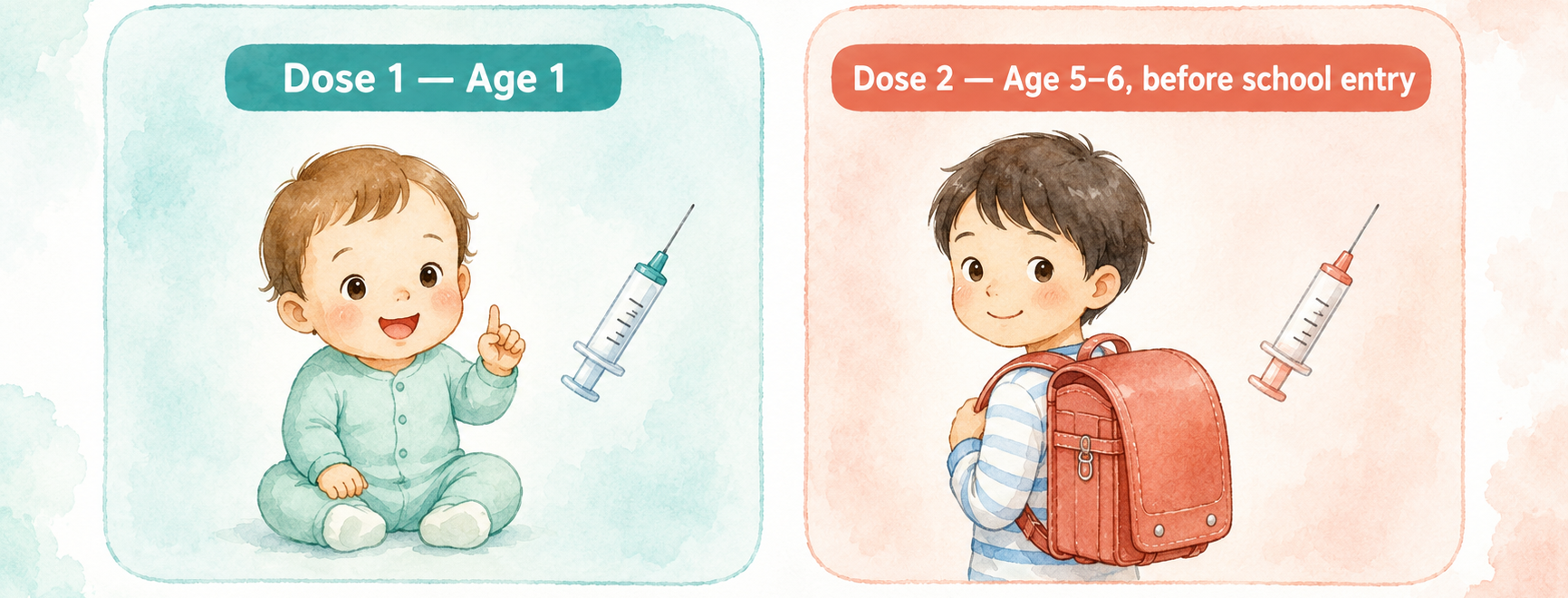
| Dose | Recommended age | Notes |
|---|---|---|
| Dose 1 | Age 1 (as soon as possible after the first birthday) | Can be given at the same visit as the first dose of varicella vaccine |
| Dose 2 | Ages 5–7 (the year before starting elementary school) | Can be given at the same visit as the MR second dose |
Timing tip: One dose is not enough. A single dose provides some protection, but two doses are needed for reliable, long-lasting immunity. If your child has had one dose but not the second, the second is still worth getting even if the timing has slipped.
Cost and Municipal Subsidies
Because the mumps vaccine is 任意接種 (nin'i sesshu — voluntary vaccination), the cost is not covered under the national routine program. You pay at the clinic, and the price varies between facilities.
However, many municipalities across Japan offer a partial subsidy for the mumps vaccine — particularly for children in the recommended age groups. The level of support differs significantly from one area to another: some municipalities cover a flat amount per dose; others cover the full cost for certain ages; and some offer no subsidy at all.
Check with your municipality first. Before booking, contact your local health center (保健センター, hoken sentaa) or visit your municipality's website to find out whether a subsidy is available in your area and what documents are needed to claim it. Subsidies are typically linked to age windows, so timing matters.
Complications
For most children, mumps is an unpleasant but manageable illness. For some, it leads to more serious complications.
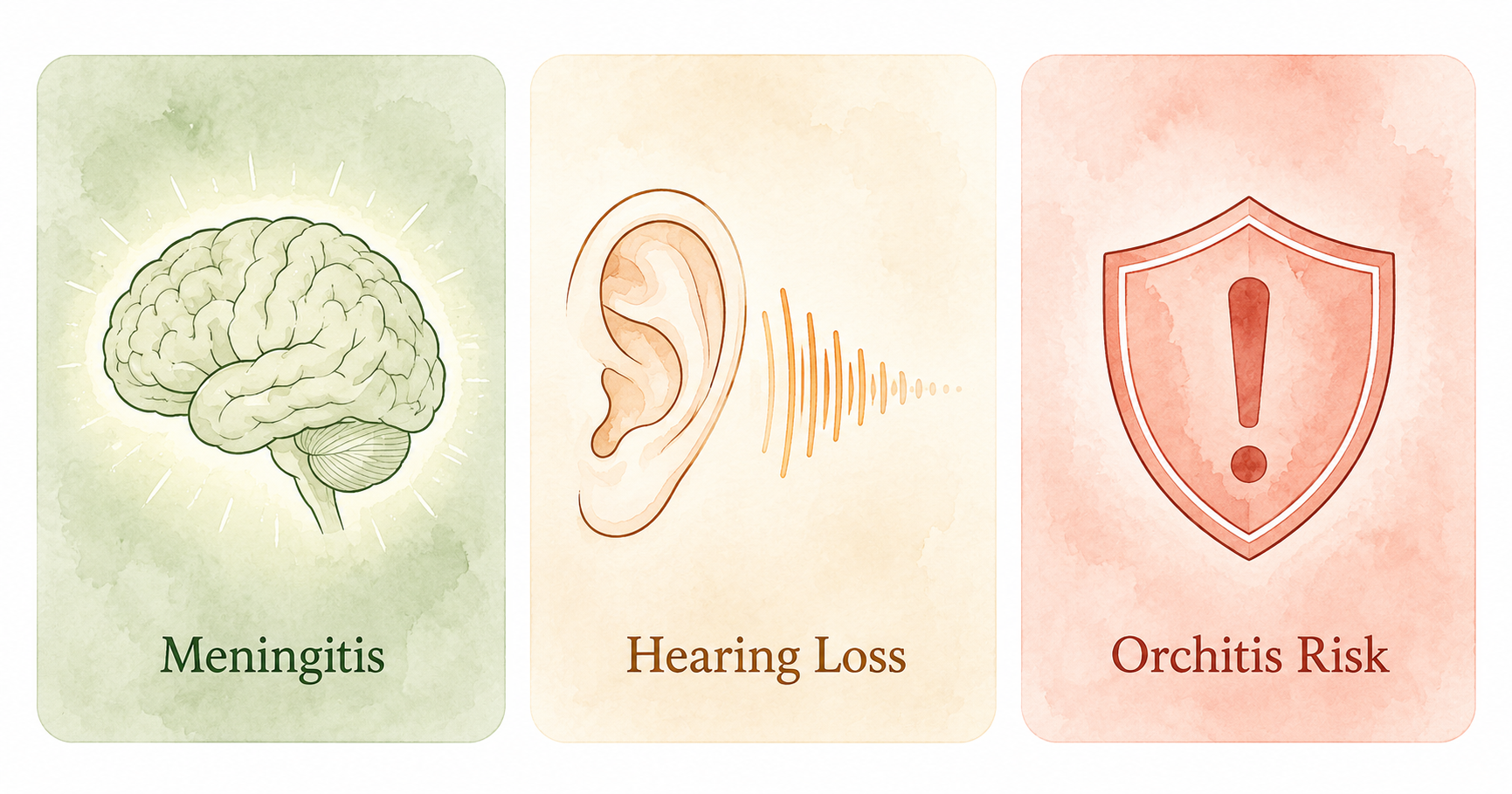
Meningitis (髄膜炎 / zuimaku-en)
Viral meningitis — inflammation of the membranes surrounding the brain and spinal cord — is the most common serious complication of mumps. It usually resolves without lasting damage, but it requires medical attention and can involve severe headache, stiff neck, and sensitivity to light.
Hearing loss (難聴 / nancho)
Mumps is one of the leading causes of acquired single-sided deafness in children. The hearing loss can be sudden and permanent. This complication is rare, but because it is irreversible, it is one of the strongest arguments for vaccination.
Orchitis (精巣炎 / seisōen) — relevant for boys and men
In males who have gone through puberty, mumps can cause painful swelling of one or both testes — a condition called orchitis. This affects around 20–40% of post-pubertal males who contract mumps, and in a minority of cases it leads to reduced fertility. The risk is essentially zero in prepubescent boys, but it is a compelling reason to ensure boys are vaccinated before adolescence.
Boys in particular: Because orchitis and its potential impact on fertility are irreversible, the Japan Pediatric Society emphasizes the importance of mumps vaccination for boys as well as girls.
Notes for International Families
Have your children already had MMR? In most Western countries — including the UK, USA, Australia, Canada, and most of Europe — the MMR (measles, mumps, rubella) vaccine is part of the standard childhood schedule and is given in two doses, typically around ages 1 and 4–6. If your child received two doses of MMR before coming to Japan, they are likely already protected against mumps and do not need the mumps vaccine again in Japan.
Check your child's vaccination record (母子手帳 or the equivalent overseas document) and confirm with your pediatrician. If the record shows two doses of MMR or two doses of a mumps-containing vaccine, further doses are generally not required.
If your child has had only one dose of MMR, or if their vaccination history is unclear, it is worth discussing a mumps booster with your pediatrician. One dose of MMR or mumps vaccine provides partial protection; two doses are the standard for reliable immunity.
If your child has had no mumps vaccination at all, starting the two-dose schedule in Japan is recommended. Ask your municipality about available subsidies before booking, as costs can add up across two doses.
English-speaking pediatric clinics. Many international clinics in Japan are familiar with the MMR question and can help assess your child's existing vaccination history and advise on what, if anything, is still needed. Checking in advance whether the clinic has English-speaking staff or an interpreter service will make the appointment smoother.
What to Bring
- 母子手帳 (boshi techou) — your Mother and Child Health Handbook, or your overseas vaccination record if your child was vaccinated abroad. The clinic needs to see what has already been given.
- 予診票 (yoshin hyō) — the pre-vaccination health questionnaire. Some municipalities send this in advance; others provide it at the clinic on the day.
- 在留カード (zairyū kādo) — your residence card.
- マイナ保険証 — your My Number health insurance card. If you don't have one, bring your 資格確認書 (shikaku kakunin-sho), the alternative certificate issued by your insurer. The old health insurance card (健康保険証) was abolished in December 2024.
- 助成券 / 補助券 — any subsidy voucher issued by your municipality, if applicable. Without this, you will be charged the full clinic rate.
Mumps is one of the vaccines families pay for themselves in most of Japan. Our guide to Japan's childhood vaccination schedule explains which vaccines are free and which are not.
Japanese Vocabulary
| Japanese | Reading | Meaning |
|---|---|---|
| おたふくかぜ | otafuku kaze | Mumps (common name) |
| 流行性耳下腺炎 | ryūkōsei jikasenen | Mumps (medical name) |
| ムンプスワクチン | munpusu wakuchin | Mumps vaccine |
| 生ワクチン | nama wakuchin | Live attenuated vaccine |
| 任意接種 | nin'i sesshu | Voluntary vaccination (self-funded) |
| 耳下腺 | jikansen | Parotid gland (the swollen area in mumps) |
| 髄膜炎 | zuimaku-en | Meningitis |
| 難聴 | nancho | Hearing loss / deafness |
| 精巣炎 | seisōen | Orchitis (testicular inflammation) |
| 無菌性髄膜炎 | mukinkisei zuimaku-en | Aseptic meningitis |
| 保健センター | hoken sentaa | Local health center (for subsidy enquiries) |