

Written and reviewed by Susumu
Born and raised in Japan · Checked against Japanese law and ministry guidance
An oral vaccine with the tightest deadline in the schedule: the first dose must be given by 14 weeks and 6 days. The timing, the two brands, and the warning signs of intussusception.
Affiliate Disclosure: This article contains affiliate links. If you click a link and make a purchase, we may earn a small commission at no extra cost to you. We only recommend products we genuinely believe are helpful. See our Terms of Use for full details.
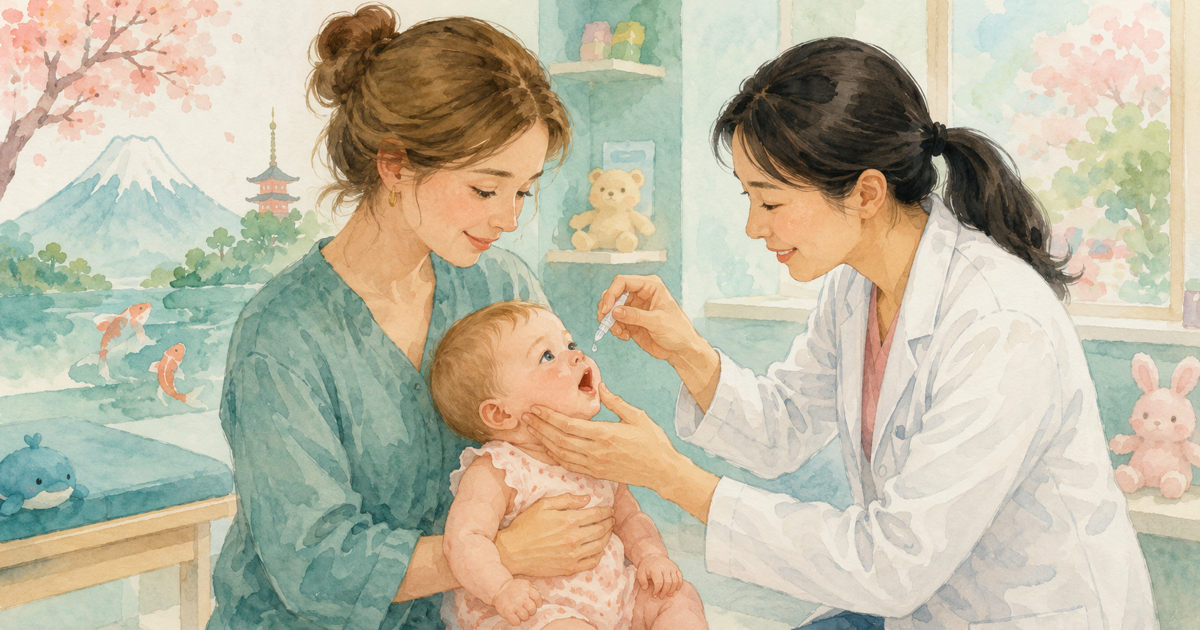
Free from October 2020: The rotavirus vaccine became part of Japan's routine (free) vaccination schedule on October 1, 2020. It's given as oral drops — not an injection — and is free for all children registered at a Japanese municipality. There is a strict first-dose deadline at 14 weeks and 6 days.
What Is Rotavirus?
Rotavirus (ロタウイルス) is the leading cause of severe diarrhea and vomiting in babies and young children worldwide. Before vaccines were available, almost every child caught it at least once by the age of 5.
For older children and adults it's usually just a rough few days. For babies — especially those under one year — it can be much more serious. The vomiting and diarrhea can cause dehydration very quickly, and quite a few babies end up in the hospital. Before the vaccine became available in Japan, rotavirus sent many babies to hospital each year.
The virus spreads easily through contaminated hands, surfaces, and objects. Good handwashing helps, but the virus can survive on hard surfaces for days to weeks, so it's hard to avoid entirely. Vaccination is the best protection.
About the Vaccine
Unlike most childhood vaccines in Japan, the rotavirus vaccine is not an injection. It's given as oral liquid drops — a small amount of liquid squirted into your baby's mouth. Babies tend to accept it easily, as the liquid has a slightly sweet flavor.
In Japan, two versions of the rotavirus vaccine are available, and both are covered by the routine free vaccination program. The main difference is the number of doses required:
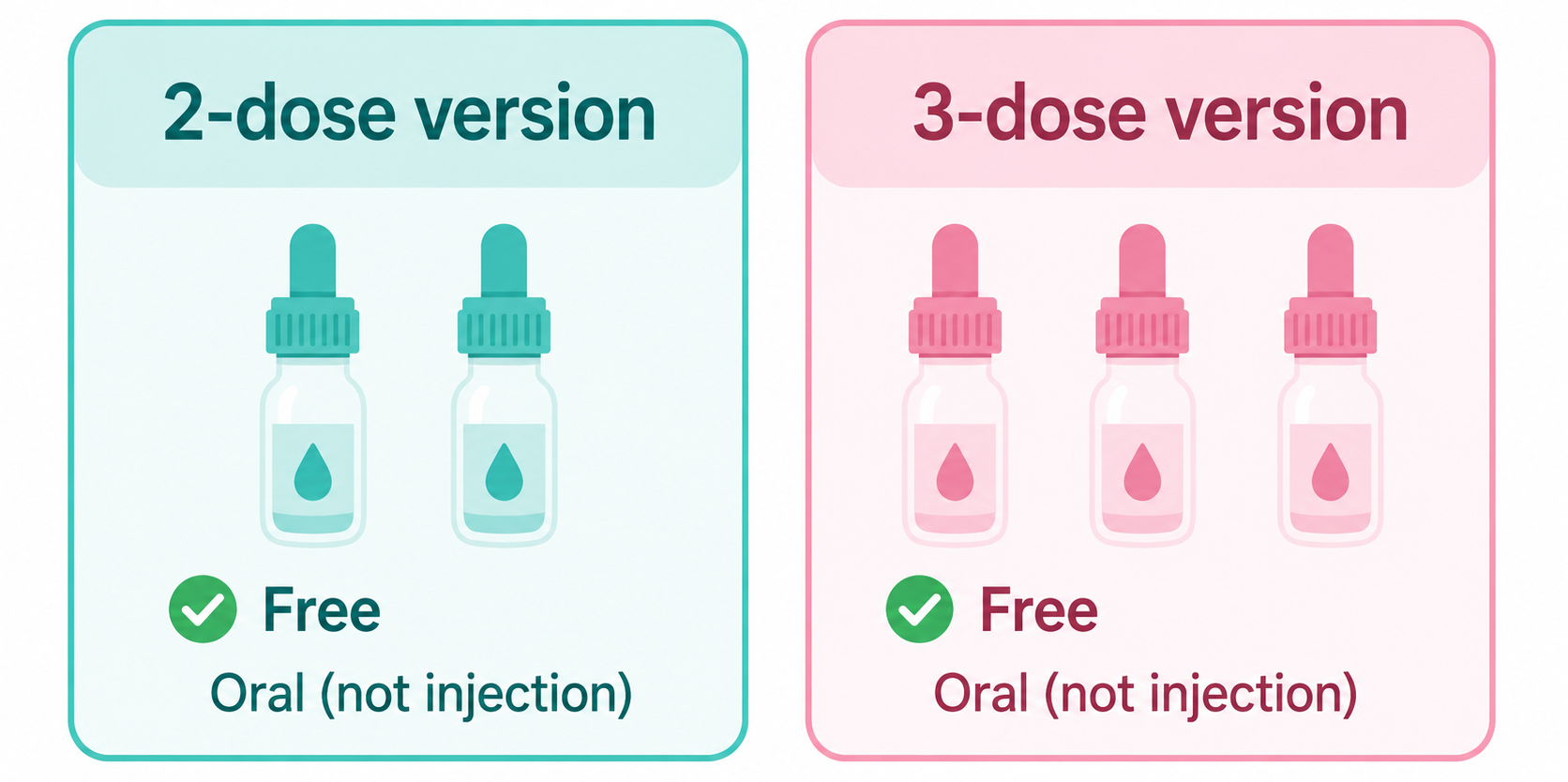
| Type | Number of Doses | Final Dose Deadline |
|---|---|---|
| 2-dose vaccine | 2 doses | By 24 weeks of age |
| 3-dose vaccine | 3 doses | By 32 weeks of age |
Both vaccines protect against the most common types of rotavirus, and both are given on the same timeline starting from around 2 months of age. Your pediatrician will advise on which is available at your clinic. Whichever you start with, complete the full course with the same vaccine.
The First-Dose Deadline
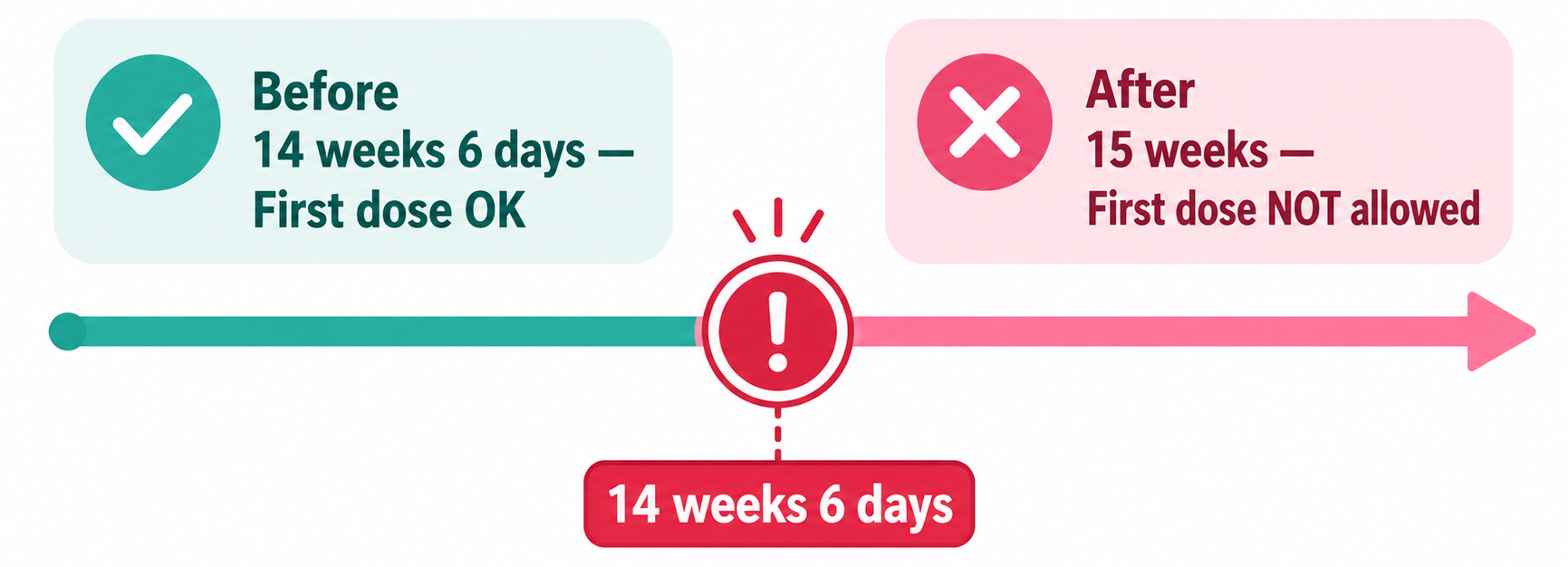
One date matters more than anything else with this vaccine: the first dose must be given by 14 weeks and 6 days of age. Once your baby turns 15 weeks, the vaccine can no longer be offered — there are no exceptions.
The reason comes down to intussusception (see below). When the first dose is given to older babies, the risk of this serious bowel condition goes up. Keeping the first dose to babies under 15 weeks is how that risk stays low.
For most families this isn't an issue — vaccinating at 2 months alongside the other routine vaccines puts you well within the window. But if your baby was premature, had an early health issue, or you've only recently found out the vaccine is free, confirm the date sooner rather than later.
⚠️ How to find your baby's deadline
14 weeks and 6 days = 104 days from birth. Add 104 days to your baby's date of birth — that is the last day the first dose can be given.
Example: baby born on 1 April → deadline is 14 July.
If you are unsure, ask your pediatrician or local health center (保健センター) to confirm the exact date. There is no catch-up option once the deadline has passed.
Vaccination Schedule
Both vaccines follow the same basic pattern: start from around 2 months of age, with a minimum interval of 4 weeks between doses.
| Dose | When | Notes |
|---|---|---|
| Dose 1 | From 6 weeks of age | Must be given by 14 weeks 6 days. Standard: start at 2 months |
| Dose 2 | At least 4 weeks after Dose 1 | 2-dose: complete by 24 weeks / 3-dose: continue to Dose 3 |
| Dose 3 3-dose only | At least 4 weeks after Dose 2 | Must be completed by 32 weeks of age |
At the 2-month appointment, the rotavirus vaccine is given alongside the five-in-one (五種混合), hepatitis B, and pneumococcal vaccines. Getting several vaccines in one visit is completely normal in Japan — your baby may receive three or four in a single appointment.
If your baby vomits after the dose: Contact your clinic for advice. Do not give an additional dose without checking with your doctor first.
Is It Free?
Yes — the rotavirus vaccine is a 定期接種 (teiki sesshu), meaning it's part of Japan's national routine vaccination program. Both the 2-dose and 3-dose versions are covered at no cost.
Eligibility is based on 住民登録 (juuminhyou registration), not nationality. If your child is registered at your local city or ward office, they are entitled to the same free routine vaccines as any Japanese child. Your municipality will send vaccination vouchers (接種券, sesshuken) by mail, typically around the time your baby turns 2 months.
If you haven't received anything and your baby is approaching 2 months, contact your local health center (保健センター, hoken sentaa) immediately — given the hard deadline, you don't want to wait.
What Happens at the Appointment
The rotavirus vaccine is given as oral drops — your baby will be held in a semi-upright position and a small amount of liquid is dropped into their mouth. The whole process takes only a few seconds. Most babies swallow it without any fuss.
Before the drops are given, the doctor will go through a pre-vaccination questionnaire (予診票, yoshinhyou) and give your baby a quick check-over.
A few practical things for the day:
- Feed your baby as normal beforehand — there is no need to fast
- Try to arrive without too much clothing so the doctor can examine the baby easily
- After all vaccines are given, you will be asked to wait at the clinic for 15–30 minutes before leaving — this is standard procedure in case of any immediate reaction
- If your baby does vomit during the wait, let the nurse or doctor know straight away
Side Effects
Most babies handle this vaccine without any trouble. Because it's given by mouth rather than injection, there's no sore arm or lump to worry about.
In the days after vaccination, some babies become a bit unsettled, have looser stools, or vomit mildly. This tends to clear up on its own within a day or two.
The one thing to keep a close eye on after vaccination is intussusception — a rare but serious bowel condition covered in the next section.
Intussusception: The Warning Signs
Intussusception (腸重積, cho-juuseki) is a type of bowel blockage where one section of the intestine slides into the next, like the sections of a telescope collapsing together. Without quick treatment it can become very serious. It's rare — but it's the main reason the rotavirus vaccine has age restrictions.
The risk is highest in the first few days after the first dose and returns to normal within about two weeks. This is why the 14-week deadline exists — giving the first dose early, while babies are young, keeps the overall risk as low as possible.
Go to an emergency department immediately if your baby shows any of these signs in the 1–2 weeks after vaccination:
- 🔴 Intense, repeated crying in short bursts — the baby seems to be in sudden, severe pain, then briefly calms down, then cries again
- 🔴 Vomiting — especially vomiting that contains bile (yellow-green liquid)
- 🔴 Blood in the stool — stools may look like redcurrant jam
- 🔴 Pale or listless — the baby is unusually quiet, floppy, or hard to rouse
- 🔴 Swollen abdomen — the belly looks visibly larger or harder than usual
Intussusception also happens in babies who haven't been vaccinated — it's not caused by the vaccine. But any baby showing these signs needs to be seen immediately, whatever their vaccination history. If you're not sure, go straight to the emergency department.
What to Bring
- 母子手帳 (boshi techou) — your Mother and Child Health Handbook. The clinic records every vaccination in here.
- 接種券 (sesshuken) — the vaccination voucher sent by your municipality. Without this, you may be charged.
- 予診票 (yoshinhyou) — the pre-vaccination health questionnaire. Some municipalities send this with the voucher; others provide it at the clinic.
- マイナ保険証 — your My Number health insurance card. If you don't have one, bring your 資格確認書 (shikaku kakunin-sho), the alternative certificate issued by your insurer. The old health insurance card (健康保険証) was abolished in December 2024.
- A spare set of clothes for your baby — just in case.
Note for parents of premature babies: If your baby was born prematurely and spent time in the NICU (neonatal intensive care unit), the 14-week-6-day deadline may arrive sooner than expected once they come home. Speak with your pediatrician early to confirm the timing and plan vaccination accordingly.
Rotavirus has the tightest deadline of any routine vaccine, so it helps to see it in the context of the wider calendar — our complete guide to Japan's childhood vaccination schedule lays out the first-year timings.
Japanese Vocabulary
| Japanese | Reading | Meaning |
|---|---|---|
| ロタウイルスワクチン | rota uirusu wakuchin | Rotavirus vaccine |
| 定期接種 | teiki sesshu | Routine (free) vaccination |
| 経口ワクチン | keiko wakuchin | Oral vaccine |
| 腸重積 | cho-juuseki | Intussusception (bowel blockage) |
| 胃腸炎 | ichōen | Gastroenteritis |
| 脱水 | dassui | Dehydration |
| 接種券 | sesshuken | Vaccination voucher |
| 予診票 | yoshinhyou | Pre-vaccination questionnaire |
| 同時接種 | douji sesshu | Simultaneous vaccination |
| 保健センター | hoken sentaa | Local health center |