Written and reviewed by Susumu
Born and raised in Japan · Checked against Japanese law and ministry guidance
Japan introduced the five-in-one vaccine (五種混合) in April 2024 — covering diphtheria, pertussis, tetanus, polio, and Hib in a single shot. Free for all registered residents. Here's the full schedule and what to expect.
Affiliate Disclosure: This article contains affiliate links. If you click a link and make a purchase, we may earn a small commission at no extra cost to you. We only recommend products we genuinely believe are helpful. See our Terms of Use for full details.
New from April 2024: Japan's five-in-one vaccine (五種混合, goshukongo) replaced the old four-in-one + Hib combination as of April 1, 2024. It's free for all children registered at a Japanese municipality — no income limit, no nationality requirement.
What Is the Five-in-One Vaccine?
The five-in-one vaccine — called 五種混合ワクチン (goshukongo wakuchin) in Japanese — is a single injection that protects against five serious diseases at once. It became part of Japan's routine (free) vaccination schedule on April 1, 2024.
Before that date, parents had to book separate appointments for a four-in-one vaccine and a Hib vaccine, which meant more clinic visits, more injections, and more scheduling headaches. The five-in-one combines them into a single shot.
The Five Diseases It Covers
| Disease | Japanese Name | Why It Matters |
|---|---|---|
| Diphtheria | ジフテリア | A bacterial throat infection that can block the airway and damage the heart |
| Pertussis | 百日咳 (hyakunichizeki) | Whooping cough — a violent, prolonged cough that can be life-threatening in young babies |
| Tetanus | 破傷風 (hashōfū) | A soil-borne bacterial toxin that causes painful muscle spasms and can be fatal |
| Polio | ポリオ (porio) | A virus that can cause permanent paralysis — Japan uses the inactivated (killed) form |
| Hib disease | ヒブ感染症 (hibu kansenshō) | Haemophilus influenzae type b — before vaccination, responsible for around 60% of bacterial meningitis cases in children under 5 |
Of these five, pertussis and Hib disease are the ones parents most need to know about. Both are particularly dangerous in the first few months of life — before your baby has had time to build up any immunity. Getting the first dose in at two months is the best protection you can give.
Why Japan Introduced It
Until March 2024, Japanese parents had to vaccinate against these five diseases using two separate injections: a four-in-one vaccine (四種混合, yonshukongo) covering diphtheria, pertussis, tetanus, and polio, plus a standalone Hib vaccine. That meant up to eight separate injections over the first year and a half of a child's life.
The five-in-one vaccine cuts that down to four injections total. For babies who are already getting multiple vaccines at each visit — which is standard — reducing the number of individual shots matters, even if the total number of clinic visits stays roughly the same.
The four-in-one vaccine ceased production during 2024, and Japan's national stock was completely exhausted by July 2025. Any child who could not complete their series with the old vaccine would continue with the five-in-one instead.
Vaccination Schedule
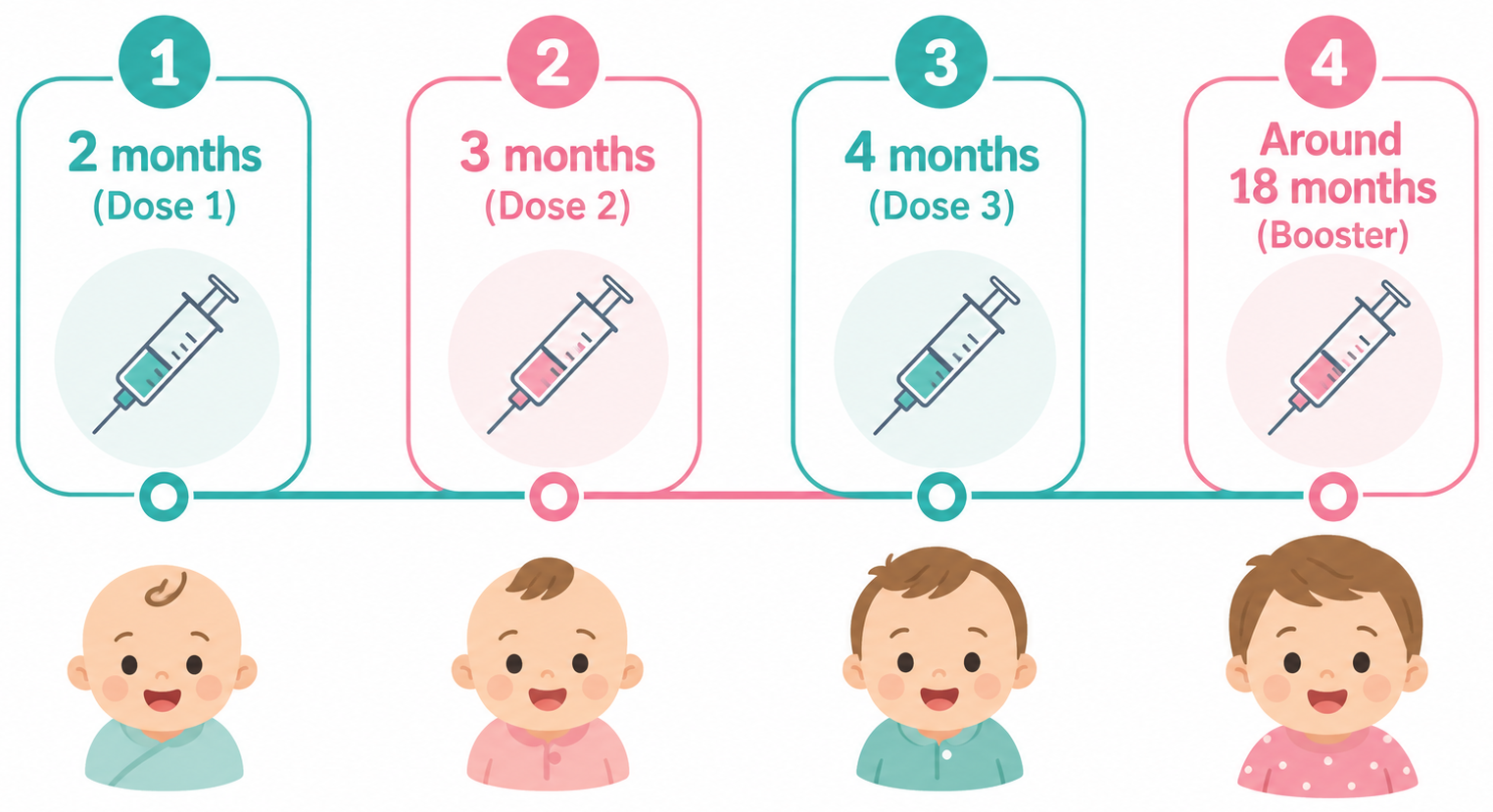
The five-in-one is given in four doses total — three doses for the primary series, then one booster.
| Dose | When | Notes |
|---|---|---|
| Dose 1 | From 2 months of age | Standard: start before 7 months of age |
| Dose 2 | At least 20 days after Dose 1 | Standard interval: 3–8 weeks |
| Dose 3 | At least 20 days after Dose 2 | Standard interval: 3–8 weeks |
| Booster (Dose 4) | At least 6 months after Dose 3 | Standard timing: 6–18 months after Dose 3 |
The eligible age range runs from 2 months up to 7 years and 6 months (90 months). If you're late starting for any reason, your pediatrician can adjust the schedule — the important thing is to get going.
Age 11–12 booster: A separate two-in-one vaccine (二種混合, nishu kongou) covering diphtheria and tetanus is given as a routine free vaccination between ages 11 and 12. This is part of the same 定期接種 program but is a different vaccine — your municipality will send details when the time comes.
⚠️ Don't wait on the booster. The booster is due 6–18 months after the third dose. It's easy to forget once the primary series is done and life gets busy — but it's an essential part of the protection, especially for whooping cough and Hib.
Is It Free?
Yes — the five-in-one vaccine is a 定期接種 (teiki sesshu), meaning it's part of Japan's national routine vaccination program. All doses are fully covered by your municipality at no cost.
Eligibility is based on 住民登録 (juuminhyou registration), not nationality. If your child is registered at your local city or ward office, they are entitled to the same free routine vaccines as any Japanese child. Your municipality will send vaccination vouchers (接種券, sesshuken) by mail.
If you haven't received anything by the time your baby is approaching 2 months old, contact your local health center (保健センター, hoken sentaa) to ask.
What Happens at the Appointment
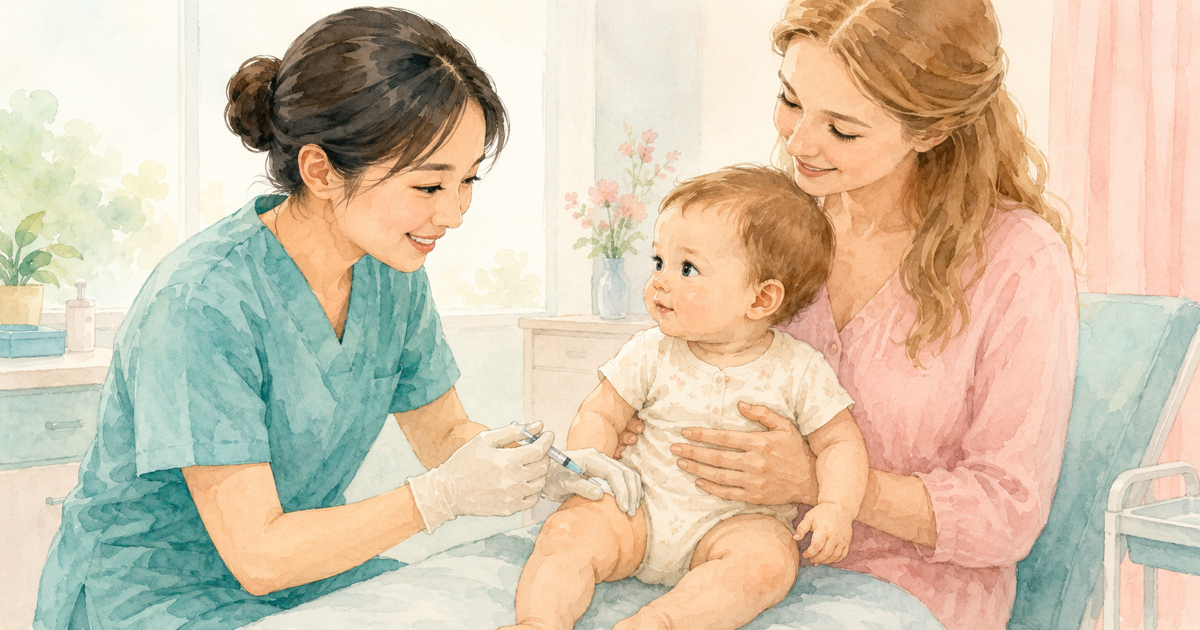
The five-in-one is given as an injection — either subcutaneous or intramuscular, at the doctor's discretion. For babies under one year, the outer thigh is the standard injection site. It's over in seconds — most of the appointment time is spent on the pre-vaccination questionnaire (予診票, yoshinhyou) and a brief check by the doctor.
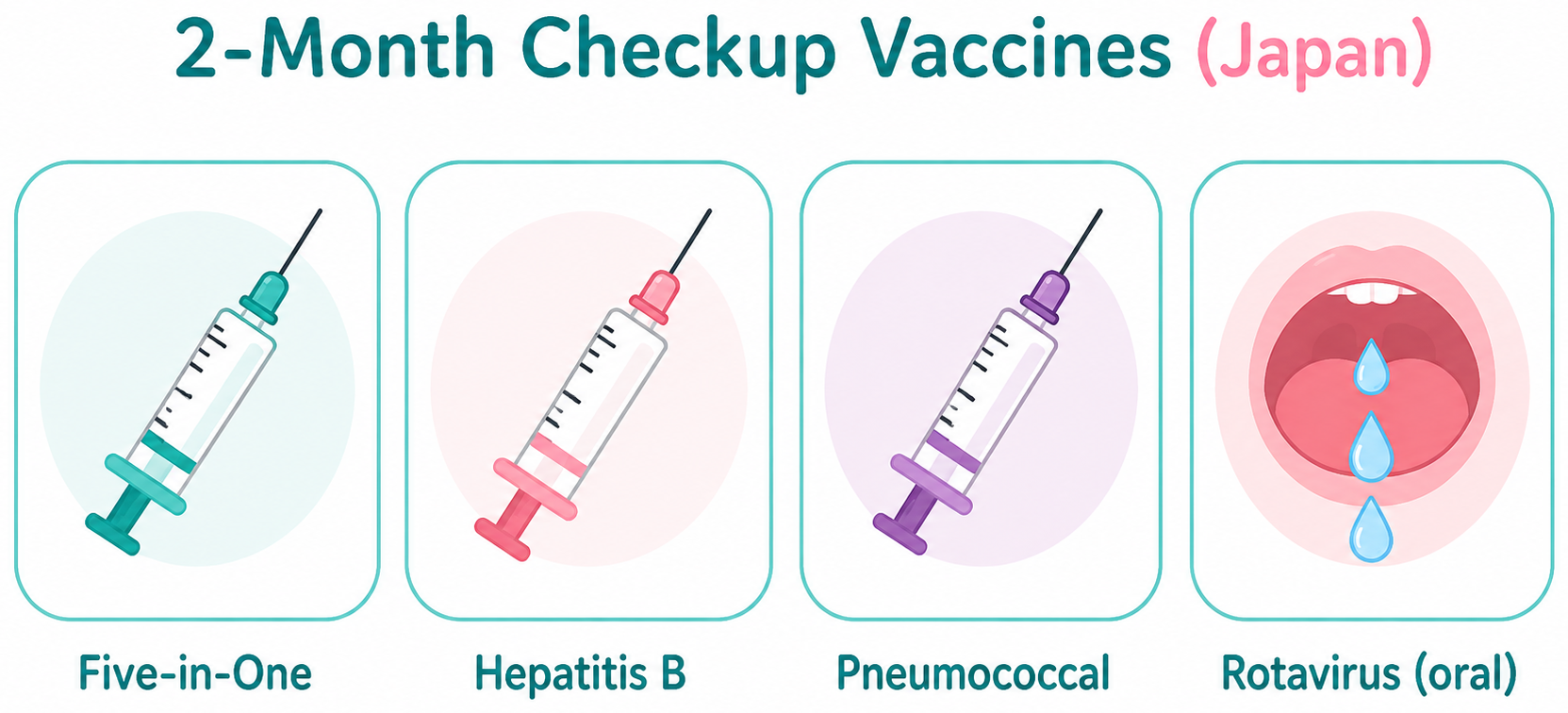
Expect multiple vaccines at the same visit. At the 2-month appointment — which is typically the busiest — it is standard practice in Japan to give four vaccines simultaneously:
- Five-in-one (五種混合)
- Hepatitis B (B型肝炎)
- Rotavirus (oral drops, not an injection)
- Pneumococcal (小児用肺炎球菌)
Simultaneous vaccination is completely standard practice in Japan and is backed by the same safety evidence as elsewhere in the world. The vaccines can be given at the same visit because the five-in-one is an inactivated vaccine — there's no interval restriction between inactivated vaccines.
Side Effects
Local reactions at the injection site are very common — about 75–79% of babies will have some redness, and around half will develop a firm lump (硬結, kouketsu). These are normal immune responses and typically clear up within a few days.
| Side Effect | How Common |
|---|---|
| Redness at injection site | ~75–79% |
| Fever (37.5°C or above) | ~58–65% |
| Hard lump at injection site | ~47–51% |
| Swelling at injection site | ~30–38% |
| Drowsiness, irritability, or reduced appetite | Less common; typically resolves within a day or two |
The hard lump can take a few weeks to go away completely — this is normal and nothing to squeeze or massage. If your baby has a high fever above 39°C, is unusually difficult to settle, or if the redness is spreading significantly, contact your clinic.
Serious reactions are very rare. Anaphylaxis (severe allergic reaction) can occur with any vaccine — this is why clinics ask you to wait 15–30 minutes after vaccination before leaving.
What If My Child Started the Old Vaccines?
If your child received some doses of the four-in-one (四種混合) and Hib vaccines before the five-in-one was introduced, switching to the five-in-one mid-series is officially permitted. This is confirmed in MHLW guidance issued to municipalities across Japan.
Since the four-in-one vaccine ceased production in 2024 and Japan's national stock ran out completely by July 2025, completing the old series is no longer an option for most families.
How many additional doses are needed depends on exactly how many doses of each old vaccine your child already received — this varies from child to child. Contact your pediatrician and bring your child's 母子手帳. They will review the vaccination history and advise on what is still needed. Your local municipality's health center (保健センター) can also help clarify the process.
What to Bring
- 母子手帳 (boshi techou) — your Mother and Child Health Handbook. The clinic records every vaccination in here.
- 接種券 (sesshuken) — the vaccination voucher sent by your municipality. Without this, you may be charged.
- 予診票 (yoshinhyou) — the pre-vaccination health questionnaire. Some municipalities send this with the voucher; others provide it at the clinic.
- マイナ保険証 — your My Number health insurance card. If you don't have one, bring your 資格確認書 (shikaku kakunin-sho), the alternative certificate issued by your insurer. The old health insurance card (健康保険証) was abolished in December 2024.
- A spare set of clothes for your baby — just in case.
Tip for international families: If your child's vaccination records are from another country, bring them too. Some pediatricians in Japan are familiar with overseas schedules and can advise on what your child may still need.
Working out where the five-in-one sits alongside the other routine shots is easier with the whole calendar in front of you — our complete guide to Japan's childhood vaccination schedule lays out the order and the ages.
Japanese Vocabulary
| Japanese | Reading | Meaning |
|---|---|---|
| 五種混合ワクチン | goshukongo wakuchin | Five-in-one vaccine |
| 定期接種 | teiki sesshu | Routine (free) vaccination |
| 初回接種 | shokai sesshu | Primary series |
| 追加接種 | tsuika sesshu | Booster dose |
| 百日咳 | hyakunichizeki | Pertussis (whooping cough) |
| ヒブ感染症 | hibu kansenshō | Hib disease |
| 接種券 | sesshuken | Vaccination voucher |
| 予診票 | yoshinhyou | Pre-vaccination questionnaire |
| 硬結 | kouketsu | Hard lump (injection site reaction) |
| 同時接種 | douji sesshu | Simultaneous vaccination |