

Written and reviewed by Susumu
Born and raised in Japan · Checked against Japanese law and ministry guidance
Three free doses, all before your baby's first birthday, starting at the busy two-month appointment. The schedule, the deadline that matters, and what happens if you start late.
Affiliate Disclosure: This article contains affiliate links. If you click a link and make a purchase, we may earn a small commission at no extra cost to you. We only recommend products we genuinely believe are helpful. See our Terms of Use for full details.
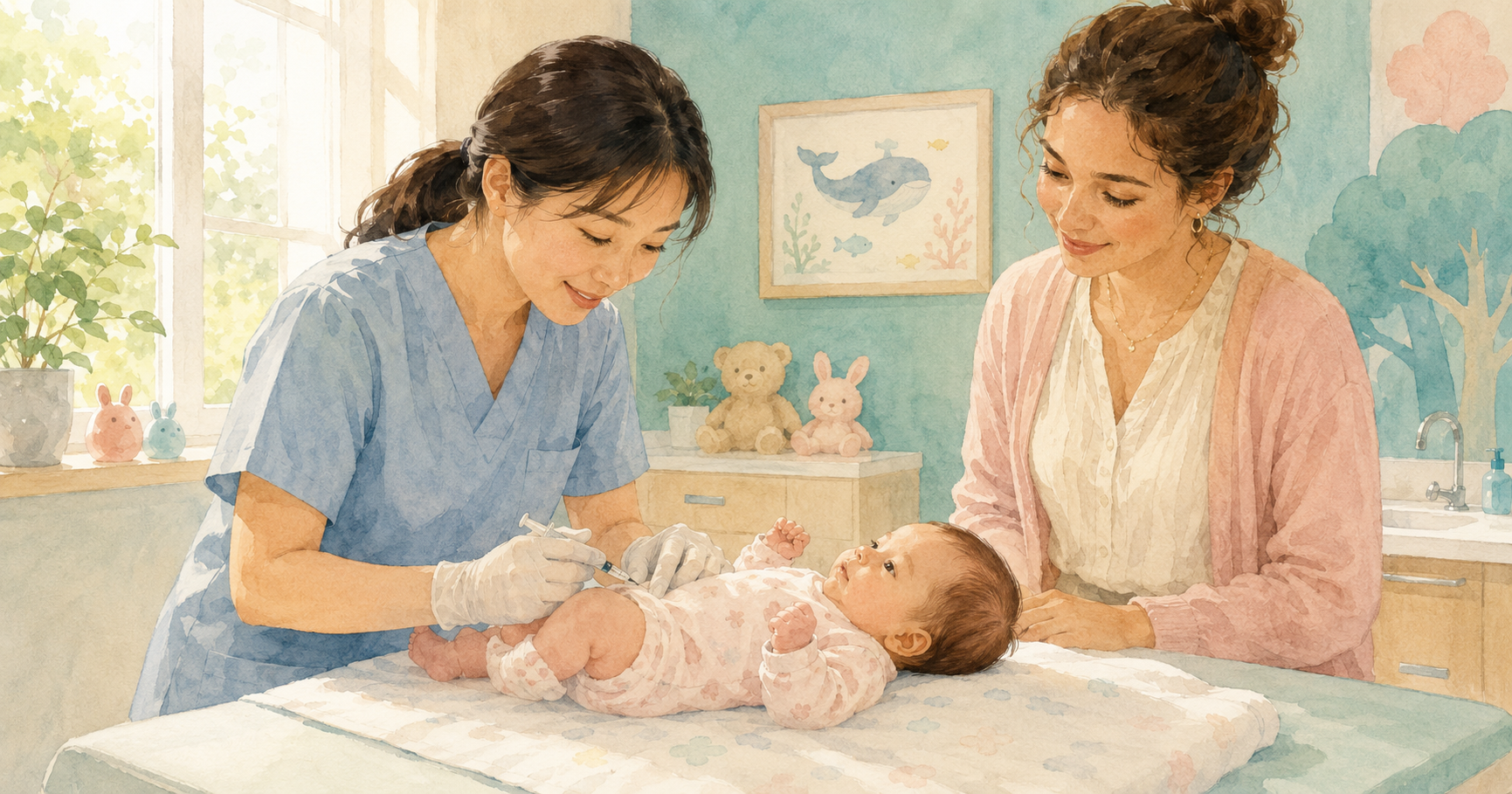
Free from October 2016: The hepatitis B vaccine became part of Japan's routine (free) vaccination schedule on October 1, 2016. It's given as three injections before your baby's first birthday, and is free for all children registered at a Japanese municipality.
What Is Hepatitis B?
Hepatitis B is a liver disease caused by the hepatitis B virus (HBV). The virus spreads through blood, from mother to child at birth, and through close contact with an infected person — which is why infants are considered a high-risk group.
Most adults who are infected recover fully. But for babies, the picture is very different. When a baby is infected at or shortly after birth, around 90% go on to develop a chronic (lifelong) infection. For infants infected during the first year of life more broadly, the figure is closer to 95%. Over time, chronic carriers face a significantly higher risk of serious liver disease, including cirrhosis and liver cancer — often decades before any symptoms appear.
Vaccination is highly effective. Completing the three-dose series produces protective antibodies in around 95% of recipients, with protection lasting 20 years or longer.
About the Vaccine
The hepatitis B vaccine is an inactivated vaccine given as a subcutaneous injection — meaning the shot goes just under the skin rather than into muscle. It is given in three doses across the first year of life.
In Japan, two versions of the vaccine are available, and both are covered by the routine free vaccination program. Switching between the two brands between doses is permitted if needed.
Vaccination Schedule
The three doses are spread across the first year of life, with a longer gap before the third dose to ensure strong, lasting immunity. All ages below refer to your baby's age from birth.
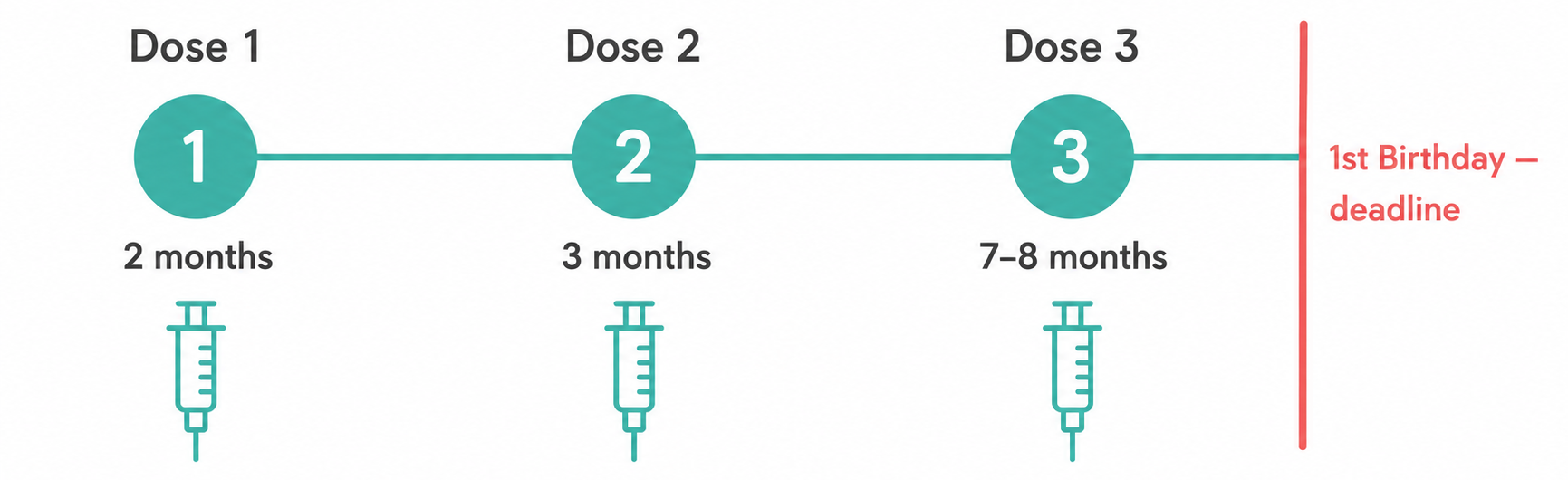
| Dose | When | Notes |
|---|---|---|
| Dose 1 | From 2 months of age | Given at the same visit as the five-in-one, rotavirus, and pneumococcal vaccines |
| Dose 2 | At least 27 days after Dose 1 | Standard: around 3 months of age |
| Dose 3 | At least 139 days after Dose 1 | Standard: 7–8 months of age. Must be completed before the first birthday |
The long gap before the third dose is intentional — it gives the immune system time to build lasting memory. Starting at 2 months and following the standard schedule puts the third dose at around 7–8 months, well before the first birthday deadline.
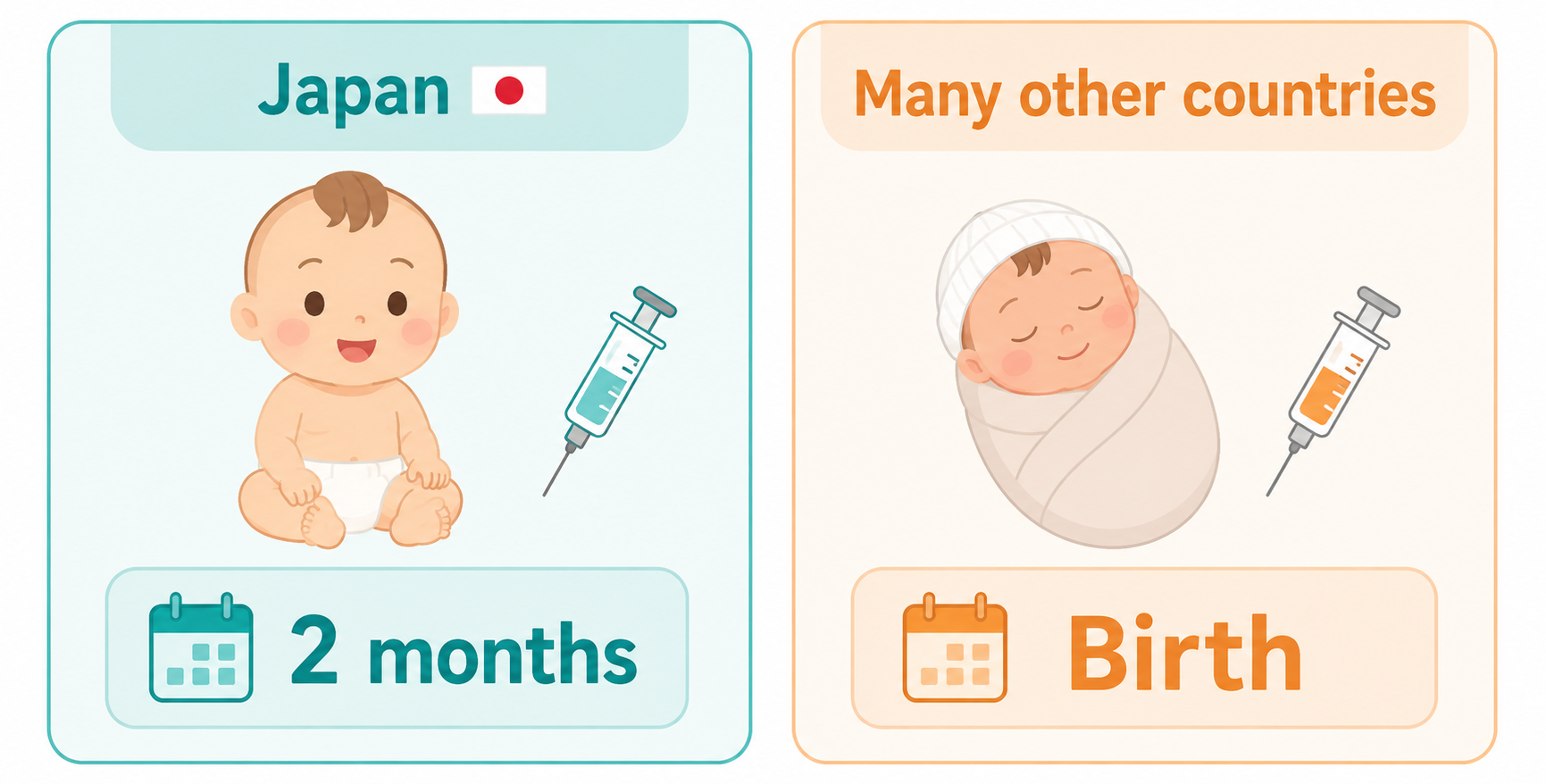
No birth dose in Japan: Many countries give a hepatitis B shot at birth. Japan does not include a birth dose in its routine schedule — vaccination begins at 2 months. If you're from a country where a birth dose is standard, be aware that Japan's schedule is different. See the section below for international families.
The Under-1 Deadline
All three doses must be completed before your baby's first birthday. This is the outer age limit for free routine vaccination — after that date, the vaccine is no longer covered at no cost under the standard program.
If you start Dose 1 at 2 months and follow the standard schedule, you'll finish well within the window. But the timing does require some planning: the gap between Dose 1 and Dose 3 must be at least 139 days (around 4.5 months), so starting late leaves less room for flexibility.
⚠️ If you're starting late: If your baby is past 2 months and hasn't had Dose 1 yet, speak with your pediatrician as soon as possible. As long as all three doses can be completed before the first birthday — with the required intervals — you're still within the free vaccination window.
Is It Free?
Yes — the hepatitis B vaccine is a 定期接種 (teiki sesshu), meaning it's part of Japan's national routine vaccination program. All three doses are fully covered at no cost.
Eligibility is based on 住民登録 (juumin tooroku), not nationality. If your child is registered at your local city or ward office, they're entitled to the same free routine vaccines as any Japanese child. Your municipality will send vaccination vouchers (接種券, sesshuken) by mail, typically around the time your baby turns 2 months.
If you haven't received anything and your baby is approaching 2 months, contact your local health center (保健センター, hoken sentaa) to ask.
What Happens at the Appointment
The hepatitis B vaccine is given as a subcutaneous injection — a small shot just under the skin, usually in the outer thigh for young babies. It's over in a few seconds.
Before the injection, the doctor will go through a pre-vaccination questionnaire (予診票, yoshinhyou) and give your baby a quick check-over. After all vaccines are given, you'll be asked to wait at the clinic for 15–30 minutes before leaving.
At the 2-month appointment, your baby will likely receive four vaccines in the same visit: hepatitis B, the five-in-one (五種混合), rotavirus (oral drops), and the pneumococcal vaccine. Receiving several vaccines in one visit is completely normal in Japan — your baby may have three or four injections plus the oral rotavirus drops, all at once.
Side Effects
Most babies tolerate the hepatitis B vaccine without any significant reaction.
The most common effects are local reactions at the injection site — redness, mild swelling, or a small firm lump. These usually settle within a few days. Some babies also develop a mild fever or become a bit more unsettled than usual in the 24–48 hours after vaccination.
Serious reactions are very rare. Anaphylaxis (a severe allergic reaction) can occur with any vaccine, which is why clinics ask you to wait 15–30 minutes after vaccination before leaving. If your baby has previously reacted to yeast-based products, let your doctor know before vaccination.
Notes for International Families
Japan does not give a birth dose. In many countries — including the US, Australia, and much of Asia — a hepatitis B shot is given at birth as part of the routine schedule. Japan's routine program does not include a birth dose; vaccination starts at 2 months. This is a deliberate policy difference, not an oversight.
If your baby received doses in another country, bring the overseas vaccination records to your pediatrician. They can review what your child has already had and advise on how to continue or complete the series in Japan. The key requirement is that the correct intervals are maintained between doses.
If your baby's mother is HBsAg-positive (hepatitis B surface antigen positive), your baby will be managed under a separate program — a combination of hepatitis B immunoglobulin (HBIG) and a 3-dose vaccine series — rather than the standard routine vaccination. This is handled through health insurance (健康保険) and is managed by the hospital from birth. If you're unsure of your status, ask your obstetrician.
Note for parents of premature babies: If your baby was born prematurely or with a low birth weight, discuss the hepatitis B vaccination schedule with your pediatrician early. Very small or early babies may need the timing adjusted.
What to Bring
- 母子手帳 (boshi techou) — your Mother and Child Health Handbook. The clinic records every vaccination in here.
- 接種券 (sesshuken) — the vaccination voucher sent by your municipality. Without this, you may be charged.
- 予診票 (yoshinhyou) — the pre-vaccination health questionnaire. Some municipalities send this with the voucher; others provide it at the clinic.
- マイナ保険証 — your My Number health insurance card. If you don't have one, bring your 資格確認書 (shikaku kakunin-sho), the alternative certificate issued by your insurer. The old health insurance card (健康保険証) was abolished in December 2024.
- A spare set of clothes for your baby — just in case.
Hepatitis B is one of several vaccines given in the first months, and the timing interacts with the others. Our complete guide to Japan's childhood vaccination schedule shows how the early doses fit together.
Japanese Vocabulary
| Japanese | Reading | Meaning |
|---|---|---|
| B型肝炎ワクチン | bi-gata kan-en wakuchin | Hepatitis B vaccine |
| 定期接種 | teiki sesshu | Routine (free) vaccination |
| 皮下注射 | hika chuusha | Subcutaneous injection |
| 肝炎 | kan-en | Hepatitis (liver inflammation) |
| 慢性感染 | mansei kansen | Chronic infection |
| HBs抗原 | HBs koogen | HBsAg — hepatitis B surface antigen (blood test marker) |
| 免疫グロブリン | meneki gurōburin | Immunoglobulin (HBIG) |
| 接種券 | sesshuken | Vaccination voucher |
| 予診票 | yoshinhyou | Pre-vaccination questionnaire |
| 同時接種 | douji sesshu | Simultaneous vaccination |