

Written and reviewed by Susumu
Born and raised in Japan · Checked against Japanese law and ministry guidance
Securing a nursery spot in Japan requires months of preparation — a process called 保活 (hokatsu). This guide walks international families through the timeline, the types of childcare available, and what to look for when visiting nurseries.
Affiliate Disclosure: This article contains affiliate links. If you click a link and make a purchase, we may earn a small commission at no extra cost to you. We only recommend products we genuinely believe are helpful. See our Terms of Use for full details.
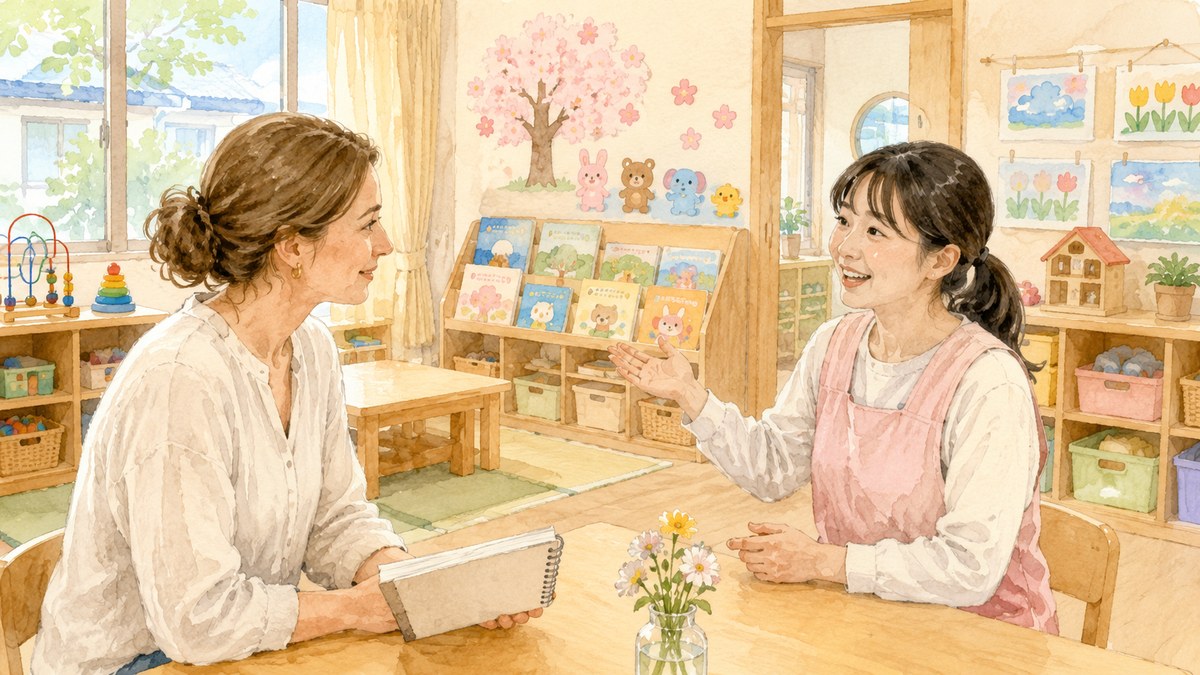
保活 (hokatsu) — short for 保育園活動 (hoikuen katsudo, "nursery activity") — is the process of researching, visiting, and securing a spot at a Japanese daycare before you even file a single form. For many families — Japanese and international alike — it is one of the most stressful parts of early parenthood in Japan. This guide explains what hokatsu involves, when to start, and how to approach it as a family living in Japan who may not speak Japanese at home.
What Is 保活?
保活 (hokatsu) combines 保育園 (hoikuen — nursery school) and 活動 (katsudo — activity). It describes everything a parent does to secure a nursery place: researching options, visiting facilities, gathering documents, and submitting applications — often months before their child is born.
Japan's nursery enrollment system works on a single annual cycle. The main intake is April, and applications are typically submitted the previous November or December. Miss that window and you are waiting another full year, or scrambling for mid-year vacancies which are rare. This is why families — especially in urban areas — start their research during pregnancy or in the early months after birth.
For international families, the process carries extra weight: everything from the consultation at the municipal office to the nursery visit happens in Japanese, and the paperwork assumes familiarity with the local system. This guide is designed to help you understand what you are walking into, and what to prepare before you get there.
The Reality of Waiting Lists
Japan's waiting-list situation has improved significantly. According to こども家庭庁 (the Children and Families Agency), the number of children on official waiting lists as of April 2025 stood at 2,254 nationwide — the lowest on record, and down from a peak of 26,081 in 2017.
Waiting List Statistics — April 2025 (こども家庭庁)
- Official waiting children nationwide: 2,254 (8 consecutive years of decline)
- 87.5% of municipalities report zero children on the official waiting list
- 84.8% of waiting children are aged 1 or 2
However, the official figure does not tell the whole story. Parents who are on a waiting list but have been placed in a non-preferred facility, or who have given up entirely, are not counted in the official number. Independent estimates put the number of children who applied for 認可保育園 but did not receive a place at closer to 70,000. This gap between the official number and the real picture is sometimes called 隠れ待機児童 (kakure taiki jido — hidden waiting children).
The key takeaway: competition is most intense for 1- and 2-year-olds. If you are planning to return to work when your child is around one year old, start hokatsu early.
0-Year-Old or 1-Year-Old Enrollment?
One of the first decisions in hokatsu is whether to aim for enrollment when your child is 0 (still a baby, often from around 57 days old) or to wait until they are 1. Both have trade-offs.
| 0歳児クラス (Age 0) | 1歳児クラス (Age 1) | |
|---|---|---|
| Competition | Lower — fewer applicants | Higher — most competitive age group |
| Parental leave | Return to work earlier (before baby's first birthday) | More time with baby (up to 1 year+) |
| Spots available | Usually more spots proportionally | Fewer new spots — mostly internal promotions from 0歳クラス |
| Strategy note | Good option in competitive areas | Harder in Tokyo and major cities |
In highly competitive areas — central Tokyo, Osaka, Yokohama — many families deliberately enroll at age 0 to secure a spot, then stay at the same nursery through age 1 and beyond. Moving up from the 0歳クラス (infant class, for babies under 1) to the 1歳クラス (toddler class, age 1) at the same nursery is typically guaranteed — meaning your child moves up automatically without re-applying — which sidesteps the most competitive application round entirely.
The 4-Step Hokatsu Timeline
Hokatsu for April enrollment follows a predictable pattern each year. The steps below are based on the standard cycle — individual municipalities may shift dates slightly, so confirm locally.
STEP 1 — September: Consult Your Municipal Office
Visit the 保育課 (hoiku-ka, childcare division) at your local city or ward office. Explain your situation and ask about the types of childcare available in your area, the application process, and how the point system (保育指数) works. This meeting is free and non-committal — it is simply gathering information. Bring your residence card (在留カード) and any employment documentation you have.
→ Ask: 認可保育園の入園申し込みについて相談したいのですが
Ninka hoikuen no nyuen moshikomi ni tsuite sodan shitai no desu ga
(I would like to ask about applying for 認可保育園)
STEP 2 — September onwards: List Your Candidate Nurseries
Research nurseries in your area and create a list of candidates. Consider location (walkable from home or near a train station you use), opening hours, whether they have an English-speaking member of staff, and whether they have experience with non-Japanese families. Many municipalities publish lists of local nurseries on their website.
STEP 3 — By October: Visit Nurseries
Contact nurseries directly to arrange a visit (見学, kengaku). Most nurseries offer scheduled visit slots on weekday mornings. You do not need to be fluent in Japanese — a short phone call or email is enough to book. During the visit, observe the environment and speak with staff. Use the checklist in the next section to guide what you look for.
STEP 4 — November to December: Narrow Down and Apply
Submit your application to the municipal office, listing nurseries in order of preference. You can typically list multiple nurseries — the more you list, the better your chances of placement somewhere. Gather all required documents (employment certificate, income verification, residence certificate) in advance. Results are usually announced in February.

Types of Childcare in Japan
Japan has several categories of childcare. Understanding the difference matters because eligibility, cost, and competition vary significantly between them.
| Type | Japanese | Key Points |
|---|---|---|
| Licensed Nursery | 認可保育園 | Government-regulated; subsidized fees based on household income; most competitive to enter |
| Certified Center | 認定こども園 | Combines nursery and kindergarten functions; similar subsidies to 認可保育園 |
| Unlicensed Nursery | 認可外保育施設 | Not government-regulated; easier to enter; fees are higher and unsubsidized |
| Tokyo-certified Nursery | 認証保育所 | Tokyo-specific category; meets city standards; some subsidies available |
| Family Daycare | 家庭的保育 (保育ママ) | A registered carer looks after a small group (typically 1–3 children) at their home |
For most working parents, 認可保育園 is the primary target because fees are income-based (and often very affordable), hours are typically long, and quality is regulated. However, building a backup plan using 認可外 options is strongly recommended — especially in competitive areas.
Visiting Nurseries: What to Check
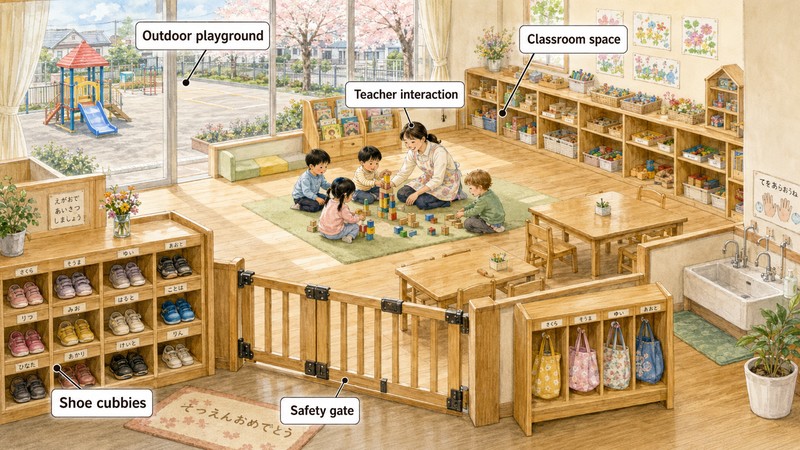
A nursery visit (園見学, en-kengaku) is your chance to assess whether a facility feels right for your child and family before committing. Most visits last 20 to 30 minutes and are guided by a staff member.
What to Observe
Space and environmentIs the classroom large enough for children to move freely? Is the outdoor space (or the route for walks, if there is no garden) safe and suitable? Is the facility clean and well-maintained?
Staff and atmosphereHow do the teachers interact with children? Do children look engaged and settled? Is the atmosphere calm or chaotic? Does the staff respond warmly to your questions?
Safety measuresAre entry and exit points secure? Is the facility free of obvious hazards? How are outdoor activities supervised?
Technology and communicationDoes the nursery use an app for daily updates and photos, or a paper notebook (連絡帳)? App-based communication can be easier for non-Japanese speakers since messages can be translated.
Questions to Ask at the Visit
Preparing questions in advance makes the most of your visit. You do not need to ask all of them — pick the ones that matter most to your situation.
| Question | Japanese (to show on your phone) |
|---|---|
| What do you value most in how you care for children? | 子どもを保育する上で大切にしていることは何ですか? |
| How often do children go outside? (If there is no garden) | 園庭がない場合、お散歩の頻度はどのくらいですか? |
| Is the daily log a notebook or an app? | 連絡帳はノートですか?アプリですか? |
| Is extended care available? Can I request it on the day? | 延長保育はできますか?当日申込みは可能ですか? |
| How quickly do you call parents if a child becomes ill or injured? | 病気やけがの場合、どのくらいの時間で連絡しますか? |
| How do you handle food allergies? | 食物アレルギーへの対応はどのようにしていますか? |
| Is there a bicycle or stroller parking area? | 駐輪場やベビーカー置き場はありますか? |
| Do you have experience with non-Japanese-speaking families? | 日本語が得意でない外国人の家庭を受け入れた経験はありますか? |
Tips for International Families
Hokatsu is stressful enough in Japanese. Here is what specifically helps when you are navigating it in a second language.
- Start at the municipal office first. Before visiting any nursery, go to your local 保育課 (childcare division at the city or ward office). Staff there can tell you exactly which nurseries are in your area, what your eligibility is, and how competitive your situation is likely to be. Many offices have multilingual support or can arrange a phone interpreter. Bring your 在留カード (residence card) and your employer's contact information.
- Ask about language support when you visit. Some nurseries have staff who speak English or another language, or have experience communicating via translation apps. This can make a significant difference in day-to-day communication — morning drop-off notes, illness calls, and event notices all arrive in Japanese.
- App-based communication is easier than paper notebooks. Nurseries that use a communication app often allow parents to receive messages in real time, which can be translated instantly on a smartphone. If language is a concern, ask specifically whether the nursery uses an app.
- List as many nurseries as possible on your application. Your application ranks nurseries in order of preference. The more you list, the better your statistical chance of placement. Do not limit yourself to two or three favorites — visiting eight and listing all eight is reasonable.
- Understand your 指数 (point score). Every applicant is assigned a numerical score — called 保育指数 (hoiku shisu) — and nursery places are allocated starting from the highest scorers. The exact criteria vary by municipality, but the most common factors are:
- — Both parents working full-time: highest base score
- — One parent full-time, one part-time: lower score
- — One parent not working: lowest score
- — Single-parent household: additional points in most areas
- — Currently on parental leave: scoring varies by municipality — in some areas you receive the same points as an active worker, in others you score lower; confirm with your local 保育課
Ask the municipal office (保育課) to show you how your situation is scored before you apply — this helps you understand how competitive your position is and whether to build in a backup plan.
- Have a backup plan. Even strong applicants do not always receive their first choice — or any 認可 place. Research 認可外 (unlicensed) options in your area in parallel, and ask the municipal office about any local subsidy schemes that can offset the higher fees.
Ready to apply?
Once you have visited nurseries and narrowed down your list, the next step is submitting your application. → How to Apply for Hoikuen: A Step-by-Step Guide
Japanese Vocabulary
| Japanese | Reading | Meaning |
|---|---|---|
| 保活 | hokatsu | The process of securing a nursery place |
| 認可保育園 | ninka hoikuen | Government-licensed nursery school |
| 保育課 | hoiku-ka | Childcare division at the municipal office |
| 保育指数 | hoiku shisu | Point score determining application priority |
| 待機児童 | taiki jido | Children on the waiting list for nursery |
| 隠れ待機児童 | kakure taiki jido | Children not counted in official waiting lists |
| 園見学 | en-kengaku | Nursery visit / tour |
| 認可外保育施設 | ninkagai hoiku shisetsu | Unlicensed childcare facility |
| 延長保育 | encho hoiku | Extended childcare beyond standard hours |
| 連絡帳 | renrakucho | Daily communication notebook between nursery and home |
| 認定こども園 | nintei kodomo en | Certified center combining nursery and kindergarten |
| 保育ママ | hoiku mama | Registered home-based childminder |