

Written and reviewed by Susumu
Born and raised in Japan · Checked against Japanese law and ministry guidance
A step-by-step guide to applying for 認可保育園 in Japan — eligibility, the October application window, the point-based selection system, required documents, costs, and what happens after acceptance.
Affiliate Disclosure: This article contains affiliate links. If you click a link and make a purchase, we may earn a small commission at no extra cost to you. We only recommend products we genuinely believe are helpful. See our Terms of Use for full details.

📌 Note: Timelines, scoring, and fees vary by municipality. This guide covers the general process — always confirm the details with your local ward or city office (区役所 / 市役所).
What Is 認可保育園?
認可保育園 (ninkai hoikuen) means "licensed daycare." These are government-approved facilities that meet national standards for space, safety, and staff-to-child ratios. Because they receive public funding, the fees are much lower than private daycare — which makes them popular, and competitive to get into.
The other type you'll see is 認可外保育施設 (unlicensed daycare). These are privately run, easier to get into, but charge a flat rate — usually ¥40,000 to ¥80,000 a month regardless of your income. For most families, licensed daycare is the better deal financially.
| 認可保育園 Licensed daycare |
認可外保育施設 Unlicensed daycare |
|
|---|---|---|
| Fees | Income-based; free for ages 3–5 and low-income households | Fixed: ¥40,000–¥80,000/month |
| Standards | National standards (floor space, staff ratios) | Varies; municipal inspection only |
| Admission | Point-based selection via municipality | Apply directly — easier to get in |
| Hours | Full-day (typically 7:30am–6:00pm) | Varies by facility |
Children can start from 57 days old up to age 5. That said, infant spots (especially for babies under 1) are limited and hard to get. Not all facilities take infants at all — something worth asking about when you visit.
Still deciding between daycare and kindergarten? See our Hoikuen vs. Yochien guide for a full comparison.
Who Can Apply?
To get a place at a licensed daycare, you need to show that you genuinely need childcare — in Japanese, this is called 保育の必要性 (hoiku no hitsuyousei). The idea is that neither parent is able to look after the child full-time at home.
The most common reason is that both parents work, but other situations count too:
- Working — full-time or part-time. More hours means more points in the selection process.
- Self-employed or freelance
- Actively job-hunting — though this gets you fewer points than being employed
- Pregnant or recently given birth — for example, when you need care for an older child
- Illness or disability — of a parent or guardian
- Caring for a family member — elderly parent, sick relative, etc.
- Enrolled in school or training
International residents can apply. There is no nationality requirement — you apply through the same process as Japanese families, as long as you and your child are registered as residents (住民登録). Your child needs to have a valid 住民票 at your address.
On a dependent visa (家族滞在)? You can still apply, but there's a catch. Dependent visa holders can only work up to 28 hours a week with supplementary activity permission (資格外活動許可). Fewer hours means a lower priority score in the selection process. All other work-authorized visas — Permanent Resident, Long-Term Resident, Engineer/Specialist, Specified Skilled Worker — have no restrictions.
Application Timeline
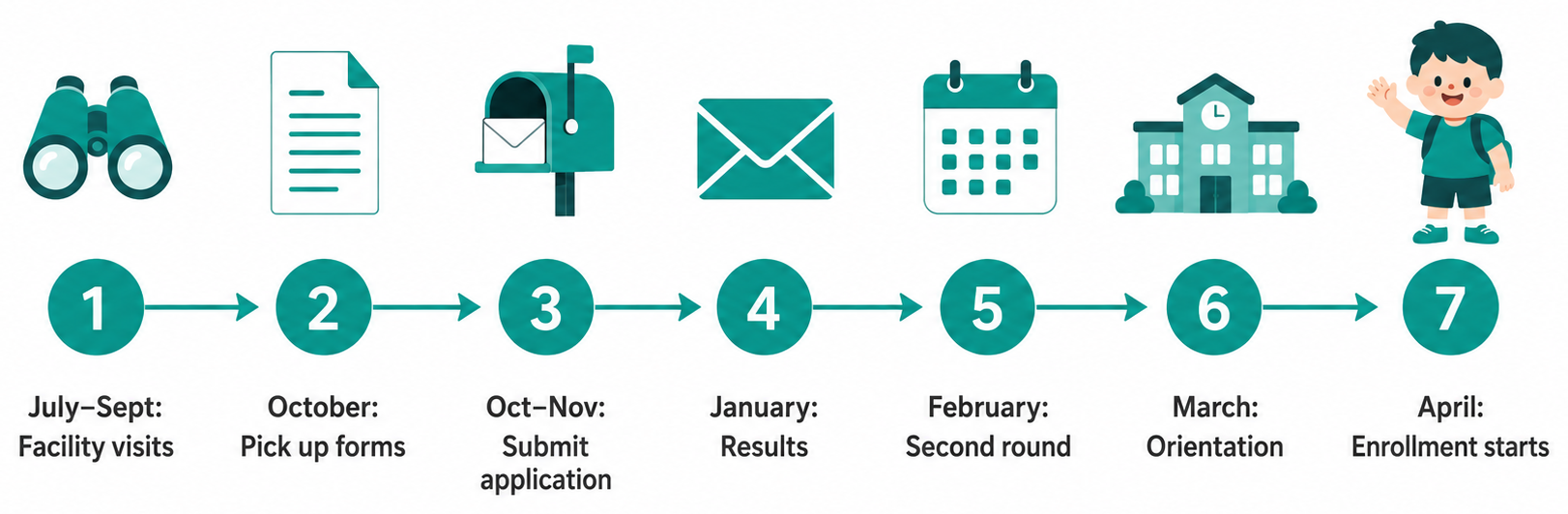
The most important intake is April 1 — when Japan's new school year begins and the most spots open up. If you miss the application window for April, you're either waiting for the occasional mid-year opening (limited, especially for infants) or trying again the following year.
| When | What to Do |
|---|---|
| July – September | Visit the facilities you're interested in (見学 / kengaku). You'll need to book in advance. Go early — popular places fill tour slots fast. |
| Early October | Pick up the application packet from your ward or city office. Read the 入園案内 (enrollment guide) — it explains how your local scoring works and the exact deadlines. |
| October – November | Submit your application with all documents, listing up to 10 facilities in order of preference. Do not miss this deadline. |
| January | Results come by mail. If you got in, expect a phone call too. If not, your application automatically carries over to the next monthly review. |
| February | Second round for remaining spots. If you were accepted, contact the facility to arrange your pre-enrollment orientation. |
| March | Orientation at the facility. You'll get a full list of items to prepare, and submit health records and allergy information. |
| April 1 | Your child starts. Most facilities begin with ならし保育 — a gradual settling-in period (see below). |
Need daycare before April? Mid-year applications are possible, but spots are scarce. Apply around six weeks before your target start date — usually by the 10th of the month before. Infant places in particular are very hard to find mid-year.
The Point System (保育指数)
When there are more applications than spots — which happens often in cities — your local municipality uses a point-based ranking system called 保育指数 (hoiku shisuu) to decide who gets in. Both parents are scored separately and the totals are added together. The higher your combined score, the better your chances.
The scoring works in two parts:
- 基準指数 (kijun shisuu) — base points based on your employment status and working hours
- 調整指数 (chōsei shisuu) — bonus points or deductions based on your family situation
The figures below are a general illustration. Every municipality publishes its own table and the numbers differ, so treat these as the shape of the thing and not as your own score — our guide to how nursery places are scored explains the national framework underneath and how to find the table your own city uses.
| Situation (per parent) | Typical base points |
|---|---|
| Full-time employment (160+ hrs/month) | 20 pts |
| Part-time (120–160 hrs/month) | 17–18 pts |
| Part-time (under 120 hrs/month) | 12–16 pts |
| Illness, disability, or caregiving | 16–20 pts |
| Job-seeking | 8–10 pts |
On top of the base score, adjustments can be made:
- Single-parent household: +3 to +6 pts
- Sibling already at the same facility: +1 to +3 pts
- Currently using unlicensed daycare: +1 to +3 pts
- Live-in grandparent or relative who could provide care: −2 pts
Every municipality has its own version of this system, so the exact numbers will differ where you live. When you pick up your application packet in October, look for the 入園案内 (nyuuen annai) — the official enrollment guide. It will tell you exactly how scores are calculated in your area.
Documents You'll Need
One thing that surprises many people: you don't apply directly to the daycare. Everything goes through your local ward or city office. Here's what you'll typically need to bring:
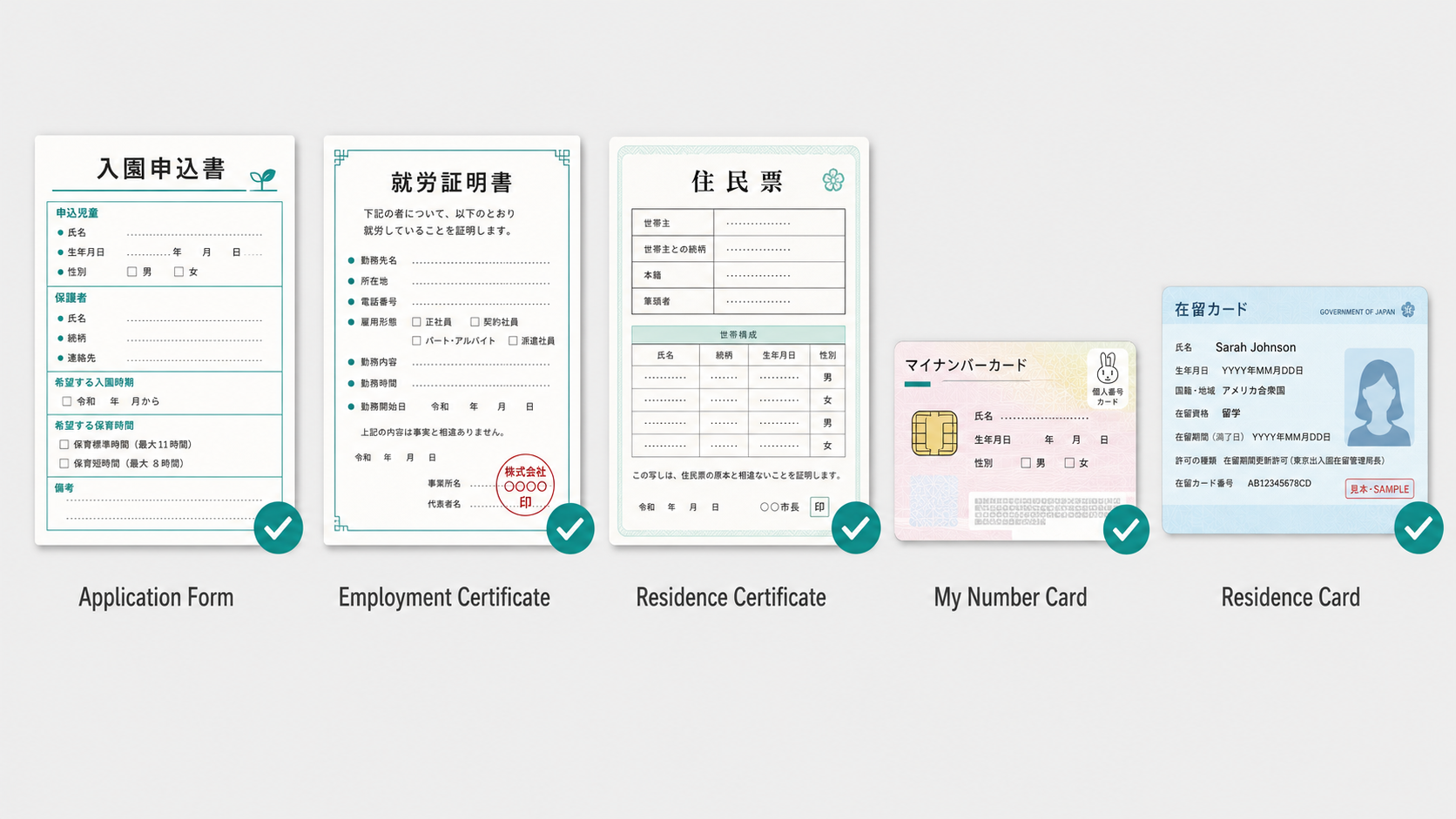
- 入園申込書 (application form) — lists your preferred facilities in order (up to 10). You get this from the ward office.
- 就労証明書 (employment certificate) — filled out and stamped by your employer. This confirms your working hours and type of employment. It's the single most important document in the whole application.
- 住民票謄本 (jūminhyō) — your family's residence certificate. Must be issued within the past 3 months.
- マイナンバー documents — My Number for the child and both parents.
- 母子健康手帳 (boshi techou) — your child's health handbook.
- Tax documents — used to calculate your fee. Either a 課税証明書 (tax certificate) or a consent form letting the ward access your tax records directly.
International residents — you'll also need:
- A copy of your 在留カード (residence card) — front and back
- If you're on a dependent visa: a copy of your 資格外活動許可 (supplementary activity permission)
- If your employer gave you the employment certificate in a foreign language: attach a Japanese translation
All application forms are in Japanese. If reading or writing Japanese is difficult for you, go to the ward office in person — the staff can help you fill things in. Some wards in areas with many international residents offer multilingual support or interpreter services. Call ahead to check.
Costs & Free Care
Since October 2019, the Japanese government's 幼保無償化 (yoho mushōka) policy made daycare free for children aged 3 to 5. This covers both Japanese and international residents, as long as you're registered as a resident — income doesn't matter.
For children under 3, fees are calculated based on your household's resident tax (住民税). The amount varies quite a bit depending on where you live and what you earn:
| Child's age | Monthly fee |
|---|---|
| Age 3–5 | Free — national policy, all income levels |
| Age 0–2 | Income-based; exact amount varies by municipality and household income |
| Age 0–2 (low-income / 住民税 non-taxable) | Free |
| Age 0–2 in Tokyo (from Sept 2025) | Free for first child — Tokyo metropolitan policy only |
If you have more than one child in daycare at the same time:
- 2nd child: 50% off
- 3rd child and beyond: free, regardless of age
What "free" doesn't include: Food ingredient costs, transport, supplies, and any extra charges for extended hours are billed separately by each facility. Factor these in when budgeting.
Results & the Waiting List
For April enrollment, results arrive in late January or early February — usually a letter in the mail, and a phone call if you got in. If you didn't get a place, you'll receive a 不承諾通知書 (fushōdaku tsūchisho) — a rejection notice. It sounds final, but in most cities it isn't: unless you withdraw it, your application carries into the next round and you stay on the waiting list. Our guide to what to do if you don't get a place covers the next steps, including the documents you need if you're extending parental leave.
If that happens, here's what you can do:
- Apply for second-round spots in February
- Enroll temporarily in an unlicensed facility while you wait
- In Tokyo: look into 認証保育園 (ninsho hoikuen) — a Tokyo-specific tier between licensed and unlicensed, with partial subsidy
The waiting list situation has improved a lot. According to the Children and Families Agency, the number of children nationally waiting for daycare peaked at around 26,000 in 2017 and had fallen to 2,254 by April 2025. Central Tokyo, Osaka, and other big cities are still competitive for infants, but in many areas outside the city center, it's much easier than it used to be.
ならし保育: The Settling-In Period
When your child starts in April, most hoikuen don't just drop them straight into a full day. Instead, there's a gradual settling-in period called ならし保育 (narashi hoiku), usually spread over one to two weeks. It typically goes like this:
For everything to have ready before that first morning — spare clothes, diapers, nap bedding, labeling, and the daily notebook — see our guide to getting ready for daycare.
- Days 1–2: 1–2 hours only
- Days 3–5: Half a day (usually no lunch or nap yet)
- Days 6–10: Building up to a full day
If you're going back to work in April, plan ahead. During ならし保育, you can't leave your child for a full working day — even if your parental leave has already ended. Talk to your employer before you accept the daycare place. Some facilities can speed up the schedule for parents with real work constraints, but it depends on the facility and how well your child adapts.
The exact schedule for your child will be discussed at the March orientation. Every facility does this a little differently.
🔔 Didn't qualify? There is now another route: こども誰でも通園制度
Since April 2026, every municipality in Japan offers a separate system that lets children aged six months to under three attend a licensed facility for a set number of hours each month — even if neither parent works. It is not a substitute for a full hoikuen place, but it does not require you to prove a childcare need, and it is not points-based. See our guide to hourly daycare without a job for who qualifies, what it costs, and how to apply.
📖 Japanese Vocabulary
Useful terms for the hoikuen application process.
| 日本語 | ひらがな | English |
|---|---|---|
| 認可保育園 | にんかほいくえん | Licensed daycare center |
| 保育の必要性 | ほいくのひつようせい | Childcare need (eligibility requirement) |
| 入園申込書 | にゅうえんもうしこみしょ | Daycare application form |
| 就労証明書 | しゅうろうしょうめいしょ | Employment certificate |
| 保育指数 | ほいくしすう | Childcare priority score |
| 利用調整 | りようちょうせい | Needs assessment / selection process |
| 待機児童 | たいきじどう | Children on the daycare waiting list |
| ならし保育 | ならしほいく | Gradual settling-in period |
| 幼保無償化 | ようほむしょうか | Free early education policy (ages 3–5) |
| 不承諾通知書 | ふしょうだくつうちしょ | Rejection notice |
| 入園案内 | にゅうえんあんない | Municipal enrollment guide booklet |
| 見学 | けんがく | Facility visit / tour |