

Written and reviewed by Susumu
Born and raised in Japan · Checked against Japanese law and ministry guidance
Licensed nursery places in Japan are not first-come or drawn at random. Every household is scored, and places go down the list from the highest. This is how that thinking works: what the national rules cover, why looking for work still qualifies you to apply, where residence status quietly enters, and the one search term that finds your own city's table.
Affiliate Disclosure: This article contains affiliate links. If you click a link and make a purchase, we may earn a small commission at no extra cost to you. We only recommend products we genuinely believe are helpful. See our Terms of Use for full details.

Licensed nursery places in Japan are not given out first-come, first-served, and they are not drawn from a hat. Each family is scored, and places go down the list from the highest score. The score has a name — 保育指数 — and most parents applying for the first time have never seen the table it comes from.
This guide is about how that thinking works, not about the numbers in any one city. Those are set locally and there are well over a thousand versions. What is national is the framework underneath, and knowing that framework tells you whether you can apply at all, what the score is made of, and where to find your own city's table.
Why Places Are Scored
Licensed childcare in Japan exists for children whose families cannot care for them during the working day. That is written into the system rather than being a matter of custom, and it has a consequence: because places are limited and demand is uneven, they have to be shared out on some defensible basis.
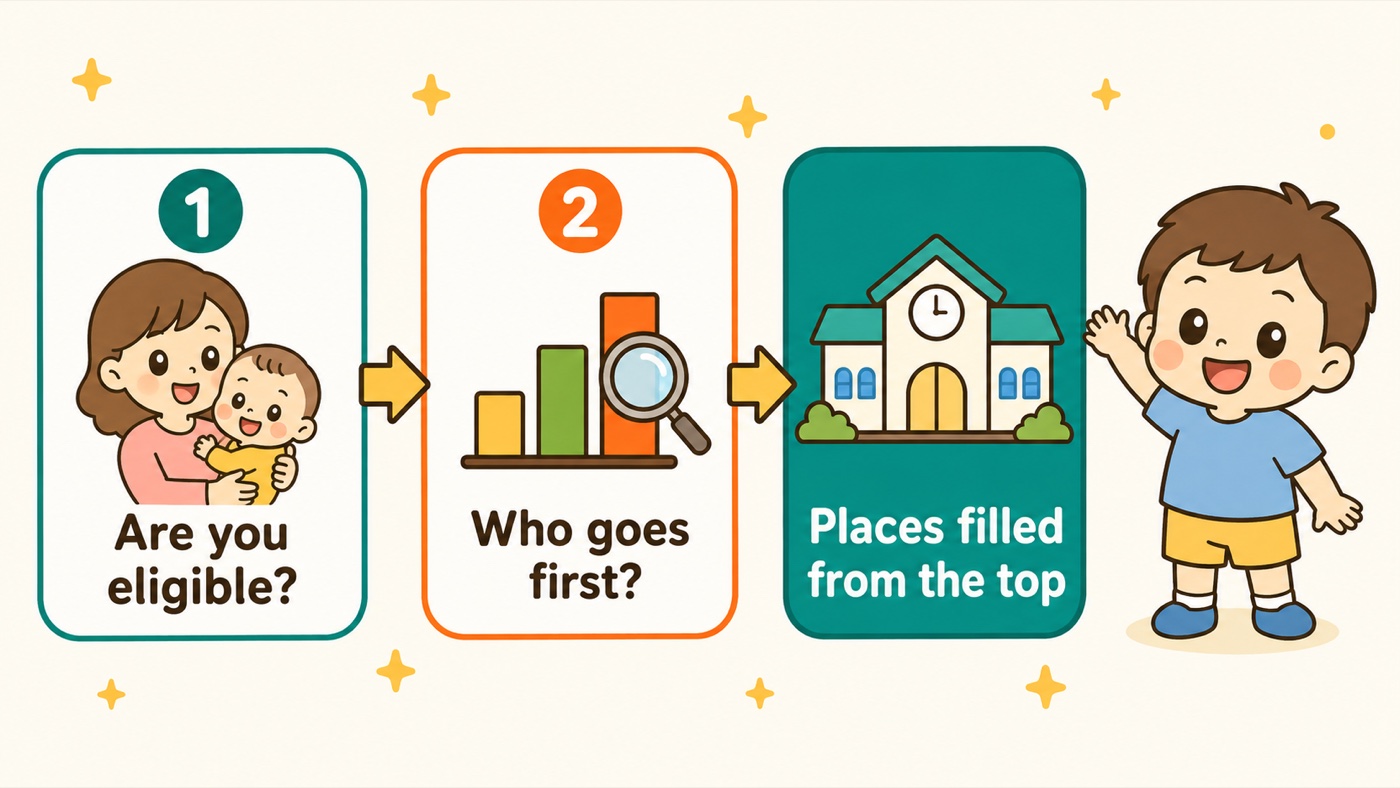
The basis Japan chose is a score. Your household's circumstances are converted into a number, applications are ranked, and places are filled from the top. Municipalities call this stage 利用調整 (riyō chōsei) — the allocation.
Two things follow, and both matter more than they sound. Applying early in the window does not help you; the ranking is what counts. And a low score is not a rejection of your family — it is a statement about how the year's applicants compare, and it can change as your circumstances do.
Whether You Can Apply at All
Before any scoring happens, your city has to certify that your household needs childcare — 保育の必要性の認定. The grounds for that are set nationally, so this part is the same wherever you live.
Any one of the following qualifies a household:
Employment
full-time, part-time or night work
Pregnancy or childbirth
A parent's illness or disability
Caring for a relative
at home or in long-term care
Disaster recovery
Looking for work
including starting a business
Studying
including vocational training
Risk of abuse or domestic violence
On parental leave
with an older child already enrolled
Anything comparable
as the municipality decides
Two of those surprise people, and both are national. You do not need a job already — looking for work is on the list. And studying counts, which reaches parents at a language school or in vocational training. Families who assume the door is closed because nobody is employed yet are working from the wrong picture. How each situation is weighted is a separate question, and that is where the local table comes in.
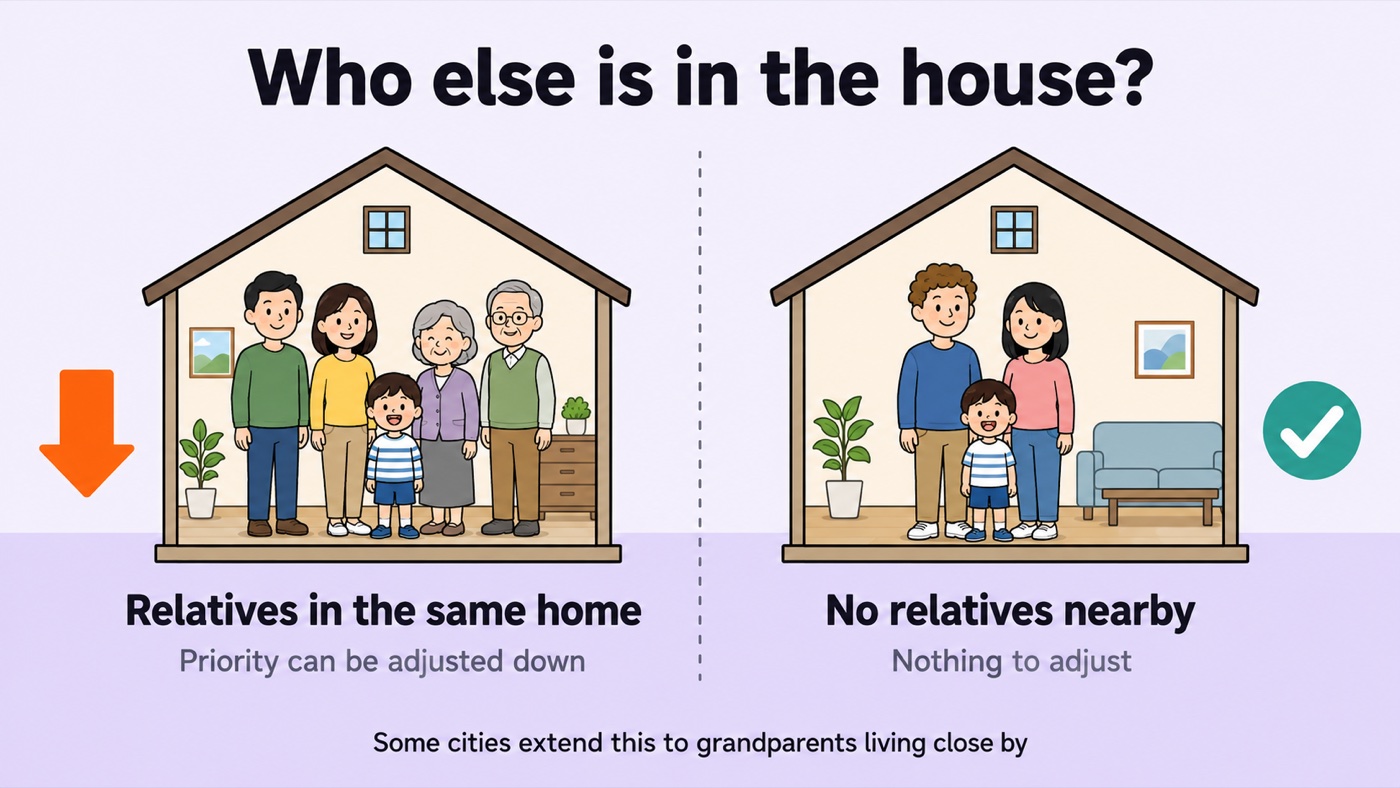
One line sits underneath that national list and is easy to miss: where a relative living in the same household could care for the child, a municipality is allowed to adjust the household's priority downward. Grandparents under the same roof, in other words, can count against you.
For most international families this quietly works the other way. With no relatives in the country, the adjustment has nothing to attach to. Some local tables extend the idea to grandparents living nearby rather than in the house, which is one more reason to read your own city's version rather than a general description of the system.
Standard Hours or Short Hours
Once the need is recognized, it is sorted into one of two national bands. These decide how many hours a day your child may attend, and they feed into the score.
The two national bands
保育標準時間 standard hours
Built around full-time work — roughly 120 hours a month and above.
保育短時間 short hours
Built around part-time work — below that figure, down to a floor set somewhere between 48 and 64 hours a month.
Below the floor, no certification. There is a minimum amount of work under which a household is not certified at all — and where exactly that line falls is your city's decision, within the range above.
Where residence status meets this
For most families this is arithmetic. For some international households it is the whole question, and the two halves of it are documented in places that never refer to each other.
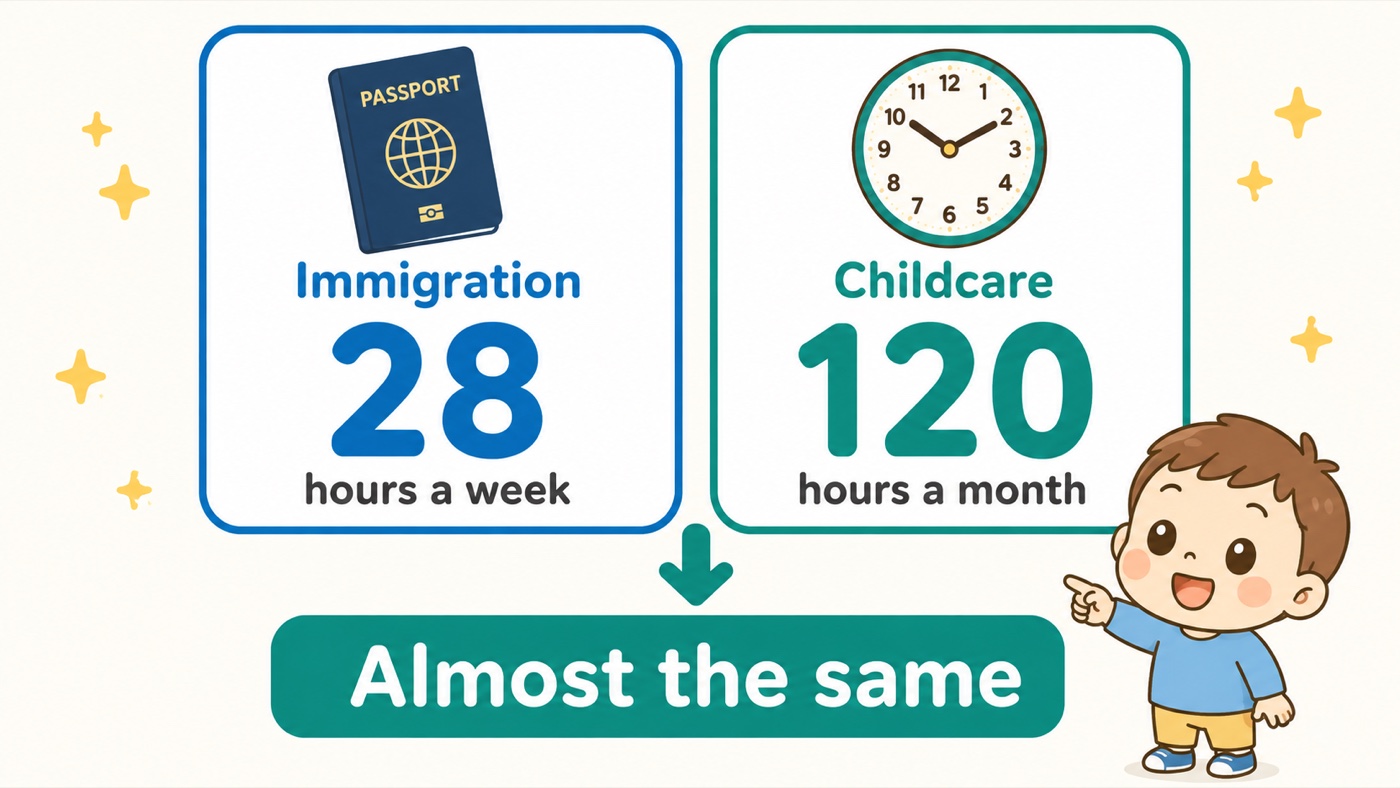
A spouse holding a dependent visa (家族滞在) may work only with permission for activities outside their status — 資格外活動許可 — and the Immigration Services Agency caps that general permission at 28 hours a week. Meanwhile the childcare system reads full-time as around 120 hours a month.
Those two numbers look unrelated until you convert them. Twenty-eight hours a week comes to roughly 121 hours a month. A spouse working the full amount their status permits lands, by coincidence, almost exactly on the line the childcare system treats as full-time.
Anything to do with your visa itself — whether to apply for permission, what your status allows, whether to change it — belongs to the Immigration Services Agency or to a qualified adviser, not to a childcare guide. What is worth knowing here is simply that the two systems touch, and that the childcare office deals with the second half of it every day.
What Moves Your Standing
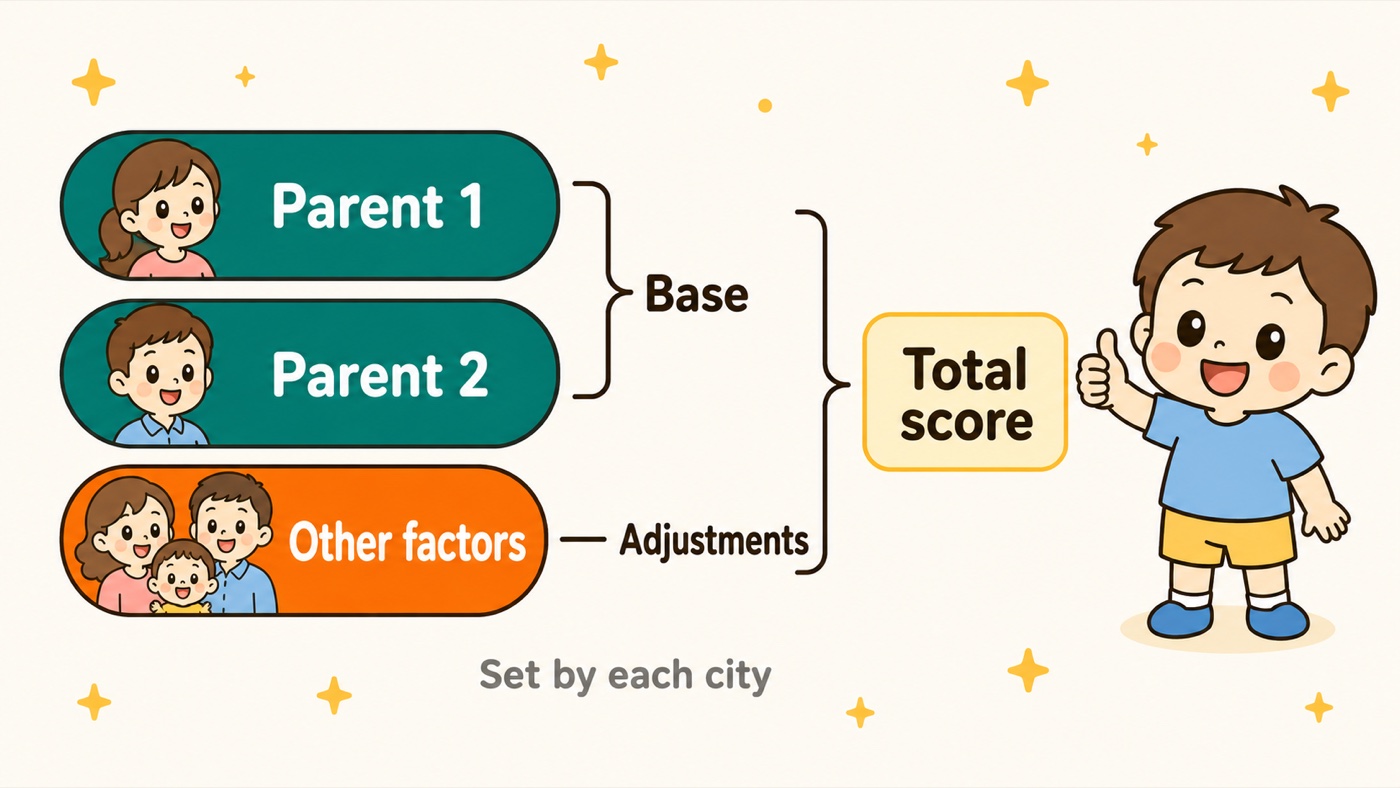
Every municipality builds its score the same way in outline. There is a base figure that comes from why you need care and how much, and then adjustments for circumstances that make a household's need more pressing. The two are added together.
The national guidance lists the situations that municipalities are expected to treat as priorities. Your own city's table will have its own version, but it is generally built around these:
- Single-parent households
- Households receiving public assistance
- Where the main earner has lost their job and the need to work is pressing
- Risk of abuse or domestic violence, and other situations calling for social protection
- Where the child has a disability
- Returning from parental leave
- Siblings, including multiples, applying to the same facility
- Children graduating from a small-scale nursery that only runs to age two
Local tables usually go further, and the additions are where the variation lives — whether time already spent at an unlicensed facility counts for anything, how commuting distance figures, how a grandparent living nearby rather than in the house is treated. There is no point in guessing at these. They are published, which is the subject of the next section.
Finding Your Own City's Table
If you take one search term away from this guide, make it this one. Municipalities publish the whole scoring table, usually as a PDF, and it is easier to find than most people expect. Search for your city's name together with:
利用調整基準
riyō chōsei kijun
the standards a city uses to rank applications
If that returns nothing, try 選考基準 (senkō kijun, selection criteria) or 入所基準 (nyūsho kijun, admission criteria) — different cities favor different words for the same document. It is also usually linked from the application booklet, which most municipalities put online as 入園のご案内 or similar.
What you get is a grid: the base figures down one side, the adjustments listed below, and a column of numbers. It will be in Japanese, and a translation tool handles it reasonably well because the document is mostly a table rather than prose.
Reading it will not tell you whether you will get a place. What it does tell you is which of your circumstances the city has decided to count, and that is genuinely useful — it is the difference between applying blind and applying with your eyes open.
Ask Before You Apply
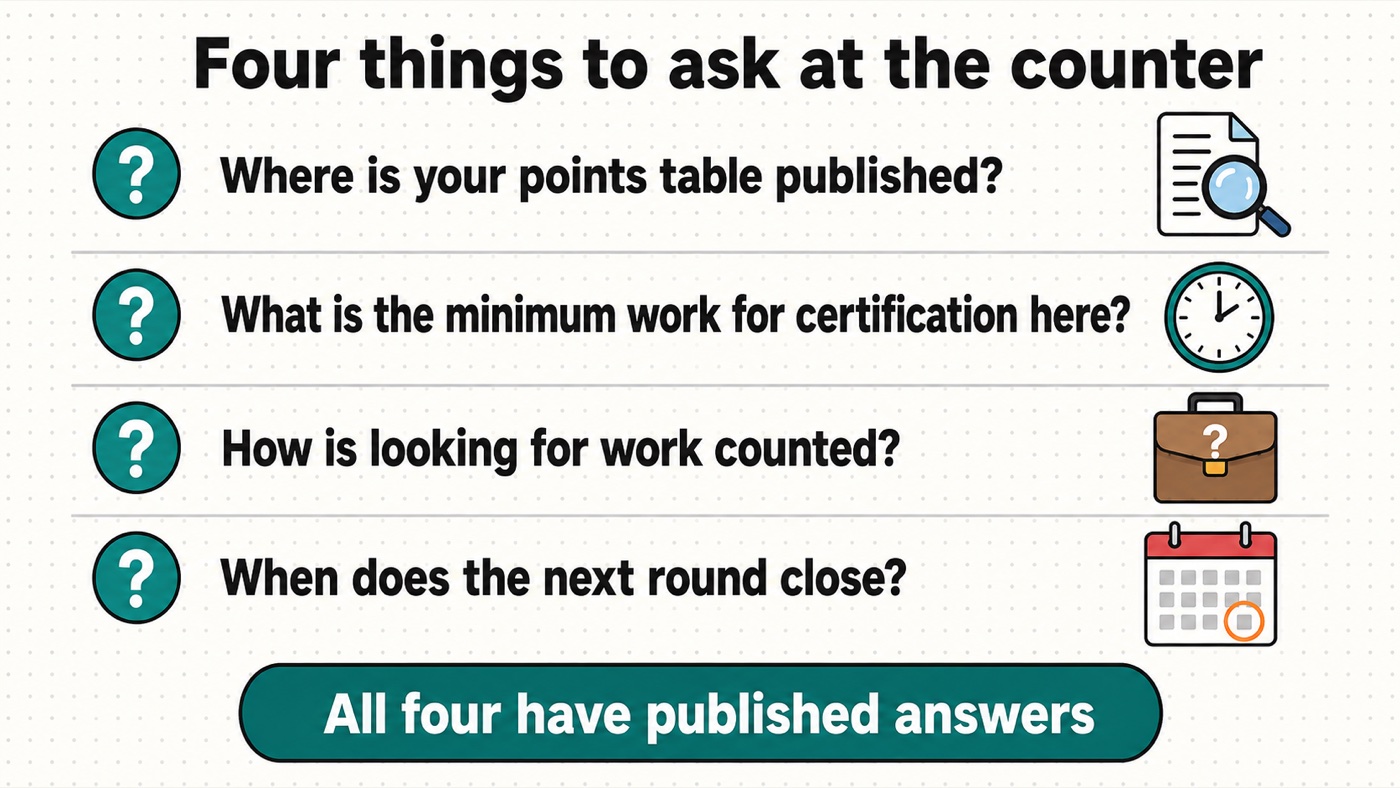
The childcare desk will walk you through how your own household would be scored, and you can ask before submitting anything. Most families never do, which is a shame: it is a short conversation and it is the one that tells you whether you need a backup plan.
Bring what you know about both parents' working hours, and expect to be asked for a 就労証明書 (shūrō shōmeisho) — a form your employer completes confirming your hours. Municipalities have their own version of it, so collect the form first and give your employer time.
These are the five worth having ready. Read the middle line aloud, or simply show the screen — either works at the counter.
我が家の場合、指数は何点になりますか。
Wagaya no baai, shisū wa nanten ni narimasu ka?
How would my household be scored?
利用調整基準の表はどこで見られますか。
Riyō chōsei kijun no hyō wa doko de miraremasu ka?
Where can I see the scoring table?
この勤務時間だと、保育標準時間と保育短時間のどちらになりますか。
Kono kinmu jikan da to, hoiku hyōjun jikan to hoiku tanjikan no dochira ni narimasu ka?
With these hours, would it be standard hours or short hours?
まだ求職中ですが、申し込みはできますか。
Mada kyūshoku-chū desu ga, mōshikomi wa dekimasu ka?
I am still looking for work. May I apply?
4月入園の申込みの締切はいつですか。
Shigatsu nyūen no mōshikomi no shimekiri wa itsu desu ka?
When is the deadline for April places?
That last question matters as much as the score does. Most places are filled in one annual round for April entry, with applications taken the previous autumn, and a household with a strong score that misses the window still waits. Our guide to applying for a hoikuen place sets out the schedule and the documents, and finding a nursery covers the search itself.
What the Score Cannot Tell You
It is worth being clear about the limits, because a number invites more confidence than it deserves.
It does not predict the outcome. Your score is only meaningful against the other applications received that year, for the specific facilities you listed. The same score can succeed in one ward and not in the next, or succeed one year and not the following one.
There is nothing to game. The figures describe circumstances rather than rewarding strategy, and the office sees every application in the district. The useful work is understanding where you stand and preparing for either answer — not manufacturing a higher number.
A licensed place is not the only route. If one does not come through, unlicensed facilities, temporary care, and the newer hourly system with no work requirement all exist alongside it, and some cities count time at an unlicensed facility in the following year's application.
Japanese Vocabulary
The words that appear on the forms and in the tables:
| Japanese | Reading | Meaning |
|---|---|---|
| 保育指数 | hoiku shisū | The score a household is given |
| 利用調整基準 | riyō chōsei kijun | The published scoring table — search for this |
| 保育の必要性 | hoiku no hitsuyōsei | The recognized need for childcare |
| 保育標準時間 | hoiku hyōjun jikan | The longer of the two daily bands |
| 保育短時間 | hoiku tanjikan | The shorter band |
| 就労証明書 | shūrō shōmeisho | Your employer's confirmation of your hours |
| 資格外活動許可 | shikakugai katsudō kyoka | Permission to work outside your residence status |
| 求職活動 | kyūshoku katsudō | Job hunting — a recognized ground for applying |
The scoring can feel opaque from outside, and the reason is mostly that the document explaining it is never handed to you. It is published, it is findable, and the desk that wrote it will talk you through your own line on it. That is a better position to apply from than most families manage.