Written and reviewed by Susumu
Born and raised in Japan · Checked against Japanese law and ministry guidance
A daycare place is a relief, and then the list arrives. What to prepare before the first day — spare clothes, diapers, nap bedding, labeling, the daily notebook — plus the two care-hour categories that decide how long your child can actually stay.
Affiliate Disclosure: This article contains affiliate links. If you click a link and make a purchase, we may earn a small commission at no extra cost to you. We only recommend products we genuinely believe are helpful. See our Terms of Use for full details.
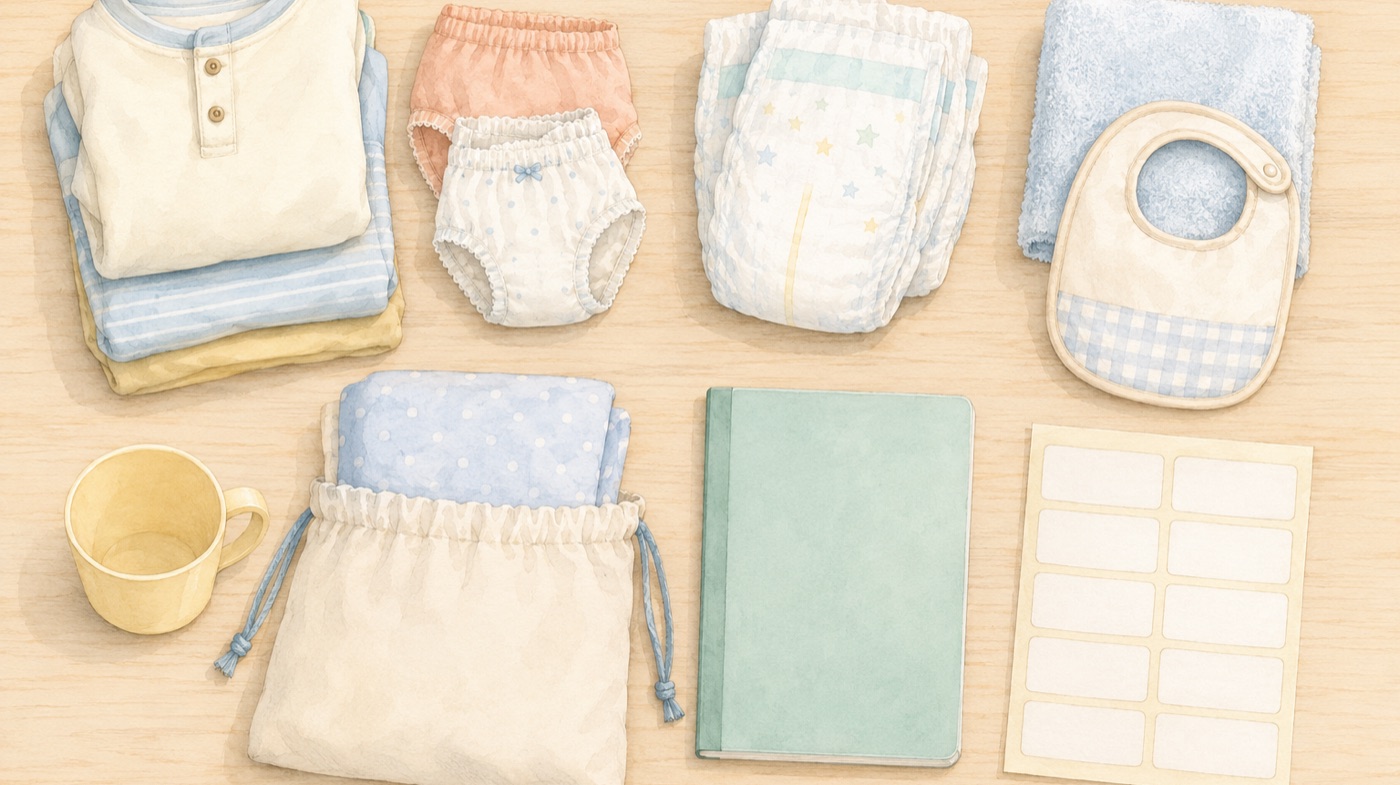
Hoikuen preparation works differently from school. Instead of one big bag bought once, it is a stock that keeps circulating: spare clothes in, dirty clothes out, diapers topped up, bedding home on Fridays. Add the labeling and the daily notebook, and there is real work in the first month. This guide covers what to gather before the start, what the facility provides, what the two care-hour categories mean for your day, and where the ongoing routine settles.
Your Hours Are Not the Opening Hours
Before the supply list, settle the question that shapes every weekday: how many hours your family is actually approved for. When your municipality certifies the need for childcare, it assigns one of two categories — 保育標準時間 (hoiku hyōjun jikan), standard hours, up to 11 hours a day; or 保育短時間 (hoiku tanjikan), short hours, up to 8 hours a day. Which one you get follows from how much the parents work, and your actual drop-off and pickup times are set within that ceiling.
The gap that catches families out is between the facility being open and your child being able to stay. A hoikuen may open early and close late, but your certified hours, the facility's extended-care (延長保育, enchō hoiku) rules, and your child's age group all narrow it. Confirm the exact window with both the municipality and the facility, and ask what happens when a train delay makes you late — there is usually a number to call and sometimes a charge.
If you are still at the application stage, our guides to hokatsu and applying for hoikuen cover how places are allocated.
Wait for the Facility's List
Do not buy a full daycare set from a generic online list. Facilities differ on what they supply and what you bring, and they can be specific about sizes: the nap sheet that fits their cots, the bag shape that fits their hooks, how many spare outfits they want on the shelf. Buying early usually means buying twice.
The real list comes at the pre-start orientation, along with the forms to return and the fee schedule. Ask in the same conversation which items stay at the facility and which travel daily, since that changes how many of each you need. It is also worth asking for the monthly fees and any one-time purchases in writing: childcare fees themselves are covered for many families, but meals, diapers, bedding, extended care, and event costs are often billed separately.
The Daily Bag
The bag that goes back and forth each day is mostly clothes and consumables. Younger children need more of everything, and the amounts rise in summer when clothes change several times a day.
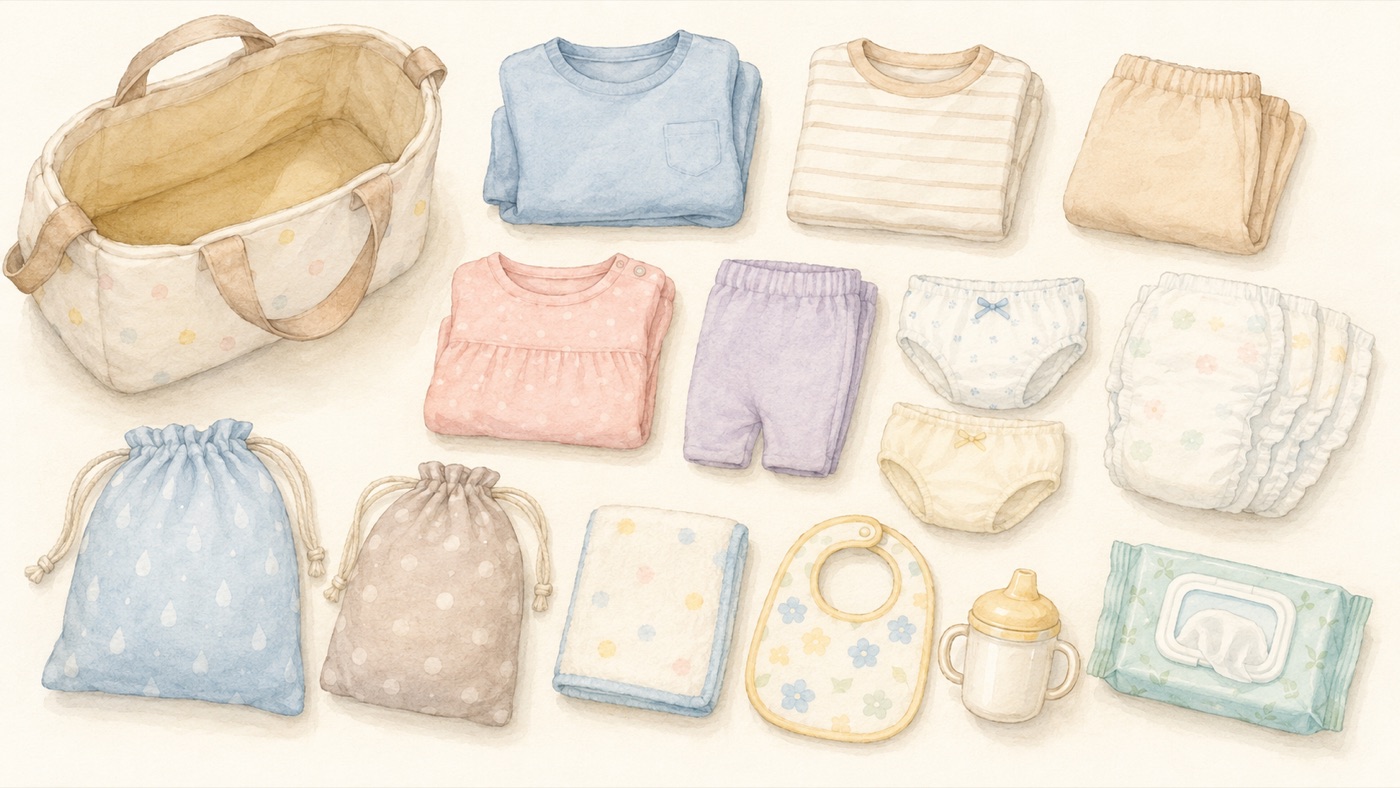
- Several changes of clothes and underwear — more than feels necessary, in the number the facility asks for.
- Diapers and wipes, if your child is still in them, often in a daily count rather than a big pack.
- A hand towel, and bibs or feeding towels for the younger age groups.
- A cup or water bottle, depending on the age group.
- Bags for wet and soiled items (汚れ物, yogoremono) — plain washable or plastic bags that come home each day.
- A seasonal hat, outdoor layers, or rain gear as the weather turns.
Clothes matter more than they look: elastic waists, no hoods or drawstrings, nothing the child cannot manage alone. Facilities often ask for exactly this, since children change themselves as soon as they are able.
Nap Bedding and Laundry
Daytime naps mean bedding, and this is one of the biggest differences between facilities. Some provide cots and sheets; others ask families to bring a futon or a nap mat and take the covers home to wash — commonly on Fridays, sometimes weekly by rotation. Ask exactly what you supply, what size, and how often it comes home, because a futon in a carry bag on a bicycle in the rain is a thing worth knowing about in advance.
The laundry rhythm is the other half of it. Wet clothes, soiled clothes, towels, and bibs come home daily; bedding weekly. Families who keep a spare set already packed find the mornings much easier than those washing to a deadline.
Meals, Allergies, and Diapers
Hoikuen provides meals, which is one of its real advantages over kindergarten, but the details have a wrinkle worth knowing. For children under three, the meal is part of the childcare itself, and there is nothing extra to send. From age three the food is treated separately: even where childcare fees are covered, families normally pay for the meal — both the rice or bread (主食, shushoku) and the dishes (副食, fukushoku). Many facilities simply bill for both, but some ask you to send the rice from home instead of paying for it, which is why you see children arriving with a small container of rice. Ask which arrangement yours uses before assuming nothing needs to be packed. Reduced-income households and third-or-later children are often exempt from the side-dish charge, so it is worth asking the municipality too.
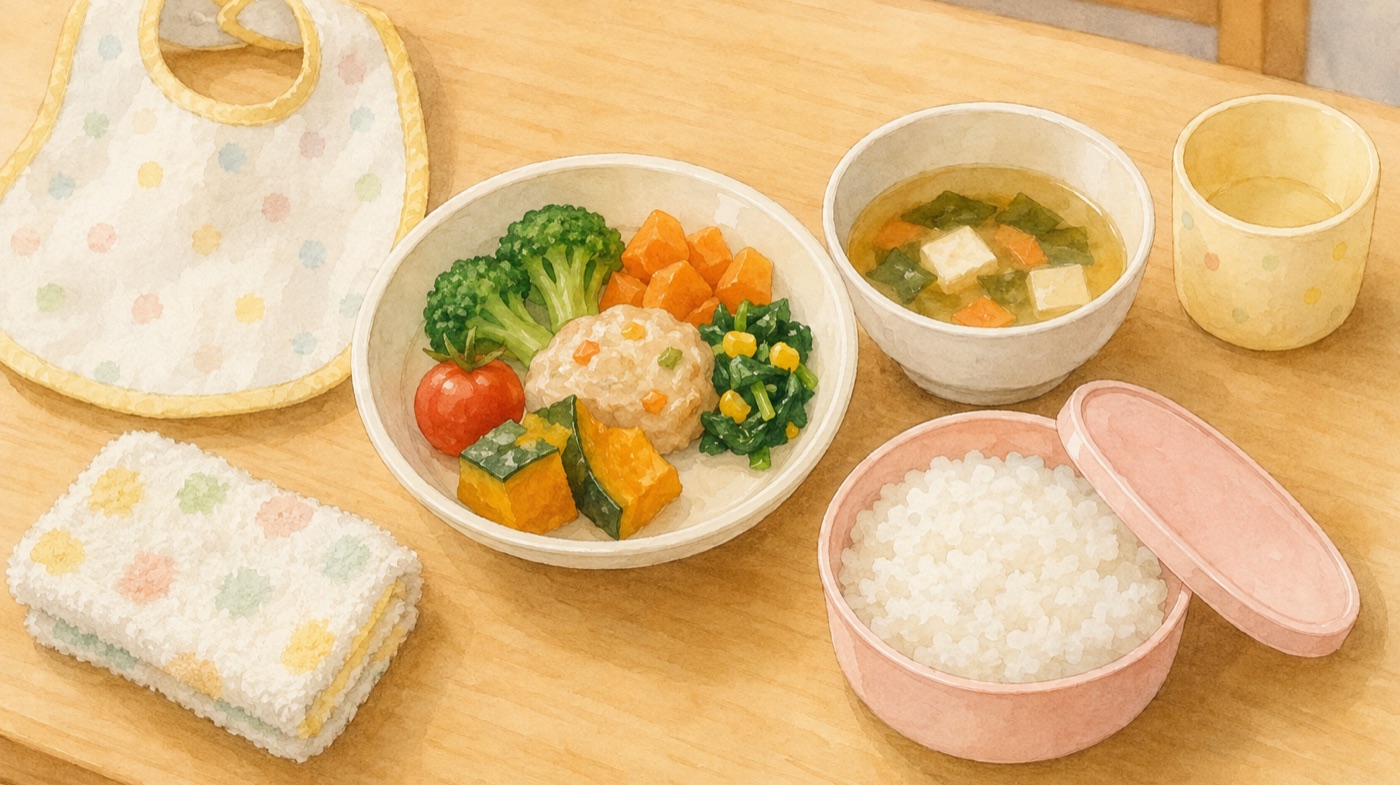
Allergies, medication, and dietary or religious restrictions need to be raised at the earliest stage, in writing, not mentioned at drop-off. Ask which form or doctor's certificate the facility needs before it can remove an ingredient, and what it can safely manage — for a complex allergy the answer shapes the arrangement. The same applies to diapers: ask whether you bring them daily or in bulk, and whether used ones come home, which still happens at some facilities. If your child is still on baby food, the kitchen will also give you a food-check list to work through at home — our guide to starting solids in Japan explains how that list works.
Labeling and the Daily Notebook
Everything gets a name: socks, towels, bibs, cups, and often every individual diaper. A name stamp is the practical answer for a stack of diapers, where writing by hand does not scale. Some facilities also want a class name or child number, so check the format before you label a whole wardrobe. Our guide to name labeling covers the methods and where the name goes.
The other daily habit is the communication notebook, 連絡帳 (renrakuchō) — temperature, sleep, meals, mood, and anything the staff should know, exchanged every day on paper or through an app. It works best as part of the morning routine rather than a form you remember occasionally; our renrakucho guide shows what to write and how to read what comes back.
The First Weeks, and Sick Days
Almost every family starts with 慣らし保育 (narashi hoiku), a phased settling-in: an hour or two at first, then through lunch, then the nap, building to full days over one to two weeks. Do not schedule a return to full working hours on the assumption that day one is a full day — our narashi hoiku guide explains the typical progression.
Plan for illness before it happens, because the first months of group care bring a run of it. Ask the facility at what temperature or symptoms it will call you, and how long a child must stay home after a fever, vomiting, or a diagnosed infection. Then decide, in advance, who can collect your child when both parents are at work. A backup adult usually has to be registered with the facility before they are allowed to pick up. Our guide to the daily schedule covers how the ordinary day runs once all of this settles.
Japanese Vocabulary
The words that come up on the supply list and in the first weeks:
| Japanese | Reading | Meaning |
|---|---|---|
| 保育標準時間 | hoiku hyōjun jikan | Standard care hours, up to 11 a day |
| 保育短時間 | hoiku tanjikan | Short care hours, up to 8 a day |
| 延長保育 | enchō hoiku | Extended care beyond your certified hours |
| 汚れ物 | yogoremono | Wet or soiled items that come home daily |
| 主食 | shushoku | The rice or bread part of a meal, sometimes brought from home |
| 副食 | fukushoku | The dishes served with the rice; billed as 副食費 |
| お布団 | o-futon | Nap bedding, often taken home to wash |