
Written and reviewed by Susumu
Born and raised in Japan · Checked against Japanese law and ministry guidance
Weaning in Japan follows a national guide, four named stages, and a first spoonful of very thin rice porridge. When to start, what to offer, why allergens should not be delayed, and the daycare food-check list that decides what your child is served.
Affiliate Disclosure: This article contains affiliate links. If you click a link and make a purchase, we may earn a small commission at no extra cost to you. We only recommend products we genuinely believe are helpful. See our Terms of Use for full details.
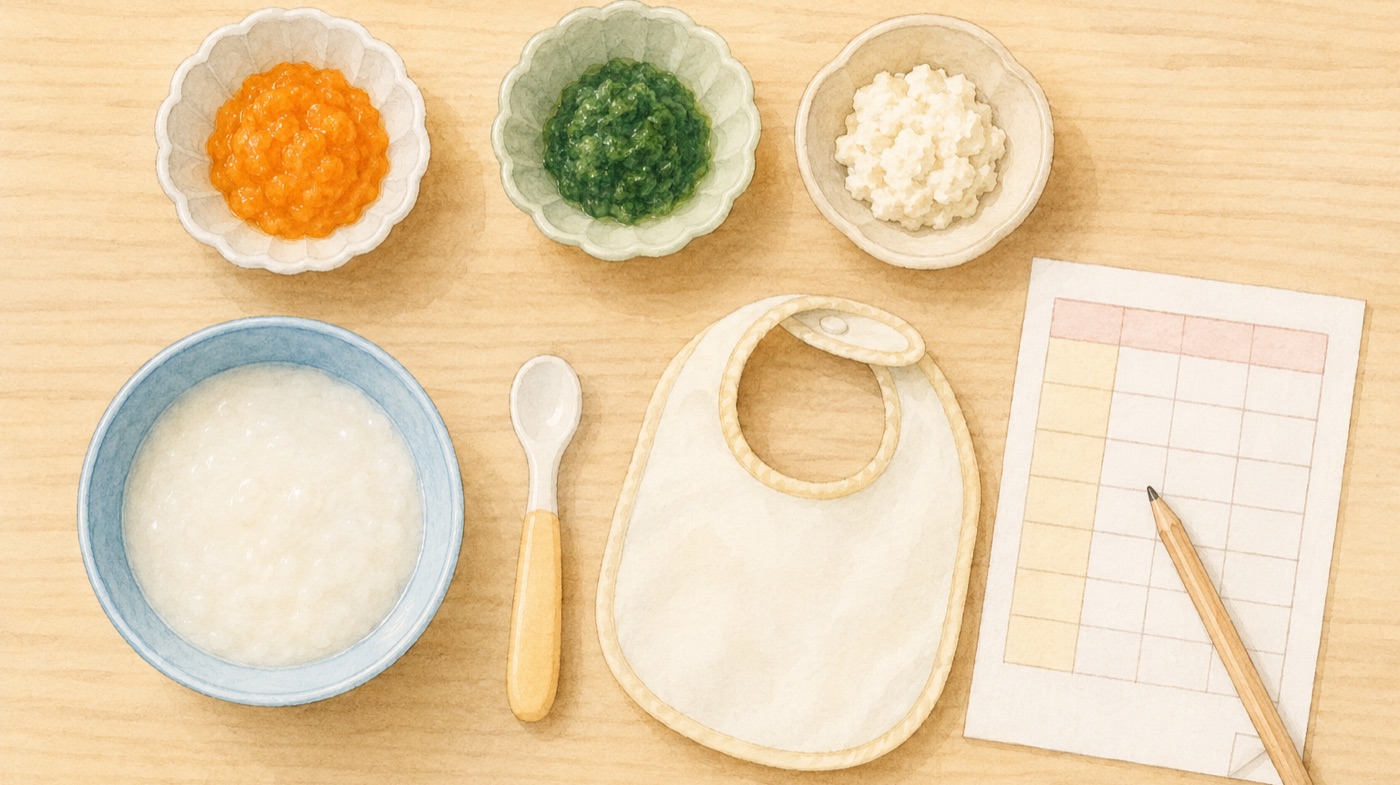
Starting solids in Japan comes with more structure than most families expect. There is a national guide behind it, a vocabulary of four stages your clinic and daycare will use, and a first food nearly everyone begins with: one spoon of very thin rice porridge. If you grew up with baby-led weaning or a "just offer what you're eating" approach, the difference is real — and worth understanding, because your child's checkups and, if they attend daycare, their meals are organized around it.
Why It Feels So Different
Weaning in Japan is called 離乳食 (rinyūshoku), and it is unusually specified. Japan's Ministry of Health, Labour and Welfare (厚生労働省) publishes a national guide for breastfeeding and weaning support — the Guide for Breastfeeding and Weaning Support (授乳・離乳の支援ガイド), last revised in 2019 — and clinics, health centers, and daycare kitchens all work from it. That guide sets out not only when to start, but the texture of the food at each age, how many times a day it is offered, and roughly what a spoonful should look like.
Compare that with the approach many families arrive with. Baby-led weaning, common in the UK, Australia, and increasingly the US, hands the baby soft finger food and lets them manage it. The WHO's guidance does not prescribe a food order at all. Japan's method is spoon-fed, purée-first, and progresses through named stages — which is why a well-meaning grandparent's advice from home can sound like it is describing a different activity entirely.
Neither approach is wrong, and plenty of families here blend the two. But the Japanese framework is the one your infant checkups will ask about, and the one a daycare kitchen will follow, so it pays to know the shape of it.
When to Start
The standard starting point is around five to six months. Age is a guide rather than a trigger, though; the signs that matter are developmental. A baby who is ready can hold their head steady and sit supported, has lost the reflex that pushes a spoon back out, and shows interest when adults eat: watching, drooling, moving their mouth.
Milk stays the main source of nutrition through the early months of solids, so the first weeks are practice rather than a replacement for feeds. Our guides to breastfeeding and formula feeding cover that side. If your baby was premature, or has a medical condition or eczema, ask your pediatrician about timing rather than following the calendar.
The Four Stages
This is the part that shapes every conversation about food in Japan. The stages have nicknames based on the mouth movement being learned, and staff will use them casually, assuming you know them.
| Stage | Age guide | Meals a day | Firmness | What the mouth is learning |
|---|---|---|---|---|
| ゴックン期 gokkun-ki |
5–6 months | 1 a day from one spoonful |
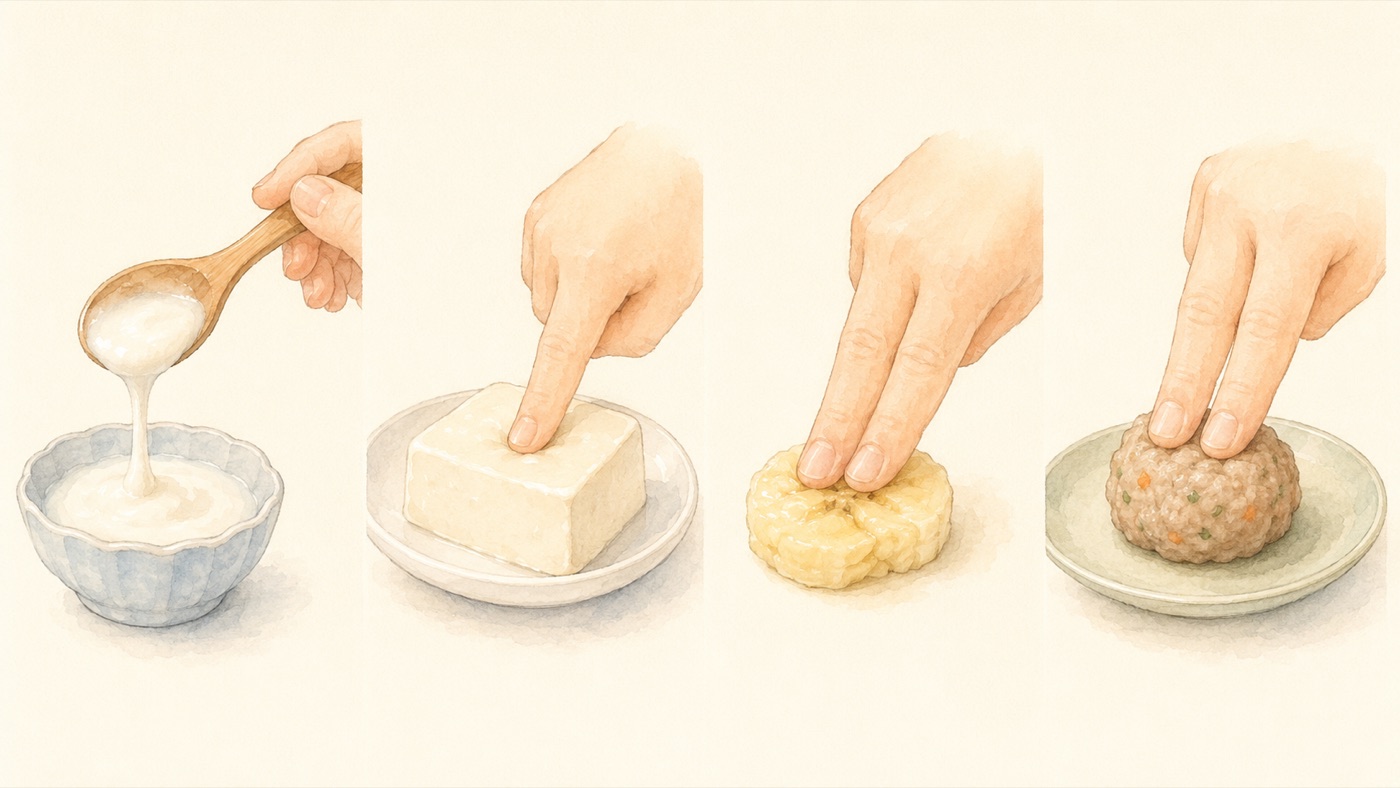
Smooth purée, about the thickness of yogurt | Closing the lips to take food in and swallow it — "gokkun" is the gulp |
| モグモグ期 mogumogu-ki |
7–8 months | 2 a day building a rhythm |
Crushable with the tongue, about the firmness of silken tofu | Crushing food between the tongue and the roof of the mouth |
| カミカミ期 kamikami-ki |
9–11 months | 3 a day | Mashable with the gums, about the firmness of a banana | Mashing with the gums, moving food to the side of the mouth |
| パクパク期 pakupaku-ki |
12–18 months | 3 meals plus snacks |
Chewable with the gums, about a soft meatball | Beginning to use the teeth, and to eat close to family food |
Source: Ministry of Health, Labour and Welfare, Guide for Breastfeeding and Weaning Support (授乳・離乳の支援ガイド, 2019 revision). Ages are guides, not deadlines — babies move at their own pace.
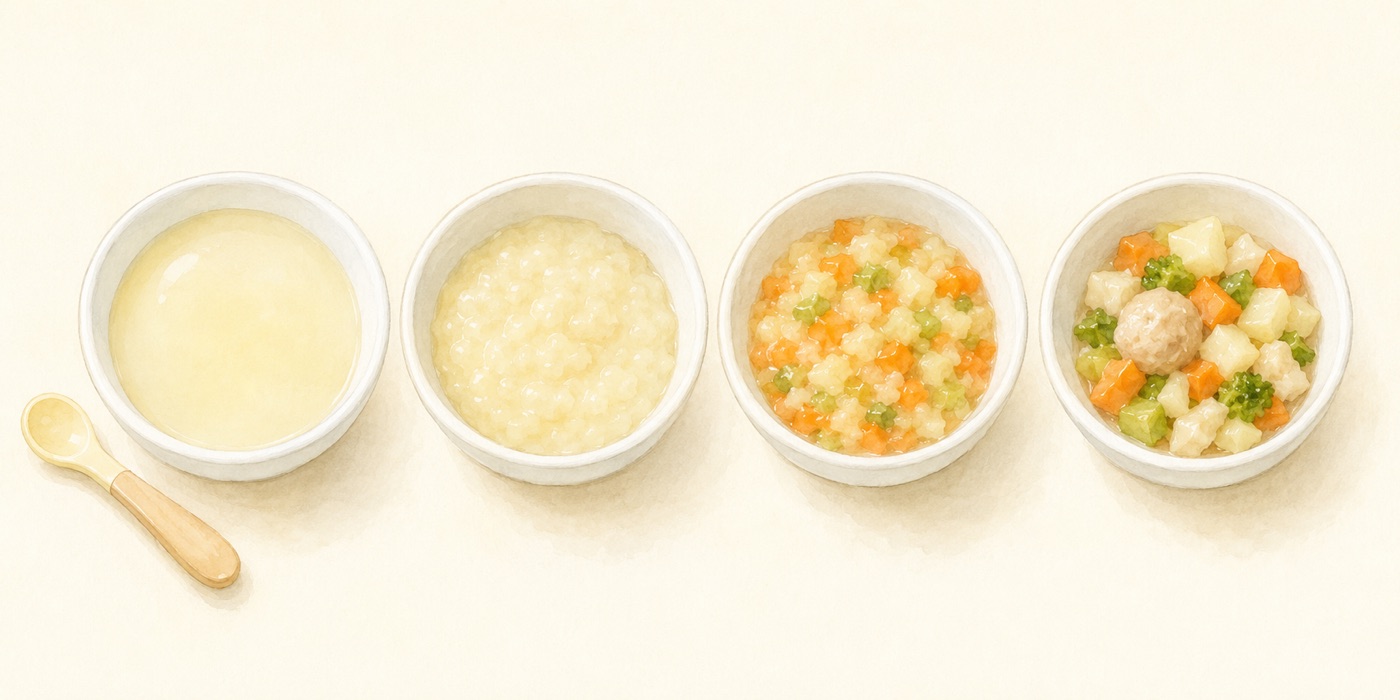
Those firmness comparisons are not decoration — they are how the guidance is actually taught, and they translate better than any measurement. If you can crush it against the roof of your mouth with your tongue, it is tofu-soft. If it gives easily between two fingers, it is banana-soft.
The First Weeks
Almost everyone starts with 10倍がゆ (jūbai-gayu) — rice porridge cooked at roughly ten parts water to one part rice, then strained or blended until it is smooth. Day one is a single teaspoon, once a day, at a time when you can watch your baby afterward. Morning is the usual choice for that reason.
From there the pattern is to add one new food at a time, in small amounts, and keep going for a few days before adding another. Vegetables usually come next (carrot, kabocha squash, spinach), then protein, typically silken tofu or flaked white fish. Rice, vegetables, then protein is the conventional order, and it is worth following simply because it makes any reaction easy to trace to a single food.
Two rules are not negotiable. No honey before the first birthday, because of the risk of infant botulism, and that includes honey baked into food. And go easy on salt, sugar, and seasoning generally; early food is meant to taste of the ingredient.
Choking is the risk that matters most
Texture in Japanese weaning is not fussiness — it is a safety rule. Japan's Consumer Affairs Agency (消費者庁) asks families to keep hard beans and nuts away from children under five entirely, even crushed, and to quarter round foods such as cherry tomatoes and large grapes rather than serving them whole. Anything round, hard, sticky, or the width of a child's airway deserves caution.
Sit your baby upright to eat, stay with them for the whole meal, and do not let them eat while lying down, walking, playing, laughing, or crying. If your child is choking and cannot cry, cough, or breathe, call 119 immediately. Learning infant choking first aid before you start solids is time well spent — municipal health centers and fire departments run free courses.
How to offer the spoon
The technique matters more than it sounds, and it is rarely explained to parents who did not grow up here. Health centers teach a specific sequence: rest the spoon lightly on the baby's lower lip and wait — do not push it in. When the mouth opens and the upper lip comes down to take the food off the spoon, draw the spoon straight out, horizontally. Then wait for the swallow before offering the next spoonful.
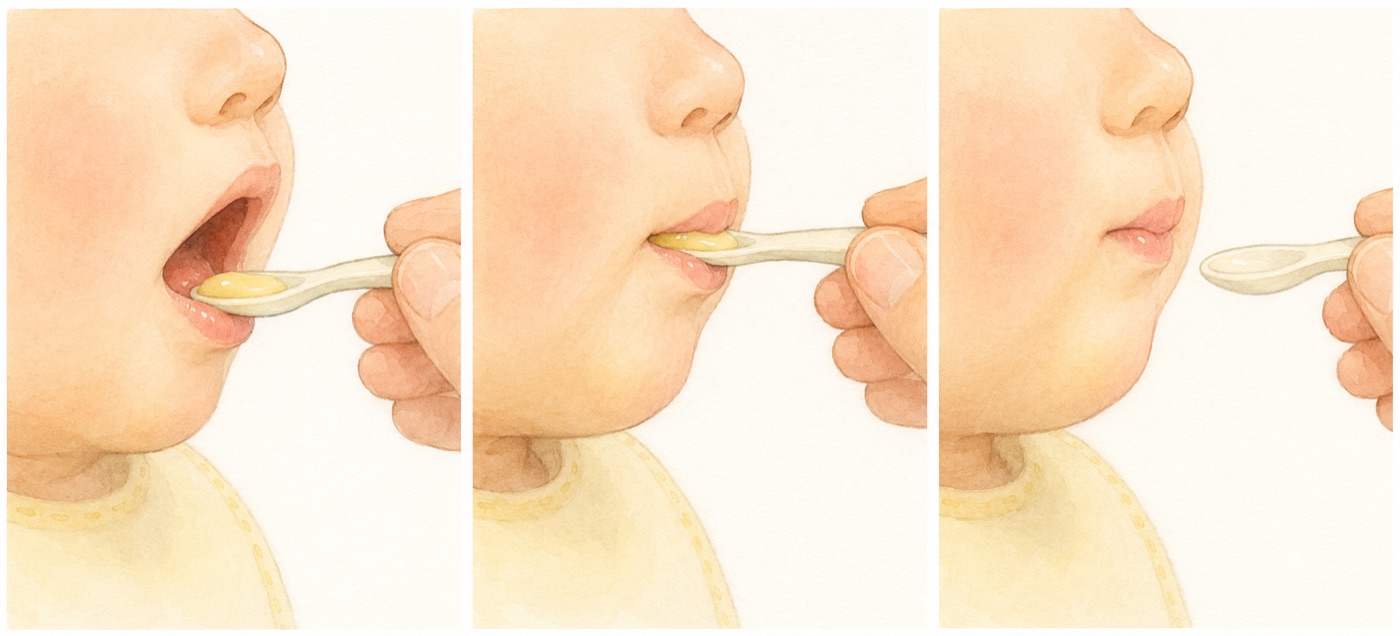
Two habits to avoid: pushing the spoon deep into the mouth, and scraping the food off against the baby's upper gums. Both do the work the baby is supposed to be learning to do. The whole point of this first stage is that the child takes the food with their own lips and swallows deliberately — which is exactly what "gokkun" names.
Allergens and Delaying Foods
This section describes what current Japanese guidance says. It is not medical advice, and it cannot account for your child. Decide how to introduce allergenic foods with your pediatrician — especially if your baby has eczema, has already reacted to a food, or there is food allergy in the family.
One point has changed since many of us were children, and it is worth knowing because the old advice still circulates. Holding allergenic foods back does not prevent allergies. Japanese guidance no longer recommends delaying them for that purpose, and eczema in infancy is understood as a risk factor in itself — which is why a baby with persistent skin trouble is a reason to speak to a doctor early, rather than a reason to postpone food on your own.
What that looks like in practice is a question for your pediatrician, not for a website: which foods, in what form, in what amount, and at what point. Eggs in particular are usually introduced under a doctor's direction, because the form and the amount both matter. What is safe to say generally is that new foods are given one at a time, in small amounts, thoroughly cooked, and earlier in the day. Each part of that has a reason: a single new food at a time means you can identify what caused a reaction, a small amount means a reaction is milder if one comes, and the morning is chosen because clinics are open and you are awake to notice.
If your baby reacts to a food
Call 119 for an ambulance if you see any of these, or if your baby simply seems badly wrong to you: difficulty breathing, wheezing, or a persistent cough; swelling of the face, lips, or throat; repeated vomiting; unusual paleness, floppiness, or unresponsiveness. In the Japanese Society of Pediatric Allergy and Clinical Immunology's guidelines (日本小児アレルギー学会, 2021), repeated vomiting after a food is classed as a severe reaction, not a mild one. Do not drive yourself if the baby is struggling to breathe.
For milder signs — a few hives, redness around the mouth, or mild swelling with no other symptoms — stop the food and contact your pediatrician the same day, and keep watching. Immediate-type reactions usually appear within an hour of eating, and they can build.
Do not assume it is over once symptoms fade. Reactions can come back hours later — sometimes the next day — after appearing to settle, which is known as a biphasic reaction. Keep your baby calm and quiet rather than bathing them or letting them get worked up, and keep checking their color, breathing, and mood through the rest of the day. If anything returns, treat it as the emergency list above.
Note the time, the food, the amount, and what you saw. That record is what allows a doctor to diagnose it properly. If you are unsure how serious it is, treat it as the more serious case and get help.
When in doubt, call 119. Ambulances are free in Japan, and calling one for a baby who turns out to be fine is a far better outcome than the reverse. Do not spend the time first phoning an advice line — an allergic reaction can worsen within minutes. Language is less of a barrier than families expect: the Fire and Disaster Management Agency runs three-way interpretation through a call center, so 119 operators can bring an interpreter onto the line around the clock, in a range of languages depending on the area. Give your address first, then say what you see.
The Daycare Food-Check List
If your child is at, or heading for, a daycare, one piece of paper governs their meals: the food-check list. It is a grid of ingredients the kitchen uses, and you tick each one off as your child eats it safely at home. The facility will not serve an ingredient your family has not already cleared.
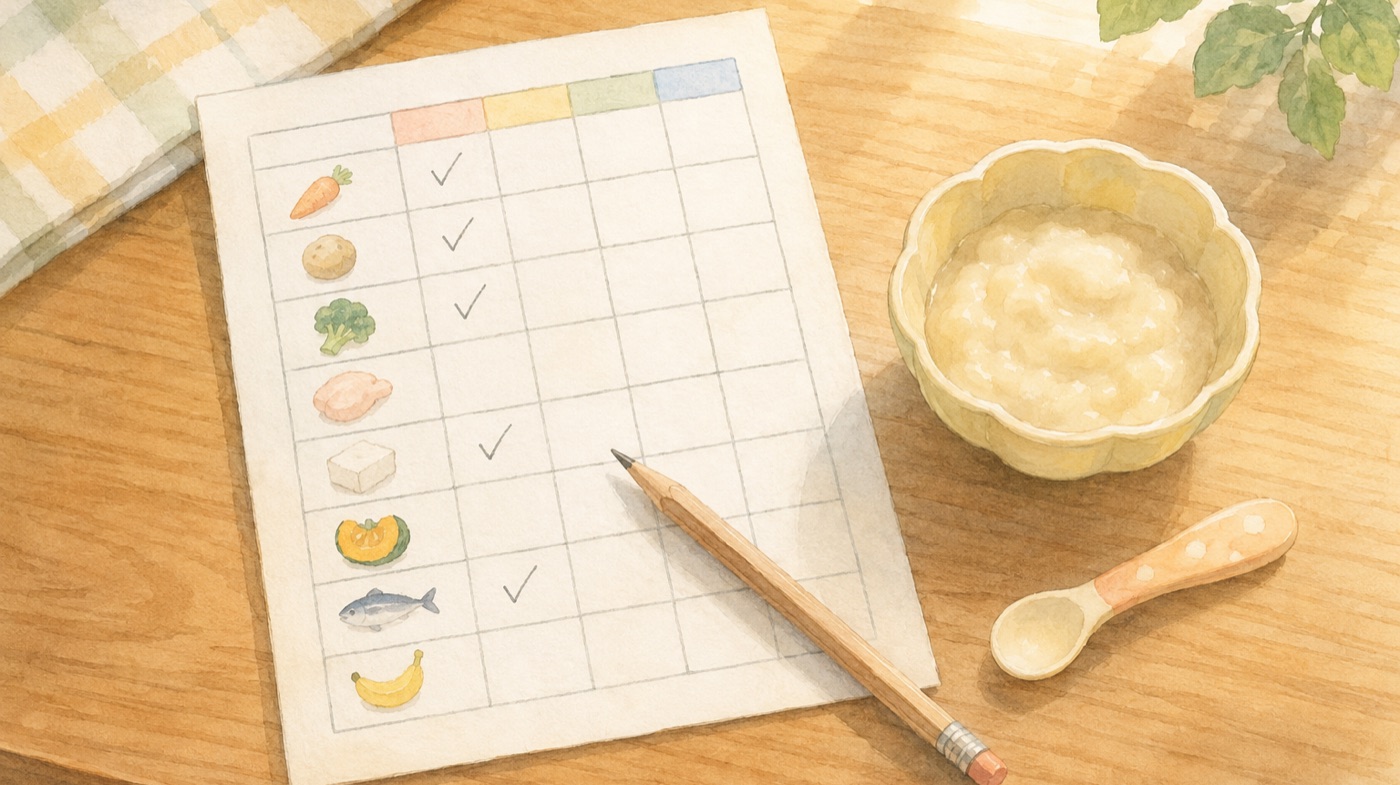
The usual rule is to have fed the ingredient at least twice at home, with no reaction, before you tick it. The purpose is allergy safety: the first exposure to any food should happen where you can watch your child and act, not in a room with twenty other babies. There is no national form, so the list, the number of feeds required, and the pace all vary by facility.
Two things catch families out. The first is timing: the list can be long, and a child starting daycare in April may need a steady run of new foods through the winter to keep up. The second is that the kitchen works to its own menu, so an ingredient not yet ticked simply gets left off your child's plate. Ask for the list at the point you accept a place, not on the first day. Our guide to getting ready for daycare covers what else arrives with it.
Making It Manageable
The Japanese method looks laborious written down, and it can be, but almost nobody cooks each meal from scratch. Freezing in portions is the standard approach: cook a batch of porridge or a vegetable, purée it, freeze it in an ice-cube tray, and thaw a cube at a time. Most families run a week or two ahead this way.
Ready-made baby food is also normal here and no one thinks less of you for using it. Supermarkets and drugstores carry pouches, jars, and dried powders labeled by stage — the packets carry the month range, which makes them a useful sanity check on texture even if you mostly cook. Our guide to baby stores in Japan covers where to look.
One last piece of advice worth taking to heart: the four stages are a map, not a schedule. Babies refuse food, go backward, and take weeks over a texture. The health checkups are a good place to raise concerns about weight, refusal, or texture aversion, and there is no prize for arriving at pakupaku-ki first.
Japanese Vocabulary
The words you will hear at checkups, from your daycare, and on the packets:
| Japanese | Reading | Meaning |
|---|---|---|
| 離乳食 | rinyūshoku | Weaning food; starting solids |
| 10倍がゆ | jūbai-gayu | Thin rice porridge, ten parts water to one of rice — the usual first food |
| ゴックン期 | gokkun-ki | The first stage, 5–6 months: learning to swallow purée |
| 食材チェック表 | shokuzai chekku-hyō | The daycare list of ingredients to try at home first |
| 食物アレルギー | shokumotsu arerugī | Food allergy |
| 取り分け | toriwake | Setting aside part of the family's meal, unseasoned, for the baby |