Written and reviewed by Susumu
Born and raised in Japan · Checked against Japanese law and ministry guidance
Free health checkups for babies and toddlers in Japan — the full schedule from 1 month to 5 years, what is checked at each age, what to bring, and tips for international families.
Affiliate Disclosure: This article contains affiliate links. If you click a link and make a purchase, we may earn a small commission at no extra cost to you. We only recommend products we genuinely believe are helpful. See our Terms of Use for full details.
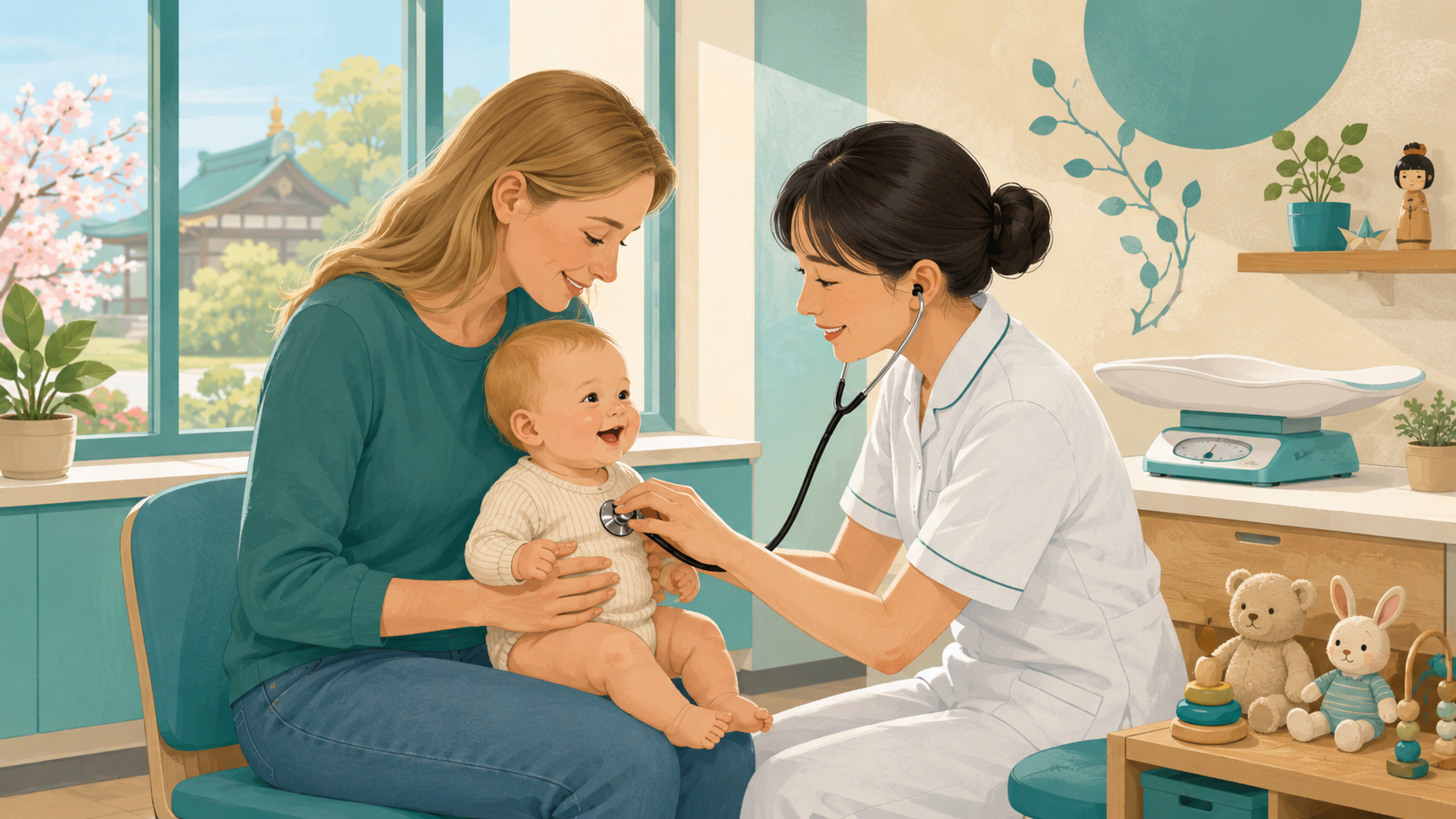
📌 Note: The checkup schedule varies slightly by municipality. Your city or ward office will mail you an invitation (お知らせ) before each checkup. If you haven't received one, contact your local 保健センター (health center).
What Are 乳幼児健診?
乳幼児健康診査 (nyūyōji kenkō shinsa), usually called 乳幼児健診 (nyūyōji kenshin), are free health checkups for babies and toddlers provided by every municipality in Japan. They check your child's physical growth, development, hearing, vision, teeth, and overall wellbeing at key ages — and they're one of the most useful services available to parents in Japan.
The checkups are free for all registered residents, regardless of nationality. You don't need to book in advance for most of them — your ward or city office will send you an invitation letter (お知らせ) in the mail before each one is due.
Two checkups — at 18 months and 3 years — are legally required under Japan's Mother and Child Health Act (母子保健法). Every municipality in Japan must offer them. The others are strongly recommended and offered free by most municipalities, but are not legally mandated.
The Full Checkup Schedule
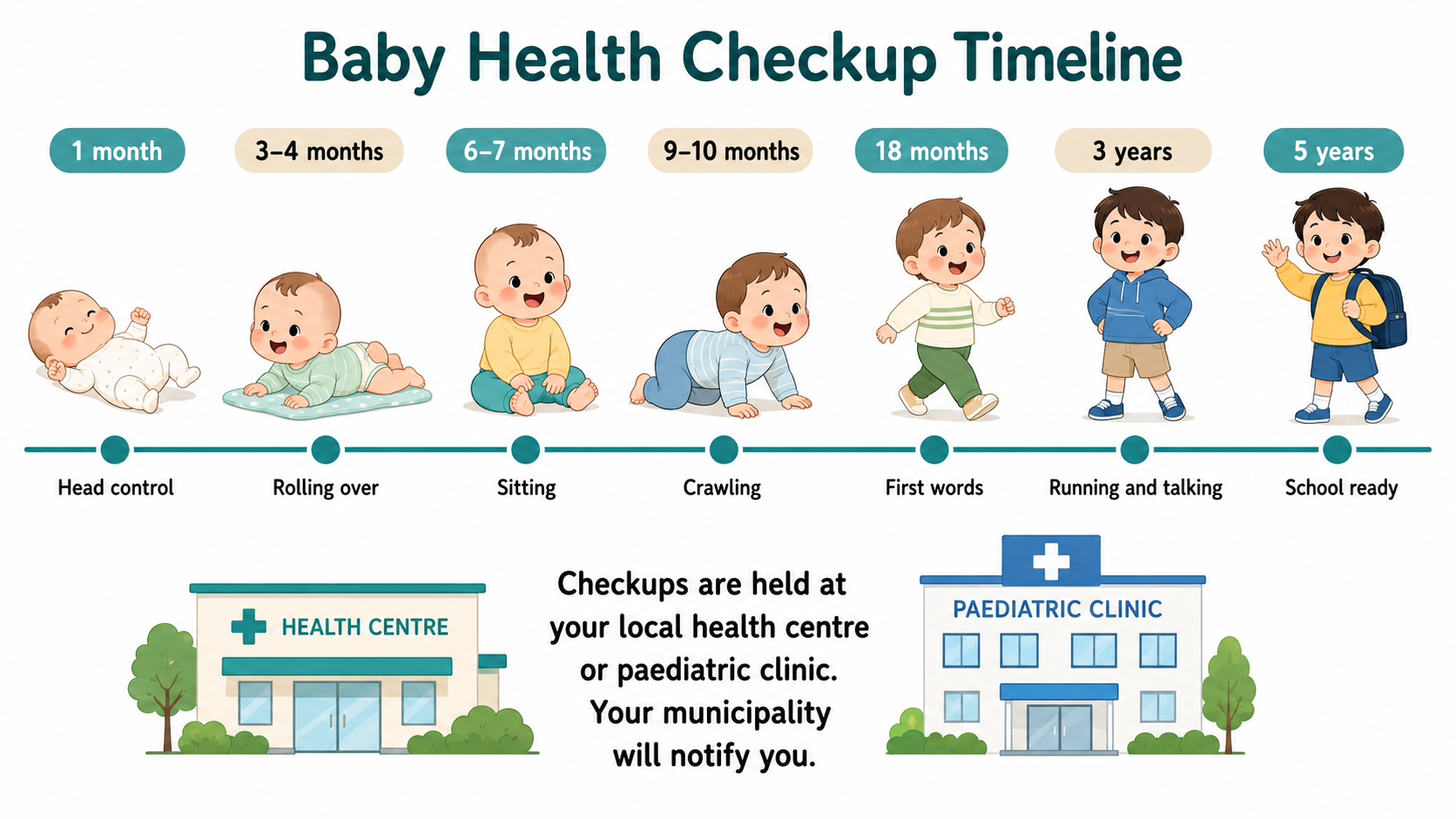
| Age | Where | Cost | Status |
|---|---|---|---|
| 1 month | Birth hospital or clinic | Mostly free (expanding) | Subsidized |
| 3–4 months | Municipal health center | Free | Recommended |
| 6–7 months | Pediatric clinic | Free (with voucher) | Recommended |
| 9–10 months | Pediatric clinic | Free (with voucher) | Recommended |
| 18 months ⭐ | Municipal health center | Free | Legally mandated |
| 3 years ⭐ | Municipal health center | Free | Legally mandated |
| 5 years 🆕 | Municipal health center | Free | Expanding nationally |
⭐ = legally required under the Mother and Child Health Act. These two checkups have a national attendance rate of over 96% — the 18-month checkup at 96.9% and the 3-year checkup at 96.0% (Ministry of Health data, FY2023). Our guide to the 18-month and 3-year checkups covers those two in detail: how the invitation reaches you, the developmental tasks, the vision test you do at home, and what follow-up means.
What Happens at Each Checkup
1-Month Checkup (1か月児健診)
Usually done at the hospital where your baby was born, or at a pediatric clinic. The doctor checks overall growth and weight gain, signs of any congenital conditions, and your baby's response to sounds and movement. The mother's own postpartum recovery is also often reviewed at this appointment.
From 2023, the national government began subsidizing 1-month checkups — ¥6,000 per child for individual clinic visits, ¥5,000 for group checkups. Whether it's fully free depends on your municipality — check with your local ward office.
3–4 Month Checkup (3〜4か月児健診)
This is a group checkup held at your local health center (保健センター). A nurse and doctor check whether your baby can hold their head up, track objects with their eyes, and respond to your voice. Hip joints are also examined for any signs of developmental dysplasia. You'll also receive guidance on starting solid foods later on.
6–7 Month Checkup (6〜7か月児健診)
Usually done at a pediatric clinic using a voucher sent by your municipality. The doctor checks whether your baby is rolling, sitting, or beginning to pull themselves up. Social development is observed — does your baby make eye contact, react to familiar faces, and respond to their name?
9–10 Month Checkup (9〜10か月児健診)
Another clinic visit. By now the doctor is looking for crawling, pulling to stand, and early signs of language development — babbling, responding to simple words. Teeth are also checked if any have come through.
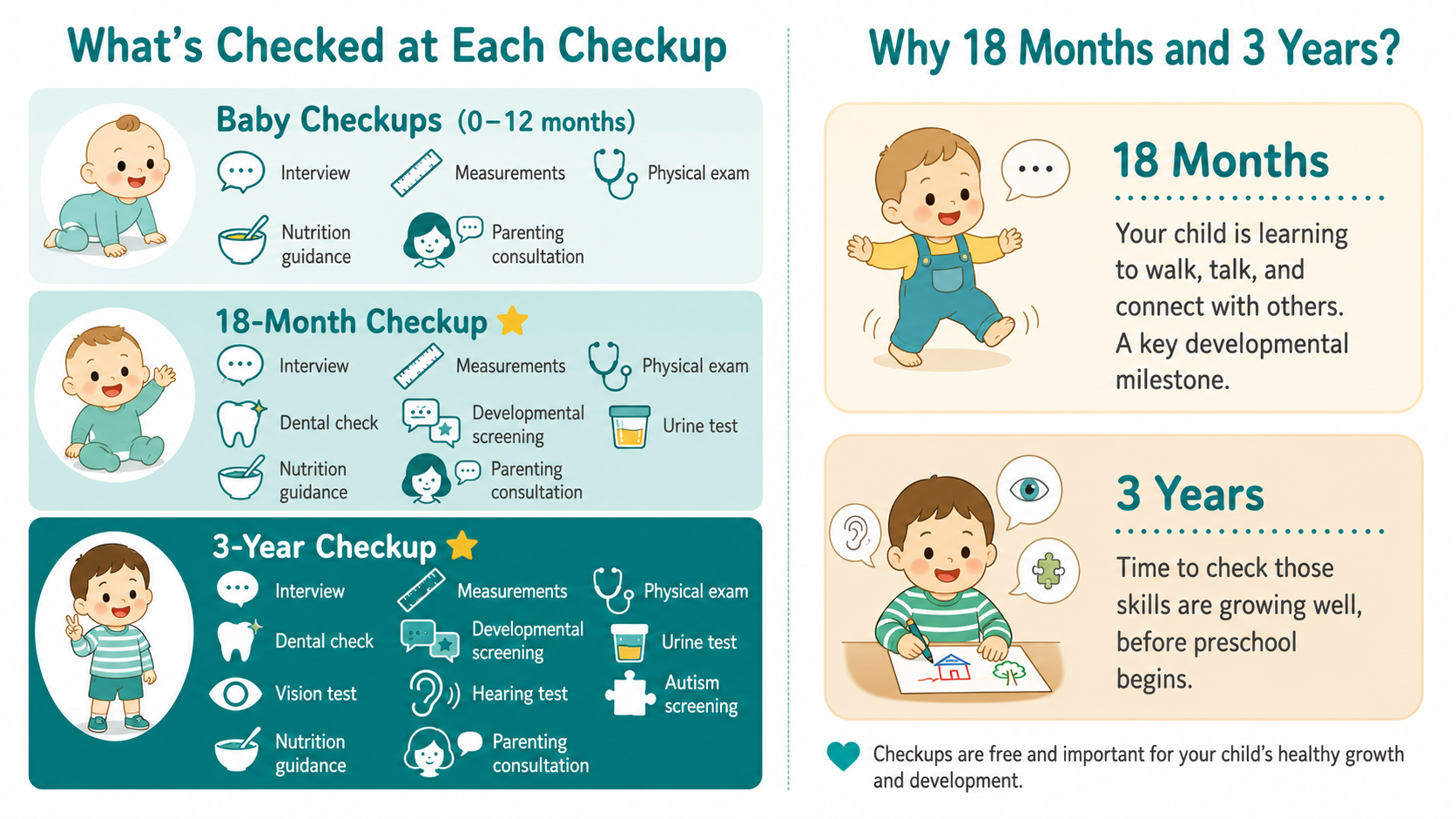
18-Month Checkup — 1歳6か月児健診 ⭐
This is the first legally mandated checkup and one of the most important. It's held at your municipal health center and takes around 30–45 minutes, with multiple stations. The doctor and nurses check:
- Whether your child is walking independently
- Fine motor skills — can they stack blocks, hold a crayon?
- Language — do they have around 10 words?
- Teeth and oral health (tooth-brushing guidance is given)
- Urinalysis — a urine sample collected at home and brought in
- Developmental screening — any early signs of speech delay or developmental concerns
- Vaccination status review
3-Year Checkup — 3歳児健診 ⭐
The second legally mandated checkup. This one is more involved — allow about 45 minutes. Some tests are done at home before you come in:
- Vision test: A simple chart is mailed to you in advance. You test your child's vision at home and bring the results.
- Hearing test: Also done at home beforehand using a simple whisper test. Results brought to the appointment.
- Urine sample: Collected at home the morning of the checkup and brought in.
At the health center, the doctor checks teeth, speech, cognitive skills, and social behavior. Autism spectrum screening is included. Height, weight, and a basic heart check are also done.
5-Year Checkup — 5歳児健診 🆕
This checkup is expanding rapidly across Japan. When the program launched in 2023, only 15% of municipalities offered a checkup for children aged 4–6. By 2024, that had risen to around 46% (800 out of 1,741 municipalities), with a government target of full national rollout by FY2028. Each checkup is subsidized at ¥6,000 per child (individual clinic) or ¥5,000 (group checkup).
The focus is on screening for developmental conditions — autism spectrum disorder, ADHD, language delays — before school entry. Research has shown that early detection at this age reduces school refusal and helps children and families get the right support before elementary school begins.
Not all municipalities offer the 5歳児健診 yet. Check with your ward office or 保健センター to see whether it's available in your area.
What to Bring
For all checkups, you'll typically need:
- 母子健康手帳 (boshi techo) — the Maternal and Child Health Handbook. This is the most important item. All measurements, vaccinations, and checkup results are recorded in it.
- マイナ保険証 or 資格確認書 — Japan replaced the traditional health insurance card (健康保険証) in December 2024. Bring your child's My Number Card registered as health insurance (マイナ保険証), or the 資格確認書 (Health Insurance Eligibility Certificate) issued automatically by your insurer if you haven't set up マイナ保険証 yet.
- 乳幼児医療費受給者証 — the child medical subsidy card issued by your municipality. It reduces or eliminates what you pay at the clinic; see our guide to the child medical fee subsidy for how to get one.
- 受診票 / お知らせ — the invitation or voucher mailed to you by your ward office
- 問診票 — the questionnaire mailed to you in advance. Fill this in before you go.
For the 3-year checkup, also bring your urine sample and the results of the home vision and hearing tests that are mailed to you.
Practical extras: a change of clothes for your child, diapers if still needed, a small snack or toy to keep them calm during the wait.
For International Residents
All checkups are free and open to all registered residents regardless of nationality. As long as your child is registered at the ward office (住民登録), you will receive the invitation letters automatically.
The invitation letters and questionnaires (問診票) arrive in Japanese only. This is one of the most common pain points for international residents. If you can't read the questionnaire, bring a bilingual friend or use a translation app before you go — the questions are usually straightforward developmental milestones.
Language support at the checkup itself is not guaranteed. Some wards in large cities (Tokyo, Osaka, Yokohama) can arrange an interpreter if you request one in advance — call your 保健センター to ask. If no interpreter is available, bring a bilingual friend if possible.
Multilingual boshi techo: Many municipalities offer the handbook in English, Chinese, Korean, Portuguese, Spanish, Vietnamese, Tagalog, and other languages. Ask for a multilingual version when you register your pregnancy at the ward office. If you didn't receive one, ask now — it's never too late.
Moved from overseas? If you've recently arrived in Japan with a young child, bring their overseas vaccination records and any previous checkup documents to your first appointment. The doctor will review them and update your boshi techo accordingly.
What If You Miss a Checkup?
There is no fine or penalty for missing a checkup. However, for the legally mandated checkups (18 months and 3 years), your municipality is required to follow up if your child doesn't attend. This typically starts with a letter, then a phone call, and if there's still no response, a home visit from a public health nurse (保健師).
This follow-up system exists for child protection reasons — non-attendance is treated as a welfare concern, not just a missed appointment. It's not something to worry about if you simply forgot or were ill, but it is useful to understand why.
If you miss a checkup for any reason, contact your 保健センター directly to reschedule. They will accommodate you.
Tip: If you move to a new municipality, your invitation letters will go to your old address. Contact your new ward office as soon as you register and ask them to set up your child's checkup schedule from scratch.
📖 Japanese Vocabulary
Useful terms for infant health checkups in Japan.
| 日本語 | ひらがな | English |
|---|---|---|
| 乳幼児健診 | にゅうようじけんしん | Infant and toddler health checkup |
| 保健センター | ほけんせんたー | Municipal health center |
| 問診票 | もんしんひょう | Pre-checkup questionnaire |
| 受診票 | じゅしんひょう | Appointment voucher / invitation |
| 1歳6か月児健診 | いっさいろっかげつじけんしん | 18-month checkup (legally mandated) |
| 3歳児健診 | さんさいじけんしん | 3-year checkup (legally mandated) |
| 保健師 | ほけんし | Public health nurse |
| 発達障害 | はったつしょうがい | Developmental disorder |
| 住民登録 | じゅうみんとうろく | Resident registration |
| マイナ保険証 | まいなほけんしょう | My Number Card used as health insurance |
| 資格確認書 | しかくかくにんしょ | Health Insurance Eligibility Certificate (alternative to マイナ保険証) |