Written and reviewed by Susumu
Born and raised in Japan · Checked against Japanese law and ministry guidance
Two checkups are required by law, and nearly every family in Japan attends them. How the invitation reaches you without applying, the blocks and pointing tests, the vision test you do at home, what follow-up observation actually means — and how to explain a bilingual child to staff counting words in Japanese.
Affiliate Disclosure: This article contains affiliate links. If you click a link and make a purchase, we may earn a small commission at no extra cost to you. We only recommend products we genuinely believe are helpful. See our Terms of Use for full details.
Two checkups in early childhood are different from all the others: the one at eighteen months and the one at three. They are the only ones your municipality is legally obliged to provide, nearly every family in Japan attends them, and they are where a child's language and development are looked at properly for the first time. For international families they also come with a worry nobody else raises: that a child growing up between two languages will look "behind" on a Japanese checklist. This guide covers what happens, how you are invited, and what it means if something is flagged.
Why These Two Are Different
Japan has a long series of infant checkups, and our guide to infant health checkups walks through the whole schedule. But two of them sit apart. Under article 12 of the Maternal and Child Health Act (母子保健法), municipalities are required to provide a checkup for children around eighteen months and again around three years old. The others, at three to four months and nine to ten months, are widely offered, but they are not written into the law in the same way.
That legal status has practical effects. These two are funded and organized by your city, the checkup itself is free (an optional extra such as fluoride treatment is sometimes charged for), and attendance is close to universal: national figures put both above 96%. They are also the checkups designed to catch things that only become visible once a child is walking and talking — speech, hearing, vision, and the beginnings of social development.
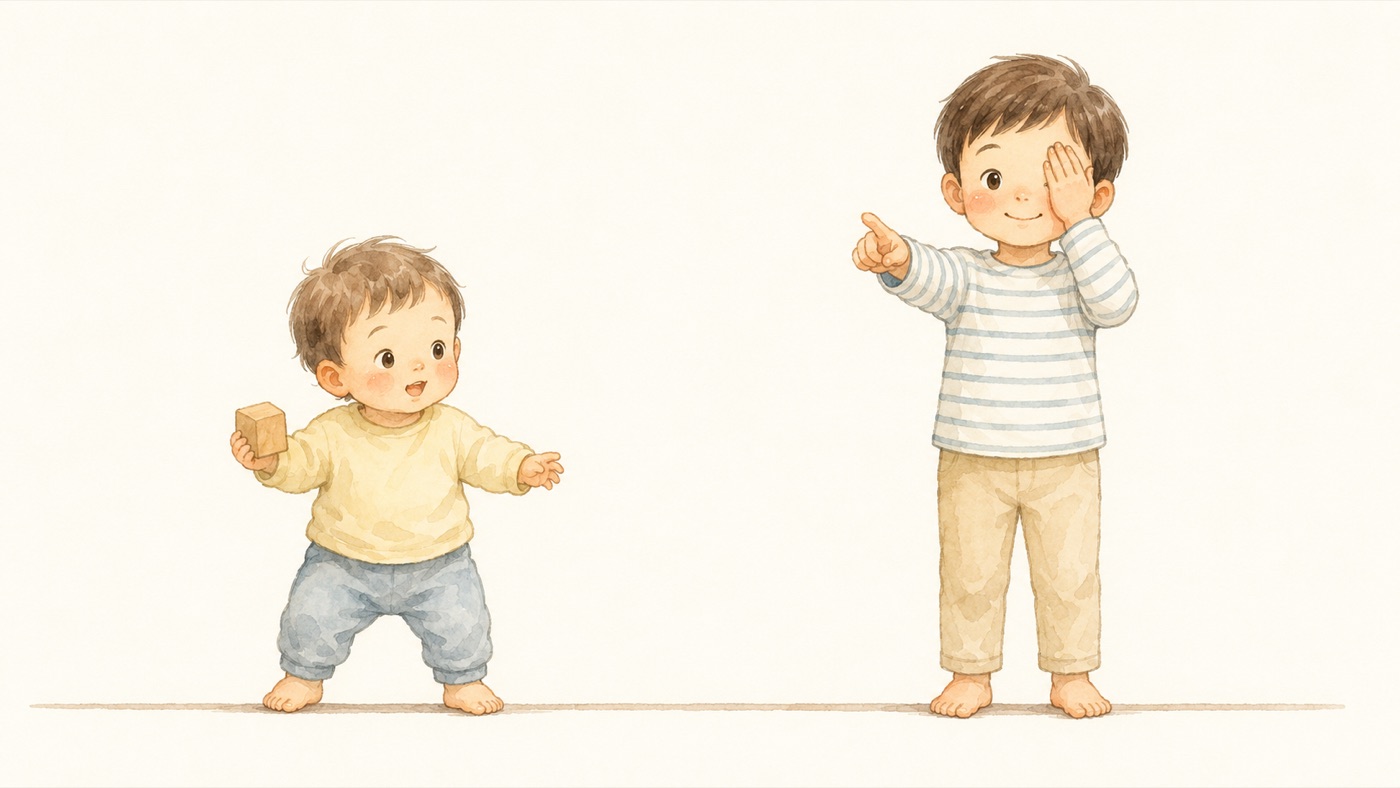
1歳6か月 — stacking blocks, pointing, first words
3歳 — plus vision, hearing, and a urine test
The two are not the same appointment twice. The three-year checkup repeats what the eighteen-month one covers and then adds to it, which is the simplest way to hold the difference in mind:
| What is checked | 18 months |
3 years |
|---|---|---|
| Height, weight, head circumference | ✓ | ✓ |
| Doctor's examination | ✓ | ✓ |
| Teeth, often with fluoride | ✓ | ✓ |
| Development, language, and a talk with staff | ✓ | ✓ |
| Vision screening — first test done at home | — | ✓ |
| Hearing screening — usually started at home | — | ✓ |
| Urine test | — | ✓ |
A general picture. The exact contents, and whether the urine sample is collected at home or at the session, are set by your municipality.
How You Get Invited
This is the question international families ask most, and the answer is reassuring: in almost all cases the invitation comes to you. Municipalities track children by age from the resident register, and send an envelope to your address as your child approaches the right age, usually a few weeks ahead. You do not need to apply, and you do not need to be watching a calendar.
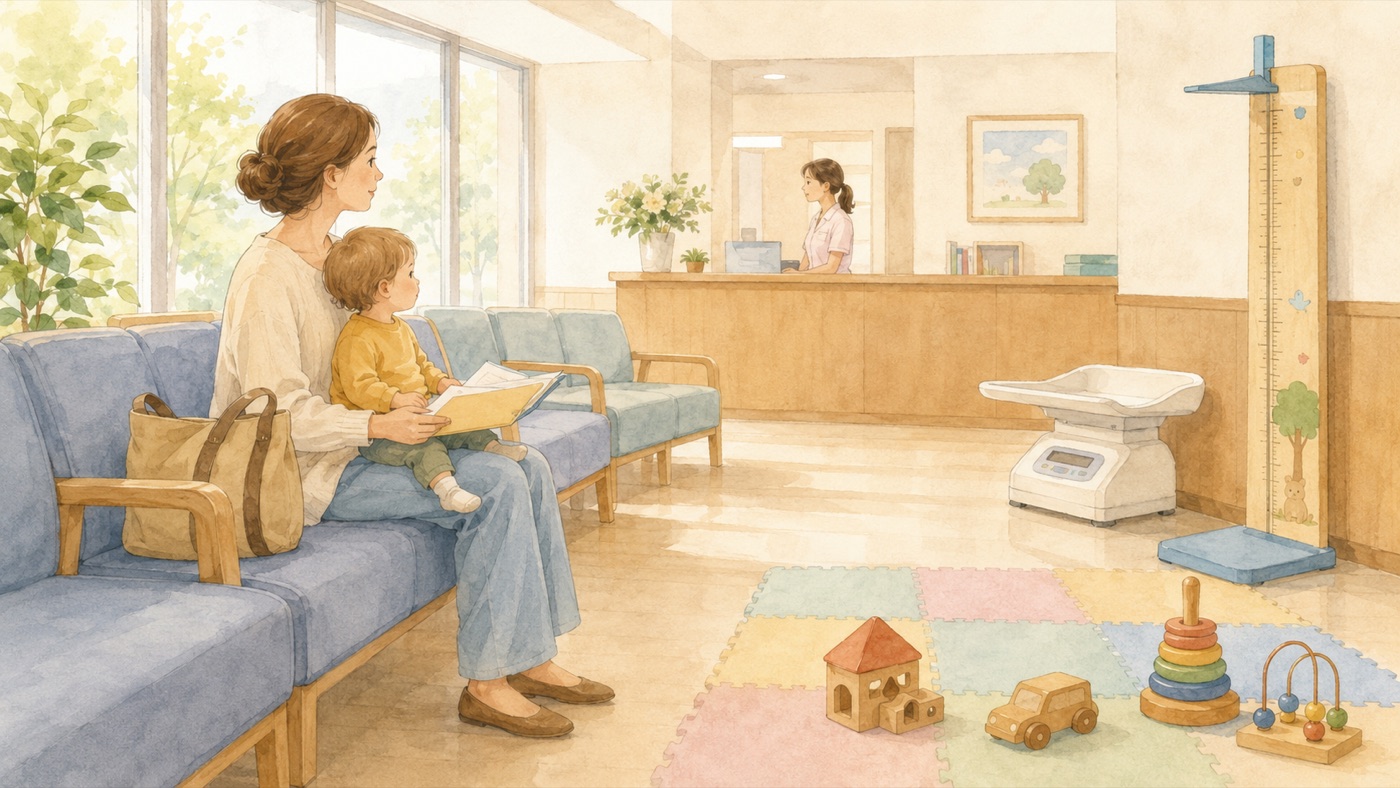
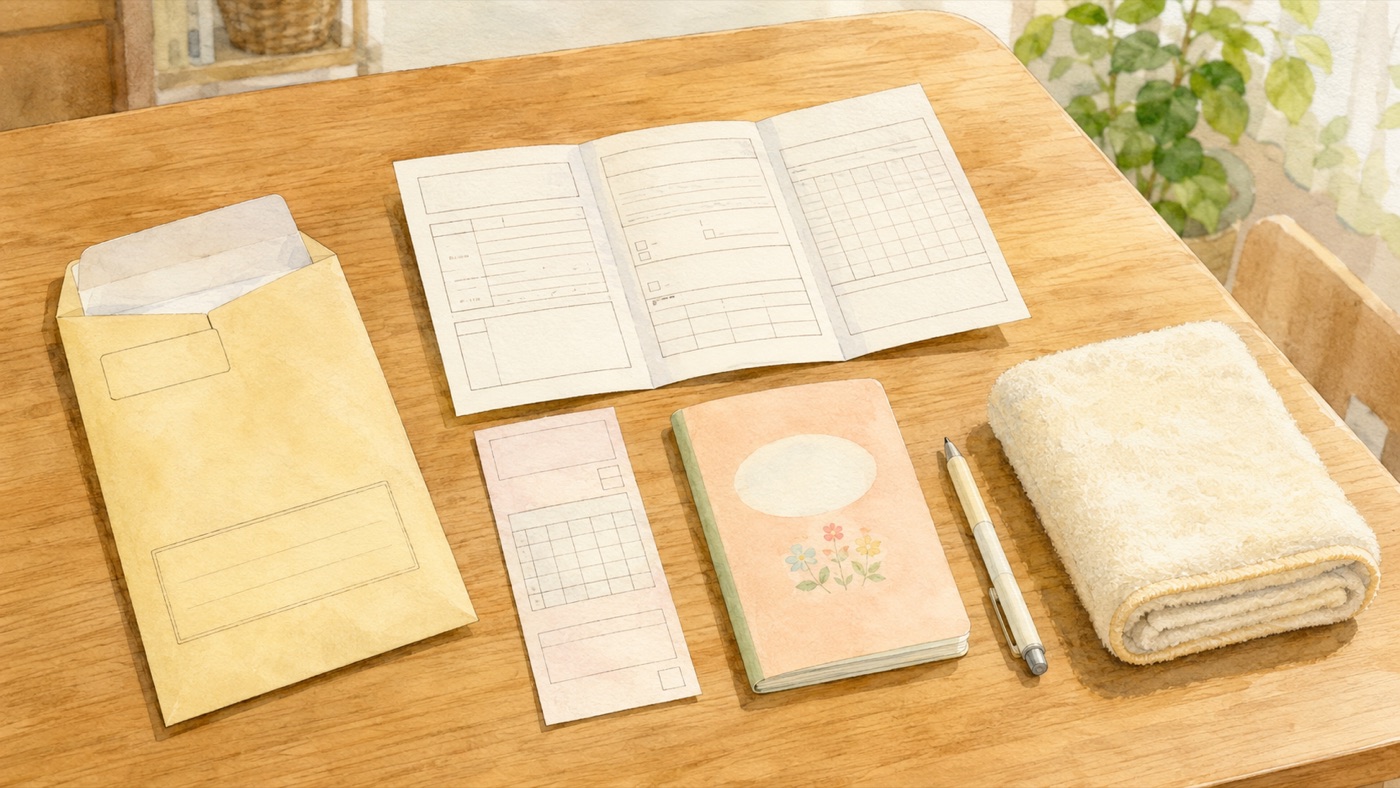
What arrives inside varies by city, but usually includes a voucher or slip (受診票), a questionnaire (問診票) to fill in beforehand, and — for the three-year checkup — the home test materials described below. Two formats exist, and your envelope will say which yours is:
- 集団健診 (shūdan kenshin) — a group session at a health center on a set date. Many cities assign you a specific day and time slot rather than letting you choose, so read the date on the letter carefully.
- 個別健診 (kobetsu kenshin) — an individual appointment you book yourself at a participating clinic, within a set window.
Two situations are worth knowing. If you move house, your new municipality picks this up from your residence registration and sends the invitation instead — the checkup does not fall through the gap, though it is worth mentioning at the city office when you register, especially if the timing is tight. And if the letter arrives and the date does not work, call the number on it: rescheduling is normal, and municipalities would far rather move you than lose you.
The 18-Month Checkup
The eighteen-month checkup (1歳6か月児健診) covers physical growth, teeth, and development. Height, weight, and head circumference are measured, a dentist checks the teeth and often applies fluoride, and a doctor examines the child. The part parents remember, though, is the developmental section.
Staff will typically ask your child to stack blocks (積み木), look at a picture card and point (指差し) at a named object ("where's the dog?"), and they will ask you how many meaningful words your child uses. Around three or more single words is the usual reference point at this age. They are also watching how your child responds to being spoken to, and whether they turn to you for reassurance.
These tasks are prompts for conversation, not a pass-or-fail exam. Children at eighteen months vary enormously, and a child who refuses to perform for a stranger in an unfamiliar room is a completely ordinary sight at these sessions. If your child does something at home that they will not do at the health center, say so — that is exactly the kind of information the staff want.
The 3-Year Checkup
The three-year checkup (3歳児健診) repeats the growth, teeth, and development checks, and adds things the earlier one does not have: a urine test, and screening of vision and hearing.
The vision and hearing screening is the part that surprises people, because much of it happens at home before you go. Your envelope will contain the materials and instructions, and you are asked to do the test at home and bring the result with you. For vision, that usually means a card printed with a Landolt ring (ランドルト環) or picture symbols, held at a set distance — commonly 2.5 meters (about 8 feet) — while you cover one eye at a time. For hearing, it is often a whispered-voice check and a questionnaire about how your child responds to sound.
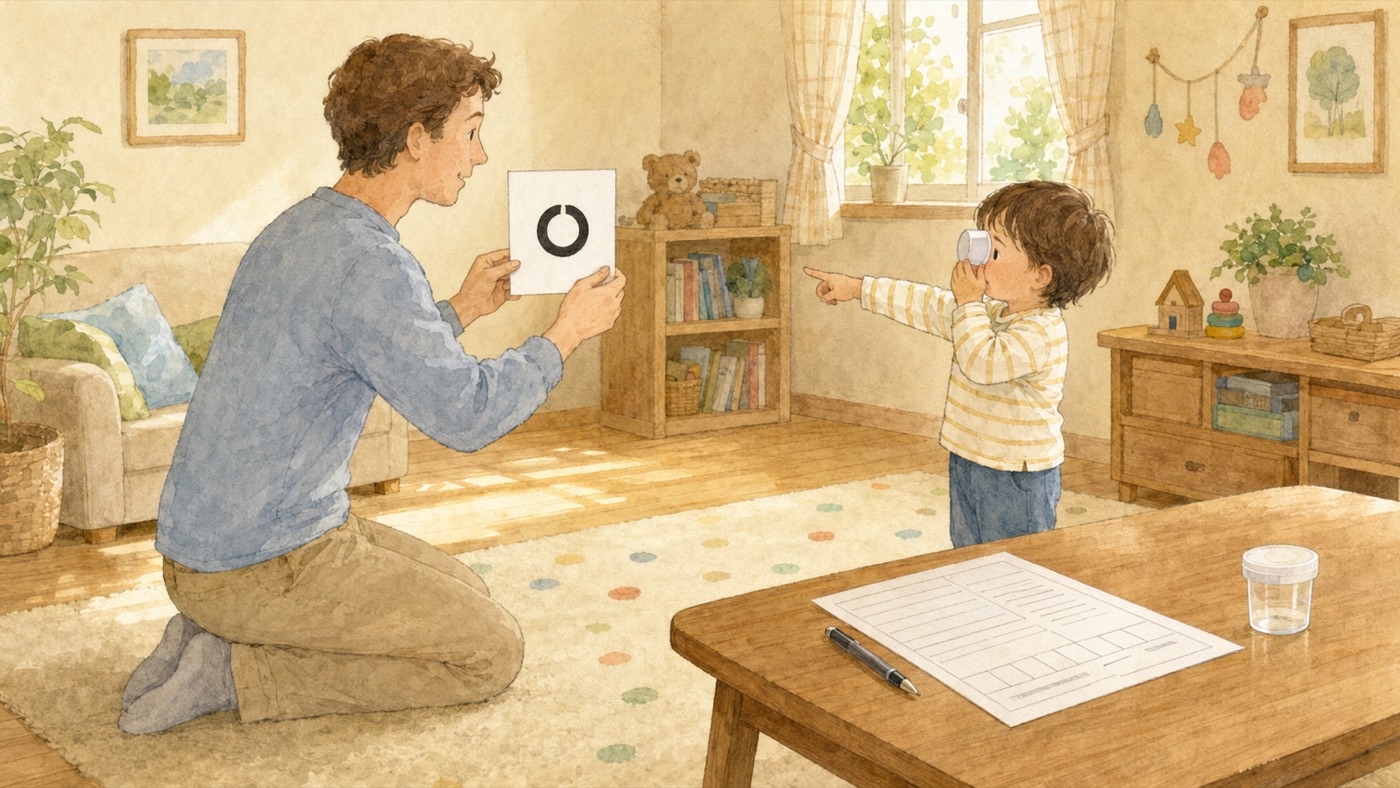
Doing this at home with a three-year-old can be comical, and plenty of parents are unsure whether they did it right. That is fine, and it is the reason the health center checks it again: if the home result is unclear or suggests a problem, they retest on the day or refer onward. What matters is that you attempt it and bring the sheet, rather than leaving it blank. The urine test is handled differently from city to city: many ask you to collect a sample at home on the morning and bring it, with a cup supplied in the pack, while some collect it at the session itself. Your letter will say which, and if it asks you to bring one, it will also say how fresh it needs to be.
Vision screening at this age exists for a specific reason. Some conditions that affect how sight develops respond well to treatment when caught early, and much less well later, which is why this checkup is worth attending even if your child seems to see perfectly.
If Your Child Is Growing Up Bilingual
Here is the worry that rarely gets addressed in Japanese guidance, because it does not come up for most families: your child is hearing two or three languages, and the checkup counts words in Japanese.
Say so, clearly, at the start. Tell staff which languages your child hears at home, roughly how much of each, and what your child can do in each language — including the words they use in a language nobody at the health center speaks. A child with ten words spread across two languages is not a child with ten words in Japanese, and staff cannot factor in what they do not know. Bringing a short written note, in Japanese if you can manage it, is a practical way to get this across when the conversation itself is happening in your second language.
It is also worth asking in advance whether interpretation is available. Some municipalities can arrange an interpreter or use a translation service for checkups; others cannot. Either way, do not let a language barrier turn into a shorter, thinner conversation about your child — bring someone who can help if that is what it takes.
If Something Is Flagged
Some families leave with a suggestion to come back, and it is worth understanding what that does and does not mean before it happens to you.
The usual outcome is 経過観察 (keika kansatsu), follow-up observation. The health center asks to see your child again in a few months to see how things have moved on. This is not a diagnosis. Development at this age is uneven, and a second look after a few months is often all that is needed. Less commonly, you may be referred for a fuller assessment (精密健康診査) with a specialist.
If you are offered follow-up, take it, even if you are confident nothing is wrong, and especially if you are worried it reflects on you. The follow-up is free, it is the route to support if support turns out to be useful, and the alternative is finding out later, when less can be done. If you disagree with what you were told, say so and ask what specifically prompted it; the staff can explain, and your own observations at home are part of the picture.
The health center is also the place to raise anything you are uneasy about, whether or not it is on their checklist: sleep, eating, behavior, hearing, your own exhaustion. These sessions are one of the few points where a professional is looking at your child unhurried, and the staff would rather hear a concern that turns out to be nothing than miss one.
What to Bring
The letter is the authority on this, but the usual list is short:
- The voucher or slip from the envelope, and the questionnaire filled in beforehand.
- Your mother and child health handbook — staff record the results in it, and it is what follows your child through the system.
- For the three-year checkup: the home vision and hearing results, and a urine sample if your letter asks you to bring one.
- A bath towel — municipalities list this routinely, since children are laid on it to be measured — plus a change of clothes and something to keep a toddler occupied, because group sessions involve waiting.
Children are usually undressed for measuring, so easy clothes help. And if your child is unwell on the day, call and move it rather than attending; a feverish toddler will not show anyone their real development.
Japanese Vocabulary
Words you will meet on the invitation and at the health center:
| Japanese | Reading | Meaning |
|---|---|---|
| 集団健診 | shūdan kenshin | A group checkup at a health center on an assigned date |
| 個別健診 | kobetsu kenshin | An individual checkup booked at a clinic |
| 指差し | yubisashi | Pointing — used to check understanding of words |
| 積み木 | tsumiki | Wooden blocks, stacked to check fine motor skills |
| 経過観察 | keika kansatsu | Follow-up observation — come back and we will look again |
| 精密健康診査 | seimitsu kenkō shinsa | A fuller assessment with a specialist |