
Written and reviewed by Susumu
Born and raised in Japan · Checked against Japanese law and ministry guidance
Since October 2026, parents who pay National Pension themselves can skip the premiums while their baby is under 1, and the months still count as paid. Who qualifies, which months are covered, and why fathers have to file.
Affiliate Disclosure: This article contains affiliate links. If you click a link and make a purchase, we may earn a small commission at no extra cost to you. We only recommend products we genuinely believe are helpful. See our Terms of Use for full details.
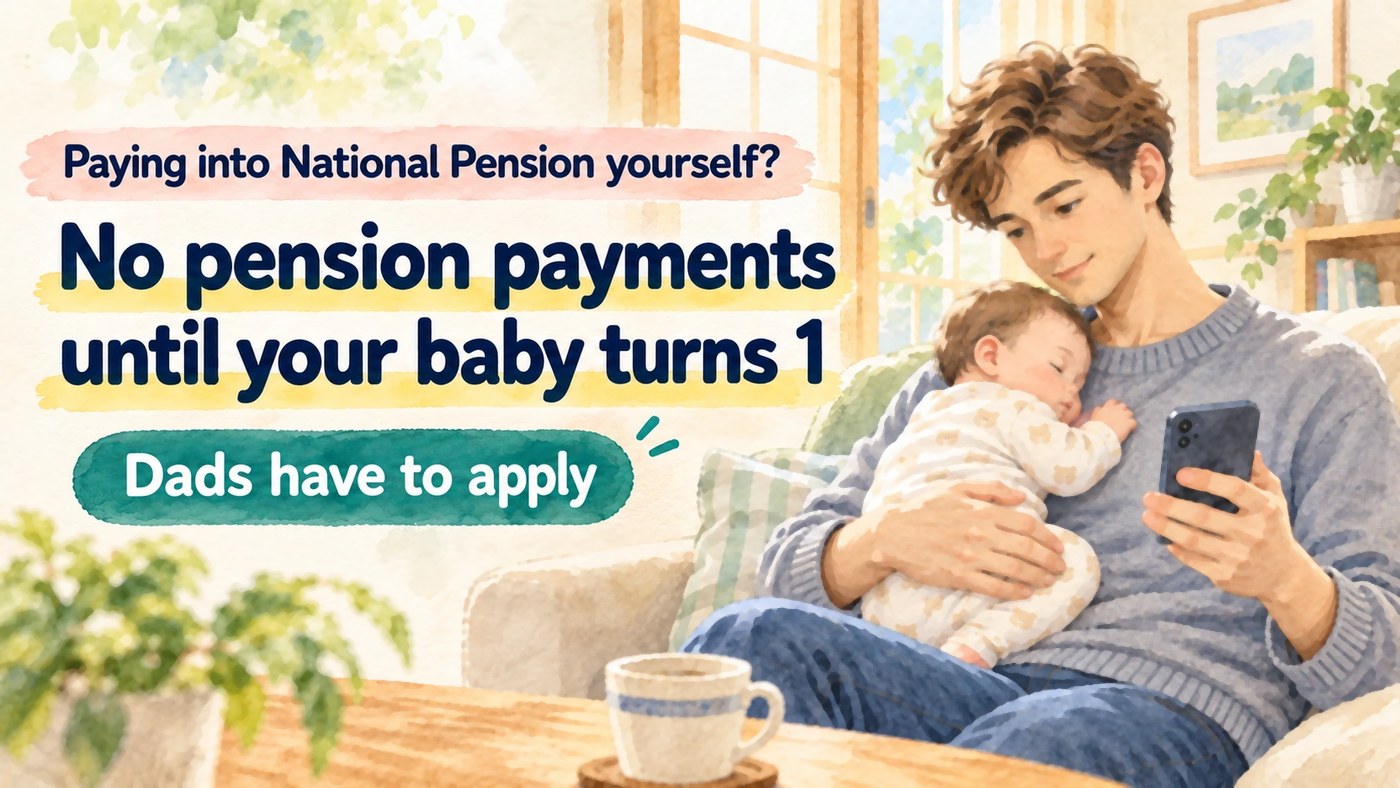
Since October 1, 2026, parents who pay into National Pension (国民年金, kokumin nenkin) themselves can stop paying premiums while their baby is under 1. There is no income test, both parents can qualify, and the months still count toward your pension as if you had paid. The catch is that it isn't fully automatic: fathers, and some mothers, have to file for it.
Who Qualifies
Everyone living in Japan between 20 and 59 is in the pension system, but not everyone pays National Pension premiums directly. The exemption is only for people who do — in pension terms, a Category 1 insured person (第1号被保険者, dai-ichi-gō hihokensha). If you pay a monthly National Pension bill yourself, by automatic bank debit, credit card or the payment slips that arrive in the mail, you are almost certainly in Category 1.
Eligible
- Category 1 members: self-employed people, freelancers, students, people between jobs, and anyone else who pays National Pension directly
- Who are the birth or adoptive parent of a child under 1
- And who live at the same registered address as that child
- Both parents, if both are in Category 1 — each gets their own exemption
- Regardless of income
Not eligible
- Company employees and public servants (Category 2), whose pension comes out of their salary. Employees on childcare leave have a separate premium exemption that goes through their employer
- Dependent spouses of employees (Category 3), who don't pay premiums in the first place
- People enrolled voluntarily (任意加入), for example to top up years after age 60
Mixed households are common. If one parent works for a company and the other is self-employed, only the self-employed parent uses this exemption.
Which Months Are Covered
The periods are different for mothers and fathers, because mothers already had a shorter exemption around the birth.
- Mothers: since 2019, the pregnancy exemption (産前産後免除, sanzen sango menjo) has covered 4 months — from the month before the due month to two months after it (6 months for twins or more). The new exemption adds the 9 months that follow.
- Fathers and adoptive parents: from the month you start caring for the child to the month before the first birthday — up to 12 months.
When the baby arrives in the due month, both parents' exemptions end at the same point: the month before the first birthday. A mother's months are counted from the due date rather than the birth itself, so an early or late arrival can move her end point by a month.
A mother who wasn't covered by the pregnancy exemption — for example, because she wasn't in Category 1 during the pregnancy — follows the same rule as fathers instead.
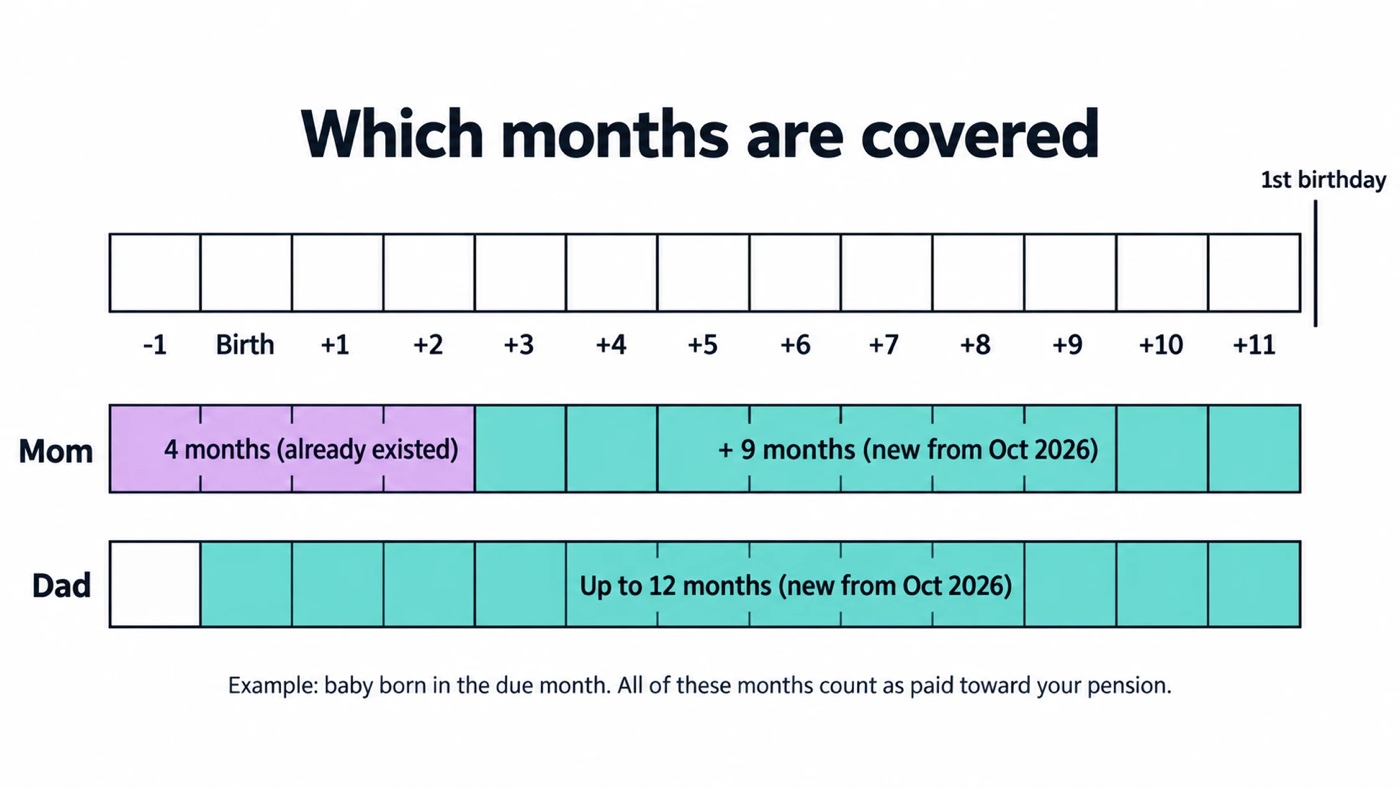
Example for a baby born in the due month. Purple is the pregnancy exemption that already existed; teal is new from October 2026.
Born before October 2026?
You can still use it, but only for the months from October 2026 onward. For a baby born in March 2026, the first birthday is in March 2027, so the exemption covers October 2026 through February 2027 — 5 months — for each parent who qualifies. In a case like this, the mother has to file as well as the father.
How Much It Saves
The National Pension premium for fiscal 2026 (April 2026 to March 2027) is ¥17,920 a month. At that rate:
| Parent | New months | Premiums you don't pay |
|---|---|---|
| Mother | 9 | About ¥161,000 |
| Father | Up to 12 | About ¥215,000 |
The premium is reset every April, so months that fall in a later fiscal year are worth a little more or less. If both parents are in Category 1, the household saves both amounts.
Your Pension Is Not Reduced
This is the part that is easy to misread. Japan has other premium exemptions — for low income, for example — and those come at a cost: the exempt months count toward your basic pension only in part. The childcare exemption is different. The law treats these months as fully paid, so your future old-age basic pension is the same as if you had paid every one of them.
If you want to add to your pension during this time, you can still pay the optional additional premium (付加保険料, fuka hokenryō) of ¥400 a month.
How to File
Fathers: you have to file
Nothing happens on its own for a father or an adoptive parent. File after the baby is born — you can't file in advance — and do it promptly, as the Japan Pension Service asks. The official pages don't say how far back a late filing can reach, so don't count on it being fixed later.
Mothers: it depends on the pregnancy exemption
- If you filed for the pregnancy exemption and it ended in September 2026 or later (roughly, a due month of July 2026 or later), the childcare exemption is processed automatically, and a notice (国民年金保険料育児免除該当通知書) is mailed to you. This depends on the Japan Pension Service being able to confirm through My Number records that you are still raising the baby in the same household.
- If your pregnancy exemption ended before September 2026, you need to file.
- If you never filed for the pregnancy exemption, you need to file. One form covers both, and the pregnancy exemption can be filed after the birth too. Filing it is worth doing on its own, since those 4 months are also treated as paid.
There are three ways to file:
- At city hall: the National Pension desk (国民年金担当窓口) of the city or ward office where you are registered
- By mail to the same office
- Online through Mynaportal (マイナポータル), the government's portal, using your My Number Card
The form is the 国民年金産前産後免除該当届/育児免除該当・終了届. You'll need something showing your My Number or your basic pension number (基礎年金番号, kiso nenkin bangō). Proof of your relationship to the child and a residence certificate are normally not needed.
Filing for your baby is one of several errands in the first weeks. Our first 30 days after birth guide covers the rest, most of them at the same city hall.
If You Already Paid, Deferred, or Were Exempt
- Premiums already paid for months that turn out to be exempt are applied to other months or refunded.
- Months already under another arrangement — a low-income exemption, a payment deferral, or the student payment deferral (学生納付特例) — become childcare exemption months once you file. That is a real gain: deferred months don't add to your pension unless you pay them back later, while these count as paid.
If You Plan to Leave Japan
People without Japanese citizenship who leave Japan can claim part of their premiums back as a lump-sum withdrawal payment (脱退一時金, dattai ichijikin). Under the National Pension Act, that payment counts months treated as paid, and the childcare exemption months fall into that group. The Ministry of Health, Labour and Welfare has said the same of the pregnancy exemption, so these months should count in the same way as months you actually paid. No official page addresses the childcare exemption directly, though, so if the lump-sum payment is part of your plans, ask a pension office (年金事務所, nenkin jimusho) before you rely on it.
Japanese Vocabulary
| Japanese | Reading | Meaning |
|---|---|---|
| 国民年金 | kokumin nenkin | National Pension |
| 第1号被保険者 | dai-ichi-gō hihokensha | Category 1 insured person — someone who pays National Pension directly |
| 育児免除 | ikuji menjo | The childcare exemption described in this guide |
| 産前産後免除 | sanzen sango menjo | The pregnancy exemption — 4 months around the due month |
| 国民年金産前産後免除該当届/育児免除該当・終了届 | kokumin nenkin sanzen sango menjo gaitō todoke / ikuji menjo gaitō・shūryō todoke | The form for both exemptions |
| 基礎年金番号 | kiso nenkin bangō | Basic pension number |
| 付加保険料 | fuka hokenryō | Optional additional premium (¥400 a month) |
| 学生納付特例 | gakusei nōfu tokurei | Student payment deferral |
| 脱退一時金 | dattai ichijikin | Lump-sum withdrawal payment for people leaving Japan |
| 年金事務所 | nenkin jimusho | Pension office (Japan Pension Service) |
More information: The official pages, in Japanese, are from the Japan Pension Service (日本年金機構) and the Ministry of Health, Labour and Welfare (厚生労働省). For your own case, ask the National Pension desk at your city hall or a pension office.