

Written and reviewed by Susumu
Born and raised in Japan · Checked against Japanese law and ministry guidance
A baby arrives and four clocks start at once, and nobody hands you the list. The first month holds seven separate errands — most at city hall, one at immigration, one that may come to your house instead. Here they all are on one page, in the order that saves you a second trip.
Affiliate Disclosure: This article contains affiliate links. If you click a link and make a purchase, we may earn a small commission at no extra cost to you. We only recommend products we genuinely believe are helpful. See our Terms of Use for full details.
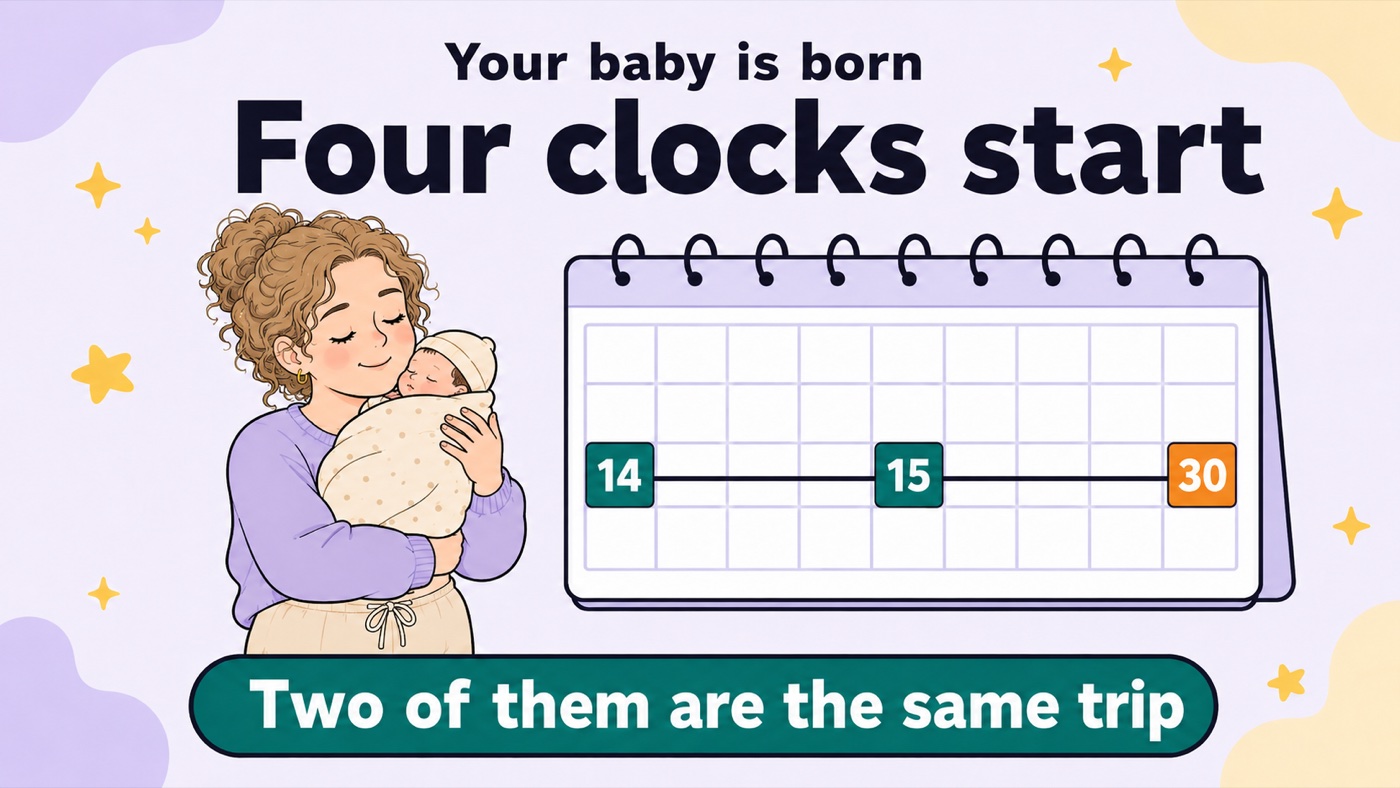
The Clocks That Start at Birth
A baby is born and several deadlines begin at once. None of them are long, and you will be doing this on very little sleep.
This page is a map rather than a manual. Each item gets a few lines and a link to the guide that covers it properly. If you read nothing else, read the table.
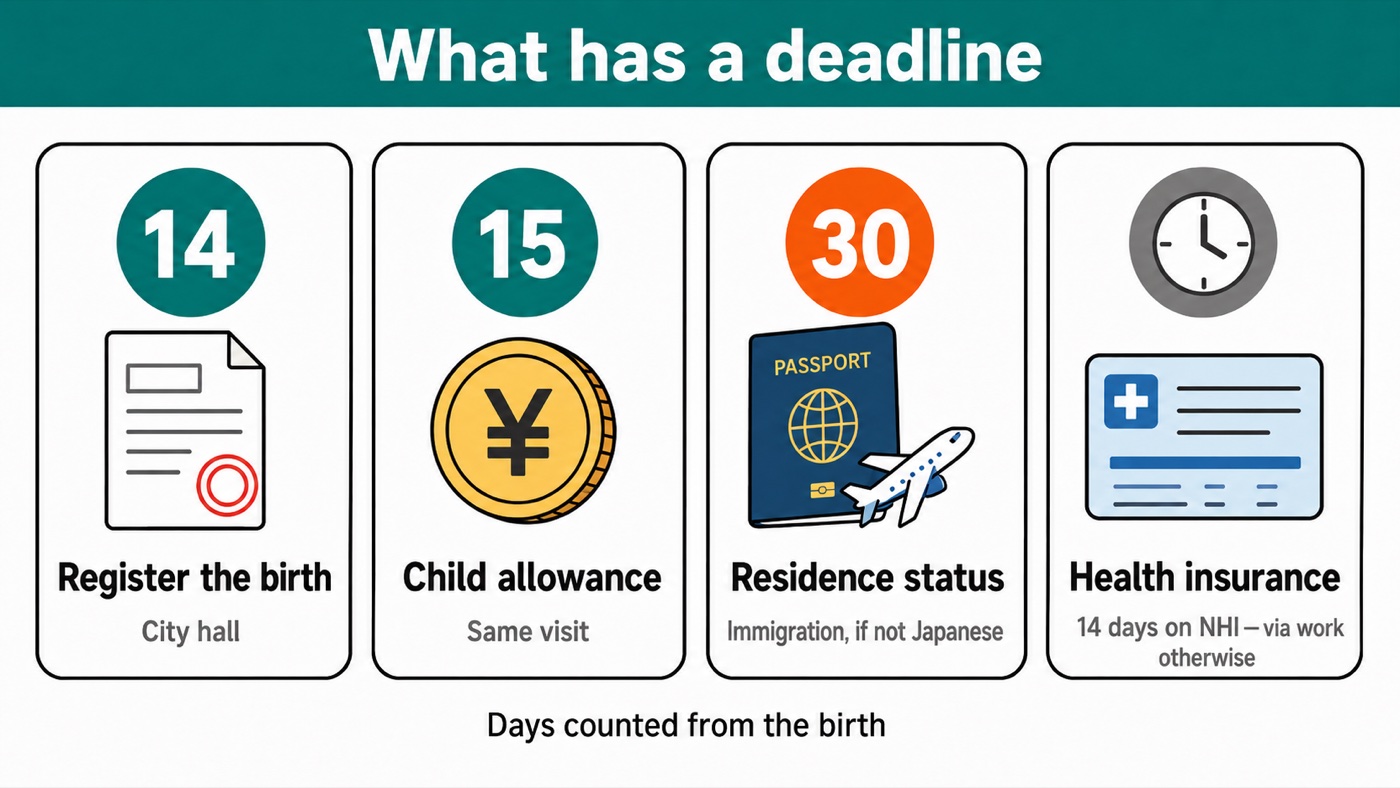
| When | What | Where |
|---|---|---|
| 14 days | Register the birth — 出生届 | City hall |
| 15 days | Claim the child allowance — 児童手当 | City hall, same visit |
| 30 days | Residence status, if your baby is not a Japanese national | Immigration Services Agency |
| 14 days on NHI | Put the baby on health insurance | Your employer, or city hall |
| Around 4 weeks | The one-month checkup | Where you gave birth |
| If offered | Home visit in the first months | Your home — most cities, not all |
One Trip to City Hall
Two deadlines fall in the same building, a day apart, and almost everyone does them together. If you are on National Health Insurance, the baby's cover is a third errand at the same counter — see the next section.
The birth registration (出生届, shusseitodoke) is due within 14 days. The hospital gives you a form with the doctor's section already completed. If the fourteenth day is a weekend or a public holiday, the next working day is fine. Our guide to registering your baby's birth covers the form itself.
If the fourteen days have already passed, go anyway. Late registrations are still accepted, so a missed deadline does not leave your child unregistered. You write the reason for the delay, and the office reports the late filing to a court. Where there was no good reason for it, the court can impose a fine of up to ¥50,000. Going late is far better than not going.
The child allowance (児童手当, jidō teate) is due within 15 days, and this one costs money if you are late.
File the allowance claim inside 15 days and it counts as though you filed in the month of the birth, so you keep that first month's payment. File later and the payment simply starts later. Nothing is backdated. Our guide to the child allowance covers the amounts.
Bring more than you think you need: the birth form, your residence card, your My Number card if you have one, your health insurance details, a bank passbook, and a personal seal if you use one. Being sent home for one missing item is the common outcome, and going back with a newborn is the part nobody warns you about.
Getting the Baby Insured
Two other things wait on this one, so it comes early. Which door you use depends on your own insurance.
If you are on National Health Insurance (国民健康保険, kokumin kenkō hoken), the notification is due at city hall within 14 days — the same window as the birth registration, so do both in the same visit. If you are on employees' health insurance, your workplace files it; tell them the baby has arrived and they will hand you a short form.
Either way, the baby's cover counts from the day of birth, not from the day the paperwork lands.
Since December 2024 Japan no longer issues the old plastic insurance cards. Your baby will be covered through a マイナ保険証 (maina hokenshō) or a 資格確認書 (shikaku kakuninsho) — a paper document your insurer issues free of charge. Our guide to マイナ保険証 for families explains both.
Why this one cannot wait. The child medical card and the one-month checkup both assume the baby is insured. Leave it late and you pay in full at the clinic and claim it back afterward.
Once the baby is insured, apply for the child medical fee subsidy at city hall. This is the card that makes doctor visits cheap or free, and every municipality runs its own version with its own age limits. Our guide to the child medical fee subsidy covers how it is used.
If Your Baby Is Not a Japanese National
A baby born in Japan to parents who are not Japanese nationals does not get a status of residence automatically. You apply for one — 在留資格取得 — at your regional immigration office within 30 days of birth.
Register the birth at city hall first, because the immigration application uses documents that come out of it.
Miss the 30 days and the route becomes longer and more complicated. This is the deadline to write on the calendar. Immigration is the authority here, not the city office — our guide to registering the birth lists what to bring, and the immigration bureau answers anything about status itself.
One more thing is easy to forget, because Japan will not remind you about it: registering the birth with your own country, usually at your embassy, and applying for the baby's passport. Requirements differ by country, so check your embassy's site early. Some countries have their own deadline.
The Money You Can Claim
Two payments sit outside the 30-day rush, and neither is urgent in the same way.
- The birth lump sum (出産育児一時金). Usually settled directly between the hospital and your insurer, so many families never handle the money. Where you do claim it yourself, you have two years from the day after the birth. See the lump-sum birth allowance.
- Maternity and parental leave payments. Filed through your employer, on their schedule rather than yours. See maternity and parental leave.
Our overview of financial support for having a child in Japan puts every payment in one place.
The Visit That Comes to You
Everything above needs you to go somewhere. This one may come to you instead.
Most cities offer a home visit in the first months — こんにちは赤ちゃん事業 (konnichiwa akachan jigyō), the "hello baby" visit, aimed at every household with a baby under four months. Cities are asked to run it rather than required to, and around nine in ten do. Some places fold in a separate newborn visit called 新生児訪問 (shinseiji hōmon); some check on you at a health checkup instead of coming to the house.
So it is not something to count on, and not something to worry about if it does not happen. Whoever comes weighs the baby, looks at feeding and sleeping, asks how you are, and answers what you want to ask. It is free, and it is not an inspection.
If the call comes, say yes. Families new to Japan sometimes turn it down because it arrives in Japanese and sounds official. It is the one point in these weeks where a health professional comes to you, sees your actual situation, and can connect you to postpartum care or anything else you need. If the language is the worry, ask whether someone can interpret, or have a Japanese-speaking friend present.
The One-Month Checkup
At around four weeks — some places anywhere between three and six — mother and baby are both seen, usually at the hospital or clinic where the birth happened. It is normally booked before you are discharged.
Bring the 母子健康手帳. It is the record that follows your child through every checkup and vaccination from here on, and the clinic will write in it. Our guide to the one-month checkup covers what is measured and asked.
What it costs depends on where you live. The law requires only two checkups, at 18 months and three years, and this is not one of them. Cities pay for it themselves, with the national government covering half since 2024.
Where your city has joined that scheme, a voucher (受診票, jushinhyō) comes with the 母子健康手帳 and covers up to ¥6,000. Look for it in the handbook packet before you go. Where there is no voucher, or where the bill runs higher, the rest is yours.
Doing It in the Right Order
Each step hands something to the next one, so the sequence saves more time than hurrying does.
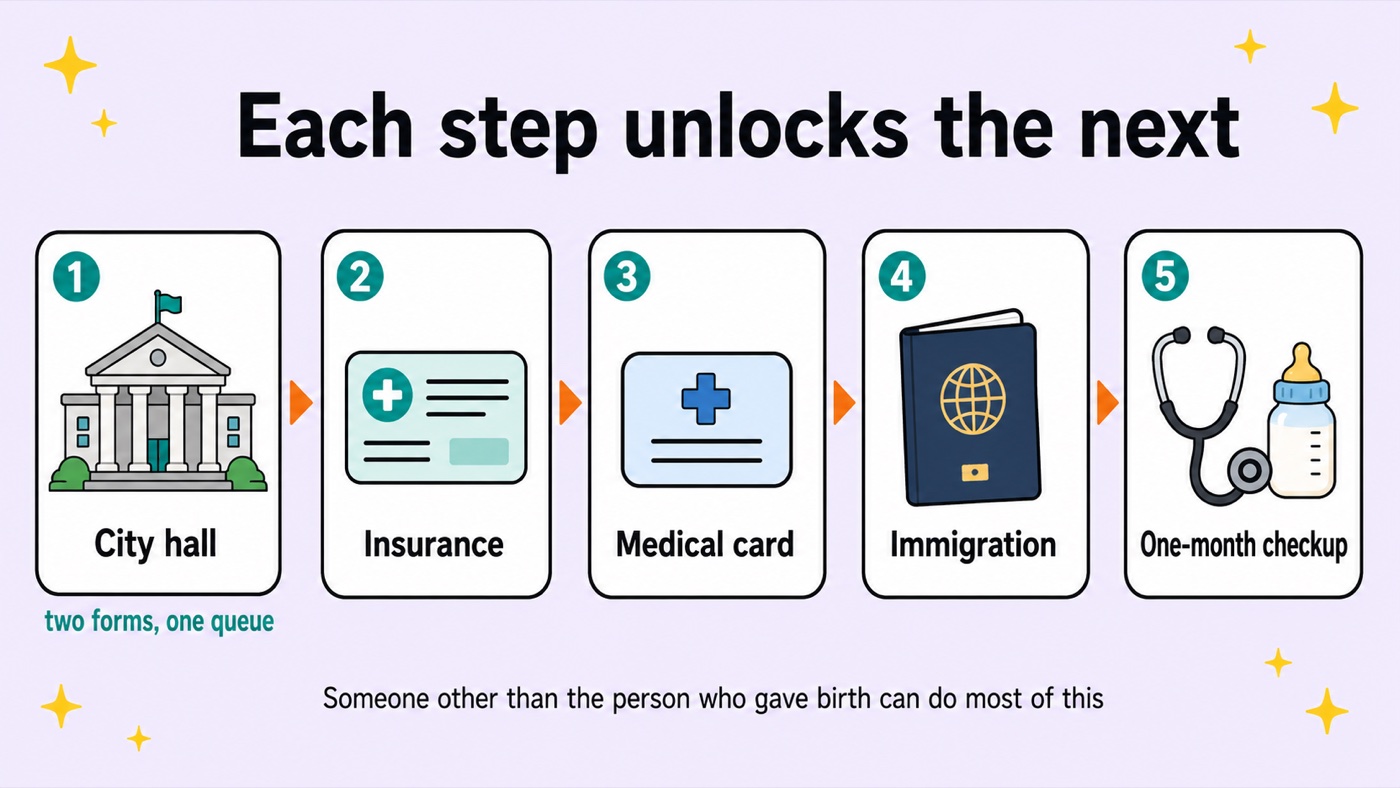
- City hall. Register the birth, and claim the child allowance in the same visit. If you are on National Health Insurance, add the baby here too.
- Health insurance. Through your workplace if that is your route. Ask them on the day the baby is born; it is usually a short form.
- The medical card. Back at city hall once the baby is insured, or by mail where the city allows it.
- Immigration. Within 30 days, if the baby is not a Japanese national.
- Your embassy. Birth registration in your own country, and the passport.
- The one-month checkup. Already booked, in most cases.
- The home visit, if your city offers one. Nothing to arrange — answer if they call.
Somebody other than the person who gave birth can do most of this. City hall does not require the mother to attend, and the first weeks are not the time to be standing in line if there is another option.
The deadlines above are national and the same wherever you live. Which counter handles what, and whether any of it can be done by mail, is your municipality's own arrangement — worth one phone call before you set out.
子どもが生まれたので、手続きをまとめてお願いできますか。
Kodomo ga umareta node, tetsuzuki o matomete onegai dekimasu ka?
Our baby has been born — could we do the procedures together?
Said at the information desk on the way in, this usually gets you walked between the right counters instead of finding them one at a time.
Japanese Vocabulary
The words on the forms and at the counters:
| Japanese | Reading | Meaning |
|---|---|---|
| 出生届 | shusseitodoke | Birth registration, due within 14 days |
| 児童手当 | jidō teate | Child allowance, claimed within 15 days |
| 在留資格取得 | zairyū shikaku shutoku | Getting a status of residence for the baby, within 30 days |
| 資格確認書 | shikaku kakuninsho | The paper that shows insurance cover, issued free |
| 乳幼児医療費助成 | nyūyōji iryōhi josei | The child medical fee subsidy, run by your city |
| 母子健康手帳 | boshi kenkō techō | The handbook every checkup is written into |
| 受診票 | jushinhyō | The checkup voucher that comes with the handbook |
| 出産育児一時金 | shussan ikuji ichijikin | The birth lump sum, usually settled by the hospital |