

Written and reviewed by Susumu
Born and raised in Japan · Checked against Japanese law and ministry guidance
Japan's 1-month checkup is two appointments in one — a full physical for your baby and a postpartum examination for you. Here is what happens, what to bring, and how the costs are covered.
Affiliate Disclosure: This article contains affiliate links. If you click a link and make a purchase, we may earn a small commission at no extra cost to you. We only recommend products we genuinely believe are helpful. See our Terms of Use for full details.

Japan's 1-month checkup is two appointments in one. Your baby gets a thorough physical examination — and you do too. Both checkups happen on the same day, usually at the hospital where you gave birth, and together they mark the end of the newborn period and the start of regular infant life in Japan.
Two Checkups in One Visit
The 1-month checkup — known as 1ヶ月健診 (ikkagetsu kenshin) — actually covers two separate appointments that happen on the same day:
👶 乳児健診 (nyūji kenshin) — Baby's checkup
A full physical examination by a pediatrician. Checks growth, development, and the transition out of the newborn stage.
🩺 産婦健診 (sanpu kenshin) — Mother's postpartum checkup
An examination by the obstetrician who attended your birth. Checks how your body is recovering, your breastfeeding situation, and your mental health.
The two appointments may be back-to-back or slightly offset in time. Either way, plan for the whole visit to take two to three hours — waiting rooms at birth clinics can be busy, and newborns have a way of making everything take longer than expected.
Your Baby's Examination
According to guidelines from the 日本産婦人科医会 (Japan Association of Obstetricians and Gynecologists, JAOG), the 1-month checkup is typically scheduled at around 4 weeks after birth, though some facilities schedule it anywhere between 3 and 6 weeks.
The pediatrician will work through the following:
The doctor will also ask about sleep, stools, and any concerns you have. This is a good moment to raise anything that has been worrying you — crying patterns, skin conditions, or feeding difficulties you have not been able to resolve on your own.

Your Postpartum Checkup
The mother's appointment — 産婦健診 (sanpu kenshin), also called 産後健診 (sango kenshin) — is a medical examination focused on how your body is recovering from birth. It is separate from the baby's checkup and carried out by your obstetrician.
The examination typically covers:
- Uterine recovery — the uterus is examined internally to confirm it has returned to close to its pre-pregnancy size (子宮復古, shikyū fukkō)
- Lochia — the postpartum discharge (悪露, oro) is assessed for color, volume, and smell. By one month, most women have light-colored or almost no discharge
- Wound healing — the perineal repair (会陰縫合) or cesarean scar (帝王切開傷) is inspected
- Breast and feeding — for breastfeeding mothers, the doctor or midwife checks for engorgement, mastitis signs, and latch issues
- Blood pressure — elevated blood pressure after birth (postpartum hypertension) can persist for weeks in some women
- Mental health screening — a standardized questionnaire is completed (see below)
Postpartum Depression Screening (EPDS)
At the postpartum checkup, you will be asked to complete the Edinburgh Postnatal Depression Scale (EPDS) — a 10-question self-report questionnaire that screens for postpartum depression and anxiety. It takes around five minutes and asks about your mood, sleep, feelings of guilt, and thoughts of self-harm over the past seven days.
About the EPDS score
Each of the 10 questions is scored 0–3. The recommended threshold for Japanese is 8/9 points — a total score of 9 or above triggers follow-up.
A high score does not mean you have postpartum depression. It means the hospital will want to talk with you further and, if necessary, refer you to a mental health professional.
The EPDS has been validated in multiple languages including English, Chinese, Korean, Arabic, Vietnamese, and Thai, and multilingual versions are available through the Japan Association of Obstetricians and Gynecologists (JAOG). If you would prefer to complete it in your first language, ask the hospital in advance — many clinics can accommodate this.
Postpartum depression affects around 10–15% of mothers globally. In Japan, the cultural expectation to manage quietly can make it harder to ask for help. The EPDS exists precisely to open that conversation without requiring you to raise the subject yourself.
Vitamin K Syrup
At the 1-month checkup, your baby will receive another dose of vitamin K2 syrup (ビタミンK2シロップ). Vitamin K is essential for blood clotting; newborns have very little stored at birth, and breast milk contains only small amounts.
In 2021, a joint statement from multiple Japanese medical societies — including the Japan Pediatric Society and the Japan Society of Obstetrics and Gynecology — updated the recommended protocol:
Which protocol your hospital follows will depend on when they updated their procedures. The doctor will advise you at discharge and confirm the plan again at the 1-month visit. If your baby is mostly formula-fed by this point, the doctor may discontinue the syrup — formula is fortified with vitamin K.
When and Where
The 1-month checkup is held at the hospital or clinic where you gave birth (産院, san'in). It is not held at a local pediatric clinic or municipal health center — those come later, starting from the 3–4-month checkup. Our guide to the infant checkup schedule covers the rounds that follow.
Book before you are discharged
Most hospitals schedule the 1-month appointment before you leave the ward. If the nurse does not raise it, ask: 「1ヶ月健診の予約をしたいのですが」 (Ikkagetsu kenshin no yoyaku o shitai no desu ga — I would like to book the 1-month checkup).
Some hospitals also offer a 2-week checkup (2週間健診) as an optional appointment between discharge and the 1-month visit. It is not mandatory, but it gives you an earlier chance to have feeding and weight gain assessed — useful if you are anxious about breastfeeding or your baby lost significant weight before discharge. Ask your hospital whether they offer it.
What to Bring
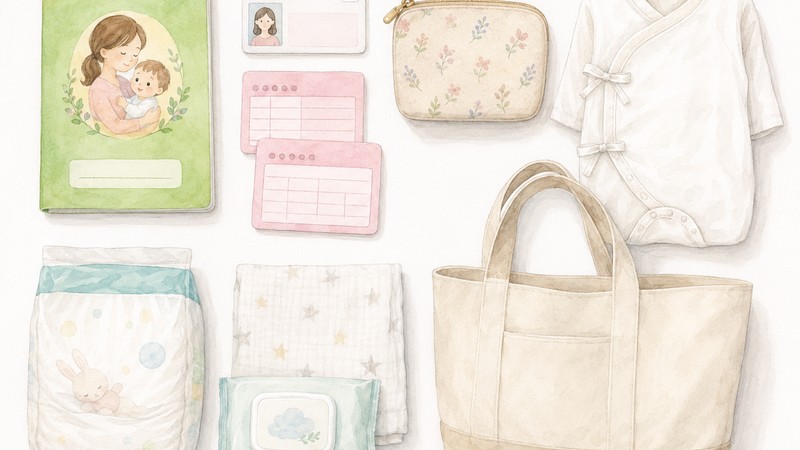
For the baby
- 母子手帳 (mother-child health handbook)
- 医療証 (medical fee subsidy certificate — issued by your ward office after birth registration)
- Diapers and wipes
- Spare change of clothes
- Blanket or muslin (おくるみ)
- Formula and bottle if not breastfeeding
For the mother
- 母子手帳 (same booklet)
- マイナンバーカード — Japan replaced the traditional health insurance card (健康保険証) with the My Number Card from December 2024. If you do not yet have yours linked to health insurance, bring your 資格確認書 (eligibility confirmation document) issued by your insurer instead
- 診察券 (hospital registration card)
- 産婦健診補助券 (postpartum checkup voucher, if issued by your municipality)
- Small pouch for coins and receipts
The 母子手帳 is used for both appointments — the doctor records the baby's measurements and your examination results in the same booklet. Keep it with you throughout the visit.
Cost and Subsidies
Baby's checkup
Covered by the 乳幼児医療費助成制度 (child medical fee subsidy). In most prefectures, the out-of-pocket cost is zero or a small flat fee (typically ¥200–500 per visit). Make sure you have your baby's 医療証 (medical certificate) — issued by your ward or city office after birth registration — to present at reception.
Mother's postpartum checkup
The national government subsidizes up to ¥5,000 per visit for the 2-week and 1-month postpartum checkups (国補助1/2・市区町村1/2). Many municipalities top this up so that the net cost is zero. Check whether your ward or city office has issued you a 産婦健診補助券 — if so, present it at the hospital.
If you have not yet received a postpartum checkup voucher, contact your 保健センター (health center) or ward office. International residents with valid residency status are eligible for the same subsidies as Japanese nationals.
FAQ
Can my partner come with me?
Yes. Partners are welcome at both the baby's and the mother's checkup. Having an extra pair of hands for a 1-month-old in a waiting room is genuinely useful.
What if my baby cries throughout the whole visit?
Completely normal. Every doctor and nurse in a maternity clinic is used to this. The examination can be done even on a crying baby — it does not affect the results.
Can I breastfeed in the waiting room?
Most birth clinics have a dedicated nursing room (授乳室, junyūshitsu). Ask at reception when you arrive — they will direct you. Feeding in the waiting room is generally fine too, but the nursing room offers more privacy.
Is the 1-month checkup compulsory?
It is not legally mandatory, but it is strongly recommended and effectively universal in Japan. Missing it means missing the structured opportunity to catch problems early — hip dysplasia in particular is much easier to treat when found at this stage.
The EPDS questionnaire is only in Japanese. What do I do?
The EPDS has been validated in multiple languages. Call the hospital in advance and ask whether they have an English version — many do. If not, you can access English and multilingual versions through the JAOG (Japan Association of Obstetricians and Gynecologists) website and bring a printed copy.
Japanese Vocabulary
| Japanese | Reading | Meaning |
|---|---|---|
| 1ヶ月健診 | ikkagetsu kenshin | 1-month checkup |
| 乳児健診 | nyūji kenshin | baby / infant checkup |
| 産婦健診 | sanpu kenshin | postpartum mother's checkup |
| 産院 | san'in | birth hospital or clinic |
| 母子手帳 | boshi techō | mother-child health handbook |
| 産婦健診補助券 | sanpu kenshin hojo ken | postpartum checkup subsidy voucher |
| 黄疸 | ōdan | jaundice |
| 股関節 | kokansetsu | hip joint |
| 悪露 | oro | postpartum discharge (lochia) |
| 子宮復古 | shikyū fukkō | uterine recovery / involution |
| ビタミンK2シロップ | bitamin K2 shiroppu | vitamin K2 syrup |
| 授乳室 | junyūshitsu | nursing room |
| 保健センター | hoken sentā | municipal health center |