

Written and reviewed by Susumu
Born and raised in Japan · Checked against Japanese law and ministry guidance
A clear guide to 産休 (maternity leave) and 育休 (parental leave) in Japan — how long each lasts, how much you get paid, the 2025 bonus for fathers, and whether international families qualify.
Affiliate Disclosure: This article contains affiliate links. If you click a link and make a purchase, we may earn a small commission at no extra cost to you. We only recommend products we genuinely believe are helpful. See our Terms of Use for full details.

📌 Note: This guide covers the general rules under Japanese law. Your exact entitlements may depend on your employment contract and how long you have worked in Japan. If you're unsure, check with your employer's HR department or your nearest Hello Work (ハローワーク) office.
産休 vs 育休 — What's the Difference?
Two types of leave protect working parents in Japan. You'll see them written everywhere once you're pregnant — but they're easy to confuse:
| 産休 (sankyu) Maternity leave |
育休 (ikukyu) Parental leave |
|
|---|---|---|
| Who | Mothers only | Both mothers and fathers |
| When | Around childbirth | After birth, while raising the baby |
| Duration | About 14 weeks total | Up to 1 year (or longer) |
| Pay | About 2/3 of salary | 67% → 50% of salary |
In practice, most mothers take 産休 first, and then go straight into 育休 — so the two overlap seamlessly. Many fathers take 育休 at the same time as the mother, especially after 2025 rule changes made it more financially rewarding to do so.
産前産後休業 (産休) — Maternity Leave
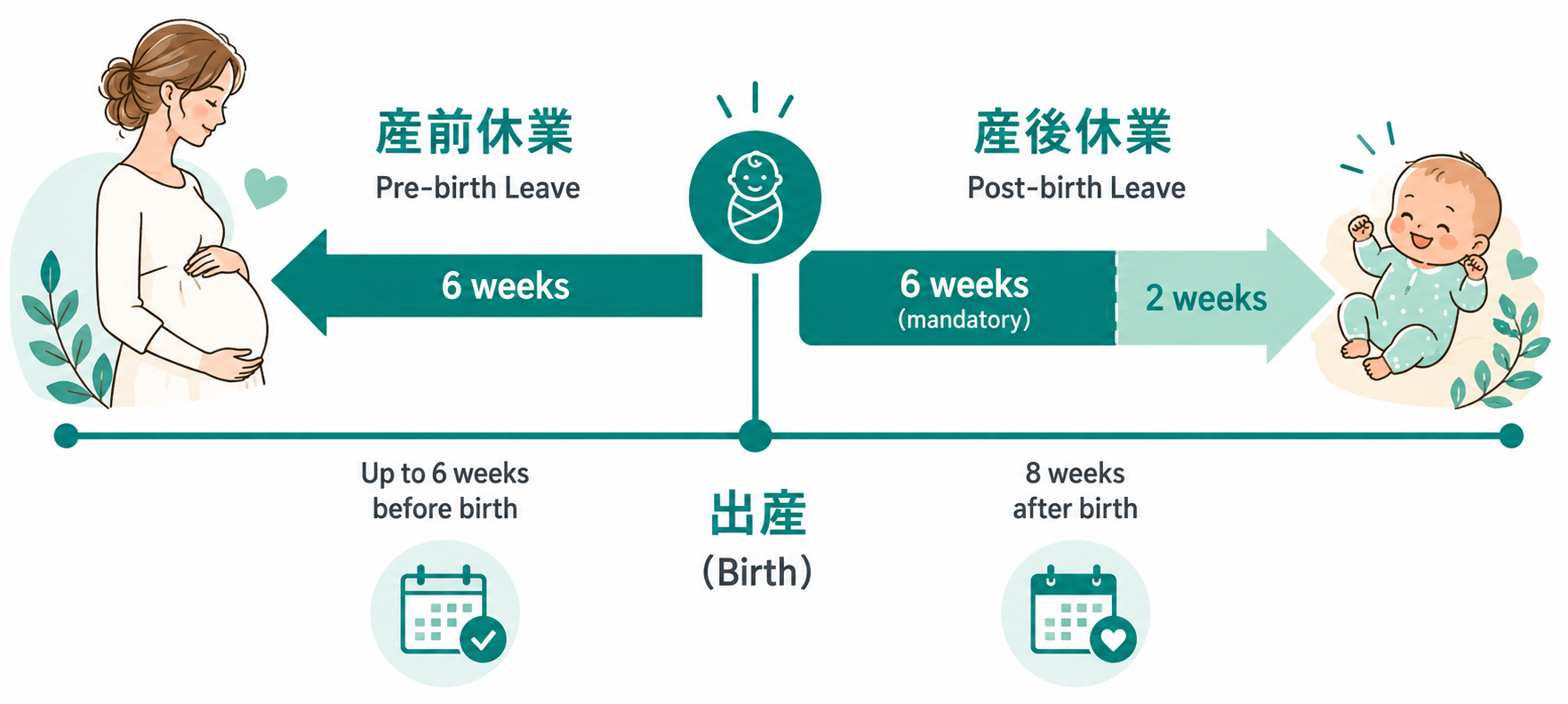
産前産後休業 (sanzen sango kyuugyo), usually called 産休 (sankyu), is the leave period around childbirth. It covers two phases:
- Before birth (産前休業): You can start leave 6 weeks before your due date. For twins or more, it's 14 weeks before. This is your choice — you're allowed to keep working right up until your due date if you want to, but most people start leave early.
- After birth (産後休業): 8 weeks after giving birth. The first 6 weeks are mandatory — your employer cannot ask you to work during this time, and you cannot return even if you want to. After 6 weeks, you can return if your doctor agrees.
Pay during 産休 — 出産手当金
If you're enrolled in workplace health insurance (健康保険), you receive 出産手当金 (shussan teate-kin) — a payment of about two-thirds of your average daily wage for the full leave period. For a single pregnancy, that's 98 days total (42 days before + 56 days after). For twins or more, it's 154 days (98 days before + 56 days after). Your employer doesn't pay your salary during 産休, but this benefit covers it.
産休 applies to all female employees regardless of employment type — full-time, part-time, or contract. There is no minimum length of service required. If you work for a company in Japan and pay into health insurance, you qualify.
育児休業 (育休) — Parental Leave
育児休業 (ikuji kyuugyo), usually called 育休 (ikukyu), is the longer leave period for raising your baby. Unlike 産休, both mothers and fathers can take it.
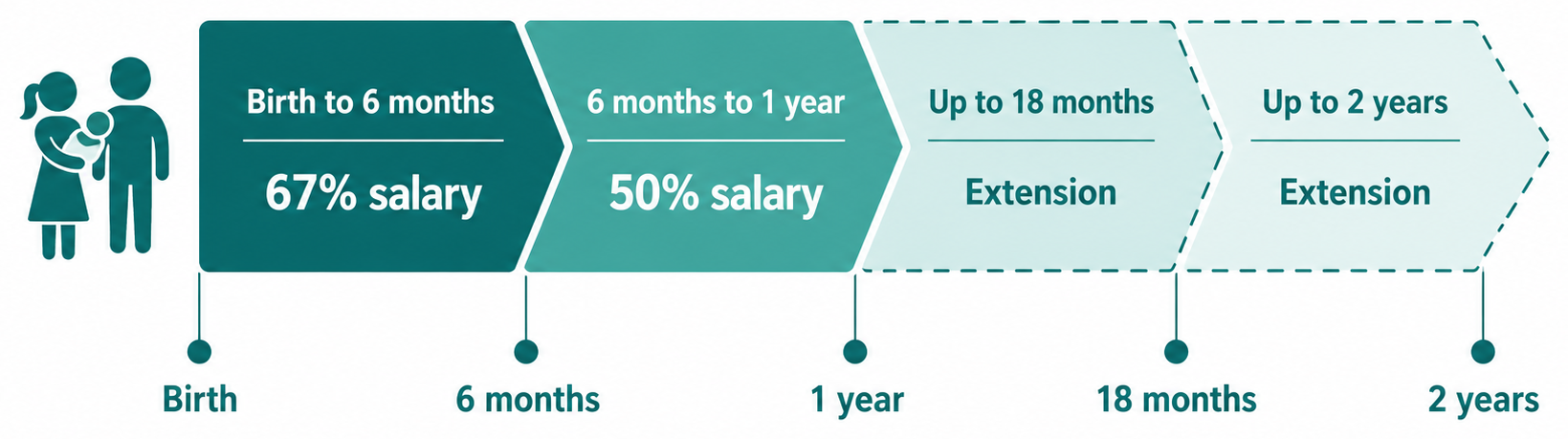
You can take 育休 until your child turns 1. If you apply for daycare and don't get a place, it can be extended to 18 months — and in some cases up to 2 years.
Pay during 育休 — 育児休業給付金
If you've been enrolled in employment insurance (雇用保険) for at least 12 months in the past 2 years, you receive 育児休業給付金 (ikuji kyuugyo kyuufukin):
- First 6 months: 67% of your pre-leave salary
- After 6 months: 50% of your pre-leave salary
On top of that, your social insurance contributions (health insurance and pension) are completely waived while you're on 育休. You don't pay, and your employer doesn't pay either. This makes the actual financial impact of taking leave much smaller than many people expect.
To qualify for 育児休業給付金: You need to have been enrolled in employment insurance (雇用保険) for at least 12 months within the 2 years before your leave starts, and you must be working 10 days or fewer per month during the leave period.
For Fathers
Japan has been actively encouraging fathers to take parental leave. In 2022, a new system called 産後パパ育休 was introduced specifically for fathers — and in 2025, a financial bonus was added to make it even more attractive.
産後パパ育休 (postnatal paternity leave): Fathers can take up to 4 weeks of leave within the first 8 weeks after birth. Unlike the standard 育休, this can be split into two separate periods, and you can continue to work on some days during the leave (with agreement from your employer).
🆕 2025 bonus: 出生後休業支援給付金
From April 2025, if both parents each take at least 14 days of leave within the first 8 weeks after birth, the father's pay rate increases from 67% to 80% for up to 28 days. This is a real incentive for couples to take leave together during those early weeks.
The rate of fathers taking parental leave in Japan has been rising fast — from 30% in 2023 to over 40% in 2024. The 2025 bonus is expected to push that even higher.
International Residents — Do the Same Rules Apply?
Yes. Japanese labor law does not make exceptions based on nationality. As long as you are employed and enrolled in the relevant insurance schemes, you have exactly the same rights as Japanese workers.
- 産休 and 出産手当金: You need to be enrolled in workplace health insurance (健康保険). This applies if you're working full-time or part-time at a company that covers you — which most do.
- 育休 and 育児休業給付金: You need to be enrolled in employment insurance (雇用保険) for at least 12 months. Most regular employees are enrolled automatically from day one.
If you're unsure whether you're enrolled in 雇用保険 or 健康保険, check your payslip (給与明細). You should see deductions for both. If not, speak to your HR department — enrollment is your legal right.
One situation to watch for: if you're on a spouse visa (家族滞在) and working part-time under supplementary activity permission, you may still qualify if you've been working consistently enough to meet the 12-month requirement. Check with your employer or Hello Work to confirm.
Planning to go back to work after leave? You'll also want to read our guides on applying for licensed daycare and kindergarten enrollment.
📖 Japanese Vocabulary
Useful terms for maternity and parental leave in Japan.
| 日本語 | ひらがな | English |
|---|---|---|
| 産前産後休業 | さんぜんさんごきゅうぎょう | Maternity leave (around childbirth) |
| 育児休業 | いくじきゅうぎょう | Parental leave (for raising the baby) |
| 出産手当金 | しゅっさんてあてきん | Maternity allowance (≈2/3 salary during 産休) |
| 育児休業給付金 | いくじきゅうぎょうきゅうふきん | Parental leave benefit (67%→50% of salary) |
| 産後パパ育休 | さんごぱぱいくきゅう | Postnatal paternity leave (up to 4 weeks) |
| 雇用保険 | こようほけん | Employment insurance |
| 健康保険 | けんこうほけん | Workplace health insurance |
| 給与明細 | きゅうよめいさい | Payslip |