

Written and reviewed by Susumu
Born and raised in Japan · Checked against Japanese law and ministry guidance
Prenatal testing in Japan — routine ultrasounds, NIPT, and amniocentesis explained. What each test involves, when it's done, and how much it costs.
Affiliate Disclosure: This article contains affiliate links. If you click a link and make a purchase, we may earn a small commission at no extra cost to you. We only recommend products we genuinely believe are helpful. See our Terms of Use for full details.
📌 Note: This article is for informational purposes only. It describes the prenatal tests available in Japan. The decision of whether to take any test is entirely personal. Always consult your obstetrician for advice specific to your situation.
What Is Prenatal Testing?
Prenatal testing (出生前検査 — しゅっせいぜんけんさ) refers to a range of tests available during pregnancy that can provide information about the health and development of the baby. In Japan, several options are available — from routine ultrasound scans included in standard prenatal care, to specialist tests that look for chromosomal conditions.
Japan's Agency for Children and Families (こども家庭庁) provides official guidance on prenatal testing at prenatal.cfa.go.jp. This page also includes a multilingual support guide for families living in Japan.
Three Categories of Tests
According to Japan's Agency for Children and Families (こども家庭庁), prenatal tests fall into three categories:
| Category | Japanese | What it tells you |
|---|---|---|
| Screening test (non-definitive) |
非確定的検査 ひかくていてきけんさ |
Estimates the probability of a chromosomal condition. Non-invasive. Not conclusive on its own. |
| Fetal observation (ultrasound) |
胎児超音波検査 たいじちょうおんぱけんさ |
Observes the baby's physical development and can indicate possibilities — but not a definitive diagnosis. |
| Diagnostic test (definitive) |
確定的検査 かくていてきけんさ |
Analyses the baby's chromosomes directly. Provides a definitive result. Carries a small procedural risk. |
Overview of All Available Tests
The following data is sourced from Japan's Agency for Children and Families (こども家庭庁). All tests are optional and separate from standard prenatal checkups.
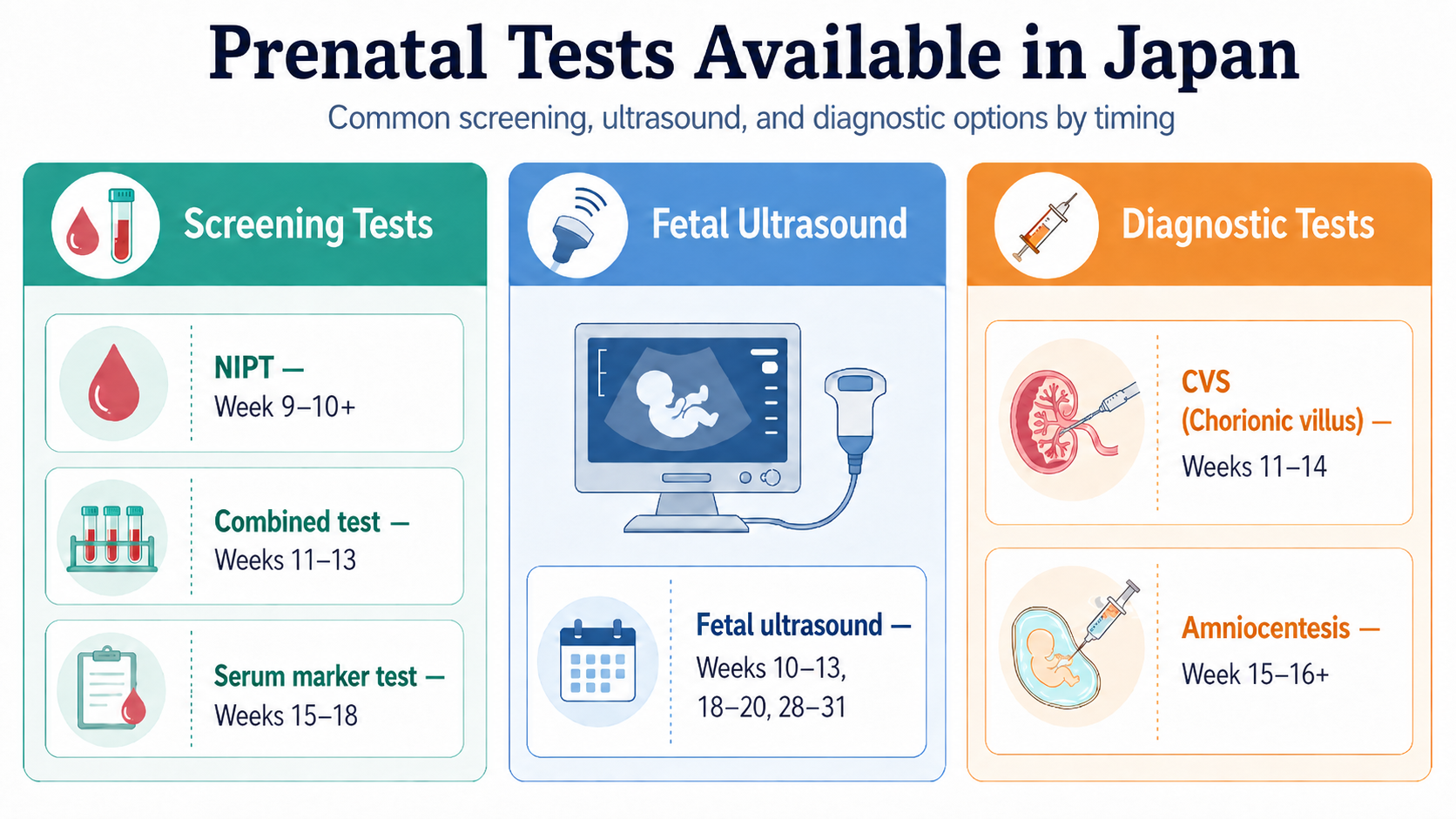
| Test | When | Method | Sensitivity* | Results in | Miscarriage risk |
|---|---|---|---|---|---|
| ① Screening tests (非確定的検査) — non-invasive, no miscarriage risk | |||||
| NIPT 新型出生前診断 |
Week 9–10+ | Blood test (fetal DNA) | 99% | 1–2 weeks | None |
| Ultrasound marker / Combined test 超音波マーカー・コンバインド検査 |
Weeks 11–13 | Ultrasound + blood test | 60–80% | Immediate–2 weeks | None |
| Maternal serum marker (Quad screen) 母体血清マーカー / クアトロ検査 |
Weeks 15–18 | Blood test only | 80% | 10 days–2 weeks | None |
| ② Fetal observation (胎児超音波検査) — non-invasive, no miscarriage risk | |||||
| Fetal ultrasound 胎児超音波検査 |
Weeks 10–13, 18–20, 28–31 | Ultrasound scan | Varies | Immediate | None |
| ③ Diagnostic tests (確定的検査) — invasive, small procedural risk | |||||
| Chorionic villus sampling (CVS) 絨毛検査 |
Weeks 11–14 | Tissue sample from placenta | ~100% | 2–3 weeks | 0.2% |
| Amniocentesis 羊水検査 |
Week 15–16+ | Sample of amniotic fluid via needle | ~100% | 2–3 weeks | 0.1–0.3% |
*Sensitivity = the probability of detecting a condition when the baby actually has it (figures are for trisomy 21). Source: こども家庭庁 prenatal.cfa.go.jp
Note on cost: None of these tests are covered by Japan's national health insurance (健康保険) as of 2026. Screening tests typically cost ¥20,000–¥100,000+; diagnostic tests ¥100,000–¥200,000. Costs vary by facility — confirm directly with your hospital.
About the maternal serum marker test: In addition to trisomy 21 and 18, this test also screens for neural tube defects (神経管閉鎖不全 — しんけいかんへいさふぜん) — a group of conditions affecting the brain and spinal cord. This makes it the only screening test that looks beyond chromosomal conditions.
NIPT in Detail
NIPT (Non-Invasive Prenatal Testing) — 新型出生前診断 — しんがたしゅっせいぜんしんだん is a blood test that analyses fragments of the baby's DNA that circulate in the mother's blood. It primarily screens for trisomy 21 (Down syndrome), trisomy 18, and trisomy 13.
NIPT is the most sensitive of the screening tests, but its result is still a probability — not a diagnosis. A positive NIPT result would typically be followed by a diagnostic test (amniocentesis or CVS) to confirm.
Detection accuracy varies by age
Because chromosomal conditions are more common in older pregnancies, the probability that a positive NIPT result is correct varies depending on the mother's age:
| Mother's age | Positive predictive value (trisomy 21) |
|---|---|
| 30 years old | Approximately 85% |
| 35 years old | Approximately 93% |
| 40 years old | Approximately 98% |
Important: These percentages represent the likelihood that a positive NIPT result corresponds to an actual chromosomal condition. They do not mean the test misses cases — NIPT has a very high sensitivity for detecting trisomy 21. Your obstetrician can explain what the figures mean for your specific situation.
No age restriction as of 2022
Until 2022, NIPT in Japan was generally offered only to mothers aged 35 and over. Following updated guidelines from Japan's relevant medical societies, NIPT is now available to any pregnant woman who wishes to have it — regardless of age.
Certified Facilities (認証施設)
In Japan, there are two types of facilities offering NIPT:
| Facility type | What this means |
|---|---|
| Certified facility 認証施設 — にんしょうしせつ |
Accredited by relevant medical societies. Offers genetic counseling before and after the test, and has protocols for supporting patients whatever the result. |
| Non-certified facility 非認証施設 — ひにんしょうしせつ |
Can legally offer NIPT but is not accredited. May not provide the same level of genetic counseling or support. |
A list of certified facilities is available in Japanese on the website of the Japan Society of Obstetrics and Gynecology. Your obstetrician can advise on facilities near you.
Routine Ultrasound Checks
Separate from the above tests, routine ultrasound scans (超音波検査 — ちょうおんぱけんさ) are performed at standard prenatal checkups throughout pregnancy. These are included as part of normal antenatal care and are not specifically prenatal testing for chromosomal conditions.
Ultrasound checks monitor the baby's growth, position, amniotic fluid levels, placenta location, and overall development. They are a standard part of every pregnancy in Japan. Our guide to prenatal checkups covers that schedule and how the vouchers cover it.
Official information: For official guidance on prenatal testing in Japan, visit prenatal.cfa.go.jp (こども家庭庁). This site includes information in multiple languages for families living in Japan.
📖 Japanese Vocabulary
Key terms for speaking with doctors or hospitals in Japan about prenatal testing.
| 日本語 | ひらがな | English |
|---|---|---|
| 出生前検査 | しゅっせいぜんけんさ | Prenatal testing |
| 非確定検査 | ひかくていけんさ | Screening test (non-definitive) |
| 確定検査 | かくていけんさ | Diagnostic test (definitive) |
| 新型出生前診断 | しんがたしゅっせいぜんしんだん | NIPT (Non-Invasive Prenatal Testing) |
| コンバインド検査 | こんばいんどけんさ | Combined test |
| 母体血清マーカー検査 | ぼたいけっせいまーかーけんさ | Maternal serum marker test |
| クアトロ検査 | くあとろけんさ | Quad screen (maternal serum marker) |
| 絨毛検査 | じゅうもうけんさ | Chorionic villus sampling (CVS) |
| 羊水検査 | ようすいけんさ | Amniocentesis |
| 染色体 | せんしょくたい | Chromosome |
| ダウン症候群 | だうんしょうこうぐん | Down syndrome (trisomy 21) |
| 超音波検査 | ちょうおんぱけんさ | Ultrasound scan |
| 遺伝カウンセリング | いでんかうんせりんぐ | Genetic counseling |
| 認証施設 | にんしょうしせつ | Certified / accredited facility |