
Written and reviewed by Susumu
Born and raised in Japan · Checked against Japanese law and ministry guidance
A salary-based payment for employees on maternity leave, separate from the flat ¥500,000 childbirth grant. What it pays, who qualifies, and how the claim works alongside your employer.
Affiliate Disclosure: This article contains affiliate links. If you click a link and make a purchase, we may earn a small commission at no extra cost to you. We only recommend products we genuinely believe are helpful. See our Terms of Use for full details.

If you work in Japan and pay into employer health insurance, you're entitled to a cash benefit while you're on maternity leave — separate from, and on top of, the flat 500,000-yen childbirth grant. Here's how 出産手当金 (shussan teatekin) works, what to expect, and how to claim it.
Two different benefits — easy to confuse
出産育児一時金 (shussan ikuji ichijikin — childbirth lump-sum grant) is a flat 500,000 yen paid for the birth itself — available to almost everyone with health insurance, regardless of employment. 出産手当金 (shussan teatekin — maternity allowance) is a salary-replacement benefit paid during your maternity leave — only available to employees in employer health insurance. Both can be received at the same time.
What Is 出産手当金?
出産手当金 (shussan teatekin) is a maternity allowance paid by your health insurer — usually the Japan Health Insurance Association (全国健康保険協会, 協会けんぽ) or your company's own health insurance society (健康保険組合) — while you're off work for childbirth. It replaces part of your salary during the weeks you're legally required to be away from the office.
The legal basis is Article 102 of the Health Insurance Act (健康保険法第102条). The benefit is paid directly to you, not to your employer, and is tax-free.
Who Qualifies
You need to be the primary insured person (被保険者) in employer health insurance — not a dependent on your spouse's plan. That's the core requirement.
Eligible
- Full-time employees covered by employer health insurance (社会保険)
- Part-time or contract workers enrolled in employer health insurance
- Civil servants covered by a mutual aid association (共済組合) — though the application process may differ slightly
Not eligible
- People enrolled in National Health Insurance (国民健康保険) — self-employed, freelancers, unemployed
- Dependents on a spouse's employer health insurance — you must be the primary insured person
- Voluntary continuation members (任意継続被保険者) — people who stayed on their former employer's plan after leaving
- Employees who continue to receive their full salary during maternity leave at an amount equal to or above the benefit (in which case, no additional payment is made)
Your nationality makes no difference. If you work for a Japanese employer and pay into their health insurance scheme, you get this on the same basis as anyone else.
Ordered to stop working before the 42-day window?
If a doctor certifies you unable to work earlier than 42 days before your due date — for threatened miscarriage, threatened premature labor, or severe morning sickness, for example — 出産手当金 doesn't cover that period. A separate benefit, 傷病手当金 (sickness and injury allowance), can cover it instead.
How Long Is It Paid?
The benefit covers the days you're off work for childbirth:
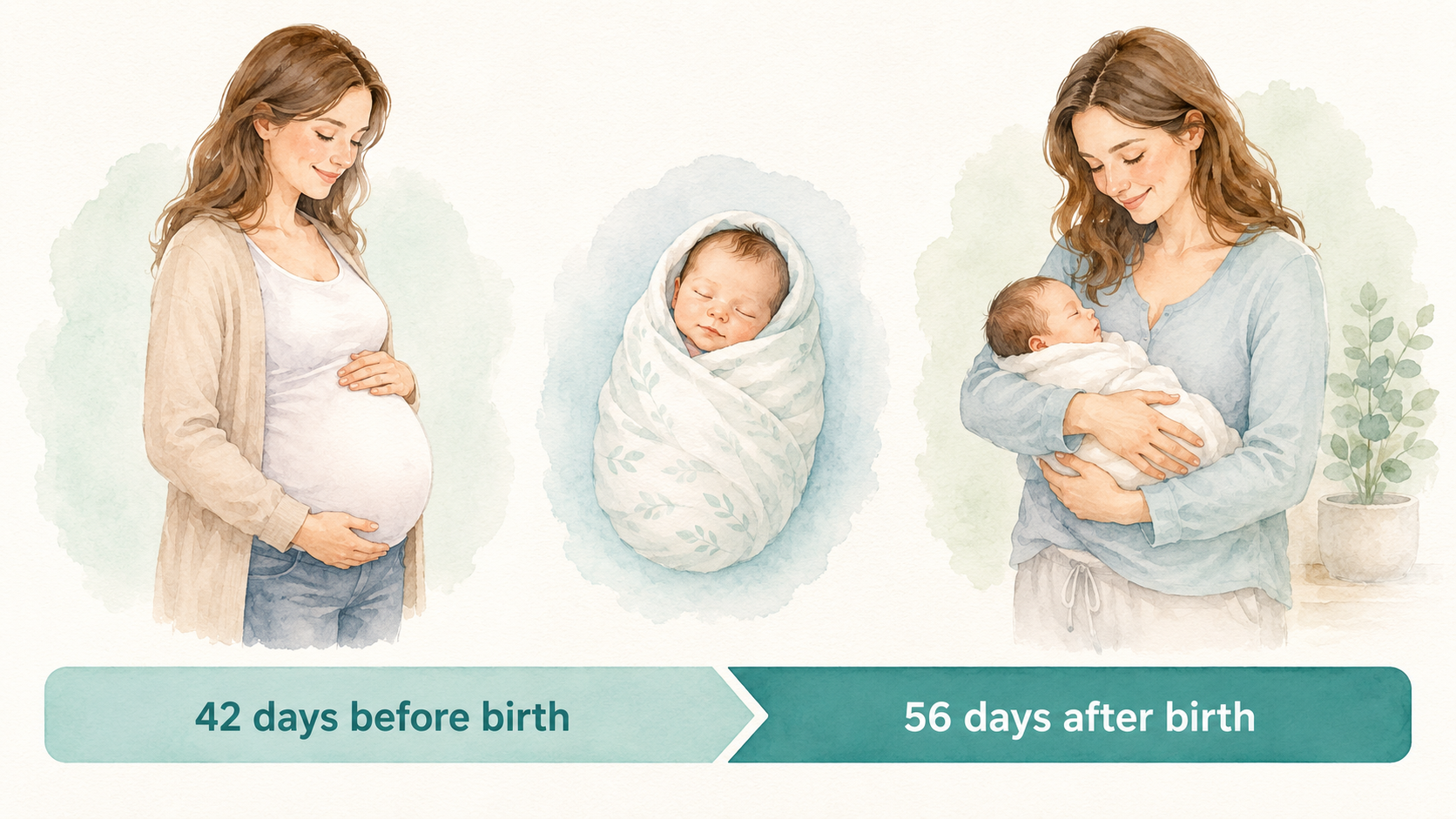
- Before birth: up to 42 days before your expected due date (98 days for a multiple pregnancy)
- After birth: up to 56 days after the day of delivery
The birth day counts as part of the prenatal period (産前, sanzen). Any day you go into work — or receive salary at or above the benefit rate — doesn't count toward your claim.
If your baby is born late
If your actual delivery date falls after your expected due date, the extra days between the two dates are added to the prenatal period and are also covered. You do not lose any benefit because your baby arrived late.
You don't have to take the full prenatal period — some people work right up until a week or two before their due date. The postnatal 56 days are a different matter: labor law bars employers from asking a woman back within 8 weeks of giving birth, so those days are fixed.
How Much Will I Receive?
The daily benefit amount is calculated from your standard monthly salary (標準報酬月額):
Daily benefit amount
Average standard monthly salary (past 12 months) ÷ 30 × 2/3
Your 標準報酬月額 (hyōjun hōshū getsugaku) is the salary band your insurer uses to set your premiums — roughly in line with your actual monthly pay, grouped into fixed brackets. The average is taken across the 12 months of coverage immediately before your benefit period starts.
If you have been enrolled in employer health insurance for less than 12 months, the insurer uses whichever is lower: the average of your actual months of coverage, or the national average standard monthly salary (全被保険者の標準報酬月額平均額), which is 320,000 yen from April 2025.
Example calculation
Monthly standard salary: 300,000 yen (consistent over the past 12 months)
- Daily standard: 300,000 ÷ 30 = 10,000 yen/day
- Daily benefit: 10,000 × 2/3 = 6,667 yen/day (rounded to the nearest yen)
- Total for standard 98-day period (42 pre + 56 post): 6,667 × 98 = 653,366 yen
Any salary your employer pays during your leave is deducted from the benefit. If what they pay covers the full daily amount or more, nothing extra is paid for that day.
How to Apply
The application form is called 健康保険出産手当金支給申請書. It can be downloaded from your health insurer's website, or obtained from your company's HR or general affairs (総務) department.

The form has three sections:
- Your section — personal details, bank account for payment, and the dates you are claiming for
- Employer section — your company certifies that you were absent from work and confirms what salary, if any, was paid during the period
- Doctor or midwife section — confirms the expected due date and actual date of delivery. This is only required on your first application; if you apply in multiple batches, the medical certification can be omitted from subsequent submissions
You can submit one lump claim after your postnatal leave ends, or split it into a prenatal claim and a postnatal one. Either way, your HR department will usually handle the submission — but worth confirming how they do it early in your pregnancy rather than scrambling at the end.
Claim deadline
Each day's benefit must be claimed within 2 years of the day after it was due. In practice this means submitting the full claim within 2 years of your postnatal leave ending. Missing this window means losing the unclaimed portion.
If You Resign Before or During Maternity Leave
Quitting doesn't automatically cut off your payments — provided both of these apply:
- You were continuously enrolled in employer health insurance for at least 1 year immediately before your resignation
- At the time of resignation, you were already receiving the benefit or were in the eligible period for it
When both apply, payments continue through the end of your benefit period even after you've left.
Critical: do not work on your last official day of employment
If you work on your last official day of employment — the day before your insurance coverage lapses — you lose eligibility for continued payment after resignation. If you plan to resign while on maternity leave, confirm with HR that your final day in the office falls before your last day of coverage.
One note on voluntary continuation (任意継続被保険者): you can't start a new claim under this status, but if payments had already begun before you left, they'll continue.
Japanese Vocabulary
| Japanese | Reading | Meaning |
|---|---|---|
| 出産手当金 | shussan teatekin | Maternity allowance |
| 健康保険出産手当金支給申請書 | kenkō hoken shussan teatekin shikyū shinseisho | The official application form for the maternity allowance — available from your insurer's website or HR department |
| 標準報酬月額 | hyōjun hōshū getsugaku | Standard monthly salary (the bracket used to calculate insurance premiums) |
| 産前 | sanzen | Prenatal / before birth |
| 産後 | sango | Postnatal / after birth |
| 被保険者 | hihokensha | Insured person (the primary member, not a dependent) |
| 国民健康保険 | kokumin kenkō hoken | National Health Insurance — the plan for self-employed, freelancers, and those not covered by employer insurance. Does not include 出産手当金. |
| 協会けんぽ | Kyōkai Kenpō | Japan Health Insurance Association — the insurer for most SME employees |
| 任意継続被保険者 | nin'i keizoku hihokensha | Voluntary continuation member — someone who stays on their former employer's plan after leaving a job |
| 出産育児一時金 | shussan ikuji ichijikin | Childbirth lump-sum grant — the separate flat 500,000-yen benefit |