

Written and reviewed by Susumu
Born and raised in Japan · Checked against Japanese law and ministry guidance
Understand why your newborn is crying — hunger, dirty diaper, tiredness, temperature, or comfort — plus the Week 3 and 3-month fussy periods, and how to soothe your baby.
Affiliate Disclosure: This article contains affiliate links. If you click a link and make a purchase, we may earn a small commission at no extra cost to you. We only recommend products we genuinely believe are helpful. See our Terms of Use for full details.

📌 Note: Crying is your baby's only way to communicate. It doesn't mean you're doing anything wrong. This guide will help you understand what your baby needs — and what to do.
The 5 Main Reasons Babies Cry
Newborns cannot talk. Crying is the only tool they have to tell you something is wrong. Most of the time, the reason falls into one of five categories.
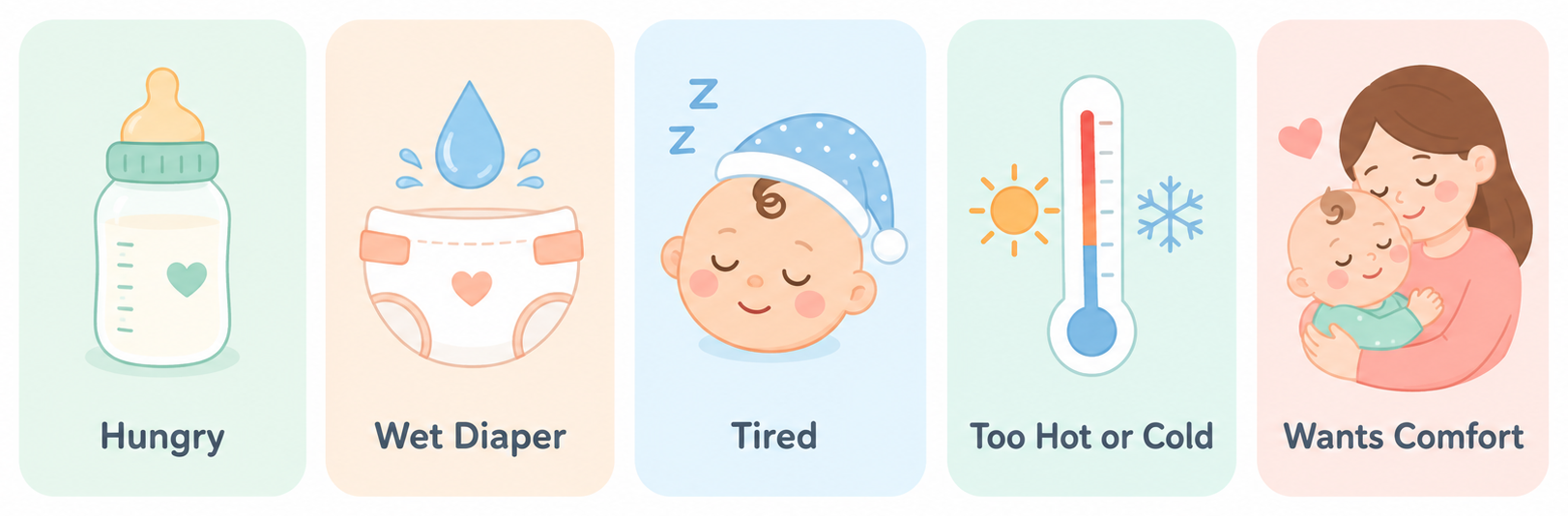
| Reason | Signs to look for |
|---|---|
| 😢 Hungry | Rooting (turning head, opening mouth), sucking on hands, crying shortly after waking up |
| 💧 Dirty diaper | Crying stops briefly when you pick them up, restless leg movements, obvious smell |
| 😴 Tired or overtired | Yawning, rubbing eyes, looking away, harder to settle the longer you wait |
| 🌡️ Too hot or cold | Check the back of the neck — not the hands or feet (which are often cool). Sweating or shivering |
| 🤱 Wants comfort | Fed recently, diaper clean, calm when held, calms with skin-to-skin contact |
Start with the basics: When your baby cries, work through the list in order — hungry first, then diaper, then tired. Most of the time, one of these is the answer.
The Week 3 Fussy Period (魔の3週目)
Around the third week of life, many parents notice a sudden and dramatic increase in crying. A baby who seemed settled suddenly screams for hours, won't sleep easily, and wakes moments after being put down. This is so common in Japan that it has a name: 魔の3週目 (ma no san-shuume) — roughly translated as "the devil's third week."
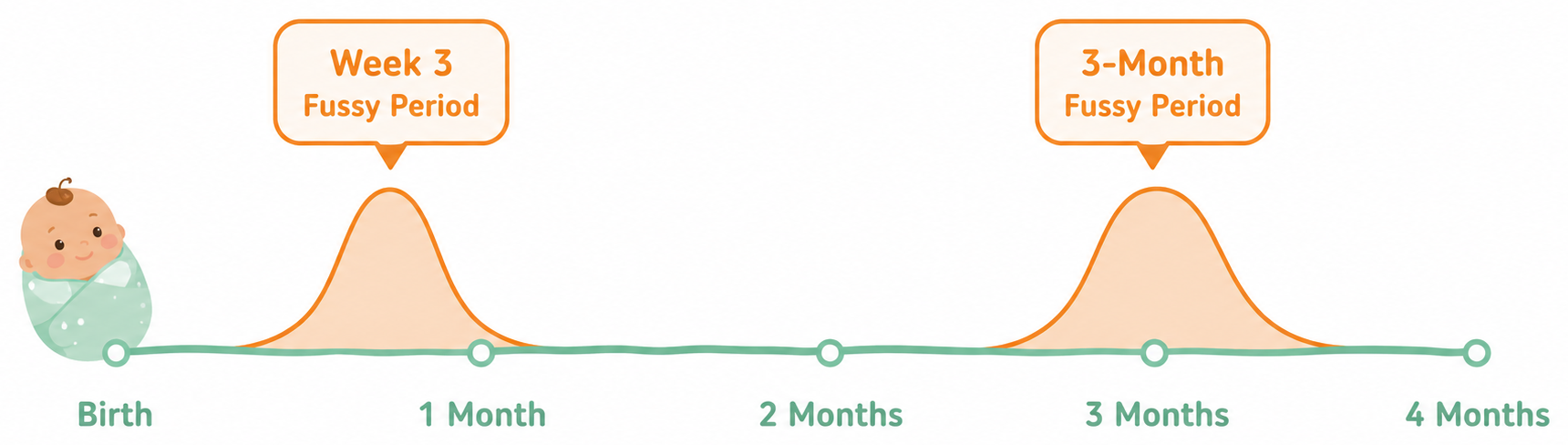
What's happening? Your baby's nervous system is developing rapidly. Their ability to sense the world around them — light, sound, sensation — increases faster than their ability to process it. Everything feels more intense. The result is a baby who is harder to settle than they were just days before.
A few things to know:
- It is temporary. The fussy period begins around week 3, peaks at around 6–8 weeks, and gradually eases by 3–4 months.
- It is not your fault. You haven't done anything wrong — this is normal neurological development.
- Feeding and diaper changes alone may not stop the crying. Your baby is not necessarily hungry — they are overstimulated.
PURPLE Crying: Western pediatric research calls this phase "PURPLE crying" — a period of normal, developmentally expected increased crying that typically peaks around 2 months. The acronym stands for: Peak of crying, Unexpected, Resists soothing, Pain-like face, Long lasting, Evening. It looks alarming but it is a recognized, normal phase that all babies go through.
The 3-Month Fussy Period (魔の3カ月)
Around 3 months, crying patterns shift again. By this age, your baby has become much more socially aware — they recognize your face and voice, smile at you, and are beginning to understand that when they cry, you come. This awareness is a milestone. But it also means their demands become more specific and harder to predict.
The most common challenge at this stage is night crying. Many babies who slept reasonably well begin waking more at night around 3 months. This isn't regression — it's development. As babies become more aware of the world, the boundary between sleep and wakefulness becomes more interesting to explore.
- Daytime crying often has a clear reason — boredom, hunger, or wanting interaction.
- Night crying at this stage is frequently about routine and habit rather than hunger or discomfort.
Good news: By 3–4 months, most babies begin to develop a more predictable rhythm of sleep and feeding. The chaos of the early weeks does not last forever.
How to Comfort a Crying Baby
Once you've checked the basics — hunger, diaper, temperature — and your baby is still crying, these techniques can help.
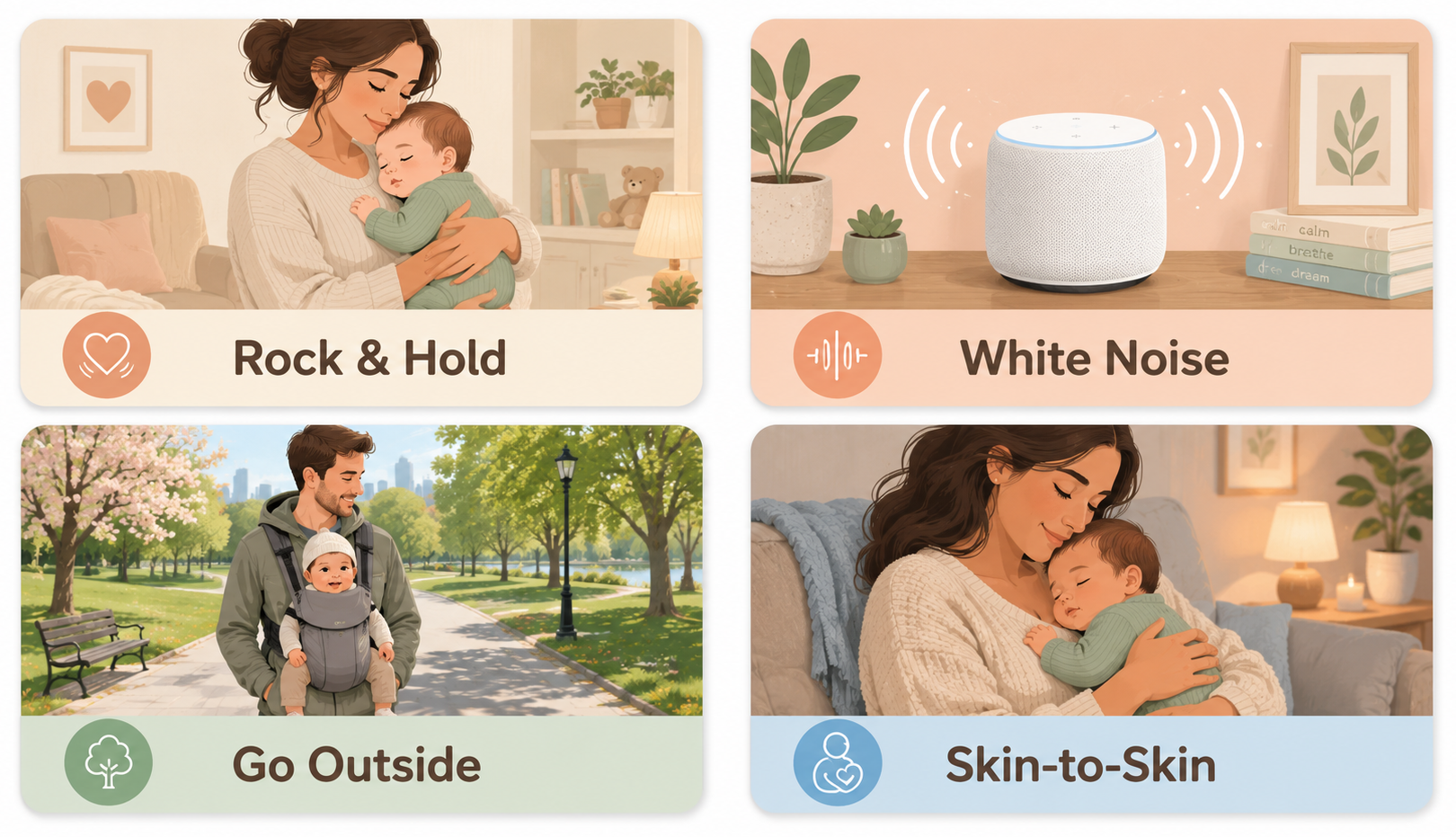
- Hold and rock — Pick your baby up and gently rock them in your arms. The motion mimics the movement they felt in the womb. Swaying from side to side (not up and down) is often most effective.
- White noise — Low, consistent sounds like a running tap, fan, or white noise app can be remarkably calming. The womb is loud — silence can feel unsettling to newborns.
- Go outside — A change of environment and fresh air often interrupts a crying cycle. Even a short walk in the baby carrier or stroller can help.
- Skin-to-skin contact — Hold your baby against your bare chest. This regulates their body temperature and heart rate and provides deep reassurance.
- Music or gentle singing — A calm, repetitive melody — even humming — can provide the predictability your baby craves. The specific song doesn't matter; consistency does.
- Reduce stimulation — If your baby is overstimulated, less is more. Dim the lights, reduce noise, and hold them close without talking or moving too much.
If you feel overwhelmed: It's okay to put your baby down safely in their crib and take a few minutes in another room to breathe. A crying baby in a safe space for a short time is far better than a parent at the end of their rope. Ask a partner, family member, or friend to take over when you need a break.
Night Crying

Night crying is one of the most exhausting experiences of early parenthood. Understanding what's happening can make it a little easier to manage.
In the first 6–8 weeks, newborns have no concept of day or night. Their sleep is driven by hunger, not the clock. Night feeds and waking are completely normal and expected.
Around 2–3 months, a day/night rhythm begins to form — but it's fragile and inconsistent. When your baby wakes and cries at night, take a breath before responding:
- Wait a moment — Give your baby 1–2 minutes before picking them up. Babies often make sounds between sleep cycles that settle on their own. Rushing in every time can actually interrupt the process of learning to self-settle.
- Check quietly — If they continue crying, go in and check without turning on bright lights or making it stimulating. Pat or shush gently without picking up if possible.
- Feed if needed — In the early weeks, night hunger is real. If it's been 2–3 hours since the last feed, feed them.
Night waking does improve with time. Most babies develop longer sleep stretches naturally between 3–6 months, though the timeline varies widely.
Where the baby actually sleeps is a separate question, and one where the advice you were given at home may not match what you see here. Our guide to baby sleep and 添い寝 in Japan sets out what Japan's own guidance says.
When to Call a Doctor
Most crying is normal and not a sign of illness. But there are times when you should seek medical attention promptly.
See a doctor if your baby:
• Has a fever above 38°C (especially if under 3 months old)
• Is crying in a way that sounds different from usual — high-pitched or weak
• Cannot be calmed at all and shows signs of pain
• Is refusing to feed for several feeds in a row
• Is unusually limp or difficult to wake
• Has a rash, vomiting, or diarrhea alongside the crying
In Japan, if you're worried, you can call the child health consultation line at #8000 (available in all prefectures; hours vary by prefecture but typically operate from early evening through the following morning — check your local municipality's website for exact times). For emergencies, call 119 (ambulance). If you are not sure whether the crying needs a doctor tonight or can wait until morning, our guide to deciding when a sick child needs care walks through that call.
📖 Japanese Vocabulary
Useful words when talking to a doctor or nurse about your baby's crying.
| 日本語 | ひらがな | English |
|---|---|---|
| 泣く | なく | To cry |
| 夜泣き | よなき | Night crying |
| ぐずる | ぐずる | To fuss / be grizzly |
| あやす | あやす | To soothe / comfort a baby |
| 魔の3週目 | まのさんしゅうめ | The week 3 fussy period |
| 魔の3カ月 | まのさんかげつ | The 3-month fussy period |
| ホワイトノイズ | ほわいとのいず | White noise |
| 授乳 | じゅにゅう | Breastfeeding / feeding |
| おむつ替え | おむつがえ | Diaper change |
| 小児科 | しょうにか | Pediatrics / children's clinic |