

Written and reviewed by Susumu
Born and raised in Japan · Checked against Japanese law and ministry guidance
Sleeping alongside your baby is ordinary here, and the advice you were given at home may have been firmer. Japan's guidance sets out what raises the risk, then says in writing that it is not prohibiting anything — and links to the American and British positions that disagree with each other. What the guidance actually says, what changed in December 2025, and what nurseries do at naptime.
Affiliate Disclosure: This article contains affiliate links. If you click a link and make a purchase, we may earn a small commission at no extra cost to you. We only recommend products we genuinely believe are helpful. See our Terms of Use for full details.
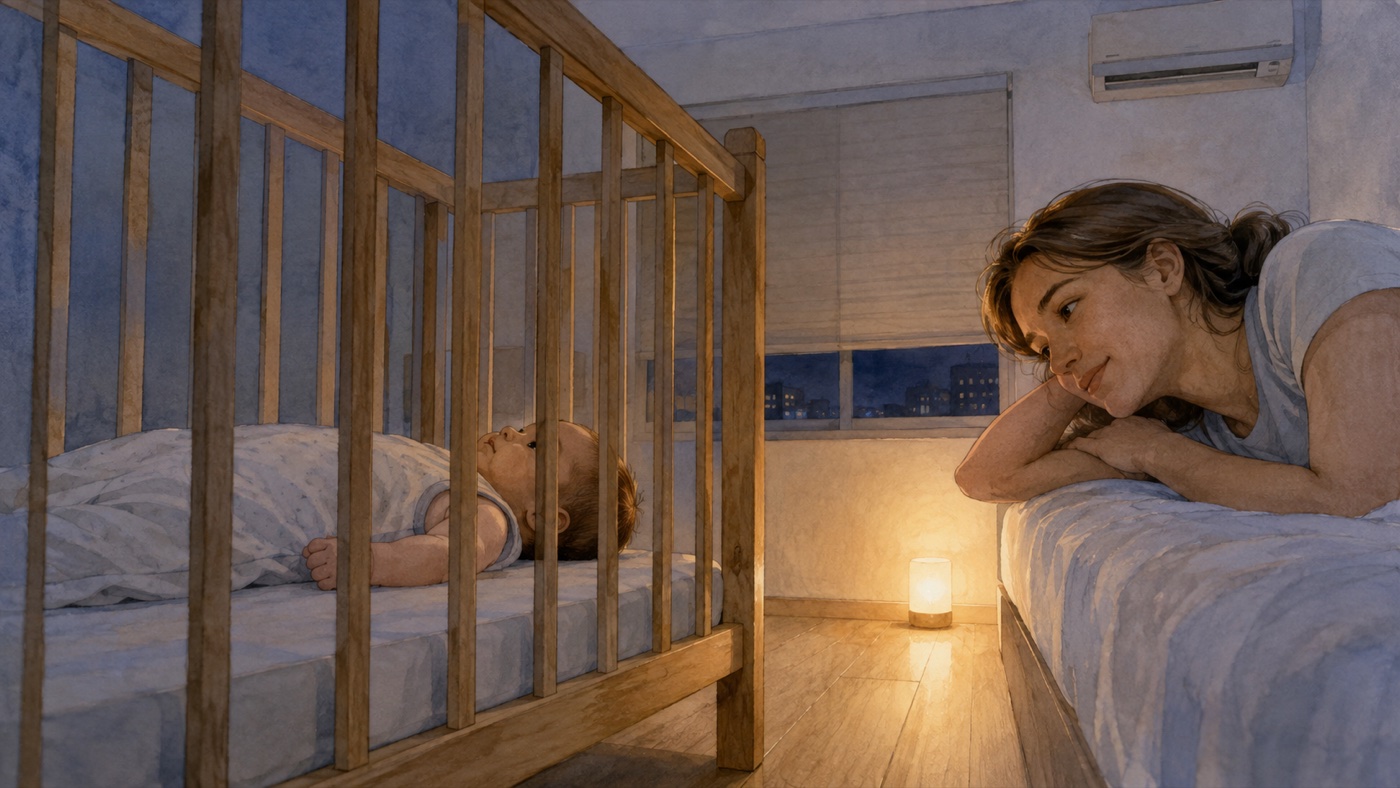
Sleep is where parenting advice diverges most sharply between countries, and Japan is no exception. Families here commonly sleep in the same room, often on futons laid side by side, and a newcomer who was told at home never to share a sleep surface can find the whole arrangement alarming.
This guide sets out what Japan's own guidance actually says, in its own words, and what happens to your baby's sleep once nursery is involved — which is the part with concrete rules attached. It does not tell you how to arrange your nights. That is a conversation for you and your pediatrician.
How Families Here Usually Sleep
The arrangement you will see most often is a room shared by the whole family, with futons laid out next to each other on the floor. Japanese has a word for the shape it makes — 川の字 (kawa no ji), the character for "river", which is three parallel strokes: parent, child, parent.
Two physical details matter more than they first appear, because they make the Japanese setup a different thing from the one Western guidance usually has in mind.
- A futon is firm and thin, and it goes directly on the floor. It is not a soft mattress with give in it.
- There is nothing to fall from. A baby who rolls off the edge of a futon has rolled onto the floor a few centimeters away.
Babies here also frequently have their own separate small futon — a ベビー布団 (bebī buton) — laid beside the adults' rather than sharing one surface. Cribs are sold everywhere too, and plenty of families use them. There is no single national practice, whatever a travel article may suggest.
None of this requires a traditional room. Most apartments rented by international families have wood-effect flooring rather than tatami, and futons work the same way on it. Plenty of households here use a bed frame and never own a futon at all.
What Japan's Guidance Says
The Children and Families Agency (こども家庭庁) publishes guidance for families with babies under one, and it is worth reading rather than inferring. It splits into two parts: reducing the risk of SIDS, and separately, preventing suffocation during sleep.
On SIDS, the agency is explicit that no method of prevention has been established, and that these three points are shown by research to lower the risk:
- Put the baby down on its back until it is one year old. The guidance notes SIDS occurs in both positions, but that the rate is lower on the back — and adds that this also helps prevent suffocation. The exception is where a doctor has advised otherwise for a medical reason.
- Breastfeed where you reasonably can. The wording is careful: circumstances vary and not everyone is able to, and it points to hospitals and health centers for support.
- Stop smoking. This covers the mother's own smoking, secondhand smoke during pregnancy, and anyone smoking around the baby afterward.
For scale, the agency records 55 deaths of infants and young children from SIDS in 2024, making it the third most common cause of death in infancy.
Separately from SIDS, the agency lists five points for lowering the risk of suffocation:
- Firm and flat bedding. Avoid soft cushions and inclined mattresses; use a futon or mattress the body does not sink into.
- Manage warmth with clothing, not covers. A duvet over the face is a suffocation risk, so until the baby is one, no duvet at all — a sleep sack and room temperature instead.
- Keep the sleep space empty. Soft toys and towels are a risk. Nothing around the baby.
- Use sleep products correctly. Choose cribs and rails that have passed the national safety standard, read the instructions, and check the age range.
- A sleep space of the baby's own is reassuring. This is the point that covers sharing a surface, and it is set out below.
The agency's own leaflet adds a few specifics: keep a crib's side rail up at all times, watch that a head or body cannot become wedged, put no pillow or soft toy where the baby sleeps, and keep anything that could cover the face or wind around the neck out of reach.
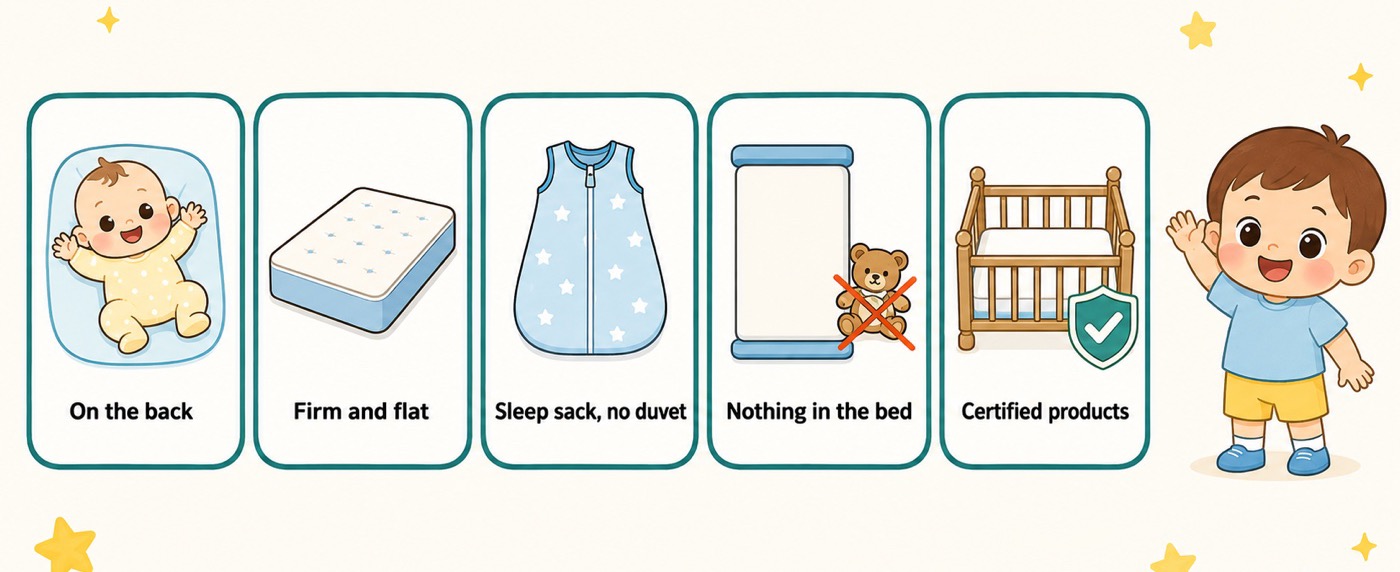
One point has changed, and older material is still circulating. Ministry posters from earlier years say to use a light duvet. The current guidance says not to use one at all before the baby's first birthday, and to put the baby in something wearable instead. That page was last updated in December 2025, so if you are handed an older leaflet, this is the line to check.
On Sharing a Sleep Surface
The Japanese word is 添い寝 (soine) — sleeping alongside. Here is what the guidance says about it, as directly as it can be rendered:
A sleep space of the baby's own leads to peace of mind. Take care with 添い寝, where there is a danger of an adult's body covering the baby or blocking its mouth and nose. 添い寝 is especially dangerous in the following cases:
- Where the person sleeping alongside has taken medication that causes drowsiness or reduces alertness
- Where the person sleeping alongside has been drinking
- Where the baby was born preterm or at a low birth weight
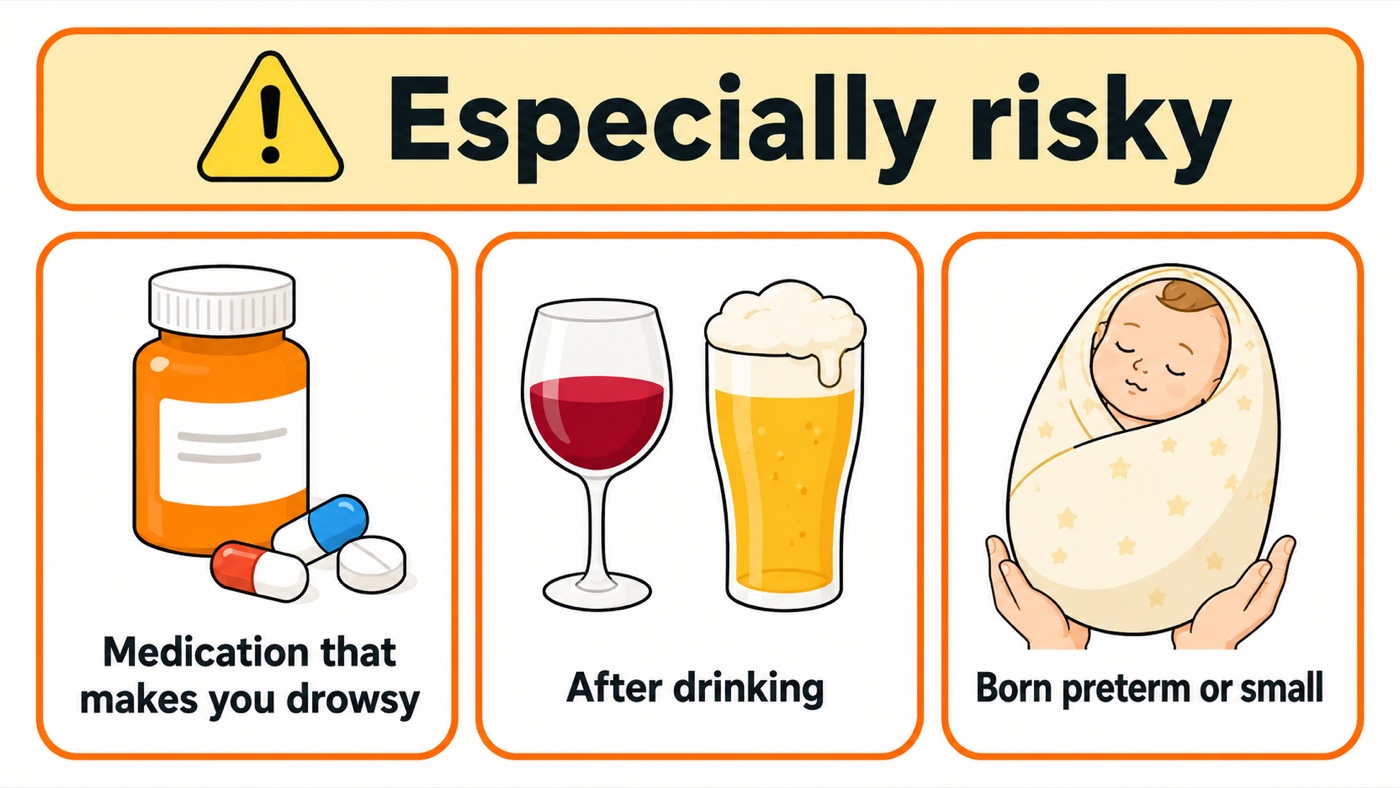
And then, at the foot of the same page, a sentence that is easy to miss and worth not missing:
The guidance states that all of the above are offered as preventive measures, and are not a prohibition of the practices concerned.
That is Japan declining to issue a ban, in writing. Whether you read that as permission or as a shrug is a matter for you. What it means practically is that a Japanese pediatrician is unlikely to open the subject the way one at home might, and that nobody is going to tell you off at a checkup.
If Your Home Country Says Otherwise
Many families arrive having been told something firmer. The American Academy of Pediatrics recommends that infants sleep in the parents' room but on a separate surface, and advises against bed-sharing. Guidance in the UK takes a different approach again, setting out the circumstances in which sharing a bed carries the most risk rather than ruling it out.
One detail settles this better than any summary could. Japan's own guidance page links out to both of them — the American recommendations and the UK material — from the bottom of the page. The agency is not pretending there is one settled answer.
So the honest summary is that three respected authorities look at the same evidence and land in different places. The country you happen to be living in is not automatically the one that is right.
Take the question to a pediatrician who knows your baby, and mention the guidance you were given at home. Our guide to getting medical help for a child in Japan covers finding one.
What Happens at Nursery
Home is where guidance is guidance. Nursery is where it becomes procedure, and this is the part most parents want to know and rarely get told.
Naptime — 午睡 (gosui) — is treated as one of the highest-risk periods of the day. The national guidance for facilities requires them to remove suffocation risks before and during sleep, and to check children at intervals rather than leaving them unattended.
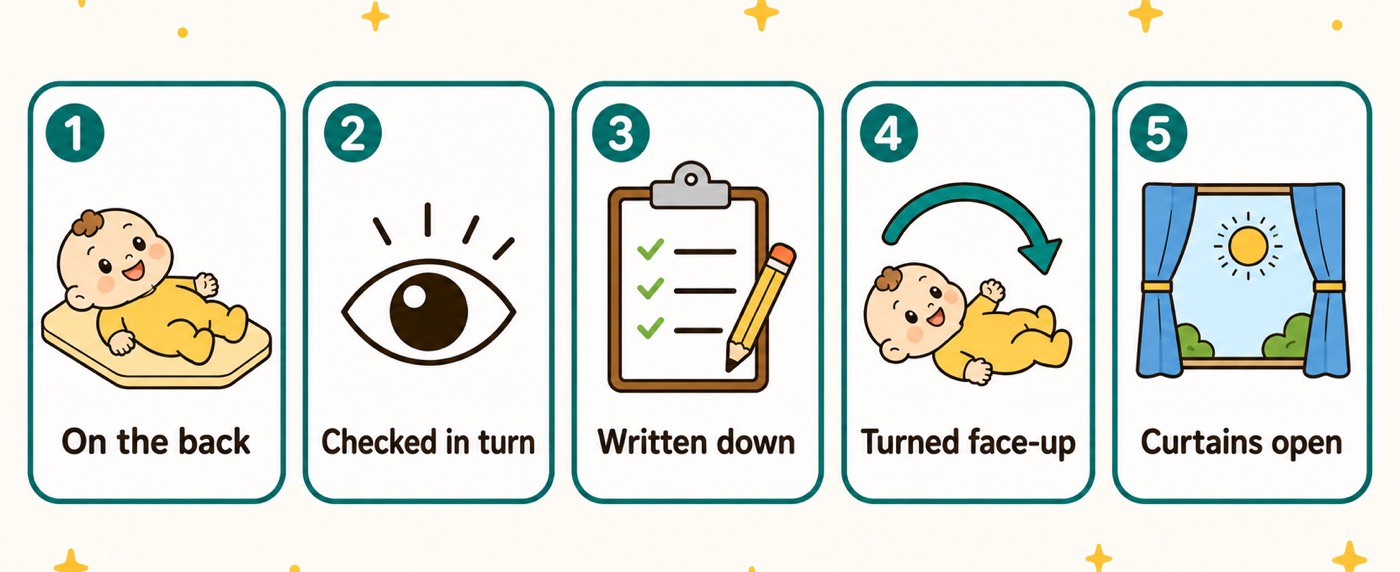
What that looks like in a room:
- Babies are placed on their backs, and a baby found face-down is turned over.
- Someone comes round at set intervals and looks at each child — color of the face and lips, whether breathing is present, the sound of it, warmth to the touch, and the position they are lying in.
- Each round is written down in a sleep observation record.
- The room stays light enough to see a face by. Curtains are generally kept open unless there is a reason to close them, which is why a nursery at naptime is often brighter than visitors expect.
- Bedding is checked — firm underneath, light on top, no pillow, mats fixed so they do not shift, and futons laid out so that every child can be seen.
How often is "at intervals"? The guideline itself says to check periodically without naming a figure. The agency's companion manual for facilities is specific: every five minutes for children under one, and every ten minutes from age one. That manual is also where the list above comes from, down to feeling for warmth, and it says to record each round on a sleep observation sheet. Individual nurseries build their own routine on top of it, so it is still worth asking yours.
The Gap Between Home and Nursery
Two mismatches come up often enough to be worth expecting.
A baby who only settles face-down. Nursery will place them on their back and turn them if they roll, because that is what the guidance requires. If this is how your child sleeps at home, say so at enrollment rather than letting it be discovered — facilities ask about a child's background and habits precisely so that they can plan for it.
Settling only next to a parent. This is the harder one, and a real reason some children take longer to adjust. Nobody will lie down with your child at nursery.
The settling-in weeks exist partly for this, and our guide to narashi hoiku describes how that period is structured. The facility guidance singles out the first days after a child starts as needing especially close watching, so this is understood rather than unusual.
Neither of these is a reason to change how your family sleeps. They are a reason to tell the nursery what is true, early.
What People Buy Here
Two items are worth knowing about because they follow directly from the guidance and are sold everywhere.
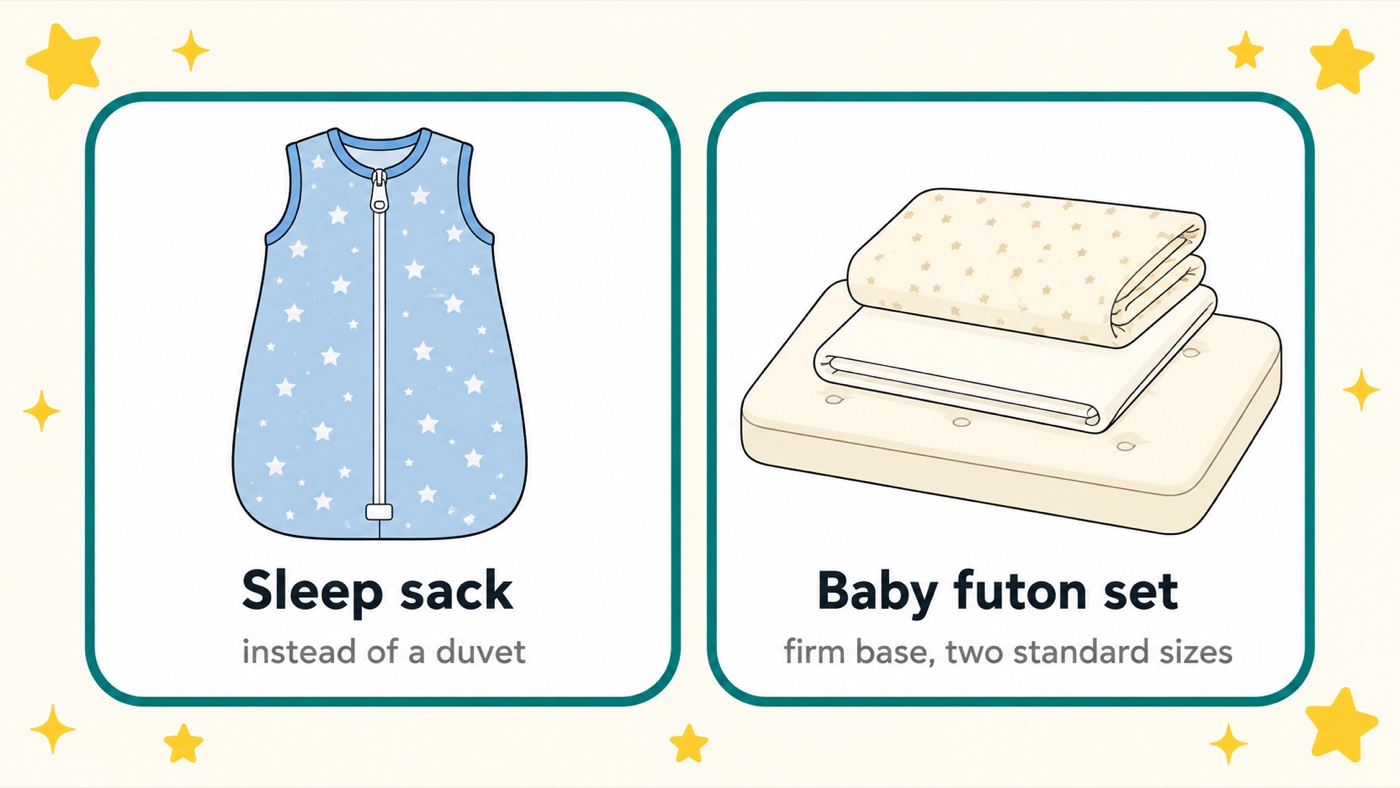
- スリーパー (surīpā) — a wearable sleep sack. Since the advice is no duvet before one, this is how warmth is handled. Shops stock them in every weight from gauze to padded.
- ベビー布団 (bebī buton) — a baby futon set, typically sold as a bundle with a firm base futon, sheets and a cover. They come in two standard sizes; the larger one is usually usable for the first couple of years and often carries on as a nap futon after that.
If your nursery asks you to bring bedding for naps, it will specify what it wants, and the sizes it names will be these standard ones. Our guide to getting ready for daycare covers the rest of the list.
Japanese Vocabulary
Words you will meet on leaflets, at checkups and in the daily notebook:
| Japanese | Reading | Meaning |
|---|---|---|
| 添い寝 | soine | Sleeping alongside a child |
| 川の字 | kawa no ji | Parent, child, parent lying in a row |
| うつぶせ寝 | utsubuse-ne | Sleeping face-down |
| あおむけ | aomuke | On the back — how babies are put down |
| 午睡 | gosui | The nursery nap |
| スリーパー | surīpā | Wearable sleep sack, used instead of a duvet |
| ベビー布団 | bebī buton | A baby's own futon set |
| 乳幼児突然死症候群 | nyūyōji totsuzenshi shōkōgun | SIDS, as written on official material |
November is Japan's SIDS awareness month, so this is the season when the posters go up in clinics and health centers. If you see one and want to read it properly, the Children and Families Agency publishes the same material as a leaflet on its website — and now you know which line about duvets to check the date on.