

Written and reviewed by Susumu
Born and raised in Japan · Checked against Japanese law and ministry guidance
Medical costs over ¥100,000 in a year can come back as a tax refund — and the year you give birth is usually the year it is worth claiming. What counts, what does not, and how to file.
Affiliate Disclosure: This article contains affiliate links. If you click a link and make a purchase, we may earn a small commission at no extra cost to you. We only recommend products we genuinely believe are helpful. See our Terms of Use for full details.

If you had a baby in Japan this year, you probably spent a lot on prenatal checkups, the delivery, and clinic visits. Some of that can come back to you as a tax refund through 医療費控除 (iryōhi kōjo — the medical expense deduction). The catch: your employer can't do it for you. You have to file for it yourself, and the year you give birth is usually the one year it's clearly worth the effort.
First: Year-End Adjustment vs. Filing Yourself
If you're a regular employee in Japan, your income tax is handled through 年末調整 (nenmatsu chōsei — year-end adjustment). Every December, your employer recalculates the tax you owe for the year, compares it against what was withheld from your monthly pay, and refunds or collects the difference. For most employees, this means you never file a tax return at all — the company does it for you.
Year-end adjustment covers a lot: your basic deduction, dependents, insurance premiums, and so on. But there are a few things it can't handle — and the medical expense deduction is the big one. To claim it, you file a 確定申告 (kakutei shinkoku — a tax return) yourself, separately from what your company does.
The point most people miss
Because your company handles year-end adjustment, it's easy to assume your taxes are fully taken care of and there's nothing left to do. But the medical expense deduction is never included in year-end adjustment. If you don't file for it, no one files it for you — and the refund simply doesn't happen.
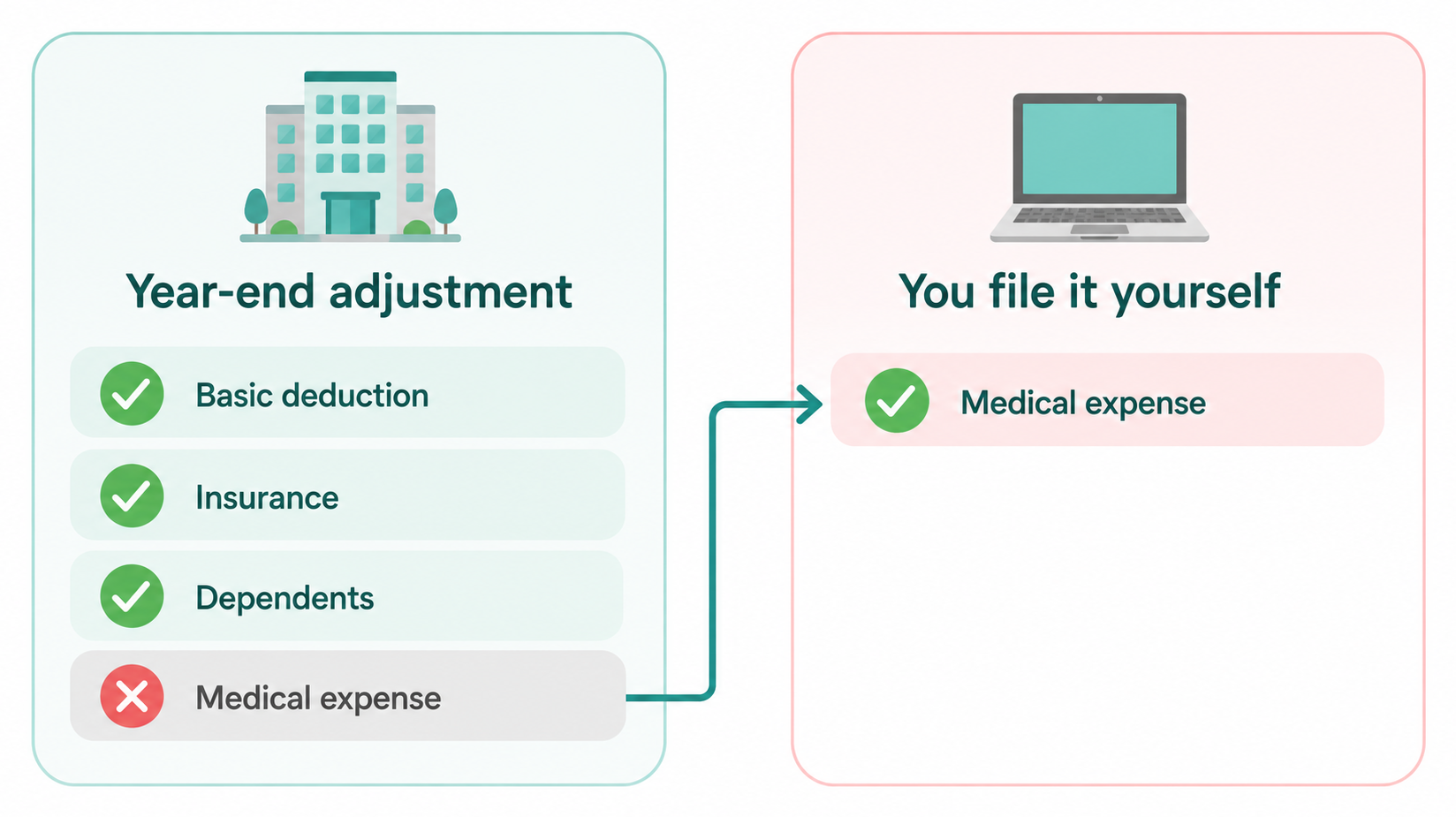
Year-end adjustment covers most deductions automatically — but not the medical one. That's the piece you have to claim yourself.
What Is the Medical Expense Deduction?
医療費控除 (iryōhi kōjo) lets you subtract part of a year's medical spending from your taxable income. Less taxable income means less tax — so what actually comes back is the tax you overpaid, not the medical costs themselves.
The amount you can deduct is worked out like this:
(Total medical costs − money you got back) − 100,000 yen*
*or 5% of your total income if that income is under 2 million yen. Maximum deduction: 2 million yen.
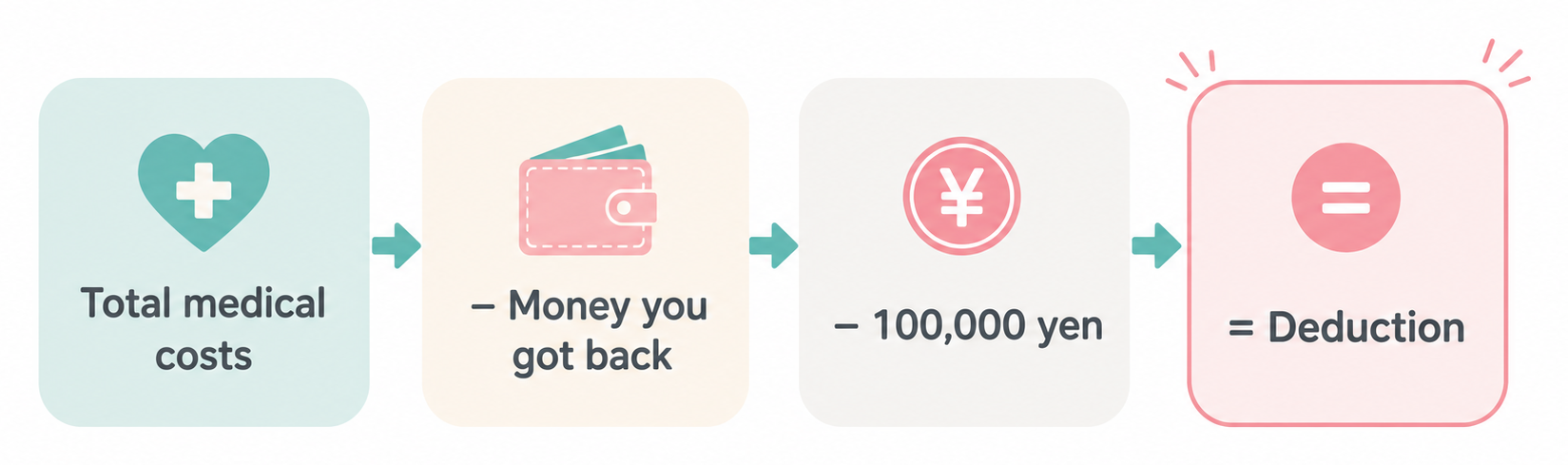
So the first 100,000 yen of medical spending is a floor you don't get to count (for most people). Everything above it becomes a deduction. The tax you get back is that deduction multiplied by your income tax rate — for many employees that's roughly 10–20%, and it also lowers your resident tax (住民税, jūminzei) for the following year.
A rough example
Say your family spent 400,000 yen on medical care in the year, and you got 60,000 yen back from insurance for part of it. Your deduction is 400,000 − 60,000 − 100,000 = 240,000 yen. If your income tax rate is 10%, that's about 24,000 yen back in income tax, plus a further cut to next year's resident tax. The exact figure depends on your income.
Why the Childbirth Year Is Different
In a normal year, most healthy people don't spend 100,000 yen on medical care, so there's nothing to deduct and no reason to file. The year you have a baby is the exception. Between monthly prenatal checkups, the delivery and hospital stay, and the extra clinic visits that come with pregnancy, medical spending in that one year adds up fast — often well past the 100,000-yen floor even after the childbirth grant is subtracted.
That's why, even if you've never filed a tax return in Japan and never expect to again, the childbirth year is the one worth stopping for. It's also worth checking the year before and after, if pregnancy or fertility treatment spread your costs across more than one calendar year.
What Counts, and What Doesn't
The deduction is for actual medical care, which is broader than you might expect but does have clear edges. Based on the National Tax Agency's own examples for childbirth:
Counts
- Prenatal checkups and tests once pregnancy is confirmed (妊婦健診)
- Delivery and hospital-stay costs
- Transport to and from the clinic or hospital by normal means — train and bus fares count, even when you can't keep every ticket
- A taxi to the hospital when going into labor, if a train or bus isn't realistic at that moment
- Fertility treatment and artificial insemination (不妊治療・人工授精)
- Prescribed medicine, and medical treatment for the whole family (not just the mother)
Doesn't count
- Travel to a parent's home to give birth there (里帰り出産 travel)
- Pajamas, toiletries, and other personal items bought for the hospital stay
- The difference for a private room chosen for comfort rather than medical need
- Purely elective or cosmetic procedures, and general health supplements
Subtract What You Got Back First
This is the step people get wrong, so it's worth being clear. Any money you received specifically to cover a medical cost has to be subtracted from that cost before you calculate the deduction. For childbirth, that means:
- The 出産育児一時金 (childbirth lump-sum grant, normally 500,000 yen) — subtracted from your delivery costs. See our childbirth grant guide.
- Any 高額療養費 (high-cost medical care refund) you received — see our high-cost medical care guide.
- Any payout from private medical insurance tied to a specific treatment or hospital stay.
What you do NOT subtract
Benefits that replace your income rather than reimburse a medical bill are not subtracted. The 出産手当金 (maternity allowance) and 育児休業給付金 (parental leave benefit) are wage replacement, not medical reimbursement, so they don't reduce your medical costs here. Only money that pays back an actual treatment cost gets subtracted.
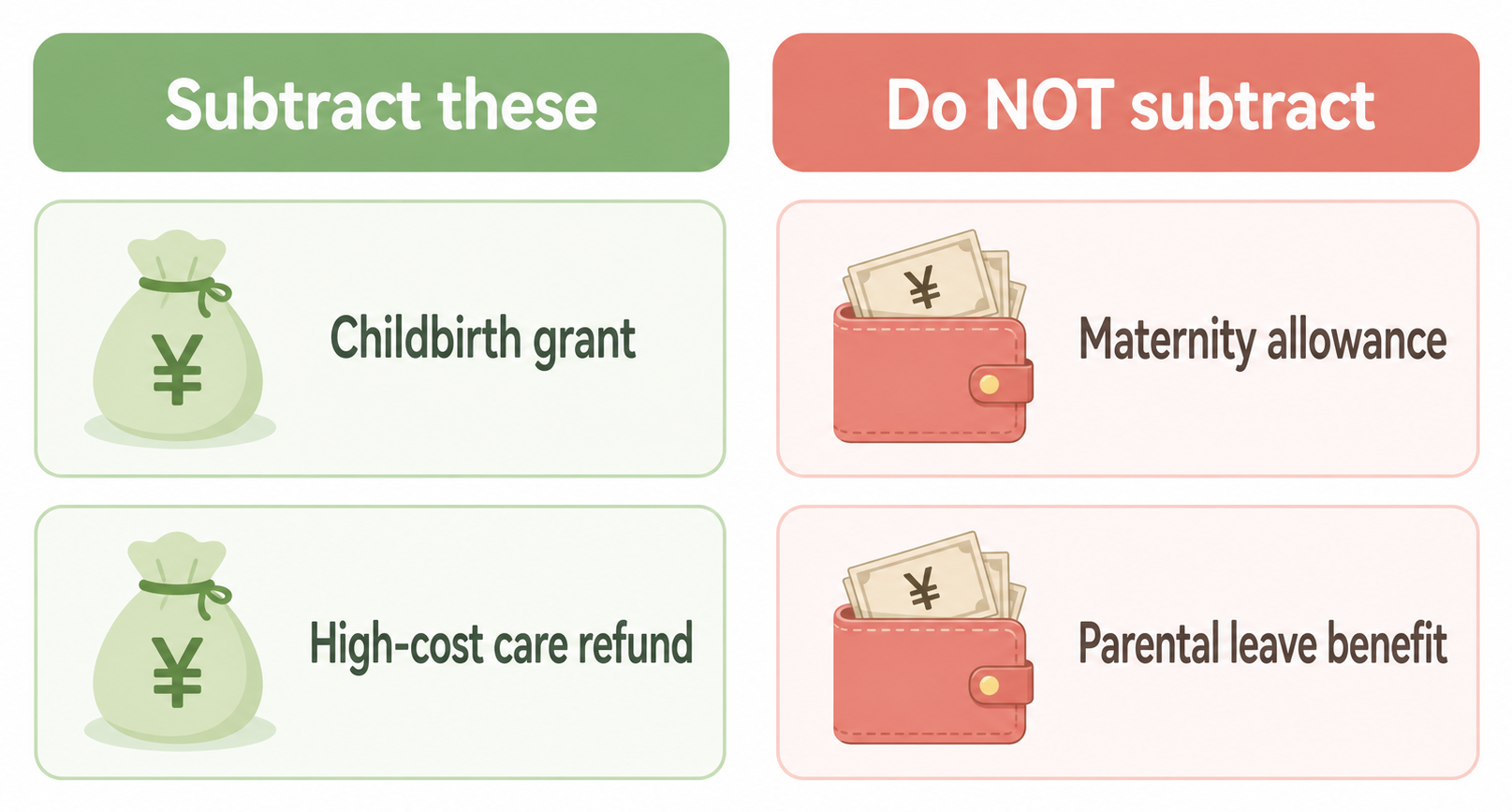
One more detail: you only subtract a reimbursement from the specific cost it was paid for. If the childbirth grant is larger than your delivery costs, the leftover isn't subtracted from your other medical spending (say, a family member's dental work) — it stays with the delivery.
Combining the Whole Family's Costs
You don't count only your own medical bills. You can add together everything paid for yourself and for family members who 生計を一にする (share your household finances) — a spouse, children, and often parents you support, whether or not they live under the same roof. All of it goes on one person's return.
Because the refund scales with the filer's tax rate, it's usually best for the higher earner in the household to claim the whole family's costs. The main exception is when one spouse's income is under about 2 million yen: for them the floor is 5% of income rather than a flat 100,000 yen, which can occasionally work out better. If it's close, it's worth calculating both ways.

How to Actually File
Filing has become fairly manageable, and you don't hand in a shoebox of receipts anymore. The process:
- Total up the year's medical costs for the whole household, and note any reimbursements to subtract.
- Fill in the 医療費控除の明細書 (iryōhi kōjo no meisaisho — a medical expense statement). You summarize the costs on this form; you no longer submit the receipts themselves. If your health insurer sent a 医療費のお知らせ (a medical cost notice), you can use its total instead of listing every visit.
- File the return. The easiest route is the National Tax Agency's online 確定申告書等作成コーナー (tax-return preparation site) and e-Tax. If you link マイナポータル (the My Number portal), a lot of your medical cost data can be pulled in automatically.
- Keep your receipts for five years. You don't send them in, but the tax office can ask to see them, so hold on to the receipts and any medical cost notice.
You're not too late
A refund claim (還付申告, kanpu shinkoku) can be filed for up to five years after the year in question. So if you gave birth a year or two ago and never claimed the deduction, you can still do it now — you haven't missed the window.
One last thing: there's a separate, smaller scheme called the セルフメディケーション税制 (self-medication tax system) for over-the-counter medicine, and you can use only one of the two in a given year. For a childbirth year, the regular medical expense deduction is almost always the bigger one, so most families won't need to think about the alternative.
Japanese Vocabulary
| Japanese | Reading | Meaning |
|---|---|---|
| 医療費控除 | iryōhi kōjo | Medical expense deduction — claimed on a tax return |
| 年末調整 | nenmatsu chōsei | Year-end adjustment — your employer settles your income tax; does not include the medical expense deduction |
| 確定申告 | kakutei shinkoku | Filing your own tax return — required to claim the deduction |
| 還付申告 | kanpu shinkoku | A return filed to claim a refund — allowed for up to 5 years back |
| 医療費控除の明細書 | iryōhi kōjo no meisaisho | The medical expense statement you fill in instead of submitting receipts |
| 妊婦健診 | ninpu kenshin | Prenatal checkups — deductible medical care |
| 出産育児一時金 | shussan ikuji ichijikin | Childbirth lump-sum grant — subtracted from delivery costs before you calculate the deduction |
| 生計を一にする | seikei o itsu ni suru | "Sharing household finances" — the test for whose medical costs you can combine |
| 住民税 | jūminzei | Resident tax — also reduced by the deduction, in the following year |
| マイナポータル | maina pōtaru | My Number portal — can auto-import medical cost data into your return |