Written and reviewed by Susumu
Born and raised in Japan · Checked against Japanese law and ministry guidance
A set meal the whole class serves and eats together, with almost no opting out. How kyūshoku works day to day, what it costs after the 2026 reform, and how allergies and religious diets are handled.
Affiliate Disclosure: This article contains affiliate links. If you click a link and make a purchase, we may earn a small commission at no extra cost to you. We only recommend products we genuinely believe are helpful. See our Terms of Use for full details.
School lunch — 給食 (kyūshoku) — is one of the parts of Japanese school life that surprises families new to Japan most. It isn't a cafeteria where children pick what they want, and it usually isn't something you can opt out of by sending a packed lunch. It's a set meal that the whole class eats together, served by the children themselves, and treated as part of their education. Here's how it actually works, what it costs now that a national free-lunch reform has started, and — the questions we hear most — how allergies, religious diets, and vegetarian diets are handled.
What Kyūshoku Actually Is
School lunch in Japan is not a side service — it's built into the school day and even into the curriculum. It runs on the 学校給食法 (gakkō kyūshoku hō), the School Lunch Act first passed in 1954, and the Ministry of Education sets nutrition standards that every meal is designed to meet. A typical lunch is a balanced set menu: rice or bread, a main dish, a soup or side, and a small carton of milk almost every day. Most public elementary and junior high schools provide it, and children eat the same meal as their classmates at their desks in the classroom, not in a separate lunch hall.
Two ideas sit behind it that are worth understanding early. First, lunch is treated as 食育 (shokuiku) — food education — so children learn about nutrition, where food comes from, and not wasting it. Second, everyone eating the same thing together is part of the point; it's meant to be shared, not individualized. That shared, standard-for-everyone nature is exactly why the accommodations further down this page are more limited than many families arriving from abroad expect.
How It Works: Serving, Eating, Cleaning Up
The food itself is cooked either in the school's own kitchen (自校式, jikōshiki) or at a central kitchen that supplies several schools (センター式, sentā-shiki). Schools with their own kitchen can generally handle individual requests, such as allergy meals, a little more flexibly.
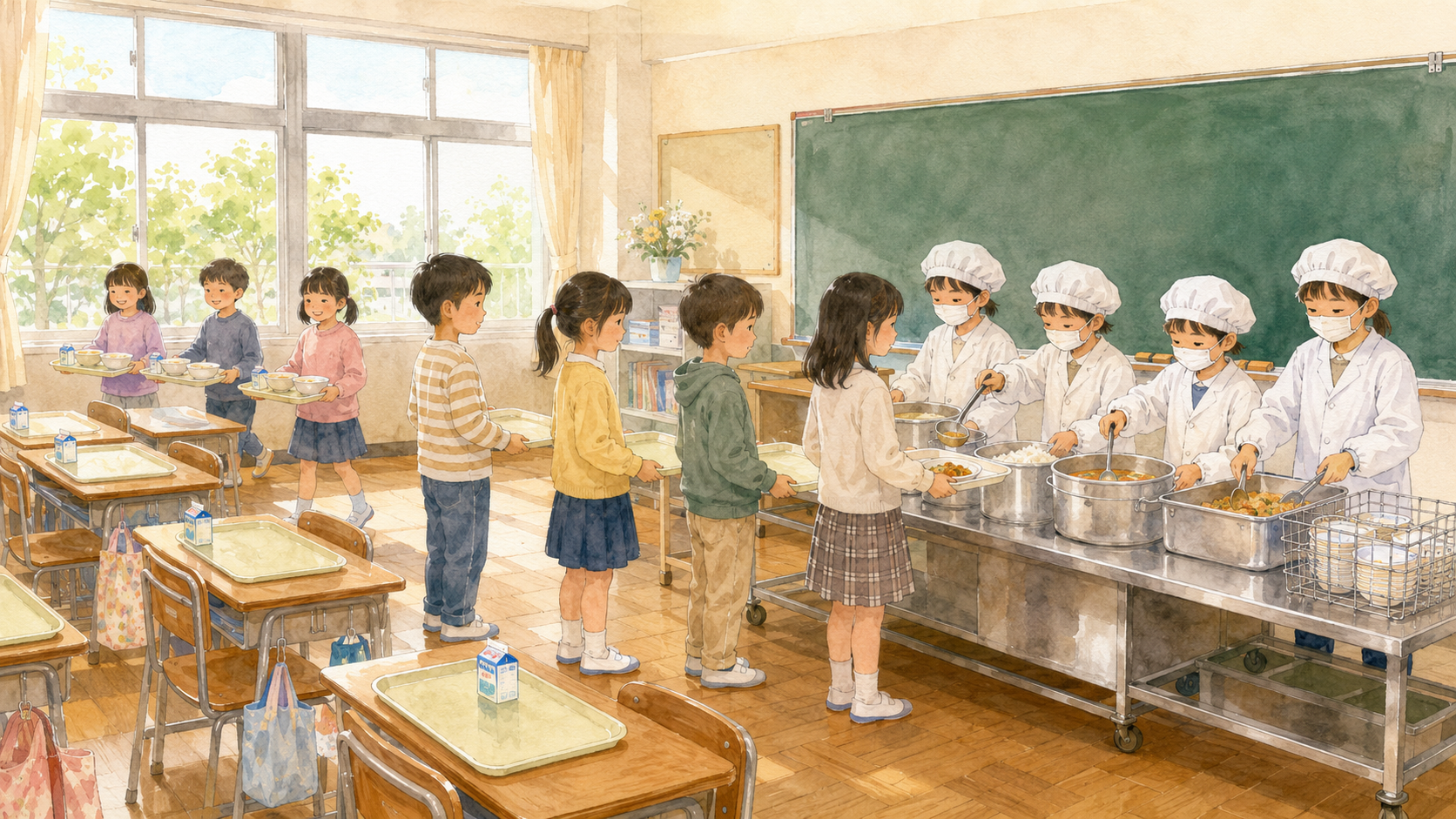
What often surprises parents is that the children run the service. Each class takes turns on 給食当番 (kyūshoku tōban), lunch duty: a rotating group of children put on white aprons, caps, and masks and set up a serving station at the front of the classroom. The rest of the class lines up with their trays, and the duty children dish out the rice, soup, and main dish onto each tray, which classmates carry back to their own desks. No one starts until everyone has been served and the class says "itadakimasu" together. Afterward the children clear away, wipe the desks, and sort the trays, cartons, and packaging for cleanup. It's a daily lesson in taking turns and responsibility as much as a meal.
You'll also hear about 完食 (kanshoku) — finishing everything on the tray. Teachers encourage children to eat what they're served and not waste food, which is a genuine part of the culture. Modern schools are far gentler about it than a generation ago and won't force a child who truly can't eat something, but it helps to know the expectation is "try to finish your portion," not "eat only what you like."
Cost and the 2026 Free-Lunch Reform
Traditionally, families paid a monthly 給食費 (kyūshokuhi), a school lunch fee covering the ingredients — commonly around ¥4,000–5,000 a month per child — while the government covered staff and facilities. That is now changing in a big way.
What's new: Starting in April 2026, the national government began a major reduction of public elementary school lunch fees. Support is provided for every child at a public elementary school regardless of household income, at a national baseline of about ¥5,200 per child per month, and parents generally don't need to apply for it. In practice this makes elementary school lunch effectively free for most families.
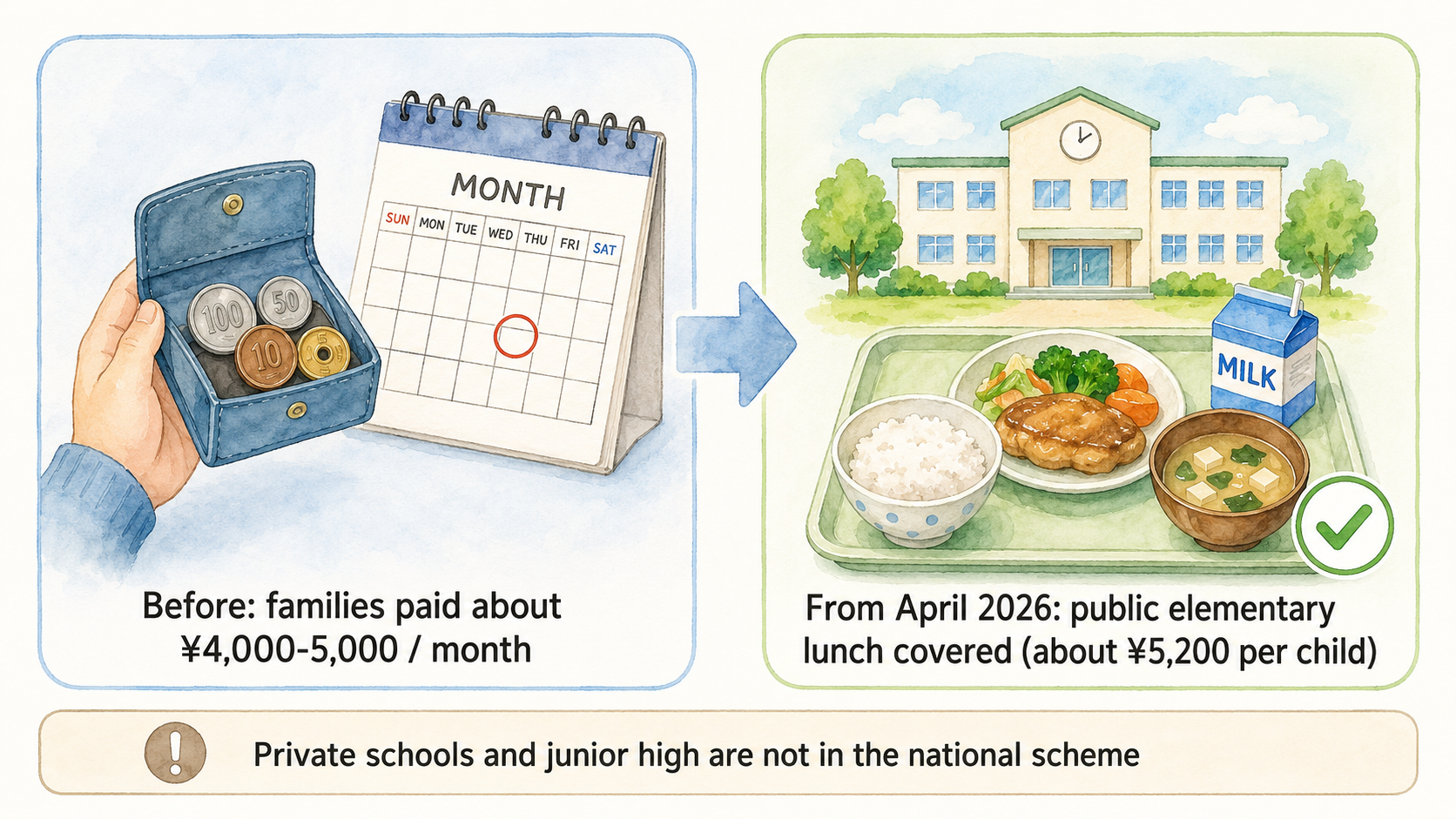
Two caveats matter for planning. First, the national scheme covers public elementary schools — private elementary schools and junior high schools are outside this uniform program (though some municipalities run their own separate support). Second, where a town's actual ingredient cost runs above the national baseline, a small parent contribution can remain. Because the details and any local top-ups vary by municipality, confirm the current situation with your city's board of education or the school itself.
Food Allergies — You Can Work With the School
This is the area where the system is most developed, and the reassuring part: if your child has a food allergy, there is a proper, official process for working with the school. The Ministry of Education publishes a national guideline for handling food allergies in school lunch, and schools follow it.
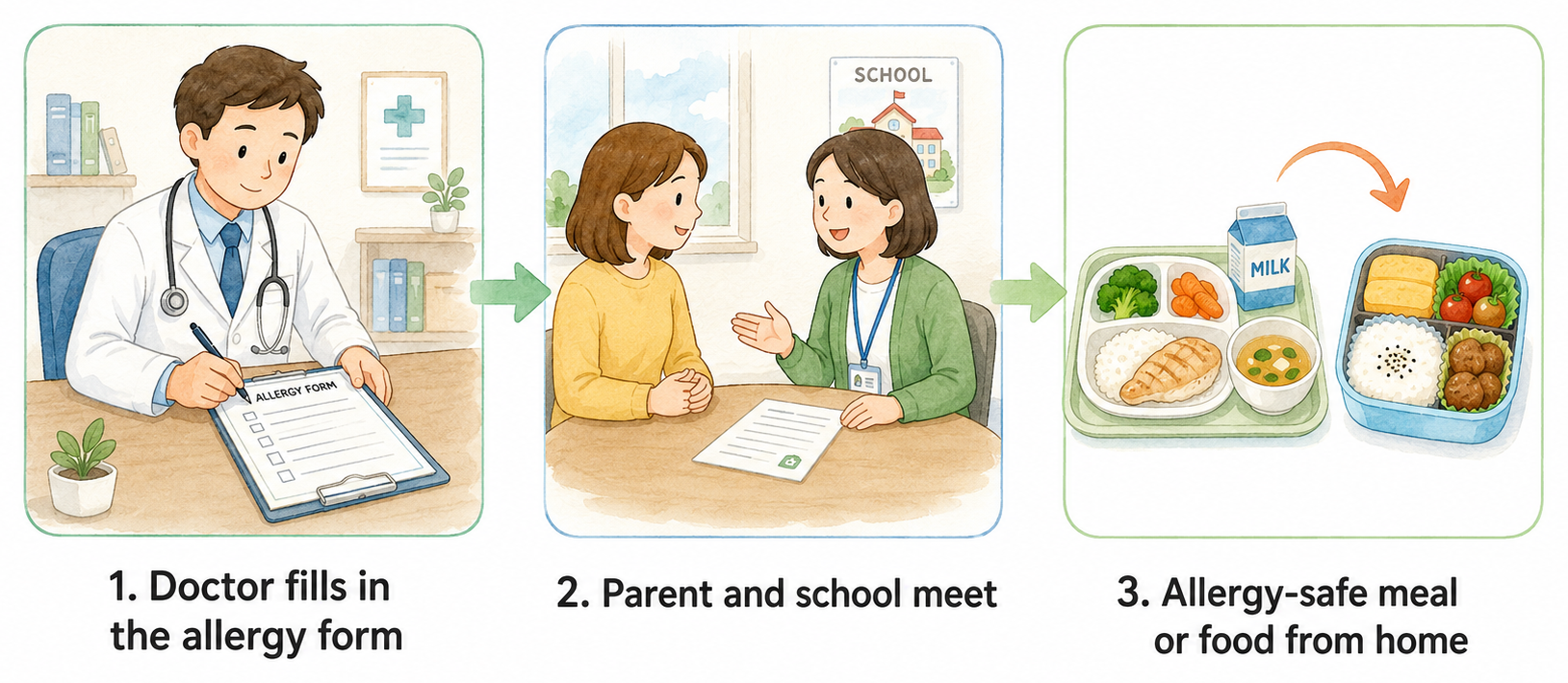
The starting point is a medical form. A doctor fills in a 学校生活管理指導表 (gakkō seikatsu kanri shidōhyō), a School Life Management Guidance Form for allergies, stating exactly what your child reacts to. On that basis the school — often through a food-allergy committee, and usually a face-to-face meeting with you — decides how to respond. Depending on the school and its kitchen, that can mean any of these:
- A removal meal (除去食, jokyoshoku) — the allergen is left out of the child's portion.
- A substitute meal (代替食, daitaishoku) — a safe alternative is provided in its place.
- A packed lunch from home for the days a safe meal can't be guaranteed.
One important principle to understand: for safety, schools generally work on a "remove it completely or don't serve it" basis, rather than trying to do complicated partial adjustments. That deliberately keeps the risk of a mistake low. Kitchens that cook on-site can often accommodate more than central-kitchen schools. The key takeaway is that allergies are taken seriously and handled through a clear, documented process — so raise it early, bring a doctor's diagnosis, and talk it through with the school before term starts.
Religious and Vegetarian Diets
Here it's important to set expectations honestly. Unlike allergies, religious and vegetarian diets are not something the school lunch system is generally set up to accommodate. The standard assumption is that all children eat the same meal, and there is no national program for halal, kosher, or vegetarian menus. A handful of municipalities have experimented with special provision, but these are rare exceptions rather than something you should count on.
What this means in practice for most families is that the realistic approach is at the family's end rather than the kitchen's:
- Read the monthly menu. Schools hand out a 献立表 (kondatehyō), a monthly menu listing each day's dishes and ingredients. Many families use it to see in advance which days include, say, pork, so the child can leave those items and eat the rest.
- Talk to the class teacher. A quiet word with the 担任 (tannin, class teacher) about your family's dietary needs helps them understand and keep an eye out, even where the menu itself can't be changed.
- Ask what your school allows. Whether a child may bring any food from home is decided school by school, so ask rather than assume — and know that individual arrangements are uncommon and not guaranteed.
The honest summary is that, for religious and vegetarian diets, the day-to-day reality in most Japanese schools is largely one of fitting in with the shared meal, using the menu to navigate it, and discussing your situation with the school — rather than expecting a separate meal to be prepared.
Practical Tips for International Families
- Raise allergies before school starts, with a doctor's diagnosis in hand, so the form and meeting can be sorted out in time for day one.
- Keep the monthly menu on the fridge. It's your main tool for spotting ingredients your family avoids and planning around them.
- Expect lunch duty. Your child will take turns serving classmates in a white apron (白衣, hakui), cap, and mask — it's completely normal. In many schools the apron is a class set that's shared and rotated: your child wears it only during their duty week, then it comes home to be washed (and often ironed) and returned. A growing number of schools instead have each child use their own apron, so check which your school follows. Either way, children usually bring their own chopsticks, cup, and napkin each day in a small pouch (給食セット, kyūshoku setto).
- Don't assume you can send a packed lunch. Sending a bentō instead of school lunch is not the default and is usually only for specific, agreed reasons — check with the school first.
- Confirm the cost for your school. With the 2026 reform, public elementary lunch is largely covered, but junior high, private schools, and any local top-up differ — ask your board of education.
For the wider picture of what the school year looks like once your child starts, see our guide to elementary school in Japan, and for the steps before day one, our elementary school enrollment guide.
Japanese Vocabulary
| Japanese | Reading | Meaning |
|---|---|---|
| 給食 | kyūshoku | School lunch — a set meal the whole class eats together |
| 学校給食法 | gakkō kyūshoku hō | The School Lunch Act (1954) that school lunch runs on |
| 給食費 | kyūshokuhi | The monthly school lunch fee (now largely covered for public elementary schools) |
| 給食当番 | kyūshoku tōban | Lunch duty — children who serve the meal to classmates on rotation |
| 完食 | kanshoku | Finishing everything on the tray — encouraged, not forced |
| 献立表 | kondatehyō | The monthly menu listing each day's dishes and ingredients |
| 食育 | shokuiku | Food education — teaching nutrition and not wasting food |
| 学校生活管理指導表 | gakkō seikatsu kanri shidōhyō | The doctor-completed form used to arrange allergy accommodations |
| 除去食 | jokyoshoku | A removal meal — the allergen left out of the child's portion |
| 代替食 | daitaishoku | A substitute meal provided in place of the allergen dish |