
Written and reviewed by Susumu
Born and raised in Japan · Checked against Japanese law and ministry guidance
Japan's public elementary school explained for international families — the school day, 給食 lunch, 掃除 cleaning, school events, PTA, and language support.
Affiliate Disclosure: This article contains affiliate links. If you click a link and make a purchase, we may earn a small commission at no extra cost to you. We only recommend products we genuinely believe are helpful. See our Terms of Use for full details.
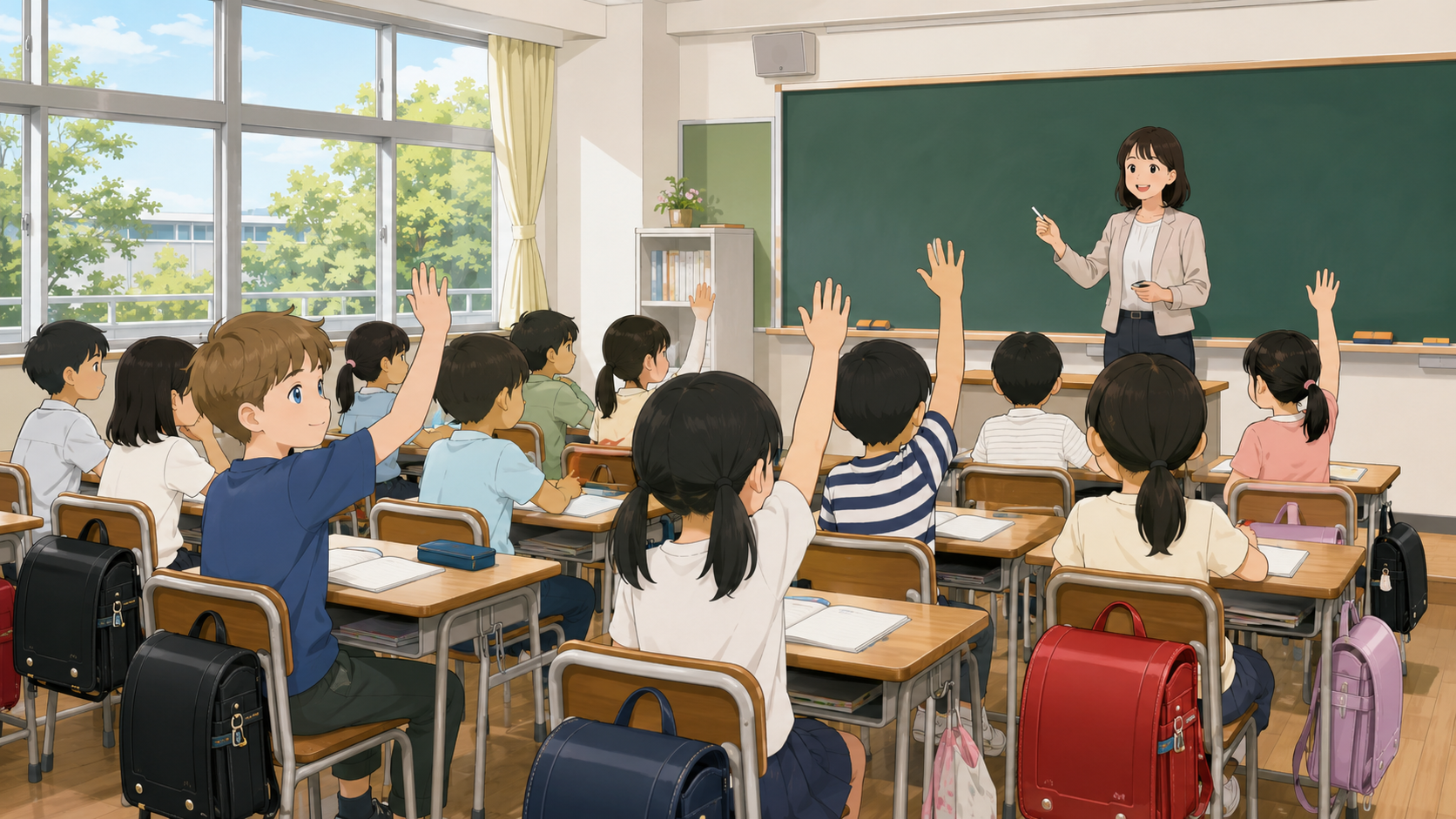
📌 Note: School routines and policies vary by school and municipality. This article covers what is standard at most Japanese public elementary schools.
Types of Schools
Before your child starts school in Japan, it helps to understand what your options are. There are three main paths for elementary-age children:
- Public elementary school (公立小学校) — run by the local government, free of charge, and open to all children registered as residents regardless of nationality. Instruction is entirely in Japanese. This is the most common choice for international families.
- Private elementary school (私立小学校) — independently operated with competitive entry exams, higher fees, and often a more distinctive curriculum or teaching philosophy. Entry is selective and not based on catchment area.
- International school — instruction in English or another language, following a foreign curriculum (IB, British, American, etc.). Fees are high — often ¥1,000,000 or more per year — and availability varies significantly by city.
For most international families, public elementary school is the practical starting point. It's free, it's local, and many children adapt faster than their parents expect. If you're still deciding, our enrollment guide walks through the process in detail.
The School Day
The Japanese school year runs from April to March, divided into three terms:
- First term: April – late July
- Summer break: late July – late August
- Second term: September – late December
- Winter break: late December – early January
- Third term: January – late March
- Spring break: late March – early April
A typical school day looks something like this:
| Time | Activity |
|---|---|
| 8:00 – 8:25 | Children arrive and prepare for the day |
| 8:25 – 8:30 | 朝の会 — morning meeting with the homeroom teacher |
| 8:30 – 12:00 | Classes (45 minutes each, with short breaks between) |
| 12:00 – 12:45 | 給食 — school lunch, served and eaten in the classroom |
| 12:45 – 13:10 | 昼休み — free time, usually outdoors |
| 13:10 – 13:25 | 掃除 — classroom cleaning time |
| 13:25 – 15:10 | Afternoon classes |
| 15:10 – 15:30 | 帰りの会 — closing meeting, then dismissal |
Lower grades (1–2) typically have fewer afternoon classes and go home earlier, around 2pm. Upper grades (5–6) may stay until 3:30pm or later. Exact times vary by school and day of the week.
What Is Taught
Japan's national curriculum is set by the Ministry of Education (文部科学省) and followed by all public schools. The core subjects across all six years are Japanese language, mathematics, science, social studies, music, art, and physical education.
A few subjects that often surprise international families:
- 道徳 (Doutoku — moral education) — a dedicated subject focusing on values like honesty, kindness, and respect. It became a formally graded subject in 2018. Children discuss real-life scenarios and reflect on their choices. There are no right or wrong answers — the goal is thoughtful discussion.
- 生活科 (Seikatsu — life studies, grades 1–2) — a practical subject combining social and natural sciences for younger children. Children learn to observe their surroundings, care for plants and small animals, and engage with their community.
- 家庭科 (Kateika — home economics, grades 5–6) — covers basic cooking, sewing, and household management. Both boys and girls take this subject.
English education was significantly expanded in 2020:
- Grades 3–4: English as a foreign language activity (外国語活動) — listening and speaking focus, not graded
- Grades 5–6: English as a formal graded subject (外国語) — reading and writing introduced alongside speaking and listening
For English-speaking children: Your child will likely find English class easy — and may even become a resource for the teacher. This is a genuine confidence boost during an otherwise challenging period of language adjustment.
School Lunch (給食)
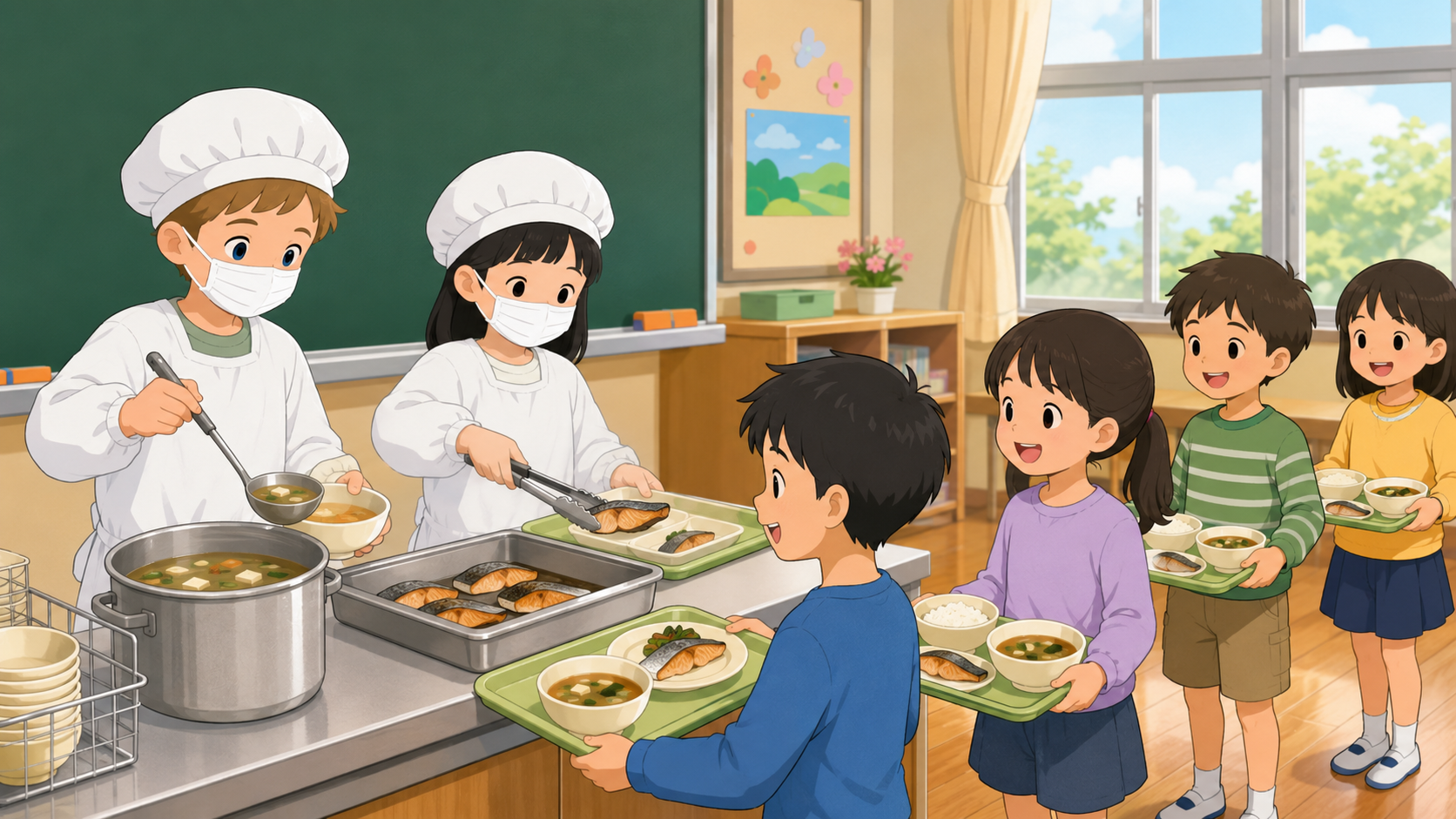
School lunch (給食 — kyuushoku) is one of the most distinctive features of Japanese elementary school — and one of the things children often remember most fondly. It isn't just about food. It's a core part of the school day, embedded in the values of community and shared responsibility.
Every day, a group of children from the class takes turns being the lunch duty team (給食当番 — kyuushoku touban). They put on white aprons and hats, collect the food from the school kitchen, and set everything out on the classroom's lunch counter (給食台). Classmates then line up, receive their food, and carry their trays back to their desks. Once everyone is seated, the class eats together.
A few things that stand out for international families:
- Children eat in the classroom, not a cafeteria. The teacher eats with them.
- The menu is set — there's no choice. Children are encouraged to try everything and ideally finish their meal (though rules on this have relaxed considerably).
- Meals are nutritionally planned by a qualified school nutritionist (栄養士). The food is typically well-balanced and made fresh on-site.
- No outside food on regular days. Children do not bring snacks or lunch boxes unless the school specifically asks (field trips, half-days, etc.).
From April 2026, the national government introduced a subsidy covering ¥5,200 per child per month toward school lunch costs at public elementary schools — with no income limit and no application required from parents. For most families, this makes school lunch effectively free. In some areas where lunch costs exceed ¥5,200 (for example, schools that use locally sourced ingredients), a small difference may still be charged. Check with your local city or ward office for the exact amount in your area.
Food allergies: Inform the school about any allergies before enrollment. Schools require an annual medical certificate (医師の診断書) to accommodate allergies. In most cases, the school removes or substitutes the specific ingredient from the standard meal. For severe or complex allergies the school cannot safely manage, parents may be asked to provide a home lunch on specific days.
Cleaning Time (掃除)
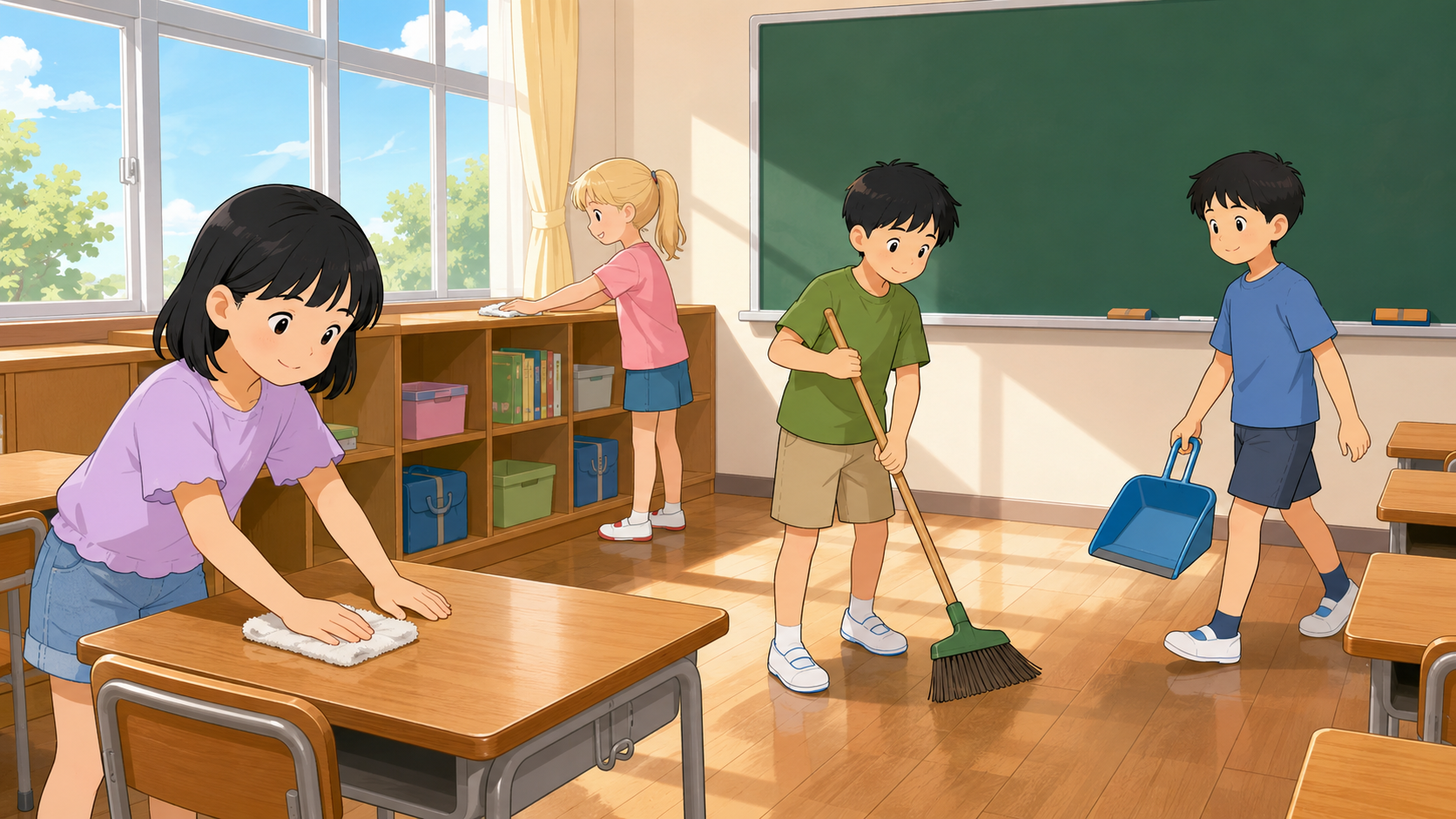
Every day after lunch, the entire school stops for about 15–20 minutes of cleaning time (掃除 — souji). Children sweep floors, wipe desks, clean toilets, and tidy hallways — without a janitor in sight. This is not a punishment. It's a deliberate part of Japanese education.
The idea behind it is straightforward: if you care for the space yourself, you treat it with more respect. Children learn to take pride in their environment and to share responsibility for communal spaces. By the time Japanese children finish elementary school, cleaning up after themselves is simply second nature.
For children from countries where school cleaning is done by adults, this can come as a surprise — but most adapt quickly and many come to enjoy it as a social break in the day.
School Events
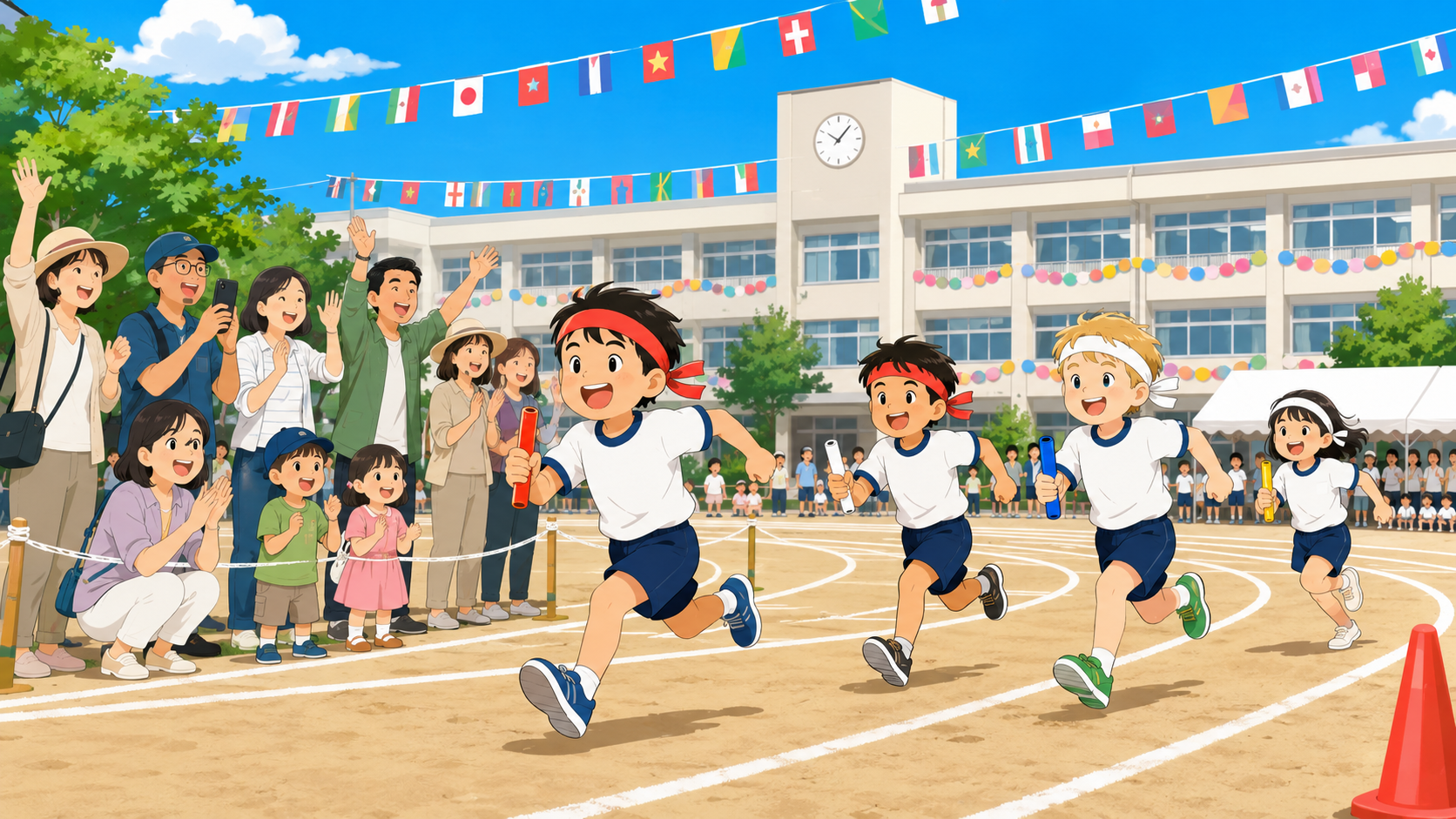
Japanese elementary schools have a rich calendar of events throughout the year. These are a big deal — parents are expected to attend many of them, and children prepare for weeks in advance.
- 運動会 (Undoukai — sports day) — one of the biggest events of the school year, usually held in autumn. Children compete in relay races, group exercises, and class performances. Parents come to watch and cheer. It's a full day and often a highlight of the school year.
- 遠足 (Ensoku — field trip) — typically held twice a year, in spring and autumn. Children travel by foot, train, or bus to a nearby park, nature area, or museum. It's usually a full day. Children bring a packed lunch (bento) and a small snack budget (typically ¥300–¥500, set by the school).
- 学芸会・音楽発表会 (School performance) — a drama or music event where each class performs for parents. Held once or twice a year depending on the school.
- 授業参観 (Open classroom day) — parents are invited to observe a regular lesson. Held several times a year. A good chance to see your child in their school environment.
- 修学旅行 (Shuugakuryokou — graduation trip) — a one- or two-night trip for Grade 6 students, usually in autumn. The most common destinations are Kyoto and Nara. Costs vary by destination and duration but typically range from ¥30,000–¥60,000, paid by parents.
Bento on event days: On 遠足 and some other event days, children bring a packed lunch instead of eating 給食. The school will notify you in advance — usually in writing or via the school app. Simple and nutritious is all that's needed.
School Communication
Japanese schools communicate with parents in two main ways: a physical communication notebook (連絡帳 — renrakucho) and printed notices (プリント) sent home in the child's bag. Some schools also use a dedicated school app for announcements and absence reporting. All communication is in Japanese.
The 連絡帳 is a small notebook that goes back and forth between home and school. Teachers write notes about the day, upcoming events, or any concerns. Parents write back — to report absences, ask questions, or pass on information. Your child carries it in their bag every day.
For non-Japanese-reading parents, this can feel daunting at first. In practice:
- The camera translation function on smartphones (Google Translate, etc.) handles most printed notices well.
- For the 連絡帳, keeping responses simple is fine — a short note, even imperfect Japanese, is always appreciated over silence.
- Let the school know early that Japanese reading is a challenge. Most teachers will adjust how they communicate and make extra effort to be clear.
PTA
Almost every Japanese public elementary school has a Parent-Teacher Association (PTA). Membership is standard practice and parents are expected to participate in some capacity — attending meetings, volunteering for events, or taking on a committee role.
PTA meetings and communications are conducted entirely in Japanese. For non-Japanese-speaking parents, this is one of the more challenging aspects of school life.
The practical advice: let the school and your PTA representative know early that your Japanese is limited. Most schools have dealt with this before and will find ways to include you without putting you in an impossible position. Showing willingness to be involved — even in small ways — goes a long way.
PTA roles vary in how demanding they are. Some are straightforward (helping at sports day, crossing guard duty), while others involve regular meetings and organizing events. If you're asked to take on a role, it's fine to ask what it involves before agreeing.
Language Adaptation
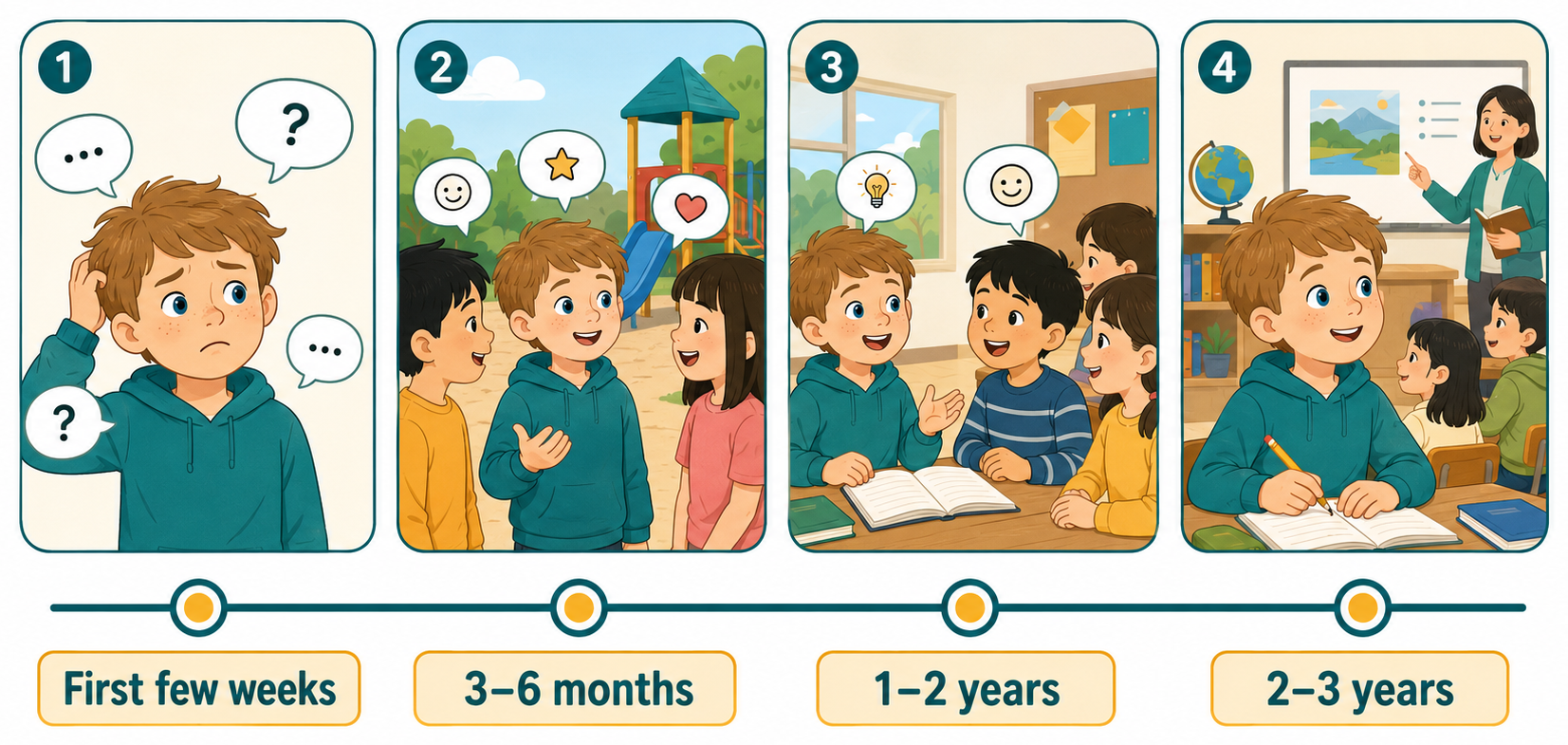
If your child doesn't speak Japanese when they start school, the first few weeks can be hard — for them and for you. But children are remarkably good at picking up languages through immersion, and Japanese elementary school is a surprisingly effective environment for it.
A rough guide to what most children experience:
- First few weeks: Survival mode. Children rely on routine, gestures, and watching what others do. A good teacher will anticipate this and make the classroom feel safe.
- 3–6 months: Basic social communication starts clicking — playground language, lunchtime, simple instructions.
- 1–2 years: Conversational Japanese comes naturally. Your child will likely surprise you.
- 2–3 years: Classroom Japanese — following lessons, reading, writing — is generally well underway with school support.
Younger children (starting at ages 6–7) tend to adapt faster and with less conscious effort. Children who arrive in upper grades face a steeper climb because classroom content is more demanding — but they get there too.
Keep the home language strong. Children in full Japanese immersion can start losing confidence in their first language. Reading books, watching TV, and just talking together in your home language every day makes a real difference.
After-School Care (学童保育)
If both parents work, 学童保育 (gakudou hoiku) — after-school childcare — is the standard solution. Run by the local government or a private operator, 学童 accepts elementary school children after school and on school breaks, typically until 6pm or 7pm.
Children do homework, play, and spend time with a small group of classmates from the same school. It's a familiar, structured environment — not just a waiting room.
To use 学童, you apply through your local city or ward office (市区町村の子育て支援課 or 児童福祉課) — not through the school. Public 学童 (放課後児童クラブ) typically costs ¥4,000–¥8,000 per month depending on your municipality. Private after-school centers are also available but cost significantly more — often ¥30,000 or above. Some areas have waiting lists, so apply as early as possible, ideally before the school year starts in April.
On school event days: When school finishes early (half days, open classroom days), 学童 typically stays open so working parents aren't left without cover. Check with your municipality for the exact hours.
📖 Japanese Vocabulary
Useful terms for navigating Japanese elementary school life.
| 日本語 | ひらがな | English |
|---|---|---|
| 給食 | きゅうしょく | School lunch |
| 給食当番 | きゅうしょくとうばん | Lunch duty team |
| 掃除 | そうじ | Cleaning time |
| 連絡帳 | れんらくちょう | School communication notebook |
| 運動会 | うんどうかい | Sports day |
| 遠足 | えんそく | Field trip |
| 修学旅行 | しゅうがくりょこう | Graduation school trip (Grade 6) |
| 授業参観 | じゅぎょうさんかん | Open classroom day |
| 道徳 | どうとく | Moral education |
| 学童保育 | がくどうほいく | After-school childcare |
| 朝の会 | あさのかい | Morning meeting |
| 帰りの会 | かえりのかい | End-of-day meeting |