

Written and reviewed by Susumu
Born and raised in Japan · Checked against Japanese law and ministry guidance
A guide to the paper and app notices Japanese schools send home — the monthly newsletters, the reply slips with next-day deadlines, the handful of words that signal action, and how to keep on top of it all without reading fluent Japanese.
Affiliate Disclosure: This article contains affiliate links. If you click a link and make a purchase, we may earn a small commission at no extra cost to you. We only recommend products we genuinely believe are helpful. See our Terms of Use for full details.

Your child comes home, and out of the randoseru comes a small stack of paper. One sheet is a monthly newsletter. One needs your seal and has to go back tomorrow. One is about a day you have to take off work. And somewhere on your phone, an app has sent three notifications about something else entirely. Figuring out which piece of paper matters, and by when, is one of the quiet daily demands of Japanese school life — and it is harder when the whole thing is in Japanese.
Paper and App, Side by Side
Japanese schools have moved a long way toward digital communication. In a 2022 education ministry survey of boards of education nationwide, 81% of municipal boards had shifted parent contact onto some digital channel — an app, a mail system, a web form — rising to 90% for major cities and 94% at prefectural level. All three were up on the year before. Many of these systems handle absence reports, so the old ritual of phoning the school before 8am is disappearing in a lot of places.
What has not happened is paper going away. A board of education having a system in place is not the same as every school using it for everything, and surveys of schools with these tools consistently find phone calls and printed handouts continuing alongside them. In practice most families end up managing two channels at once: the app carries urgent and school-wide news, and the randoseru carries the class-level paper. Neither is a complete picture on its own, which is the part that trips people up.
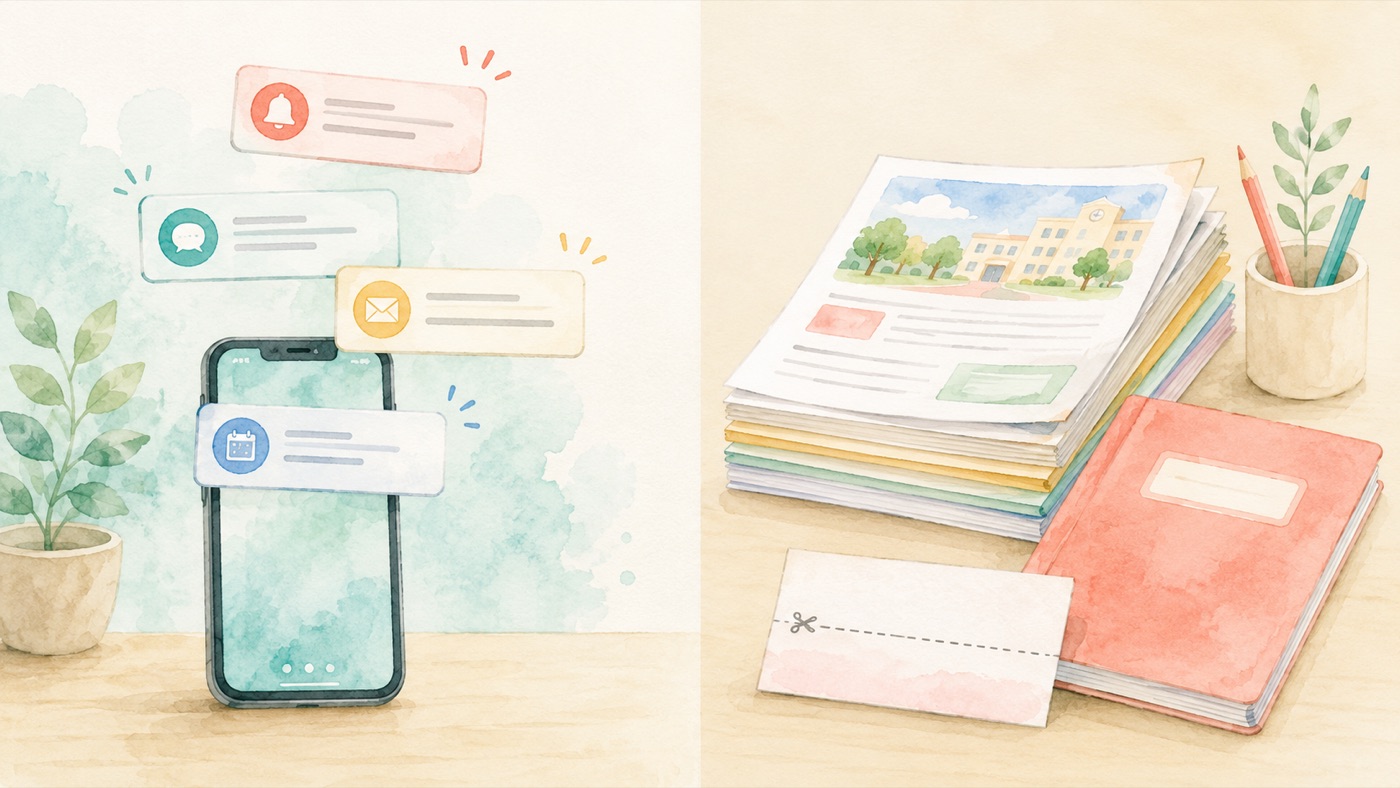
So the first thing to establish, ideally in April, is which channel your school uses for what. Ask the class teacher directly: is absence reported through the app or by phone? Are the monthly newsletters posted in the app, or only on paper? Does a reply slip ever come back digitally? Schools answer these questions readily; the trouble is that they rarely think to explain the system unprompted, because to everyone else it is obvious.
The Regular Newsletters
Alongside one-off notices, a predictable set of newsletters arrives on a monthly rhythm. These are collectively おたより (o-tayori), and knowing which is which tells you how carefully to read:
| Newsletter | What it carries |
|---|---|
| 学校だより gakkō dayori |
From the principal, for the whole school. Term dates, school-wide events, a message about the season. Read once, then file. |
| 学年だより gakunen dayori |
For your child's year group. This one usually carries the month's schedule — which is where you find the days your child finishes early. |
| 学級通信 gakkyū tsūshin |
From the class teacher, about your child's class specifically. Often the one with the things you actually need to bring or prepare. |
| 給食だより kyūshoku dayori |
The month's lunch menu, usually with allergen information. See our guide to school lunch. |
| 保健だより hoken dayori |
From the school nurse. Health checkups, what is going around, and seasonal advice. |
If you only have time for one, make it the 学年だより. The monthly calendar printed on it is the single most useful page a Japanese school gives you, because it is where shortened days, event days, and no-lunch days appear — the details that decide whether you need to arrange childcare or take leave.
Sorting the Stack in Two Minutes
You do not need to read every sheet in full. Almost every notice can be sorted by looking at three things:
- Is there a dotted line across the page? A cut line (切り取り線) near the bottom means the lower portion is a reply slip that comes back to school. That sheet is not optional — it has to go back, usually within a day or two.
- Is there a date with 締切 or 提出期限 next to it? That is a deadline, and it is often two or three days away rather than two weeks.
- Are there numerals with 月 and 日? Dates are where the actionable content lives. Even without reading the surrounding sentence, a date plus a time plus a place usually means "be there".
Everything else — the seasonal greeting, the note about autumn leaves, the paragraph thanking parents for their cooperation — can wait until you have a quiet moment, or forever.
The Words That Mean "Do Something"
A handful of words do almost all the work of telling you a notice requires action. Learning to spot these visually — not to read them fluently, just to recognize the shape — changes how manageable the stack feels:
| Japanese | Reading | What it signals |
|---|---|---|
| 提出 | teishutsu | Submit — something goes back to school |
| 締切 / 提出期限 | shimekiri / teishutsu kigen | Deadline. The date beside it is the one that matters |
| 持ち物 | mochimono | Things to bring on a given day |
| 記入 | kinyū | Fill in — a form needs writing on |
| 記名 | kimei | Write the child's name on it |
| 押印 / 印 | ōin / in | A seal was traditionally required; a signature is now widely accepted |
| 切り取り線 | kiritori-sen | Cut line — tear here and return the lower part |
| 下校時刻 | gekō jikoku | Dismissal time — changes on event days and short days |
Slips You Have to Send Back
The reply slip below the cut line is the part of the system that most often goes wrong for families new to it. The slip is usually short — a name, a circle around 参加 (attending) or 不参加 (not attending), sometimes a seal — and it goes back to school in your child's bag, not by email, and not on the day of the event.
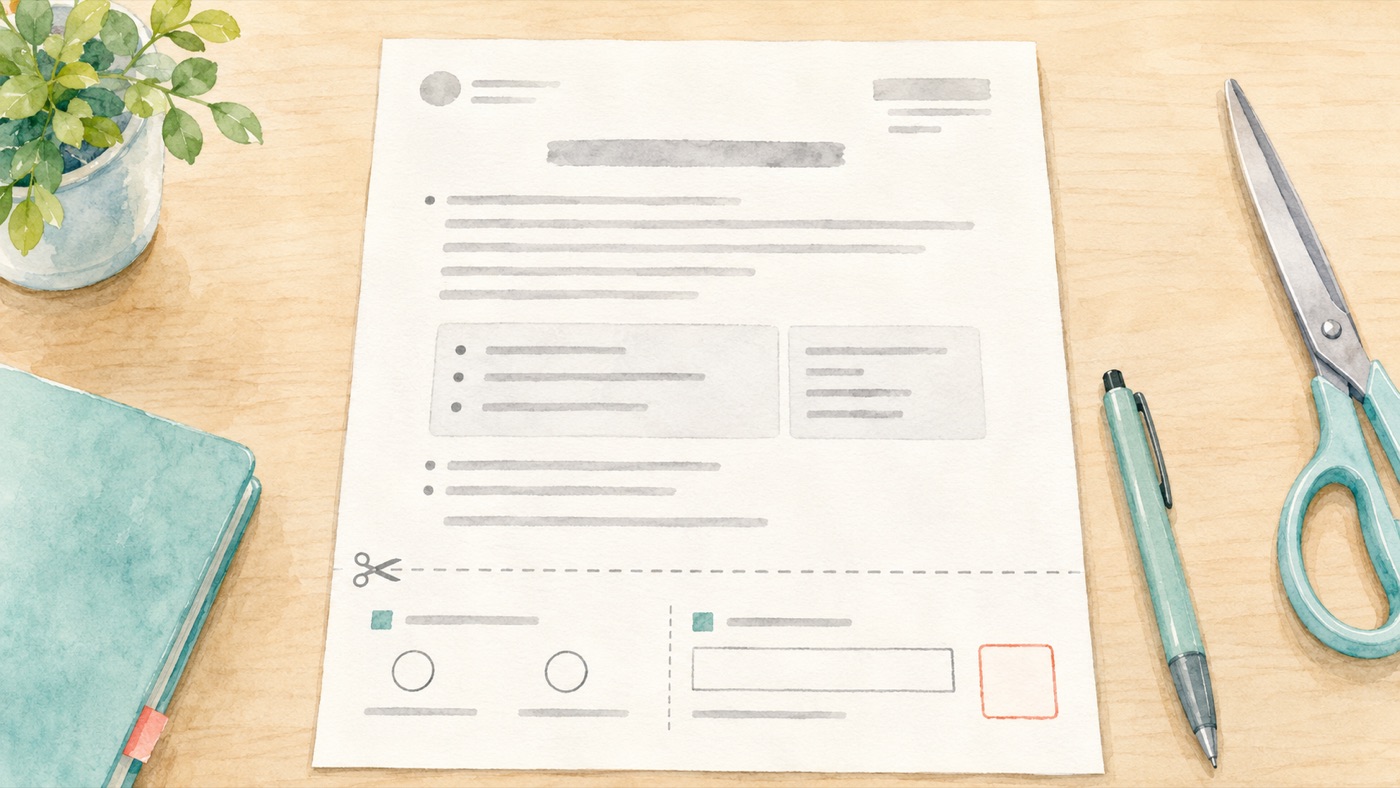
Two practical habits prevent nearly all the trouble. First, deal with reply slips the evening they arrive rather than setting them aside; the deadline is frequently the next morning. Second, on the seal question: schools traditionally asked for a personal seal (印鑑), but in 2020 the education ministry told boards of education to review the practice and drop it where it was only being asked for out of habit. Many schools did, and a signature is widely accepted now. If a form has a small circle marked 印, writing your name there is fine unless the school says otherwise.
Where a notice concerns an event you are expected to attend, our guide to parent events at Japanese elementary schools explains what each one involves and how much of the day it takes.
Reading Them Without Reading Japanese
Phone camera translation has made this genuinely manageable. Point your phone's camera at the sheet, and you get a workable version in seconds — enough to catch dates, deadlines, and what is being asked. It handles printed school notices better than handwriting, which is fortunate, because almost all of these are printed.
A few habits make it work better:
- Photograph everything on the day it arrives, even the sheets you have no time to read. A phone album of notices is far easier to search later than a pile on the counter, and it survives the sheet being lost in the bag.
- Translate the calendar page of the 学年だより each month and put the dates straight into your phone. This one habit prevents most of the surprises.
- Ask the school what support exists. Municipalities with larger international populations often provide translated versions of standard forms, and some schools can arrange an interpreter for meetings. Support varies a great deal, but it is rarely offered unprompted — you have to ask.
The other resource is other parents. A classmate's parent can tell you in one message what a notice means, and that connection is worth building early, before you need it.
When You Miss One
You will miss something eventually. Everyone does, including Japanese parents — the sheet stays at the bottom of the randoseru, or the deadline passes over a weekend. It is not treated as a failing.
The response that works is simply to contact the school as soon as you notice, through whichever channel they use, and say what happened. Teachers deal with this constantly and will usually just re-send the form or extend the deadline. What causes real problems is silence — a slip that never comes back, with no explanation, leaves the teacher unable to plan.
If you are unsure whether something was ever sent, the communication notebook is the natural place to ask a short question and get a written answer back. For a wider picture of how Japanese elementary school works day to day, see our overview of elementary school in Japan.
Japanese Vocabulary
The newsletter names are in the table above, and the action words are in the one before it. These are the remaining terms that turn up around school notices:
| Japanese | Reading | Meaning |
|---|---|---|
| おたより | o-tayori | The general word for a newsletter or notice from school |
| 配布 | haifu | Distributed — how notices are described as being handed out |
| 連絡帳 | renrakucho | The notebook that travels between home and teacher |
| 参加 / 不参加 | sanka / fusanka | Attending / not attending — usually circled on a reply slip |
| 保護者 | hogosha | Parent or guardian — how notices address you |
| 印鑑 | inkan | Personal seal; a signature is accepted at most schools now |
| 短縮授業 | tanshuku jugyō | A shortened school day — check the dismissal time |
| 欠席連絡 | kesseki renraku | Reporting an absence, now often done through the school app |