

Written and reviewed by Susumu
Born and raised in Japan · Checked against Japanese law and ministry guidance
How to tell a Japanese elementary school your child will be absent, arriving late, or leaving early — the app and phone deadlines that vary by school, who is allowed to pick up a child mid-day, and why the school calls when no report comes in.
Affiliate Disclosure: This article contains affiliate links. If you click a link and make a purchase, we may earn a small commission at no extra cost to you. We only recommend products we genuinely believe are helpful. See our Terms of Use for full details.

It is 7:40 in the morning, your child has a fever, and the school needs to know before attendance is taken. What you actually have to communicate is short — which child, and that they will not be there. The rest of this page is what surrounds that: how to say it, what changes when a child is late rather than absent, and what the school does when nothing arrives at all.
Reporting an Absence Today
An absence is 欠席 (kesseki). Send it through whichever channel your school uses, as early as you can. The teacher takes attendance at the morning meeting, so a report that arrives after that has already caused the thing it was meant to prevent.
Two pieces of information do the work: which child, and that they will not be there. A reason helps but does not need detail. 体調不良 (taichō furyō) — unwell — is the standard catch-all, and it covers fever, stomach ache, and the mornings where a child is plainly not right.
If you are phoning, the call is thirty seconds. Lead with the grade and class, because that is what the office needs to find the child. Then the name, then the reason.
1年2組の[名前]です。今日は熱があるので欠席します。
Ichi-nen ni-kumi no [name] desu. Kyō wa netsu ga aru node kesseki shimasu.
This is [name] in Class 1-2. She has a fever, so she will be absent today.
Nobody on the other end is assessing your Japanese. The office takes a stack of these calls every morning and is listening for one thing — which child — so a sentence that gets the class and the name across has done its job.
One thing the report does not do is cancel that day's school lunch. The fee is charged anyway. Canceling lunch is a separate request with a deadline several working days ahead in many municipalities, because the food is ordered in advance — practical for a family trip, impossible for a fever that started overnight. Our guide to school lunch covers how the fees work.
Arriving Late
Lateness is 遅刻 (chikoku), and it is reported the same way as an absence, with a rough arrival time if you have one.
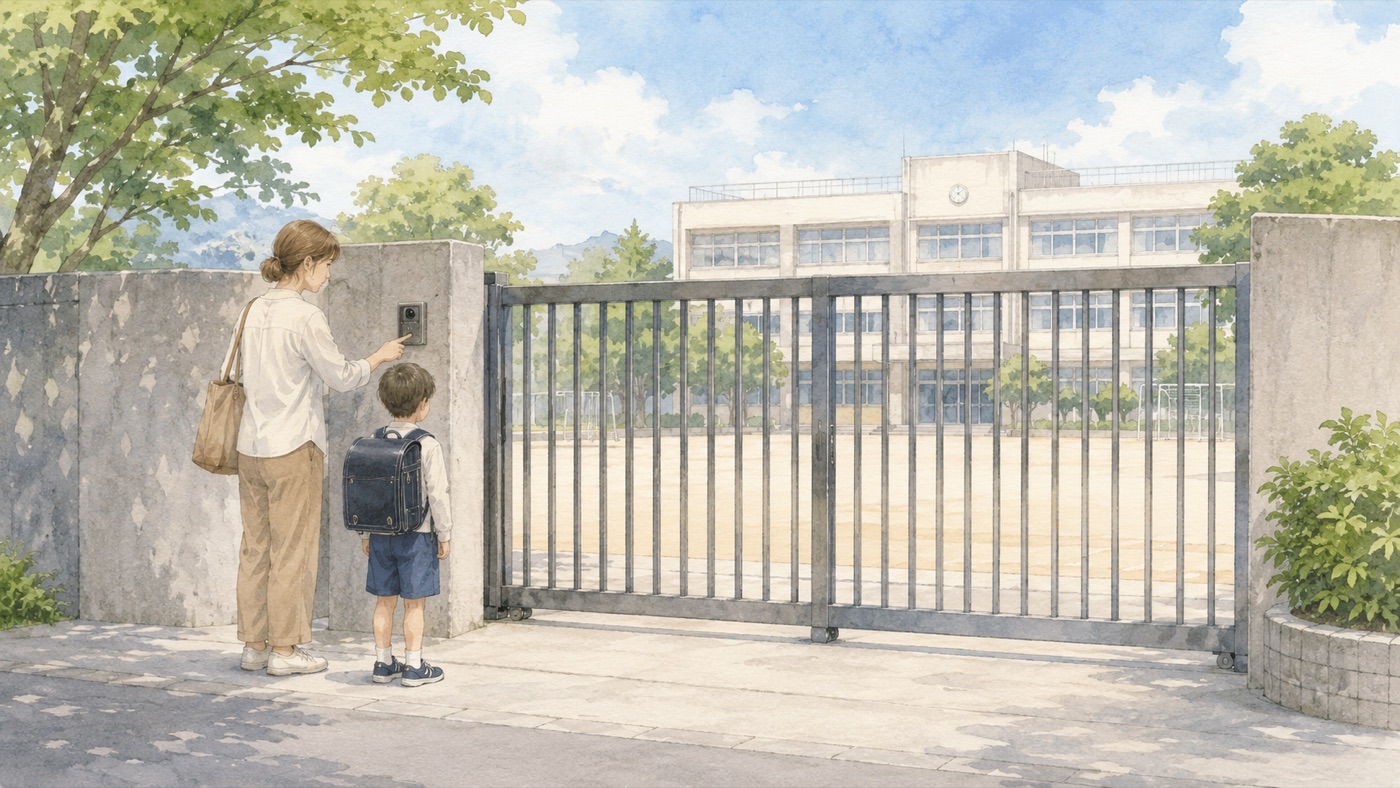
What differs from most countries is the gate. Japanese elementary schools lock theirs once the morning rush is over, as a security measure, so a late child cannot simply walk in and go to the classroom. There will be an intercom, and someone will let you in.
The question to ask your school is not how to report a late arrival — that part is the same as an absence — but where a late child goes on arrival, and whether an adult has to bring them that far.
Leaving Early
Leaving before the end of the day is 早退 (sōtai), and schools treat it more carefully than an absence. They are handing a child over partway through the day and remain responsible until that handover happens.
So your child will not be sent home alone. An adult collects them, and the handover happens inside the building — at the classroom or the children's entrance rather than the gate — which means changing into slippers and walking in. Allow a few more minutes than you expect.
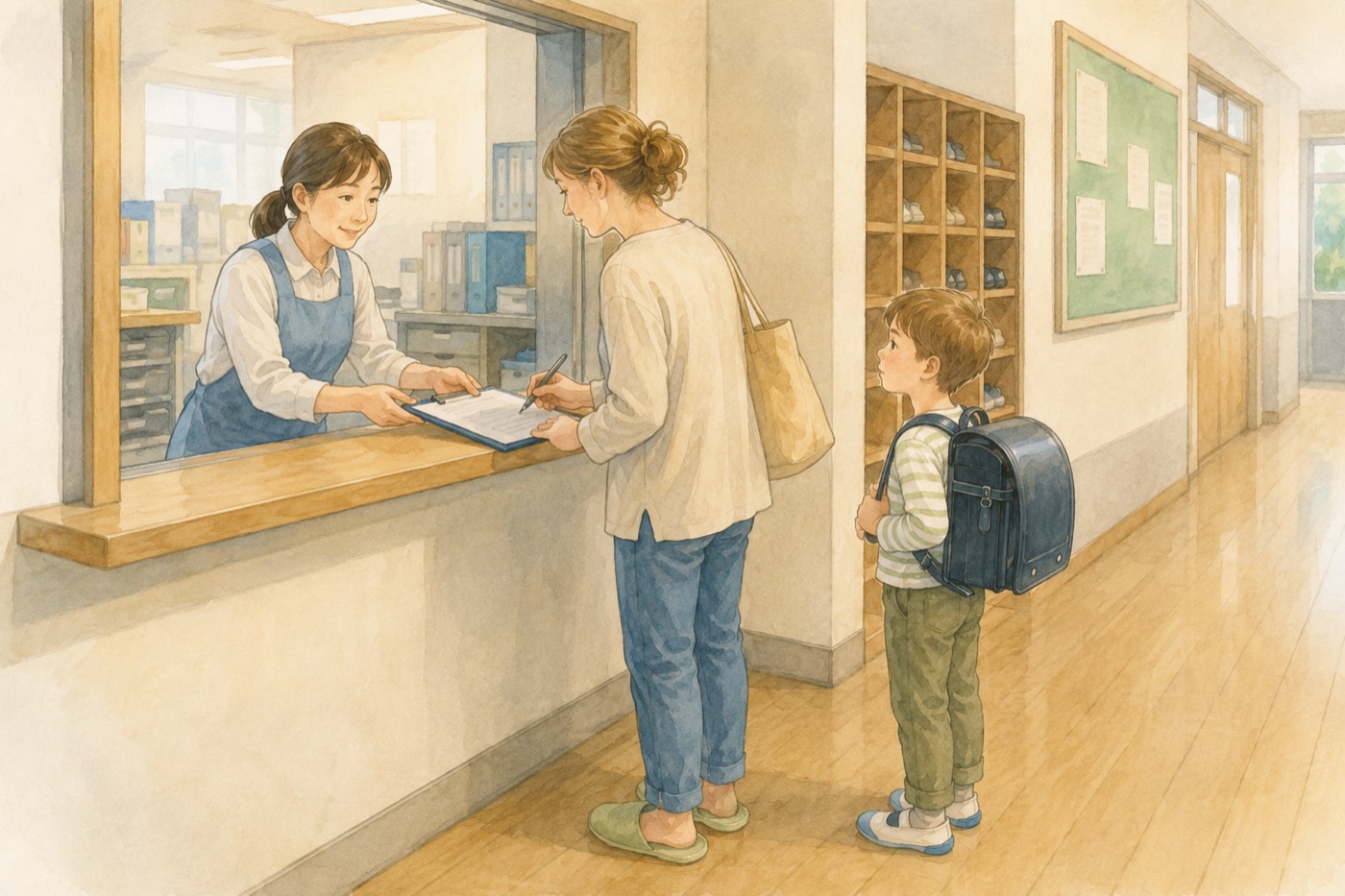
A planned early departure — a dental appointment, an embassy visit — is easiest handled with a note the day before rather than a call on the morning. That gives the teacher time to have the child's bag ready and saves everyone the wait.
What Happens If You Say Nothing
If a child does not arrive and no report has come in, the school calls home. This is not a reprimand and it has nothing to do with attendance records. A child who left the house but never reached the classroom is treated as an emergency until proven otherwise, and confirming safety is the school's responsibility.
That is worth knowing because it changes what you should worry about. A late report, a clumsy one, or one sent through the wrong channel is a minor thing. Silence is the problem, because from the school's side silence is indistinguishable from something having gone wrong on the way in.
So report at ten in the morning if that is when you realize. And if the school calls first, the conversation is short and nobody is irritated — they wanted to hear that your child is at home.
When It Is an Illness the School Tracks
Ordinary illness is an ordinary absence. A short list of contagious illnesses works differently: the school directs the child to stay home for a set period, and those days are recorded separately rather than counted against the child. Schools usually want a phone call for these, on top of the normal channel, because the school nurse needs to know and the return date has to be agreed rather than assumed.
Influenza is the one most families meet, and its rule is national. A child stays home until five days have passed since symptoms began and two days have passed since the fever came down, whichever lands later. Both the day symptoms started and the day the fever broke count as day zero, which is where the miscounting usually happens.
Whether a doctor's note is needed to come back is a separate question. Nothing in the law requires one, and many schools and municipalities have dropped it or replaced it with a form the parent fills in — but some still ask, and the certificate costs money. Our guide to class closures and attendance suspension covers how these days are recorded.
Time off for a death in the family, 忌引 (kibiki), is its own category again and is kept off the absence count entirely. The number of days depends on how close the relative was. Tell the school what has happened and they will tell you what applies.
The Four Ways Schools Take Reports
There is no national system, and municipalities do not standardize it either — which is why a parent at a different school will give you a confident answer to the wrong question. In practice it comes down to four channels, and most schools run two: something digital for the ordinary case, and the phone for everything else.
- A school app. The most common arrangement now, and the easiest if your Japanese is limited, because you are choosing from fixed options rather than composing a sentence.
- A web form. Simpler than an app and usually built for same-day reports, with a window that closes at a set time.
- The telephone. The fallback almost everywhere once the digital window has shut, and still the main channel at some schools. This is the one that needs spoken Japanese.
- The communication notebook. A note in the renrakucho, carried in by a neighbor's child. Fine for a planned absence, no use at all for a fever that started at six that morning.
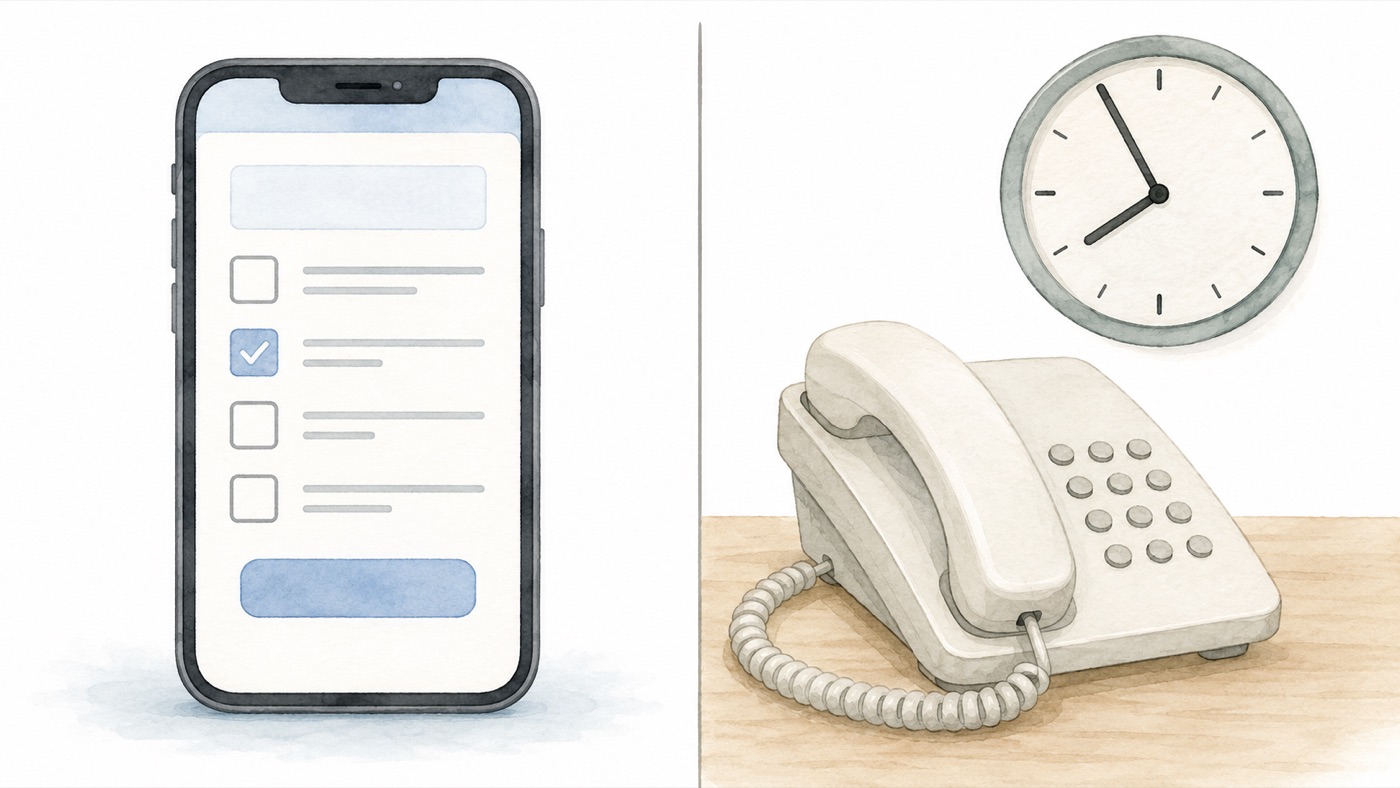
Where both are available, use the digital one. It leaves a record, it does not depend on anyone picking up, and it takes the language out of the exchange entirely.
What to Settle at the Start of the Year
Everything above works better if five details are already answered before the morning you need them. April, when the class list changes and nothing is urgent, is when to ask.
1. The channel and the deadline. Which one, and by what time in the morning.
2. The fallback. What to do once that deadline has passed — usually a phone call.
3. Late arrivals. Where a late child goes, and whether an adult comes in with them.
4. Early pickup. Whether anyone other than a parent may collect your child, and whether that person has to be named to the school first.
5. Illness. Whether the school wants a doctor's note before a child returns from a contagious illness.
Five answers, written somewhere you can find them at 7:40 in the morning. That is the only hour you will ever need them, and it is the worst possible one for going through a folder of paper.
Japanese Vocabulary
These are the words that turn up in the forms, the app menus, and the phone calls:
| Japanese | Reading | Meaning |
|---|---|---|
| 遅刻 | chikoku | Arriving late |
| 早退 | sōtai | Leaving before the end of the day |
| 登校 | tōkō | Going to school — the morning journey and arrival |
| 体調不良 | taichō furyō | Unwell — the usual all-purpose reason on a form |
| 病欠 | byōketsu | Absence through illness — one of the two categories on the attendance record |
| 事故欠 | jikoketsu | The other category: absence for any reason that is not illness — a family trip, a funeral, something at home |
| 忌引 | kibiki | Leave for a death in the family — kept off the absence count entirely |
| 職員室 | shokuinshitsu | Staff room — where a parent goes to speak to a teacher |
| 安否確認 | anpi kakunin | The safety check — why the school calls when nobody reports |
For where the school's instructions arrive in the first place — which notice carries the deadline, which channel the school actually uses — see our guide to school notices. For how the school day is put together around all of this, see our overview of elementary school in Japan.