Written and reviewed by Susumu
Born and raised in Japan · Checked against Japanese law and ministry guidance
What happens when a Japanese elementary school sends your child to the health room — who the nurse-teacher is, when the school calls you, the rules on medicine, and the accident scheme that pays for injuries at school and on the way there.
Affiliate Disclosure: This article contains affiliate links. If you click a link and make a purchase, we may earn a small commission at no extra cost to you. We only recommend products we genuinely believe are helpful. See our Terms of Use for full details.
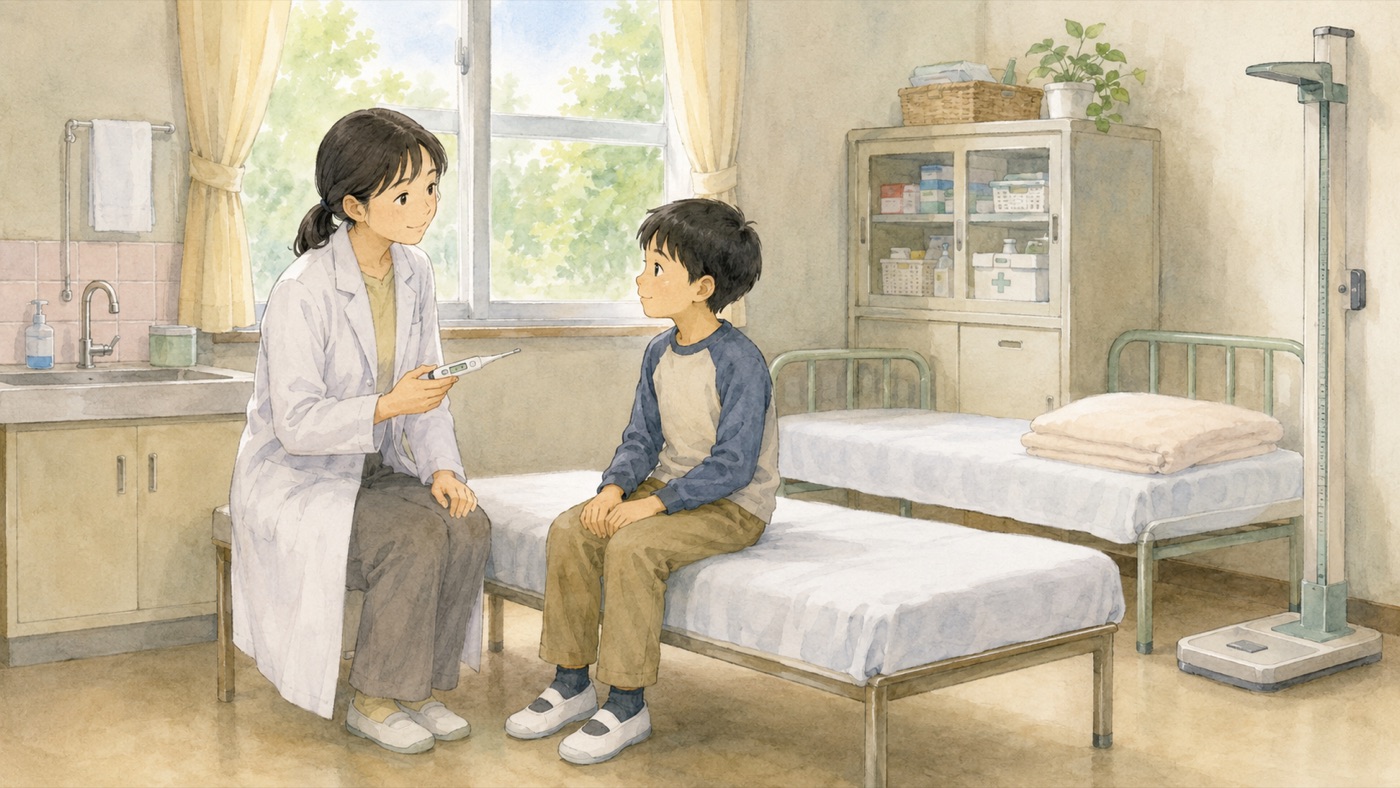
Your phone rings mid-morning and it is the school. Your child is in the health room. Most of the time this ends with them going back to class, and the call is a courtesy. Occasionally it ends at a clinic — and at that point there is one decision that costs money if you get it wrong, and almost nobody tells international families about it in advance.
The Health Room and Who Runs It
Every Japanese elementary school has a 保健室 (hokenshitsu) — a health room with beds, a sink, and a scale. This is not a matter of school policy: the law requires schools to keep a room for health checks, health consultations, and first aid, and it requires them to employ a 養護教諭 (yōgo kyōyu) to run it.
That title is usually translated as school nurse, though the role is wider than the English suggests. They carry out the annual health checks and they teach health topics. The law also puts health consultation in their remit, alongside first aid, so the role reaches beyond treating scraped knees.
What the health room is not is a clinic. It carries first-aid supplies and basic over-the-counter items and nothing more. A child with a fever rests there until someone collects them; a child who has been hurt gets cleaned up and assessed. Anything beyond that goes to a doctor.
When Your Child Feels Unwell
A child who says they feel bad is sent to the health room, where the nurse takes their temperature and asks what is wrong. Often that is the end of it — a short rest and back to class. If the child is running a fever or is not getting better, the school calls home.
A visit that ends with the child going back to class may never reach you, or may reach you at the end of the day through a note. That is not the school keeping something from you — a child who lies down for twenty minutes and then rejoins the lesson has not had an incident that justifies interrupting a parent's working day.
When the School Calls
If the school calls, they have already decided the child should go home. What they need from you is when you can arrive and who is coming, and the handover follows the same pattern as any early pickup: an adult collects the child from inside the building, not at the gate. Our guide to absence, late arrival, and early pickup covers how that works.
If you cannot get there quickly, say so plainly and give a time. Schools plan around the answer, and a child resting in the health room for another hour is an ordinary situation rather than a problem. Agreeing to a time you cannot make helps nobody.
When It Is an Injury
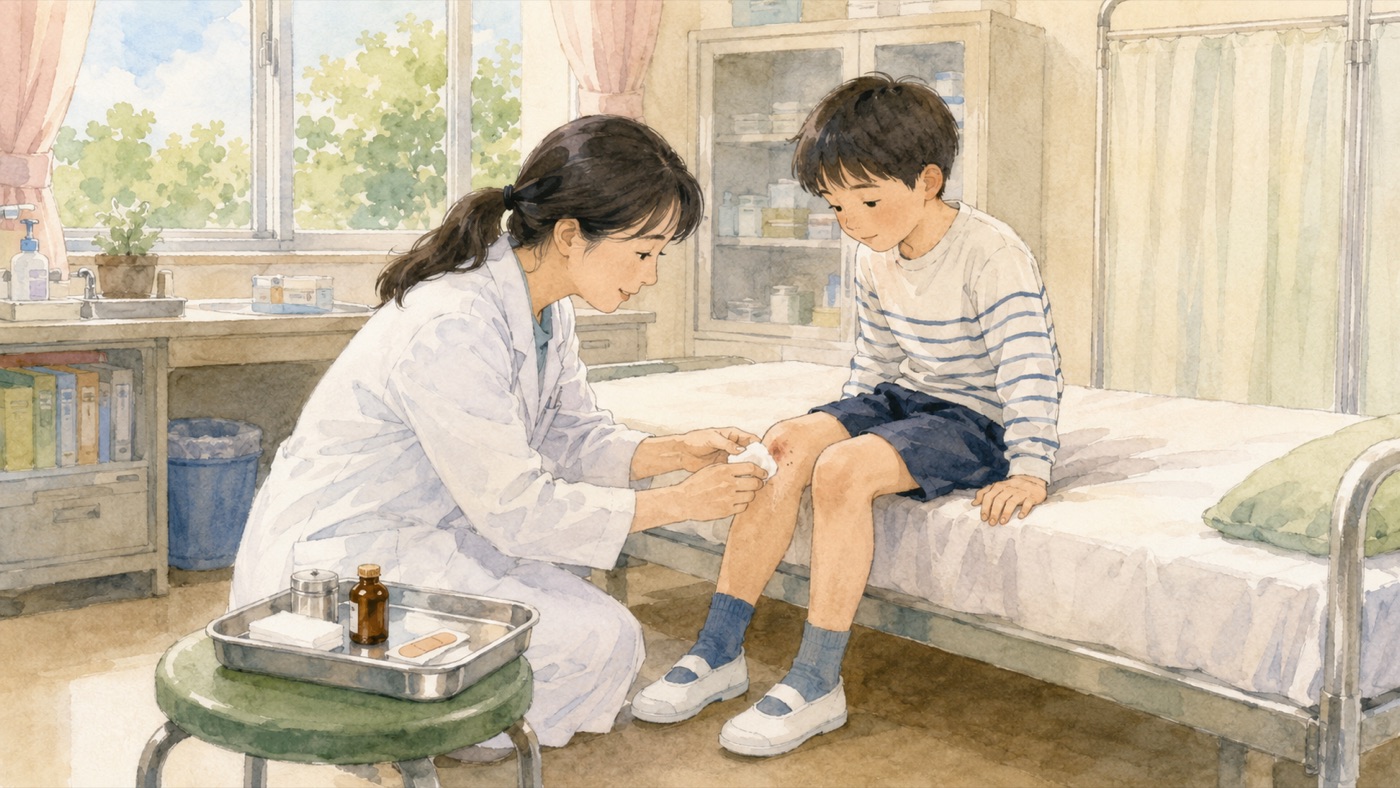
For scrapes and knocks, the nurse treats it and the day continues. You may hear about it through a note or the communication notebook rather than a phone call.
For anything that might need a doctor — a deep cut, a possible fracture, a head knock — the school contacts you and, depending on severity, either asks you to take the child to a clinic or arranges transport. In a genuine emergency they will call an ambulance, and reach you as soon as they can after that.
An injury at school sits in a different category from an illness, and it carries its own insurance system. That is the next section, and it is the part to read before you need it.
Do Not Use Your Medical Voucher
Injuries that happen under school supervision are covered by a national program run by the Japan Sport Council — the 災害共済給付 (saigai kyōsai kyūfu). Most parents have never heard of it, which is understandable: you joined by signing one line on a Japanese form in April, and the cost disappeared into the same monthly transfer as the lunch money.
Here is what that form did. Your municipality holds the contract, not you, and it signs children up with parental consent. The premium is tiny. For the 2026 school year it is 920 yen a year per elementary school child, and families pay between 40% and 60% of that — so the sum actually collected from you is somewhere under 600 yen for the whole year. It renews annually as long as the premium is paid.
The program runs from daycare and kindergarten right through high school, so a child who attended either was already covered before elementary school started. Almost every family is in it. Very few realize what it does.
It covers what the program calls "under school management," which is broader than lesson time. Classes, break times, club activities, school trips, and the journey to and from school all count. A child hurt on the walk home is covered.
It is not only for injuries, either. A short list of illnesses counts too when the cause sits with the school — food poisoning traced to school lunch, heatstroke, and a handful of others set out in law. So a child taken ill after a hot afternoon of PE falls under the same program as a child who broke a wrist in the playground.
Two different documents come into this, and it helps to keep them straight. The first is what proves your insurance — either a My Number card registered as a health insurance card or a paper certificate. The second is the child medical subsidy certificate your city hall issued: 医療証 or 受給者証 depending on where you live, the card that makes children's visits free or nearly free. Two separate things from two separate issuers.
Tell the receptionist the injury happened at school. Then pay the ordinary copayment — 30% once a child is at elementary school. The subsidy certificate should not be applied, because the school accident program covers it instead and the two cannot both pay.
学校でけがをしました。
Gakkō de kega o shimashita.
The injury happened at school.
Saying it out loud matters more than it used to. Municipalities are gradually folding the subsidy certificate into the My Number card, so at a clinic that has made the switch the discount can be applied automatically from the card alone — without anyone asking where the injury came from. Telling them at the desk is the one step that works whichever system your clinic and municipality are using.
Keep carrying the paper certificate anyway. Not every clinic has switched over, and some municipalities still want to see both.
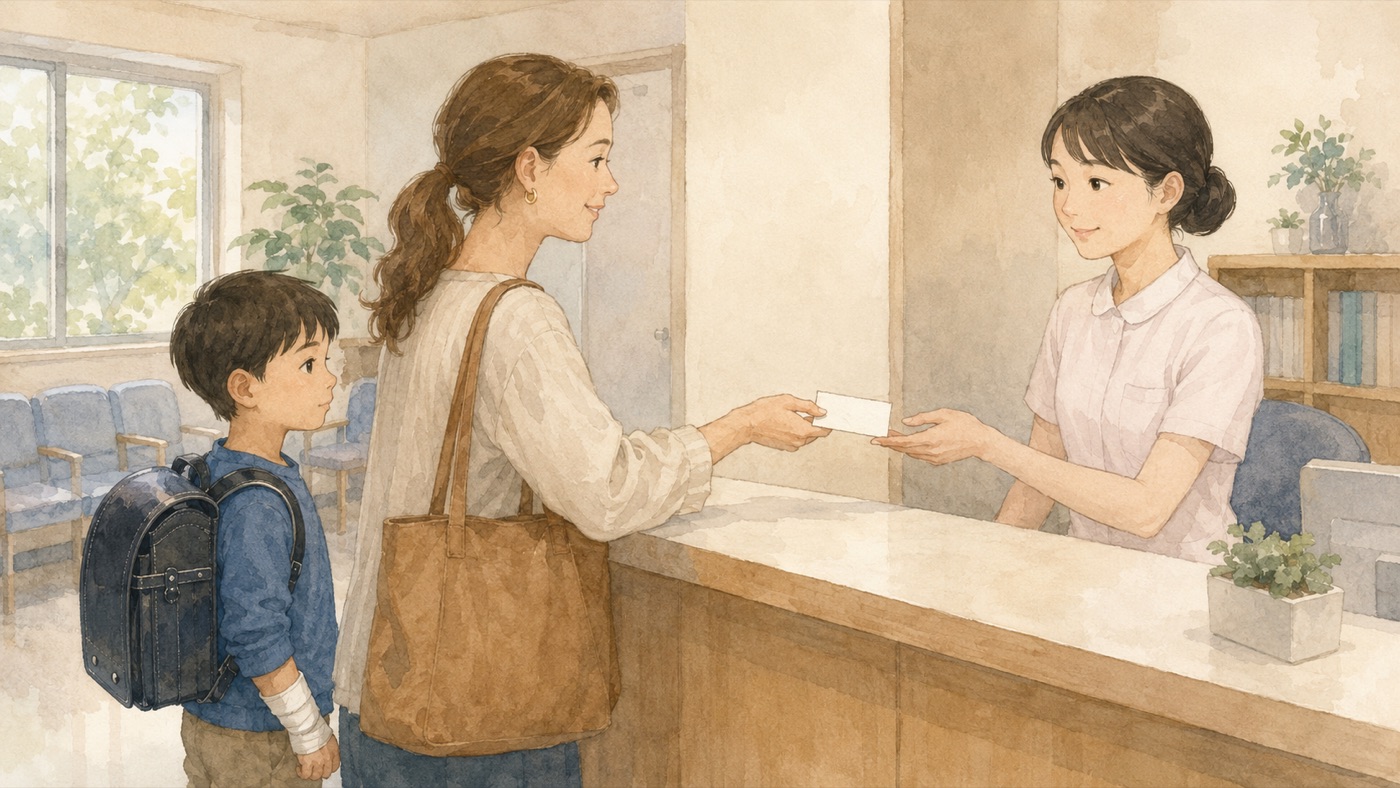
This catches people out precisely because the subsidy is so routine — at every other visit, handing the certificate over is simply what you do. Our guide to the child medical fee subsidy explains what it normally covers.
You get back more than you paid. The payout is 40% of the total bill, while what you handed over at the window was 30% — the extra 10% is toward the other costs of getting treated.
| On a 5,000 yen bill | Amount |
|---|---|
| You pay at the clinic | ¥1,500 |
| Refunded to you | ¥1,500 |
| Added for the other costs of treatment | ¥500 |
| You get back | ¥2,000 |
The claim travels through the school rather than straight to the Japan Sport Council: your municipality files it, and the money comes back to you the same way. So the step that matters on your side is telling the school you took the child to a clinic, and asking for the paperwork. Keep every receipt.
Do not sit on it. Claims expire two years after the month of treatment, counted separately for each month of a course of treatment. That is generous enough for an ordinary injury and easy to miss for something that drags on.
One threshold matters. The program applies when the total medical cost reaches 5,000 yen — which is 1,500 yen at the window, since you are paying 30%. Below that, the program does not apply and your municipal voucher is the right document after all. So a graze that costs 900 yen to treat goes on the voucher; a broken wrist does not.
Some things fall outside the program even when the injury plainly happened at school:
- Treatment outside the health insurance system. Private-fee treatment is not covered, which is the practical reason for showing your insurance at the window rather than paying privately.
- Private room charges. Excluded, as they are under health insurance generally.
- Injuries someone else has already paid for. If a third party caused the injury and has compensated you — a road accident being the clearest case — the program does not pay on top.
- Households receiving public assistance. Medical costs are not paid through this program for children in households on 生活保護, because they are met another way.
If you hand the voucher over and only afterward realize the injury happened at school, say so. Above that 5,000 yen threshold the usual remedy is to go back and redo the payment at the clinic — you settle the copayment properly, and the claim then goes through the school as it should. Ask the school or your city hall how they want it handled. Awkward, but fixable, and much easier the same week than months later.
Medicine at School
Japanese schools are cautious here, and the reason is that the health room is not a medical facility. It stocks basic over-the-counter supplies for first aid and nothing else. Staff do not diagnose and they do not prescribe.
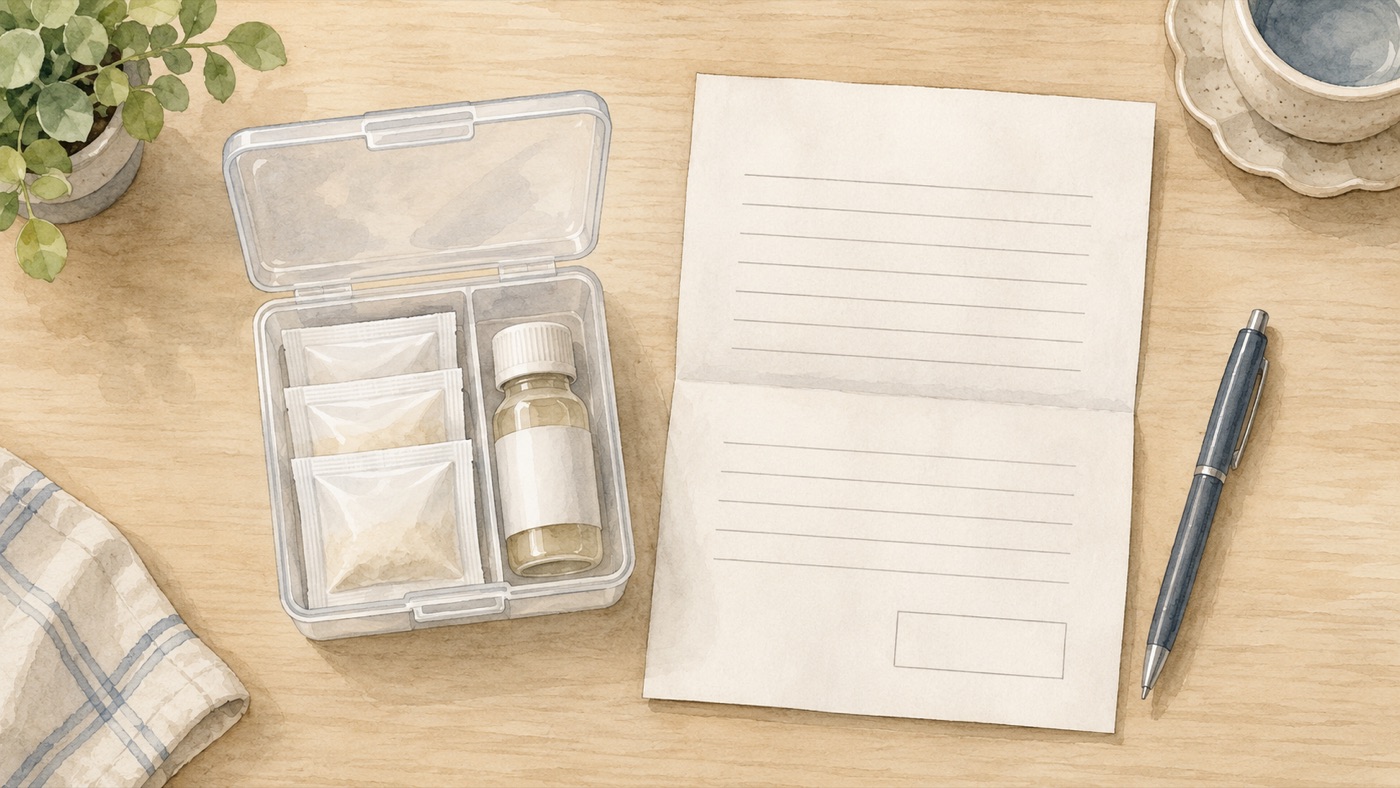
If your child needs to take prescribed medicine during the school day, that is usually possible, but it runs on paperwork: a written request from you, naming the medicine, the dose, and the timing, often with a copy of the pharmacy's instruction sheet attached. Schools have their own form for this. Even then, the staff member's role is to assist the child in taking their own medicine rather than to administer it.
Over-the-counter medicine you have bought yourself is a different matter, and many schools will not accept it at all. If your child needs something during the day, ask the school what their rule is before sending anything in a bag.
What the School Needs to Know First
All of the above works better when the school already has the information. The forms that come home in April are where this goes. Fill them in carefully, even though they arrive in a stack of other paper and nothing about them looks urgent.
- Allergies, especially food and medication, and what happens in a reaction.
- Ongoing conditions — asthma, epilepsy, anything that might present at school — and what the school should do.
- Emergency contacts, more than one, with a note about who is reachable during working hours.
- Your usual clinic, so the school can point you to the right place if you do not know the area.
- Language — if a phone call in Japanese is difficult, say so now and ask how they would prefer to reach you.
Raise that last one rather than hoping it does not come up. The school cannot work around a difficulty it does not know about.
Japanese Vocabulary
These are the words that come up in the phone call and on the forms:
| Japanese | Reading | Meaning |
|---|---|---|
| 保健室 | hokenshitsu | The health room |
| 養護教諭 | yōgo kyōyu | The nurse-teacher who runs it |
| けが | kega | An injury, as distinct from an illness |
| 災害共済給付 | saigai kyōsai kyūfu | The national program that pays for injuries at school |
| 学校管理下 | gakkō kanrika | Under school supervision — the test for whether the program applies, and it includes the walk to school |
| 服薬依頼書 | fukuyaku iraisho | The form you sign to have medicine taken at school |
| 緊急連絡先 | kinkyū renrakusaki | Emergency contact — the number they will try first |
| アレルギー | arerugī | Allergy — written on the April forms and acted on all year |
For how the school reaches you in the first place, and what to do when you are the one making the call, see our guide to reporting an absence. For the wider shape of the school day, see our overview of elementary school in Japan.