
Written and reviewed by Susumu
Born and raised in Japan · Checked against Japanese law and ministry guidance
How summer vacation works at Japanese elementary schools — who sets the dates, the homework packet and 自由研究 project, the report card that needs signing, radio taisō in the park, and how working families cover six weeks without school.
Affiliate Disclosure: This article contains affiliate links. If you click a link and make a purchase, we may earn a small commission at no extra cost to you. We only recommend products we genuinely believe are helpful. See our Terms of Use for full details.
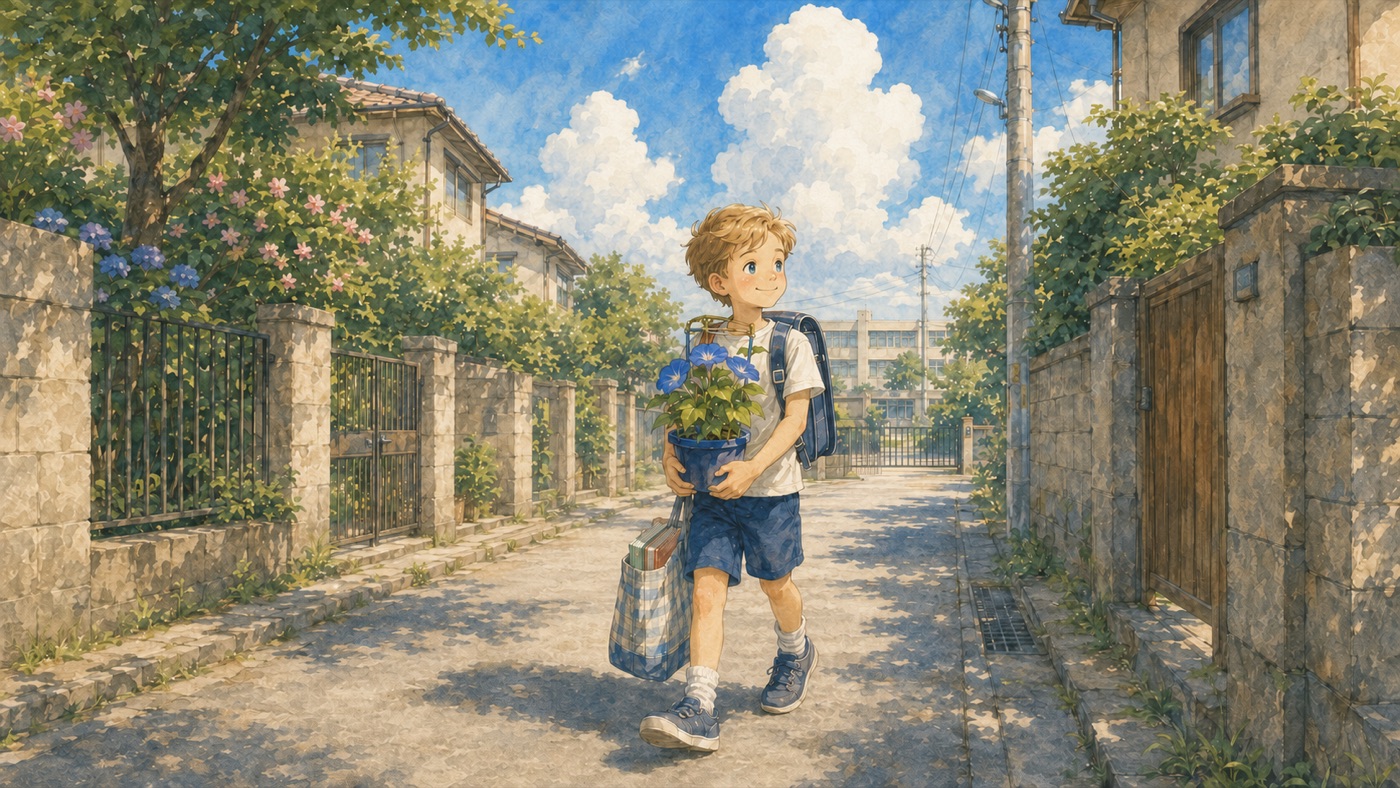
On the last day of term your child comes home carrying more than they took: a report card, a stack of notebooks, a bag of art, a homework packet, and quite possibly a potted plant. Then the school closes for five or six weeks. What fills that time — the homework, the morning exercises in the park, and the question of where a child goes while parents work — follows a rhythm most Japanese families know by heart and nobody thinks to explain.
The Dates, and Who Sets Them
There is no national summer vacation. For public schools, the law hands the school calendar — terms and every long break — to the local board of education, so the dates are set city by city. Most of the country lands in roughly the same place: school lets out around July 20 and starts again in late August, five to six weeks later.
The clear exception is the north. In Hokkaido and other snowy regions the summer break is noticeably shorter — closer to four weeks — with the difference given back as a longer winter break, because deep winter is the harder season to run a school in. If you have moved between regions, do not assume the dates carried over.
The exact first and last days are printed in the school's year calendar and repeated in the newsletters that come home in July. Check them before booking a trip — plans made around "Japanese summer vacation" in general can miss your own school's dates by a week.
The Last Day of Term
The term ends with a closing ceremony, 終業式 (shūgyōshiki) — usually a short assembly followed by classroom time, often ending before lunch. It is also the day the classroom empties out. Everything your child keeps at school comes home over the final week: art, notebooks, the calligraphy set, indoor shoes for washing, and — for first graders especially — the morning glory pot each child has been growing at school, which now comes home for the family to keep alive and observe over the break.
The report card, 通知表 (tsūchihyō), usually comes home this day too. Two things about it surprise people. First, it is gentler than many countries' report cards at this age — in the early years especially, effort and habits get as much space as grades. Second, it is not actually required by law. The official academic record is a separate internal document; the report card exists for parents, and its format, contents, and even whether it is issued at all are decided by each school's principal. That is why a friend's child at the next school over may bring home something completely different — or nothing until later in the year.
Most schools ask a parent to look at it, sign or stamp it, sometimes add a short comment, and send it back with the child on the first day of the new term. If you cannot read it, ask the teacher what needs to go back and when — it usually travels in the same folder it came home in.
The Homework Packet
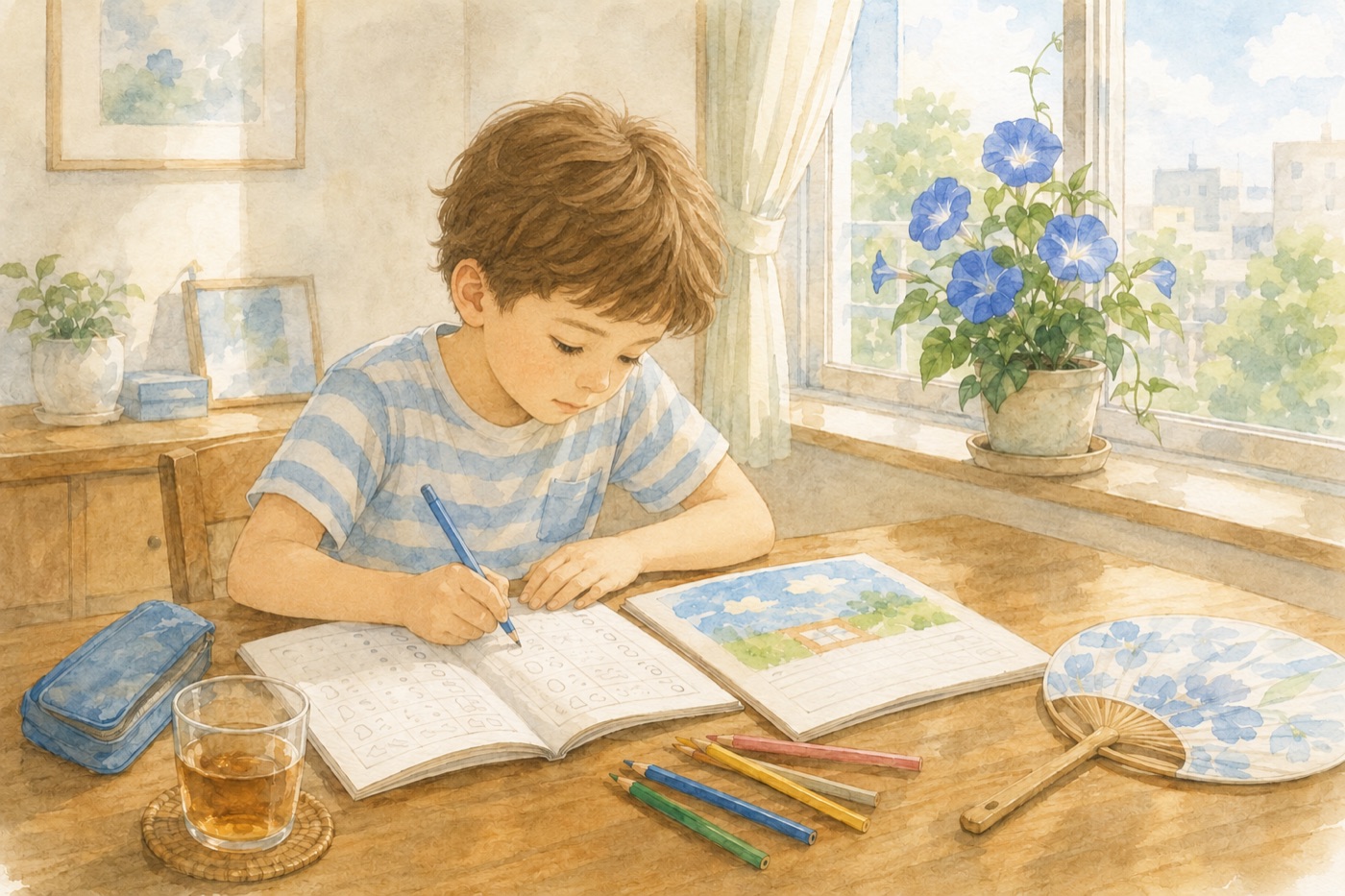
Japanese elementary schools send homework into the summer, and for a child new to the system the packet can look startling. The contents are set by each school and teacher, but a typical packet draws from a familiar menu:
- Math and Japanese drill sheets, often bound as a single workbook
- Kanji practice
- A reading log, and in some grades a book report (読書感想文)
- A picture diary (絵日記) — a few illustrated entries about the break, not one per day
- An observation task, classically the morning glory: water it, watch it, record it
- An art or craft piece, sometimes tied to a competition the school enters
The instruction sheet that comes with the packet is the document that matters. It says what is required and what is optional, what paper size a piece should be on, and what goes back on day one. Keep it with the packet all summer. If any of it is unclear, ask the teacher before the break starts, while there is still someone to ask.
Pacing is the real challenge, and it is the same one Japanese families fight: the packet is sized for steady work across six weeks, and children everywhere put it off until the final days of August. A little each morning, before the day heats up, is the arrangement most households settle on.
自由研究: The Independent Project
The most distinctive item in the packet deserves its own section. 自由研究 (jiyū kenkyū) — literally "free research" — is an open-ended project the child chooses and carries out over the break. It does not have to be a science experiment. Timing how fast ice melts in different places, mapping the insects in a park, keeping a weather log, learning to cook three dishes and writing them up, building a model — all are ordinary submissions.
What comes back to school is usually a poster, a notebook, a report, or the object itself, sometimes presented to the class. Projects are often displayed in the classroom or hallway during the second term, so the work is more public than a worksheet — which is exactly why children remember them.
For a family new to Japan, the trap is not the idea but the format: whether the school expects a particular paper size, whether photos are fine, whether a parent is allowed to help (openly, everyone's parents help). The instruction sheet answers most of this, and the teacher answers the rest. It is also the piece of homework where limited Japanese matters least: the real work is watching, building, and measuring, and the written part can be kept short.
If Both Parents Work
Six weeks with no school is the hardest practical problem of the Japanese summer, and the standard answer is 学童保育 (gakudo hoiku) — the after-school care system, which switches to all-day operation during long breaks. Children go in the morning with a bag of homework and, at many clubs, a lunch from home: only around half of clubs provide lunch during vacations, so check yours, because the answer decides your mornings for six weeks. Our guide to gakudo hoiku covers how the system works, the fees, and how to apply.
The part that catches newcomers is timing. Many municipalities accept summer-only enrollment, but the application window typically runs in May or June — well before the break feels close — and a spot is not guaranteed even then, since capacity is limited and proof of employment is usually required. Ask about summer arrangements when the school year starts, not when the break is on the horizon. Some families instead patch the weeks together with day camps, swimming intensives, grandparents, and staggered parental leave — all normal, all used in combination.
A quieter consequence of no school is no school lunch: the reliably balanced meal your child eats on school days disappears for six weeks, which is a bigger shift in the household routine than it sounds. See our guide to school lunch for what that daily meal normally covers.
Radio Taisō and the Neighborhood Summer
Early on a summer morning, in parks across Japan, children and adults gather to do a short broadcast exercise routine together — ラジオ体操 (rajio taisō). It lasts a few minutes, children bring a stamp card on a string around their neck, someone stamps it after the session, and a full card at the end may earn a small prize. It is one of the most durable images of the Japanese summer, and it is still real, though no longer universal.
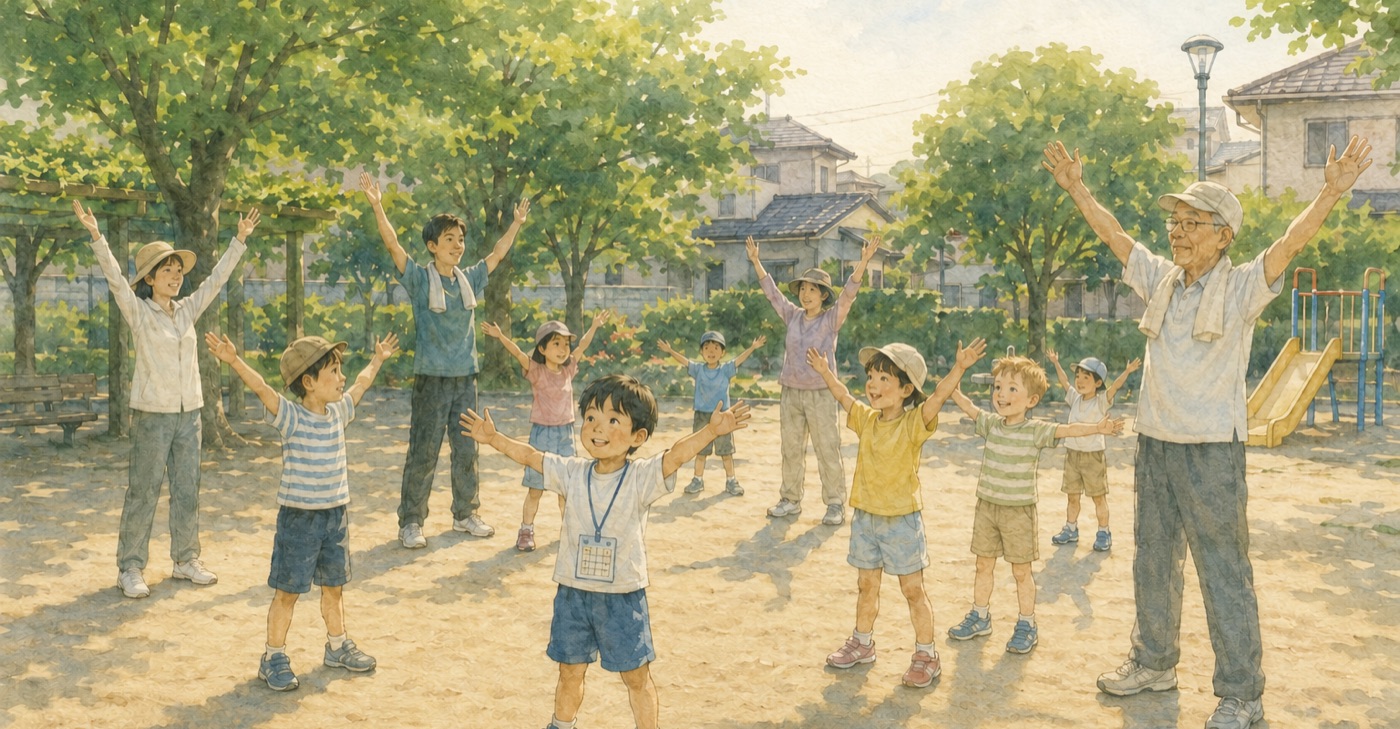
The organizer is usually the neighborhood association or a local children's club, not the school — which is why your child's teacher may hand out a stamp card without being able to tell you where or when the sessions are. Some neighborhoods run it for the whole break, some for a single week, some not at all. A neighbor with children, or the bulletin board by the park, will know.
The same is true of the wider summer: municipalities and community groups fill the break with library reading programs, festivals, community-center workshops, and in some areas supervised open sessions at school pools. None of it is required, and a recently arrived family is just as welcome at all of it — these events are, quietly, one of the fastest ways into the neighborhood.
The First Day Back
The new term opens with a starting ceremony, 始業式 (shigyōshiki), and the traffic of the last day reverses: the homework packet, the signed report card, the project, and the observation record all travel back to school — occasionally on different days, if the instruction sheet says so. Mark the first day on your calendar in July, because late August has a way of arriving suddenly.
The final week of the break is a national institution of its own: children finishing five weeks of homework in five days, parents drawn into late-night poster production. Some schools also schedule one or two mid-break checkpoints — a day when children come in briefly, or a deadline for part of the homework — which are announced in the July newsletters. For where those notices come from and which ones need action, see our guide to school notices; for the wider shape of the school year, see our overview of elementary school in Japan.
Japanese Vocabulary
These are the words that appear on the calendar, the packet, and the notices around the break:
| Japanese | Reading | Meaning |
|---|---|---|
| 夏休み | natsuyasumi | Summer vacation |
| 終業式 | shūgyōshiki | Closing ceremony on the last day of term |
| 始業式 | shigyōshiki | Opening ceremony on the first day of the new term |
| 通知表 | tsūchihyō | The report card — sign it and send it back |
| 宿題 | shukudai | Homework |
| 自由研究 | jiyū kenkyū | The independent summer project |
| 絵日記 | enikki | Picture diary — illustrated entries about the break |
| 読書感想文 | dokusho kansōbun | Book report |
| ラジオ体操 | rajio taisō | The morning broadcast exercises in the park |