
Written and reviewed by Susumu
Born and raised in Japan · Checked against Japanese law and ministry guidance
Japan's new background checks for people who work with children start on December 25. What the law asks of schools and daycare, which places are covered, how to tell whether a tutoring school or club has signed up, and what it does not cover.
Affiliate Disclosure: This article contains affiliate links. If you click a link and make a purchase, we may earn a small commission at no extra cost to you. We only recommend products we genuinely believe are helpful. See our Terms of Use for full details.
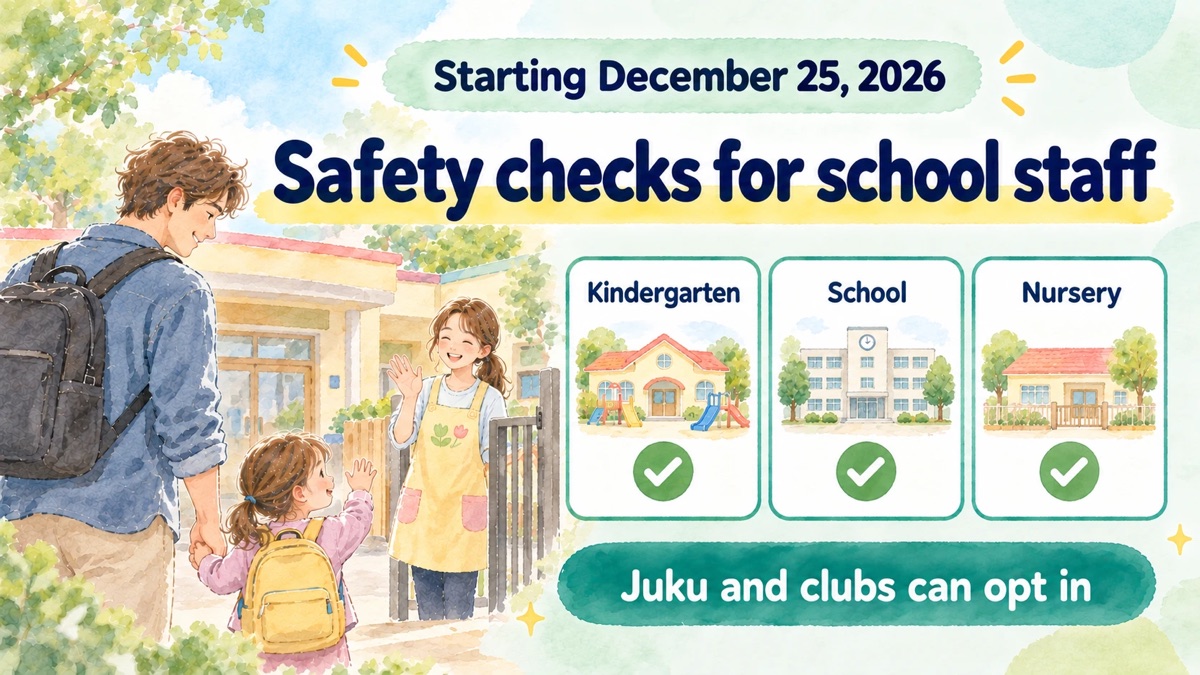
- From December 25, 2026, people who work with children at nurseries, kindergartens and schools get a background check for past sex-offense convictions. Anyone with one is kept away from children.
- Tutoring schools, after-school care and sports clubs are covered only if they choose to be certified.
- Parents do not need to do anything. To see whether a tutoring school or club is certified, look for the owl mark or the government's list.
The law's short name is こども性暴力防止法, but in Japan it is usually called 日本版DBS, "Japan's DBS," after the Disclosure and Barring Service, the British body that runs criminal record checks for work with children. Many countries have similar checks, and in English they are often simply called background checks. If you have had one for a job with children elsewhere, the idea will be familiar; this guide explains how Japan does it.
What Changes on December 25
The law was passed in June 2024 and takes effect on December 25, 2026.
It puts the duty on the places that look after and teach children, not on parents. Those places have to do three things:
- Prevent abuse day to day, with rules for staff, training, and ways for children to speak up.
- Respond when abuse is suspected, by protecting the child and looking into what happened.
- Check staff for past sex-offense convictions, and keep anyone with one out of work with children.
The record check is the part that makes the news, and it is the part the "DBS" nickname refers to. But it is one of three.
Two Kinds of Places: Required and Voluntary
The law splits the places children go into two groups. For some, everything above is required. For others it is voluntary: they can apply to the Children and Families Agency (こども家庭庁) to be certified, and only once certified do the same duties apply to them.
| Required (義務) | Voluntary, only if certified (認定) |
|---|---|
| Kindergartens (幼稚園), elementary, junior high and high schools | Unlicensed daycare (認可外保育施設) |
| Licensed daycare (認可保育所), including small-scale and home-based licensed nurseries | After-school care (学童保育 / 放課後児童クラブ) |
| Kodomo-en (認定こども園), the combined nursery-kindergartens | Tutoring schools (学習塾) and sports clubs |
| Children's centers (児童館), children's homes and other child welfare facilities | Temporary childcare (一時預かり) |
| Licensed support services for children with disabilities, such as after-school day services | Sick-child care (病児保育) |
| The new hourly daycare system (こども誰でも通園制度) | Some other child welfare and disability services |
Two points about the table. The required side covers public and private places alike, so a private kindergarten is covered just as a city-run one is. And the voluntary side really is optional: a tutoring school that does not apply has broken no rule. Certification takes an online application and is expected to take one to two months, so the list of certified places is likely to build up gradually after December 25.
If you are using any of these, our guides to after-school care, kodomo-en and hourly daycare without a job cover how each one works.
What Covered Places Have to Do
Most of what changes happens without parents seeing it. These are the measures the agency lists, in plain terms.
Every day:
- Watching how children are doing, physically and emotionally
- Interviews or questionnaires with children, so early signs are picked up
- A place children can go to talk, and making sure they know about it
- Training for staff, and written rules on how staff behave with children
- Explaining those rules to children and parents
That last point is the one you are most likely to notice: your child's school or nursery may send a letter or hold a briefing explaining its rules.
When abuse is suspected: the place must protect and support the child, and investigate. The agency's guidance on how to handle this is detailed, and it applies whether or not anyone has a criminal record.
How the Record Check Works
Who is checked
Not everyone who works at a school or nursery. The law covers staff whose work meets three tests: they have authority over children, their contact with children is ongoing, and it can happen out of other adults' sight (支配性・継続性・閉鎖性).
- Always checked: teachers, school counselors and school club coaches; nursery heads and childcare workers; at certified places, people such as tutoring-school instructors and after-school care staff.
- Decided case by case: office staff, school bus drivers, security guards, depending on how much unsupervised contact they actually have.
Employment type does not matter. Part-time staff, agency staff and volunteers are included when their work meets the three tests.
What is checked
The check looks for convictions for specified sex offenses (特定性犯罪). This includes offenses against adults, not only against children: non-consensual indecency, groping, secret filming, child prostitution and child pornography are among them.
Convictions only count for a set time:
- a prison sentence: for 20 years after it ends
- a suspended sentence: for 10 years after the sentence is final
- a fine: for 10 years after it is paid
The employer starts the check through a national online system, the worker submits their own documents, and the agency checks them against Ministry of Justice records before reporting back to the employer. Parents are not part of this process and do not see the results.
When
| Who | Deadline |
|---|---|
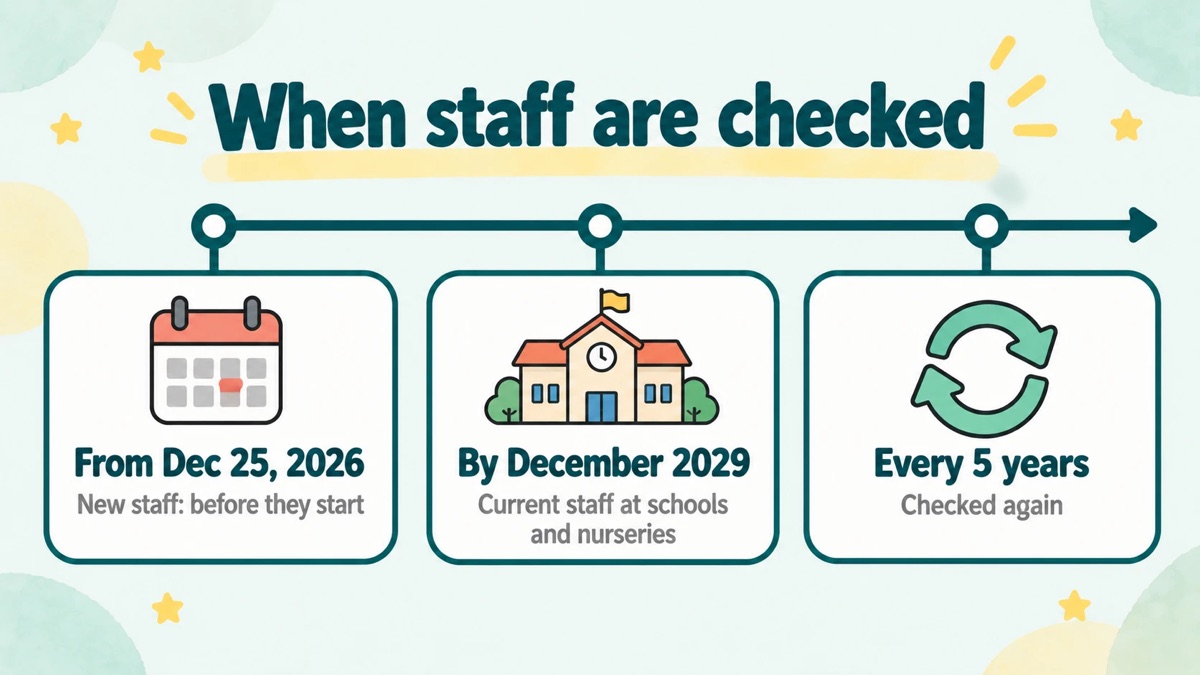
| New hires, from December 25 | Before they start working with children |
| Current staff at required places | Within three years, by December 2029 |
| Current staff at certified places | Within one year of certification |
| Everyone who has been checked | Again every five years |
So the check does not happen everywhere at once. Staff already working at your child's school on December 25 may not be checked until well into 2027 or later, which is how the law was designed to roll out.
What happens if a conviction turns up
The place must treat it as a risk and keep that person out of work with children, for example by moving them to another role. The same duty applies when an investigation or other information shows a risk, even without a conviction.
If you work with children yourself. Many readers teach English, coach sports or work in a nursery here. If your role is covered, your employer will ask you to apply through the online system.
Staff without Japanese nationality submit a residence card, resident record and passport copy instead of the family register that Japanese nationals provide. The agency's standard processing time is one to two months for non-Japanese nationals, against two weeks to a month for Japanese nationals, so a job offer may take a little longer to finalize.
How to Tell Whether a Place Is Covered
For required places, you do not need to check. If your child attends a school, a licensed nursery or a kodomo-en, it is covered by law.
For voluntary places, there are two signs:
- The agency's list. Certified providers are published on the Children and Families Agency website, so you can look up whether a tutoring school or club has been certified.
- The owl mark. The law comes with a mascot, an orange owl called こまもろう (Komamorō), and two marks built around it. Certified places can show the round certified mark (認定), and places required by law can show the square "required by law" mark (法定). You may see them on websites, pamphlets, uniforms and front entrances. Displaying either mark without permission is against the law.
No mark does not mean unsafe. Certification is voluntary and only starting, and a well-run club may simply not have applied yet. It is reasonable to ask, though. Two questions cover it: whether they are certified, and if not, what rules their staff follow and who your child can talk to if something feels wrong.
To ask a tutoring school or club:
こども性暴力防止法の認定は受けていますか?
Kodomo seibōryoku bōshi-hō no nintei wa ukete imasu ka? (Are you certified under the child sexual violence prevention law?)
Babysitters
This depends on how the babysitter works.
- A babysitter working alone, on their own account, is not covered. The agency says so directly.
- A babysitter booked through a matching service can be. If the service is registered as an unlicensed childcare provider and contracts its sitters, it can apply for certification, and its sitters are then checked as its staff.
If you use a matching service, it is worth asking whether it has applied for certification, using the same question as above.
What the Law Does Not Cover
It helps to be clear about the edges, so the new system is not mistaken for a guarantee.
- Places that are not certified. The voluntary side only applies once a provider applies and is approved.
- Some lessons cannot be certified at all. To count as an education business, lessons must be face to face, at a place the provider arranges rather than the child's home, run for six months or more, and taught by at least three instructors. A private tutor who teaches in your home, or a class run by one or two people, falls outside.
- Individual babysitters, as above.
- Old convictions past the time limits above.
- Abuse by someone with no conviction on record. The check can only find past convictions.
The agency itself points out that abuse by adults close to a child is hard to notice. That is why the day-to-day measures, and what happens at home, matter as much as the check.
What You Can Do at Home
Alongside the law, the agency has published guidance for parents. In short:

Things to talk about with your child, early and often:
- The parts of the body a swimsuit covers are private. They are not shown to anyone or touched by anyone, and that goes for your child and for other people alike.
- If someone tries to touch you in a way you don't like, you can say "no" or "stop."
- If you couldn't say it, it is still not your fault.
- If something bad happens, tell an adult straight away.
Changes the agency suggests asking about, with a simple "What's wrong?": trouble sleeping or bad dreams, trouble concentrating, a loss of confidence, or a change in how close they let people come, either avoiding contact or getting unusually close.
If your child tells you something has happened, the guidance is to thank them for telling you, tell them it is not their fault, and listen without doubting or blaming. Keep questions to a minimum and let them say what they want to say: questioning in detail can affect what a child remembers. Then contact one of the services below as soon as you can.
Japanese Vocabulary
Terms you will see in school letters and on provider websites:
| Japanese | Reading | Meaning |
|---|---|---|
| こども性暴力防止法 | kodomo seibōryoku bōshi-hō | The law described in this guide |
| 日本版DBS | nihon-ban dī-bī-esu | Its everyday nickname, "Japan's DBS," named after a British system |
| 犯罪事実確認 | hanzai jijitsu kakunin | The criminal record check (background check) itself |
| 特定性犯罪 | tokutei sei-hanzai | The sex offenses the check covers |
| 認定事業者 | nintei jigyōsha | A provider that opted in and was certified |
| 法定事業者 | hōtei jigyōsha | A provider required by law, such as a school or licensed nursery |
| こまもろう | komamorō | The owl mascot and the marks providers can display |
The system starts on December 25, and much of it, from the list of certified providers to the checks on current staff, will take shape over the following months and years. We will update this guide as it does.