
Written and reviewed by Susumu
Born and raised in Japan · Checked against Japanese law and ministry guidance
Certified centers combine kindergarten and daycare in one place and accept children whether or not both parents work. How they differ from yōchien and hoikuen, the 1/2/3 categories, and how to apply.
Affiliate Disclosure: This article contains affiliate links. If you click a link and make a purchase, we may earn a small commission at no extra cost to you. We only recommend products we genuinely believe are helpful. See our Terms of Use for full details.
When you start looking at early childhood options in Japan, you quickly meet three names: 幼稚園 (yōchien, kindergarten), 保育所 / 保育園 (hoikuen, daycare), and a third one that confuses almost everyone — 認定こども園 (nintei kodomo-en). A certified center rolls a kindergarten and a daycare into one place, and it takes children whether or not their parents work. Here's what it actually is, how it differs from the other two, which category your child falls into, how the application works, and what you'll pay.
What a Certified Center Is
A 認定こども園 (nintei kodomo-en), usually translated as a "certified center," is a single facility that provides both the education of a kindergarten and the childcare of a daycare. It is overseen by the Children and Families Agency (こども家庭庁, Kodomo Katei Chō), the government body that now handles childcare and early education together.
What makes it different is that it doesn't sort children by whether their parents work. A traditional daycare is for children whose parents are working (or otherwise unable to provide daytime care), while a kindergarten is an education program any family can use. A certified center does both under one roof, so a two-year-old whose parents both work and a four-year-old whose parent stays home can attend the same center — just under different arrangements. Those arrangements are the certification categories, which come up below.
How It Differs from Yōchien and Hoikuen
It's easiest to see what a certified center is by putting it next to the two things it combines.
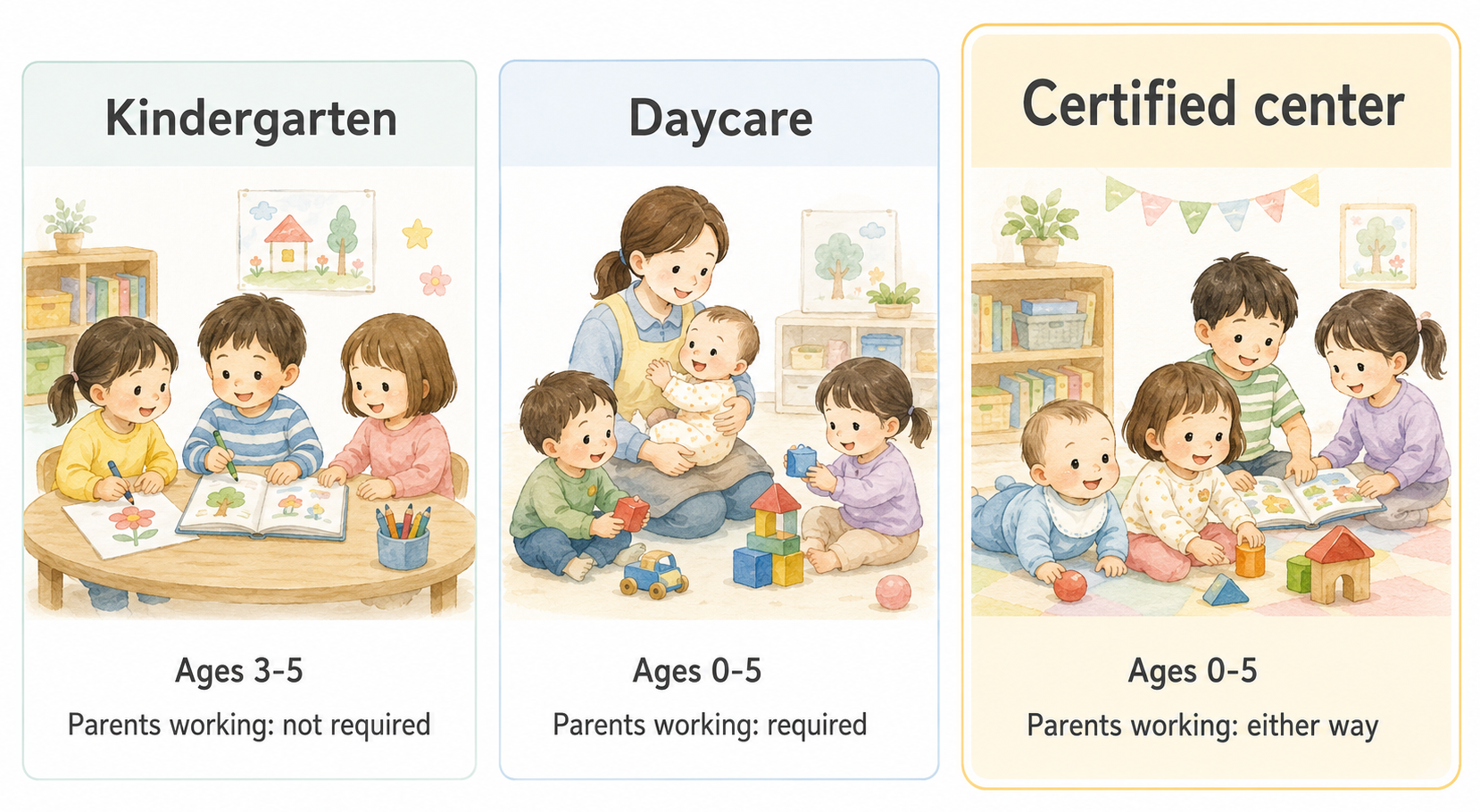
| Yōchien (幼稚園) | Hoikuen (保育所) | Certified center (認定こども園) | |
|---|---|---|---|
| Main purpose | Education | Childcare | Both |
| Ages | 3–5 | 0–5 | 0–5 |
| Do parents need to be working? | No | Yes | Takes both |
| Typical hours | ~4 hrs, plus optional extended care | Up to ~11 hrs | Depends on your category |
| Where you apply | The kindergarten directly | Your city hall | Depends on your category |
For the other two options in detail, see our guides to applying for hoikuen and applying for kindergarten.
The Four Types
"Certified center" is an umbrella term. Behind it are four types, which mostly matter to the operators rather than to you as a parent — but you may see the labels, so here is what they mean:
- 幼保連携型 (yōho renkei-gata) — a single, purpose-built facility that is fully both a kindergarten and a daycare. This is the most complete form.
- 幼稚園型 (yōchien-gata) — an existing kindergarten that has added daycare-style hours for children who need longer care.
- 保育所型 (hoikusho-gata) — an existing daycare that has added a kindergarten-style education program and can accept children whose parents don't work.
- 地方裁量型 (chihō sairyō-gata) — a facility that wasn't previously a licensed kindergarten or daycare but is approved to operate as a certified center, often to meet local needs.
Whatever the type, it changes little for you day to day. What actually shapes your child's place is their certification category.
Certification: Are You 1号, 2号, or 3号?
Before your child can attend, your city assigns a certification category (認定区分, nintei kubun). It is decided by your child's age and whether your household has a recognized "need for childcare" — meaning both parents work, or there is another accepted reason such as illness or caregiving. This category then determines your hours, how you apply, and part of your cost.
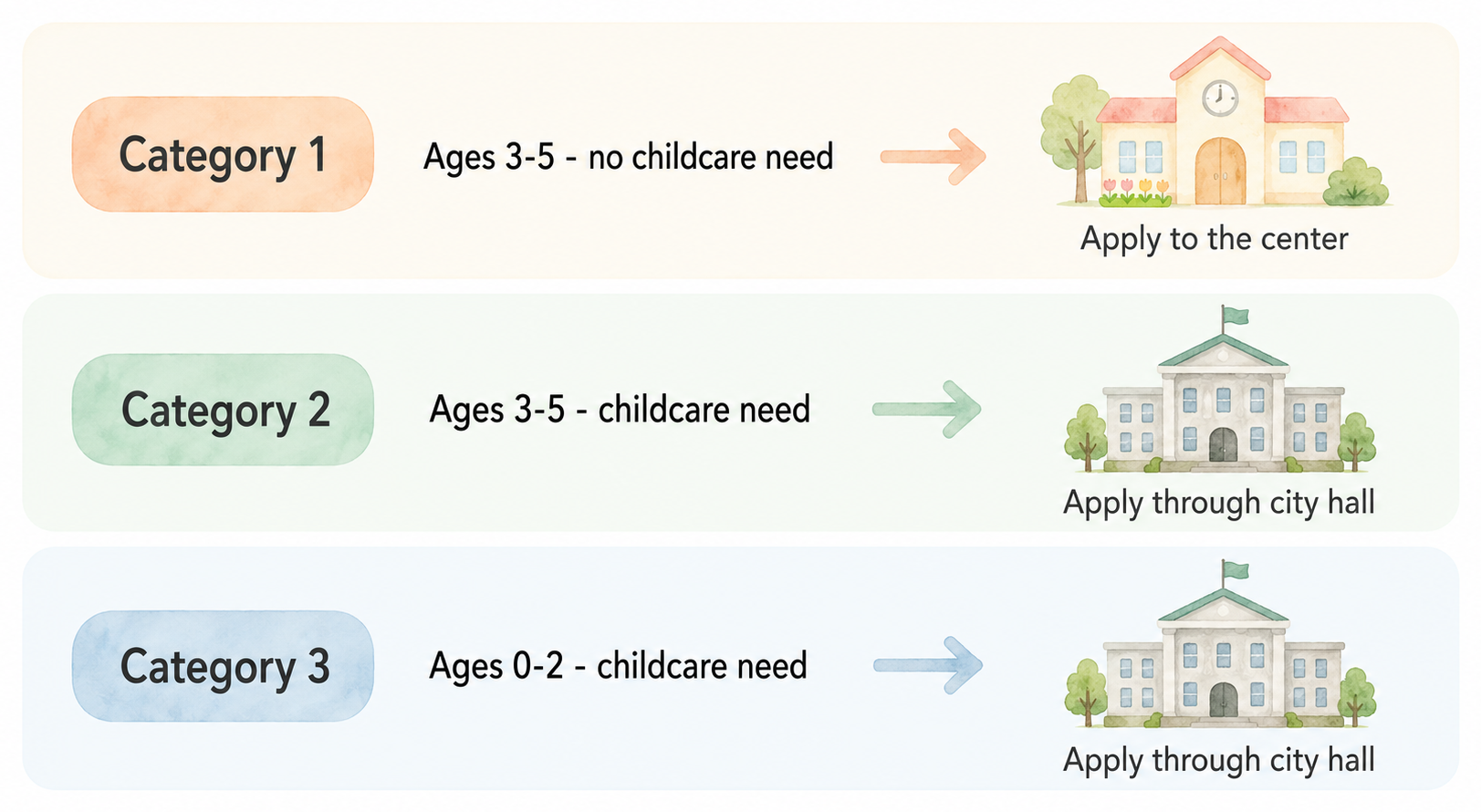
1号認定 (ichigō nintei) — age 3–5, no childcare need
For children aged 3 to 5 whose families do not need full daytime childcare — for example if a parent is home. Your child attends the education part, roughly four hours a day, often with optional paid extended care. You apply to the center directly.
2号認定 (nigō nintei) — age 3–5, with childcare need
For children aged 3 to 5 whose parents work (or otherwise need childcare). Your child gets the longer daycare hours as well as the education program. You apply through your city hall.
3号認定 (sangō nintei) — age 0–2, with childcare need
For children under 3 whose parents work (or otherwise need childcare). This is the daycare side for the youngest children. You apply through your city hall.
How to Apply
This is where the category really matters, because the route is different — and getting it wrong wastes time.
If you're 1号 (age 3–5, no childcare need): you apply directly to the center, much like a private kindergarten. The center decides on admission, gives you an informal acceptance (内定, naitei), and then processes your certification with the city on your behalf. You finish by signing a contract with the center.
If you're 2号 or 3号 (you need childcare): you go through your city hall. You first apply for a childcare-need certification (保育認定, hoiku nintei), proving the need with documents such as an employment certificate (就労証明書, shūrō shōmeisho). The city then runs a placement process — and in areas with more applicants than spots, this can be competitive, exactly like applying for a regular daycare. Our guide to hokatsu (the daycare hunt) covers how that competition works.
So your first move is to work out your category. If you need full-day care because you work, it's the city-hall route; if you don't, you deal with the center directly.
Cost and Free Preschool
Japan made early childhood education and care largely free in October 2019, and certified centers are included.
- Ages 3–5: the base fee is free for all households (this covers both 1号 and 2号).
- Ages 0–2 (3号): free only for households exempt from residence tax (住民税非課税世帯); other families pay a fee set on a sliding scale by income.
What is not covered stays with you: the cost of food ingredients (食材料費), transport, and event fees are still paid by parents. The side-dish portion of the meal cost (副食費) is waived for lower-income households (roughly under ¥3.6 million a year) and for a family's third child and beyond. Amounts and any local extras vary from city to city, so check the current figures with the center or your city hall.
Why It Can Suit International Families
A certified center has one quality that helps a lot while you're still finding your feet in Japan: it doesn't make you commit to an "education track" or a "childcare track" up front, and it bends when your situation changes.
- It takes your child whether or not you work. If your work status is uncertain — common when one parent is job-hunting or studying — you still have a place.
- It offers continuity if your circumstances shift. At a regular daycare, a child can lose their spot if the working parent stops working. At a certified center, a child who is three or older can usually stay and switch to the 1号 arrangement, so they don't have to change schools and friends. One caveat: for a child under three this doesn't apply — with no 1号 option below age three, losing the childcare need can still mean losing the place.
- One place from birth to school age. A single center can carry your child from infancy through to elementary school entry, which means less paperwork and one familiar community.
It won't be the right fit for every family — a center's location, its open spots, and how it actually runs matter more than the label on the door — but it belongs on your list. For the wider picture of early childhood options, see our overview of preschool in Japan.
Japanese Vocabulary
| Japanese | Reading | Meaning |
|---|---|---|
| 認定こども園 | nintei kodomo-en | Certified center — combines a kindergarten and a daycare |
| 幼稚園 | yōchien | Kindergarten — education for ages 3–5 |
| 保育所 / 保育園 | hoikusho / hoikuen | Daycare — childcare for children of working parents |
| 認定区分 | nintei kubun | Certification category (1号 / 2号 / 3号) your child is assigned |
| 保育認定 | hoiku nintei | Childcare-need certification, required for the 2号 and 3号 routes |
| 就労証明書 | shūrō shōmeisho | Employment certificate used to prove a need for childcare |
| 内定 | naitei | Informal acceptance from a center (the 1号 route) |
| 保育教諭 | hoiku kyōyu | A teacher holding both a kindergarten license and a childcare qualification |
| 幼児教育・保育の無償化 | yōji kyōiku hoiku no mushōka | The policy making preschool largely free from October 2019 |