

Written and reviewed by Susumu
Born and raised in Japan · Checked against Japanese law and ministry guidance
Pregnant in Japan and not sure what to do next? This step-by-step guide covers your first OB/GYN visit, getting your boshi techo, prenatal checkup vouchers, what to avoid, and your rights at work.
Affiliate Disclosure: This article contains affiliate links. If you click a link and make a purchase, we may earn a small commission at no extra cost to you. We only recommend products we genuinely believe are helpful. See our Terms of Use for full details.

📌 Note: This guide covers the essential first steps for international families in Japan. Always consult your doctor or midwife for advice specific to your pregnancy.
You're Pregnant — What Now?
A positive pregnancy test is one of life's bigger moments. In Japan, it can also bring a particular kind of uncertainty — especially if you are not sure how the healthcare system works, what paperwork is involved, or who to call first.
The good news is that Japan has excellent prenatal care, and international families are fully entitled to use it. This guide walks you through the most important steps, in the right order, so you know exactly what to do next.
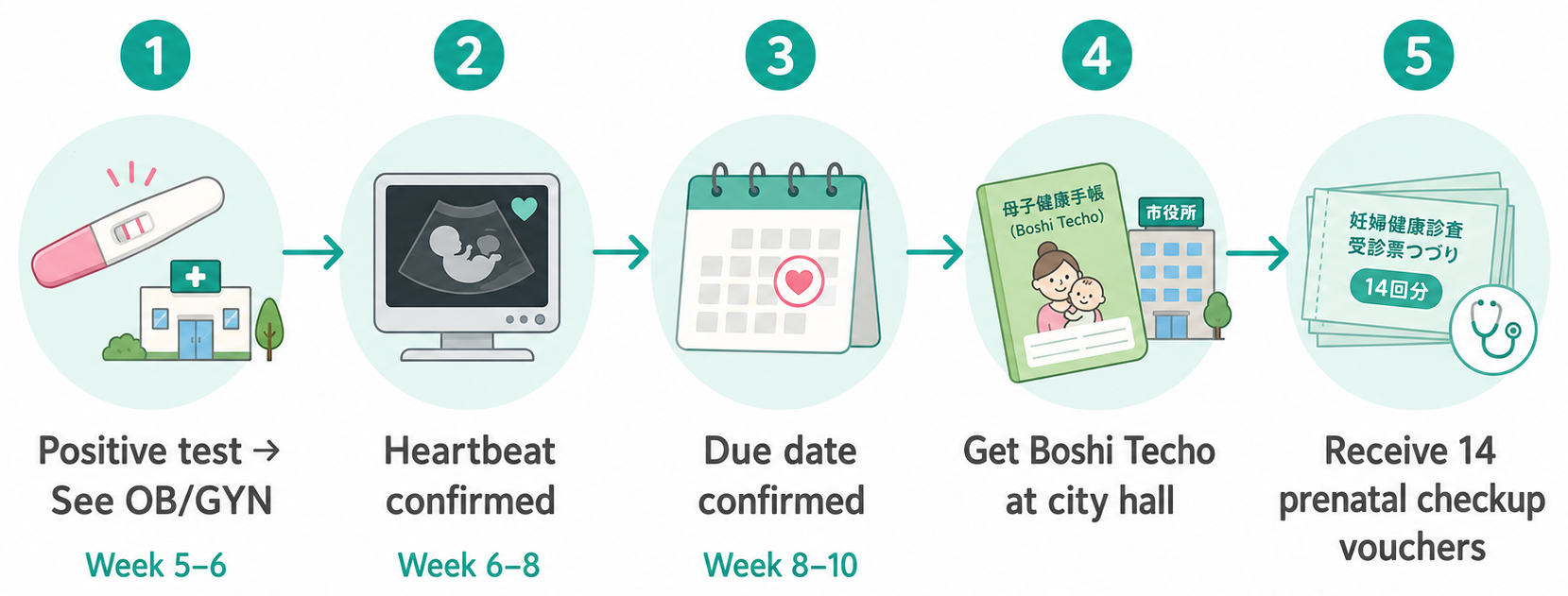
Step 1: See an OB/GYN as Soon as Possible
After a positive home pregnancy test, your first step is to book an appointment at a 産婦人科 (sanfujinka) — an obstetrics and gynaecology clinic. Aim to go at around week 5 or 6 of pregnancy, which is approximately one week after a missed period.
Do not wait too long. One important reason to go early is to rule out an ectopic pregnancy (子宮外妊娠 — しきゅうがいにんしん) — a pregnancy that develops outside the uterus. This is a medical emergency if not caught early. The first ultrasound confirms that the pregnancy is developing inside the uterus.
Tip: You do not need a referral to visit a 産婦人科. You can book directly by phone or online. Look for a clinic that offers English support if possible — see the Finding an English-Speaking Clinic section below.
What happens at your first visits
The first few appointments follow a natural progression as your pregnancy develops:
| Week | What happens |
|---|---|
| Week 5–6 | 胎嚢確認 (tainō kakunin) — The gestational sac is confirmed inside the uterus via transvaginal ultrasound. This rules out an ectopic pregnancy. |
| Week 6–8 | 心拍確認 (shinpaku kakunin) — The baby's heartbeat is confirmed. Once detected, the risk of miscarriage drops significantly. |
| Week 8–10 | 分娩予定日確定 (bunben yoteibī kakutei) — Your due date is officially confirmed by measuring the baby's size (CRL). The clinic gives you a form to take to city hall for your boshi techo. |
Cost note: The first 2–3 visits — before you have your boshi techo and checkup vouchers — are typically not subsidized. You will pay out of pocket, usually around ¥5,000–¥15,000 per visit depending on the clinic and the tests carried out. Keep your receipts.
Step 2: Get Your Boshi Techo
Once your due date is confirmed (usually around week 8–10), your clinic will give you a 妊娠届出書 (ninshintodokesho) — a pregnancy notification form. Take this to your local city hall or ward office (市区町村役場) to receive your 母子健康手帳 (boshi techo) — the Mother and Child Health Handbook.
At the same time, you will also receive:
- 妊婦健康診査受診票 (ninpu kenkō shinsa jushinhyō) — 14 prenatal checkup vouchers that subsidize the cost of your regular appointments
- Information about local support services and child-rearing resources
International residents: Bring your residence card (在留カード) and the pregnancy notification form from your clinic. The boshi techo is available in 10 languages including English, Chinese, Korean, Vietnamese, and Portuguese — ask for the multilingual version at the counter.
Digital boshi techo: Some municipalities now offer a digital version of the handbook accessible via smartphone. Check with your local city hall whether this is available in your area.
For a full guide — including how to get the handbook, what it records, and multilingual downloads — see: Maternal and Child Health Handbook (Boshi Techo) →
Step 3: Folic Acid
Folic acid (葉酸 — ようさん) is a B vitamin that plays an important role in early fetal development. Japan's Ministry of Health recommends an intake of 400 μg per day during early pregnancy to reduce the risk of neural tube defects (神経管閉鎖障害) — conditions affecting the development of the brain and spine in the very first weeks.
Folic acid is found naturally in foods such as spinach, edamame, broccoli, and natto. Your doctor or midwife will advise you on whether a supplement is appropriate for your situation. If you have any concerns — including dietary restrictions or cultural considerations — discuss these at your first appointment.
Note: If you do take a folic acid supplement, the recommended amount is 400 μg/day and should not exceed 1,000 μg/day. Supplements are available at pharmacies (薬局) across Japan.
Step 4: Know What to Avoid
Some lifestyle adjustments are important from the moment you find out you are pregnant. Japan has specific guidance on several of these.
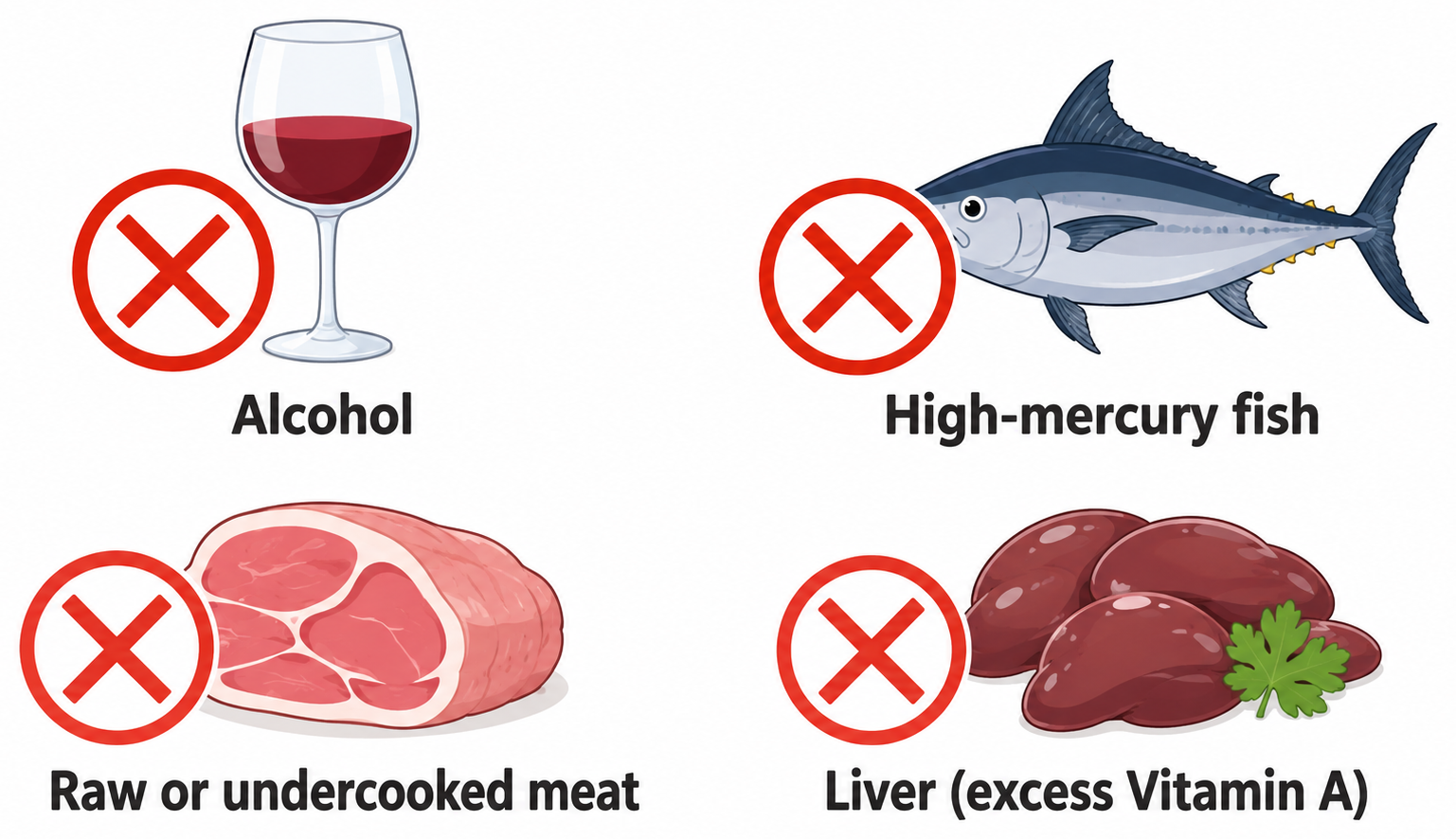
Alcohol
Avoid entirely. There is no safe level of alcohol during pregnancy. Alcohol crosses the placenta and can cause fetal alcohol syndrome and other developmental problems.
Certain fish — Japan's mercury guidelines
Japan's Ministry of Health has specific guidelines on fish consumption during pregnancy due to mercury content. The following fish should be limited:
| Fish (per 80g serving) | Limit |
|---|---|
| Swordfish (メカジキ), Alfonsino (キンメダイ), Bluefin tuna (クロマグロ), Bigeye tuna (メバチ) | Once per week |
| Golden tilefish (キダイ), Pacific blue marlin (マカジキ), Southern bluefin tuna (ミナミマグロ) | Twice per week |
| Salmon, mackerel, sardine, horse mackerel, saury, canned tuna (ツナ缶), yellowfin tuna (キハダ) | No restriction |
Raw and undercooked foods
- Raw meat — risk of Toxoplasma infection
- Raw ham (生ハム) and unpasteurized soft cheese — risk of Listeria, which can cause miscarriage or stillbirth
- Liver (レバー) — extremely high in vitamin A. Even small amounts can exceed safe limits during pregnancy. Avoid completely.
Caffeine
Keep caffeine below 200 mg per day — a guideline widely recommended in Japan. One cup of drip coffee contains approximately 100–150 mg. Green tea, matcha, and black tea also contain caffeine — be mindful of your total intake across all drinks.
Medications and supplements
Do not take any medication, supplement, or herbal remedy without first checking with your doctor. Some seemingly harmless herbal teas contain ingredients that can stimulate uterine contractions.
X-rays
If you need any medical procedure involving X-rays or CT scans, always tell the medical staff that you are pregnant. Dental X-rays with proper shielding are generally considered safe, but always inform your dentist.
Step 5: Tell Your Employer
There is no legal deadline for when you must inform your employer that you are pregnant. However, your legal protections only activate once your employer is aware. It is generally advisable to tell your employer sooner rather than later — particularly if your work involves physical strain, long commutes, or irregular hours.
Your rights as a pregnant employee in Japan
- Paid time off for prenatal checkups — Your employer must allow you paid time off to attend all 14 prenatal checkups. This is a legal right.
- Exemption from overtime, night work, and holiday work — You can request these exemptions at any point during pregnancy.
- Prenatal leave (産前休業) — You can take maternity leave from 6 weeks before your due date (14 weeks for twins or multiples).
- Postnatal leave (産後休業) — 8 weeks after birth. The first 6 weeks are mandatory — employers cannot ask you to return earlier without medical approval.
- Protection from dismissal — It is illegal to dismiss an employee for becoming pregnant or for taking maternity leave.
母健連絡カード (Boken Renraku Card): If your doctor recommends workplace adjustments — such as reduced standing, no heavy lifting, or restricted commuting — they can issue a Maternal Health Management Communication Card. Your employer is legally required to follow the doctor's instructions on this card.
Step 6: Check Your Health Insurance
All international residents staying in Japan for 3 months or longer are required to be enrolled in Japanese public health insurance — either through their employer (社会保険) or through their local city hall (国民健康保険). If you have not linked your My Number Card to your insurance yet, our guide to マイナ保険証 covers what changes at the clinic counter. If you are not yet enrolled, do this immediately.
Why does this matter for pregnancy?
- Routine prenatal checkups are not covered by health insurance — they are not classified as illness or injury. The municipal vouchers (see Step 2) partially cover costs, but you need to be a registered resident to receive them.
- The lump-sum birth allowance (出産育児一時金) of ¥500,000 is only available to residents enrolled in health insurance. Missing this because of a registration gap is unfortunately common. Enroll as soon as possible.
For full details on the lump-sum birth allowance, see: Lump-Sum Birth Allowance (Shussan Ikuji Ichijikin).
Step 7: Your Prenatal Checkup Schedule
Once you have your boshi techo and checkup vouchers, your regular prenatal appointments begin. Japan's Ministry of Health recommends 14 checkups in total, with the frequency increasing as your due date approaches. Our guide to prenatal checkups sets out what is tested at each visit and how the vouchers cover the cost.
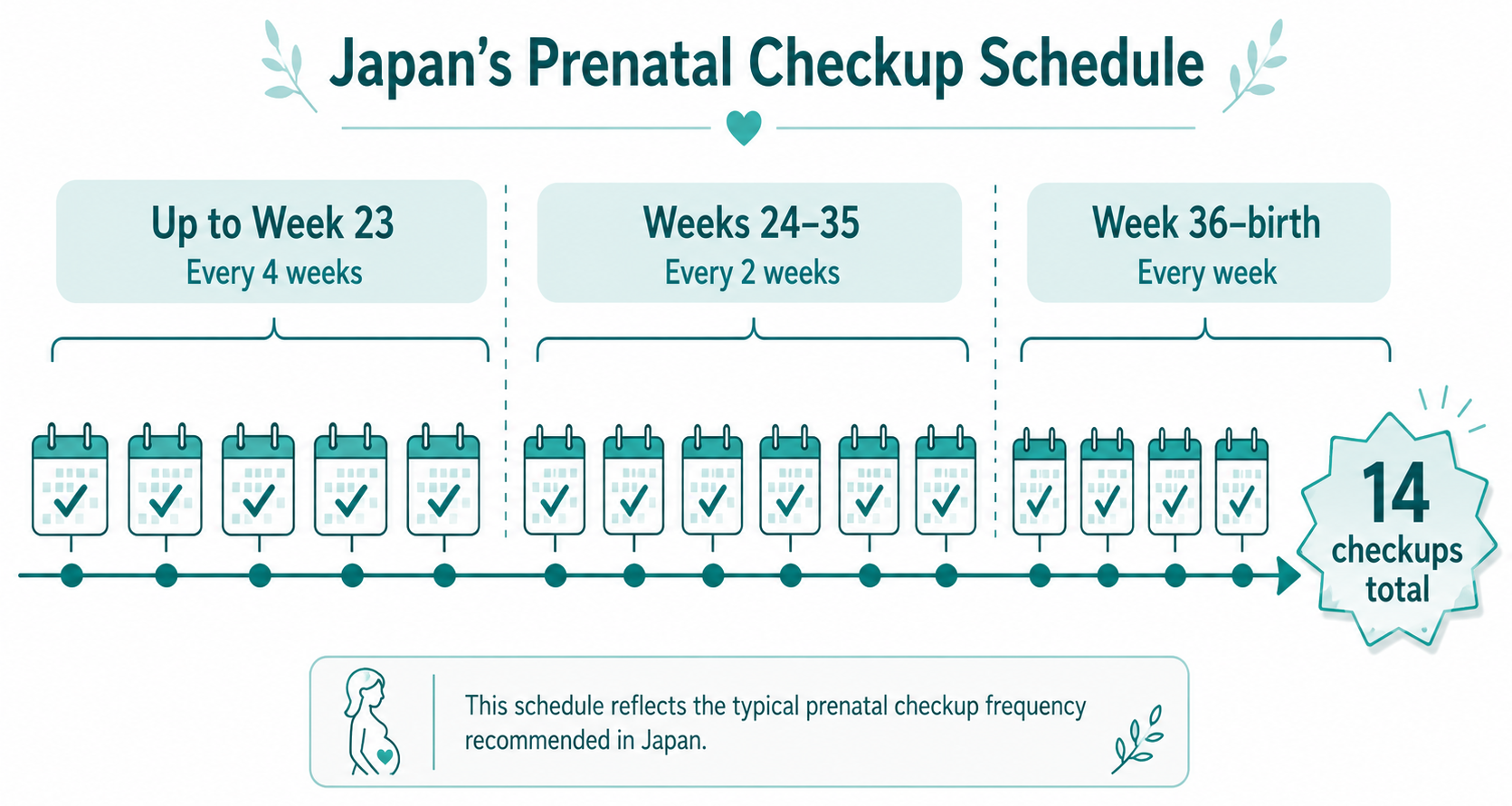
| Stage | Weeks | Frequency |
|---|---|---|
| Early pregnancy | Up to week 23 | Every 4 weeks |
| Mid pregnancy | Weeks 24–35 | Every 2 weeks |
| Late pregnancy | Week 36 – birth | Every week |
At each checkup, you can typically expect: blood pressure measurement, weight check, urine test, abdominal ultrasound, and a brief consultation with the doctor or midwife. Blood tests are carried out at certain stages to screen for conditions such as anemia, gestational diabetes, and infections.
Twins: If you are expecting twins or multiples, you will receive 17 vouchers (3 additional) and your checkup schedule will be more frequent. Your clinic will advise you on the specific schedule.
Finding an English-Speaking Clinic
Navigating prenatal care in Japanese can be challenging, especially in the early weeks when so much is happening quickly. Here are the most reliable resources for finding English-speaking support.
AMDA International Medical Information Center
AMDA provides free multilingual telephone medical consultation, including help finding English-speaking clinics near you and over-the-phone interpretation for medical appointments.
- Phone: 03-6233-9266
- Hours: Weekdays, 10:00–16:00
- Languages: English, Chinese, Korean, Spanish, Portuguese, and more
internationalpatients.jp
A hospital search database supported by the Ministry of Health, allowing you to search by region, language support, and medical specialty (including 産婦人科).
- Website: internationalpatients.jp
In areas with fewer options: Even if your clinic does not have an English-speaking doctor, AMDA can provide telephone interpretation during your appointment. Call ahead to arrange this with both AMDA and your clinic.
📖 Japanese Vocabulary
Key terms you will encounter during early pregnancy in Japan.
| 日本語 | ひらがな | English |
|---|---|---|
| 産婦人科 | さんふじんか | Obstetrics and gynaecology (OB/GYN) clinic |
| 妊娠届出書 | にんしんとどけしょ | Pregnancy notification form (from clinic → city hall) |
| 子宮外妊娠 | しきゅうがいにんしん | Ectopic pregnancy |
| 胎嚢確認 | たいのうかくにん | Gestational sac confirmation |
| 心拍確認 | しんぱくかくにん | Heartbeat confirmation |
| 分娩予定日 | ぶんべんよていび | Due date (estimated delivery date) |
| 妊婦健診 | にんぷけんしん | Prenatal checkup |
| 受診票 | じゅしんひょう | Prenatal checkup voucher |
| 葉酸 | ようさん | Folic acid |
| 産前休業 | さんぜんきゅうぎょう | Prenatal leave (maternity leave before birth) |
| 産後休業 | さんごきゅうぎょう | Postnatal leave (maternity leave after birth) |
| 母健連絡カード | ぼけんれんらくかーど | Maternal Health Management Communication Card |