
Written and reviewed by Susumu
Born and raised in Japan · Checked against Japanese law and ministry guidance
The nursery calls off the pool on a morning that looks fine to you, and a word you have never seen appears in the forecast. Japan runs its summer on a heat index rather than a temperature, with national alerts issued the evening before. What the words mean, what gets called off, and why most nurseries expect sunscreen to be applied at home.
Affiliate Disclosure: This article contains affiliate links. If you click a link and make a purchase, we may earn a small commission at no extra cost to you. We only recommend products we genuinely believe are helpful. See our Terms of Use for full details.
The Words You Will Hear This Summer
Japanese forecasts name hot days instead of only describing them, and the names carry fixed thresholds set by the Japan Meteorological Agency. Once you know the ladder, a weather report tells you something concrete.
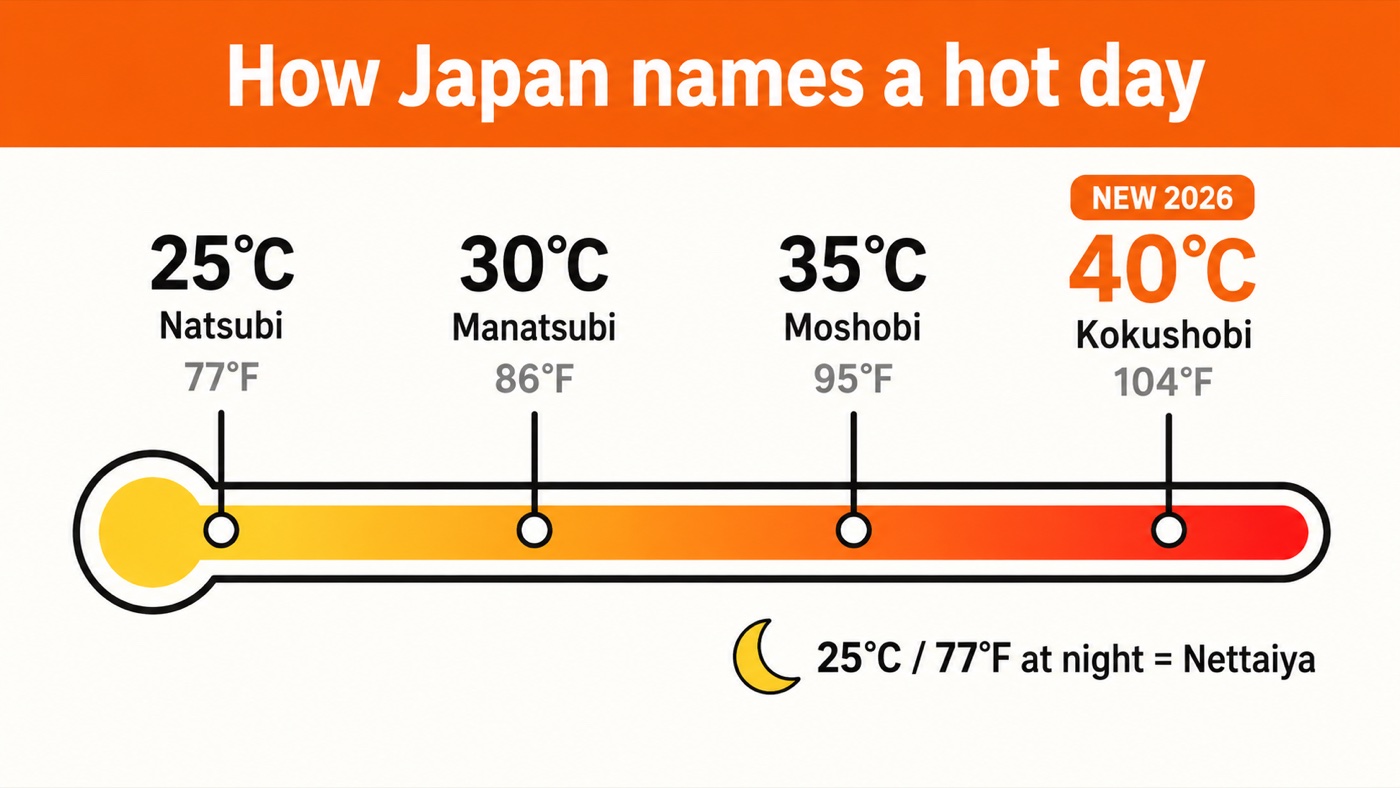
| Japanese | Reading | Daily high | In °F |
|---|---|---|---|
| 夏日 | natsubi | 25°C or above | 77°F |
| 真夏日 | manatsubi | 30°C or above | 86°F |
| 猛暑日 | mōshobi | 35°C or above | 95°F |
| 酷暑日 NEW | kokushobi | 40°C or above | 104°F |
| 熱帯夜 | nettaiya | Overnight low 25°C or above | 77°F |
酷暑日 is brand new. The Meteorological Agency announced it on April 17, 2026, after running a public survey on what to call a day of 40°C (104°F) or more. It is the first addition to this ladder since 猛暑日 arrived in 2007, nineteen years earlier.
熱帯夜 describes the night rather than the day, and a run of them is what wears a household down. A body that does not cool overnight starts the next day already behind.
Why It Is Not About Temperature
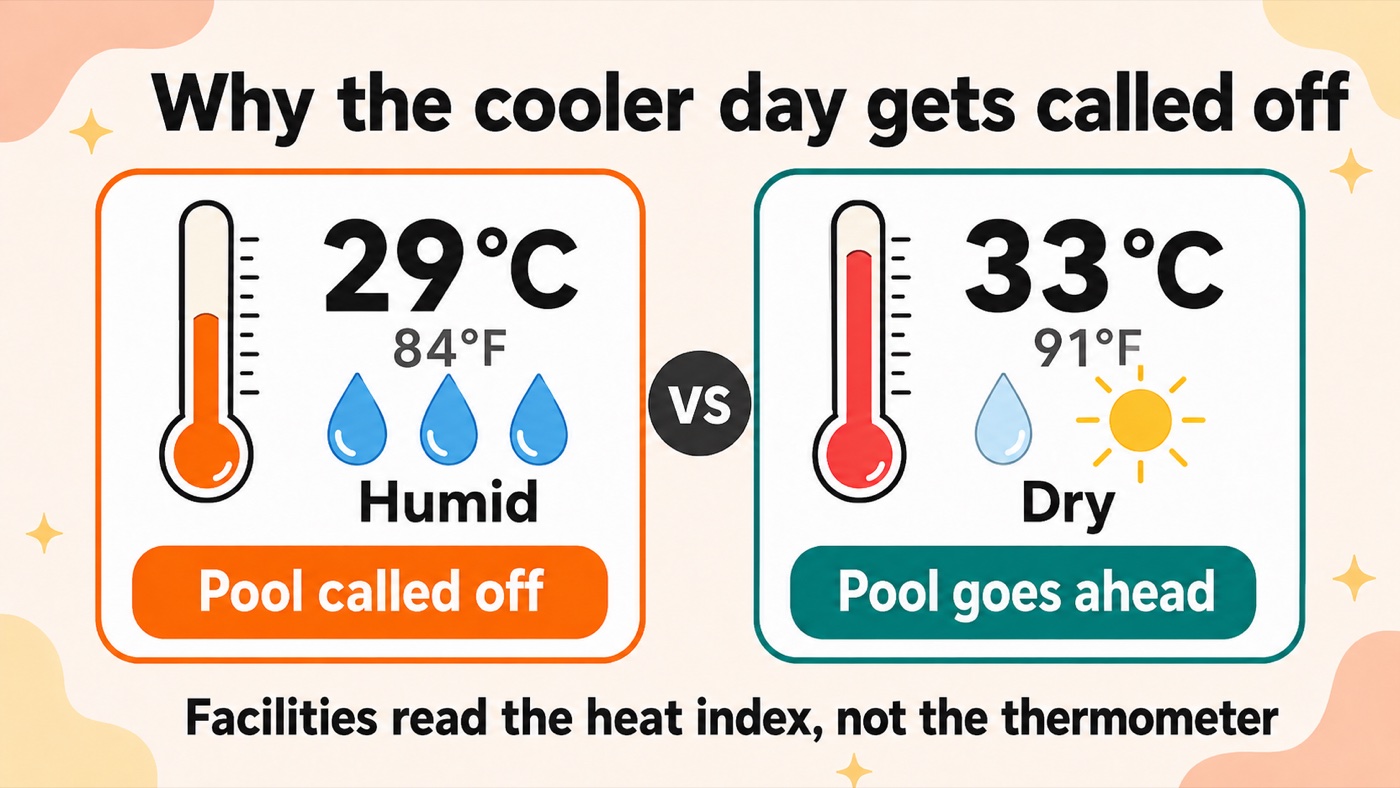
The nursery cancels water play on a 29°C (84°F) morning and runs it on a 33°C (91°F) one. From outside, that looks like a coin toss. Japanese facilities are not reading the thermometer.
They use 暑さ指数 (atsusa shisū), the heat index, known internationally as WBGT. It combines humidity, radiant heat from the ground and buildings, and air temperature — and humidity carries the most weight. A humid 29°C day can score higher than a dry 33°C one, which is exactly why the decisions look inconsistent from outside.
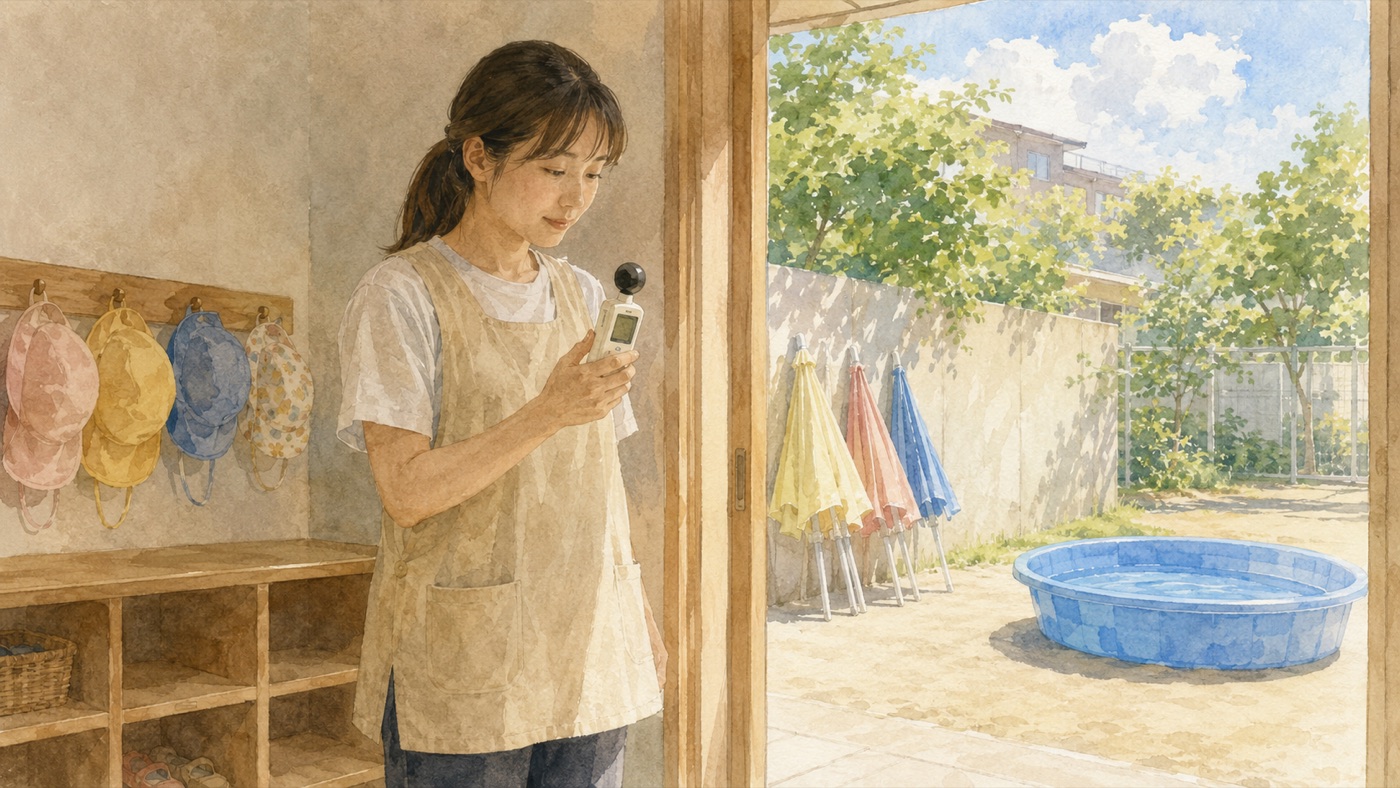
The scale below comes from the Japan Sport Association's guideline on exercise in the heat, and the Environment Ministry carries it on its heat portal. It is a reference rather than a rulebook, and it is the background most facilities have in mind:
| 暑さ指数 | Band | Guidance for activity |
|---|---|---|
| 31 and above | 危険 — danger | Exercise called off as a general rule |
| 28 – 31 | 厳重警戒 | Strenuous activity stopped |
| 25 – 28 | 警戒 | Frequent breaks |
| 21 – 25 | 注意 | Fluid breaks encouraged |
One thing to be clear about: there is no national number that forces a cancellation. A 2024 notice from the education ministry asks each school to measure the index around activities and to set its own criteria in advance — the line, who makes the call, and how it is passed on.
The line itself belongs to the school. Two schools in the same city can reach different decisions on the same morning and both be doing exactly what is asked of them.
Facilities also weigh things the index cannot see: how much shade the yard has, the ages of the children, whether the gym has air conditioning, how the group looked yesterday. A number is one input among several.
You can look at the readings yourself. The Environment Ministry publishes current and forecast figures by location at wbgt.env.go.jp. Reading them alongside the notices tends to make the pattern of decisions at your own facility make sense.
When an Alert Is Issued
Above the daily index sit two national alerts, issued jointly by the Environment Ministry and the Meteorological Agency. They are announced on television, on weather apps, and often by the school itself.
| Alert | Issued when | Announced |
|---|---|---|
| 熱中症警戒アラート heat alert |
Any measuring point in the area is forecast to reach an index of 33 | 5 p.m. the day before, and again at 5 a.m. |
| 熱中症特別警戒アラート special heat alert |
Every measuring point in the prefecture is forecast to reach 35 | 2 p.m. the day before |
The timing is the useful part. Both land the afternoon or evening before the day they describe, so an evening check tells you whether tomorrow's plans are likely to survive. The special alert is rare by design — it requires the whole prefecture to be forecast at 35 — and when it appears, it is signaling something well outside an ordinary hot day.
Both alerts run only through the warm season, from late April to late October. Outside those months there is nothing to check.
What Gets Called Off
Facilities decide for themselves, so the list varies, but these are the usual casualties of a high reading:
- The pool and water play. Counter-intuitive to parents who assume water is the safe option, but a poolside in full sun is one of the hottest places on the site.
- Outdoor play and walks. Nurseries without a garden often walk to a park; that is usually the first thing dropped.
- PE and club activity, or a move indoors where a gym is air-conditioned.
- Sports day practice. Autumn events mean rehearsals through the hottest weeks, and these get shortened or moved.
- Excursions, sometimes postponed rather than canceled.
If a cancellation seems to come out of nowhere, the heat index is the thing to ask about, and most facilities will happily explain how they weigh it. Asking how the decision gets made is a different conversation from questioning the decision — the first is easy to answer and tells you what to expect for the rest of the summer.
What You Are Asked to Send
Summer adds items to the daily bag, and the specifics are set by each facility, not nationally. Our guides to getting ready for daycare and for elementary school cover the year-round list; these are the seasonal additions.
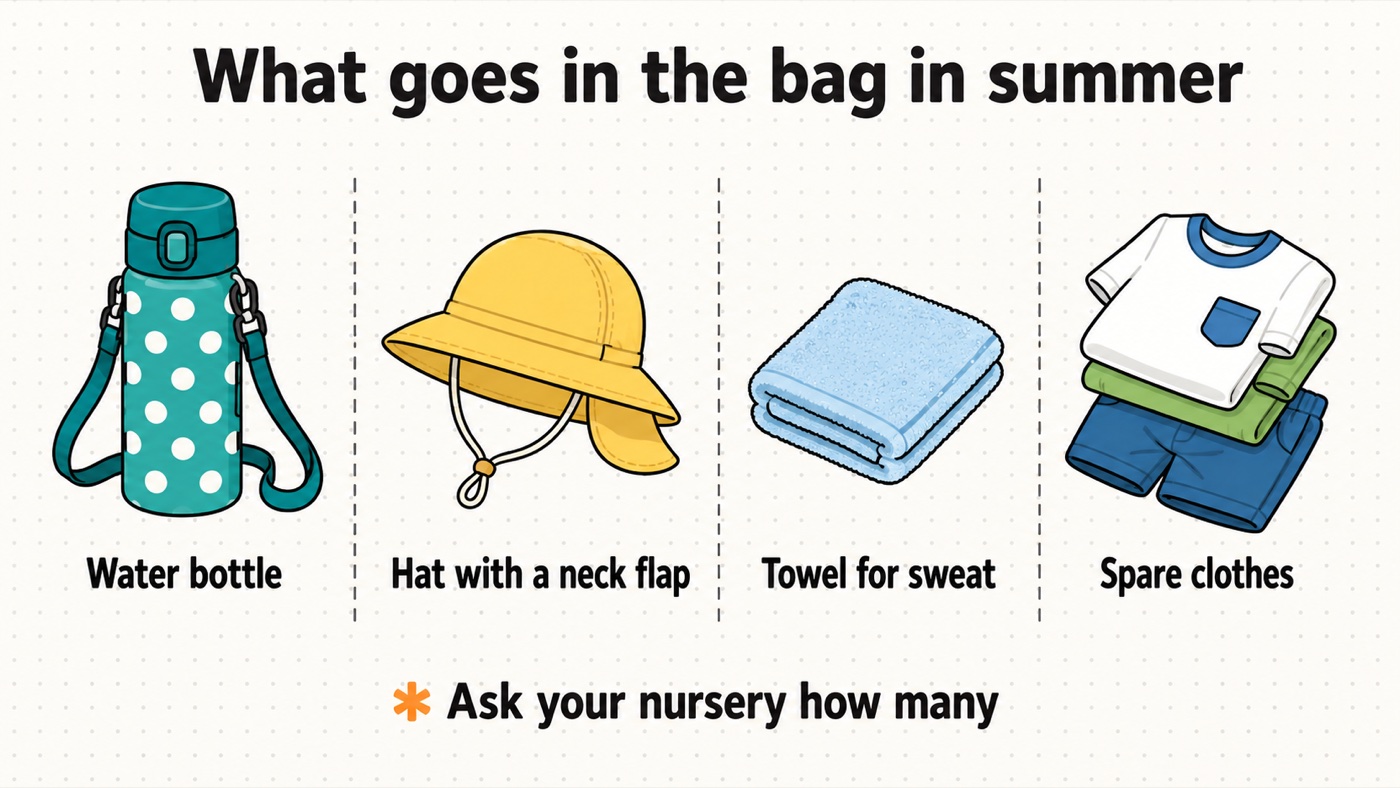
- 水筒 (suitō), a water bottle. Effectively universal in summer. Facilities often specify a size, whether a shoulder strap is wanted, and what may go in it — water and barley tea are the usual answers, and sweetened drinks frequently are not.
- A hat. Some places issue their own; the education ministry's guidance for hot days mentions shading the face and neck, and hats with a neck flap are common in Japanese shops.
- A towel for sweat, and more changes of clothes than you would send in other seasons.
The quantities are worth asking about instead of guessing. A nursery that gets through three changes of clothes on a July day will say so if asked, and it saves the note home.
Sunscreen: A Difference in Expectations
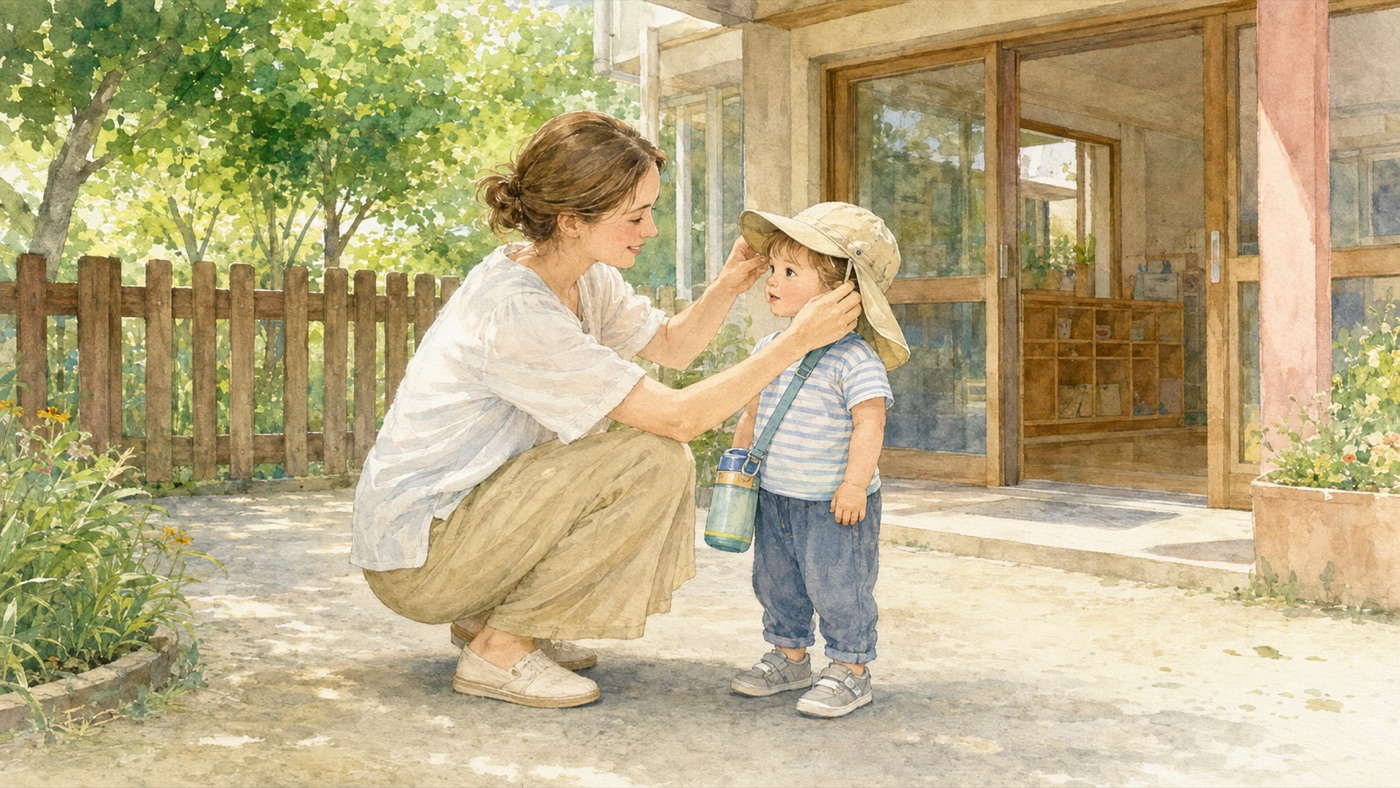
This is where families from Australia, the United States, New Zealand and much of Europe hit something genuinely different, and it is worth understanding before a hot week rather than after one.
What the guidance says. Japan does have national advice on sun protection. The Environment Ministry's UV manual encourages protecting children from excessive sun exposure using hats, clothing and sunscreen. For infants it notes that staying out of the sun during the strongest hours can serve the same purpose without it. It also observes that products sold for children in Japan commonly use mineral filters only, labeled 紫外線吸収剤無配合.
What facilities actually do. Most nurseries do not apply sunscreen to children during the day. The reason is usually not a view about sun protection but a rule about products: many treat anything over-the-counter, sunscreen included, as something they cannot put on a child without instructions from a doctor. The working assumption is that a parent applies it at home before drop-off.
If you are used to a system where staff reapply through the day, this is the gap to know about. Nobody will tell you it is not happening, because from the facility's side nothing is unusual. Ask what your nursery does — whether it will apply anything at all, whether you may send a product, and what it would need from you if so. The answer decides whether protection has to be handled entirely at home.
School pools are a separate question. Whether sunscreen and rash guards are allowed at swimming lessons is decided school by school, and the usual concern raised is the water, not the sun. Practice has been shifting toward permission, with conditions, in a lot of places.
If it matters to your family, ask your own school instead of assuming either answer. If the answer is no, that is your school's call and not a national rule.
Cooling Gear: Ask Before You Send It
Japanese shops carry a summer aisle that repays a browse: cooling towels, hats with a pocket for an ice pack, wraps for the neck, cooling sheets, salt tablets. Most of it is inexpensive and none of it needs explaining once you see it.
The catch is at the school gate. What a child may carry is set by each school, and the rules are not obvious from outside. Handheld fans, neck coolers and parasols are all permitted in some places and not in others — sometimes for reasons of safety, sometimes under a general policy on what comes in the bag.
Sending something unannounced tends to end with it coming home again. A line in the daily notebook beforehand, or a question at pickup, settles it in one exchange — and schools are usually receptive when the request is about heat rather than preference.
If You Are Worried About a Child
This guide is about how the summer is organized, not about diagnosis, and heat illness in a child is not something to work through from a web page.
If a child seems seriously unwell in the heat — and particularly if they are confused, unresponsive, having convulsions, or cannot take fluids — call 119 for an ambulance. It is free, and the operator will guide you. Do not spend time deciding whether it is serious enough. For anything less alarming that still concerns you, a pediatrician is the right call, and our guide to getting medical help for a child in Japan covers how to reach one.
Nurseries and schools work to their own plan for a child who becomes unwell, including who they contact and in what order. If your Japanese is limited, it helps to check that they hold a number that reaches you quickly, and a second contact for when it does not.
Japanese Vocabulary
Words that turn up in forecasts, school notices and the summer aisle:
| Japanese | Reading | Meaning |
|---|---|---|
| 熱中症 | necchūshō | Heat illness, as a general term |
| 暑さ指数 | atsusa shisū | The heat index activity decisions run on |
| 熱中症警戒アラート | necchūshō keikai arāto | The national heat alert |
| 猛暑日 / 酷暑日 | mōshobi / kokushobi | A day of 35°C (95°F) or more, and of 40°C (104°F) or more |
| 熱帯夜 | nettaiya | A night that stays at 25°C (77°F) or above |
| 水筒 | suitō | Water bottle, part of the summer bag |
| 日焼け止め | hiyakedome | Sunscreen |
| 中止 | chūshi | Canceled — the word on the notice |
Japan has spent the last two decades building a public system for heat, and 2026 added a word to it because the old top of the scale stopped being the top. The system is genuinely useful once you can read it — and most of what it asks of a family comes down to checking the evening forecast and asking the nursery what its number is.