
Written and reviewed by Susumu
Born and raised in Japan · Checked against Japanese law and ministry guidance
Everything a first-grader needs, in the order you'll actually need it: the randoseru a year ahead, the supply list that only arrives in winter, the labeling, and the municipal help available if money is tight.
Affiliate Disclosure: This article contains affiliate links. If you click a link and make a purchase, we may earn a small commission at no extra cost to you. We only recommend products we genuinely believe are helpful. See our Terms of Use for full details.
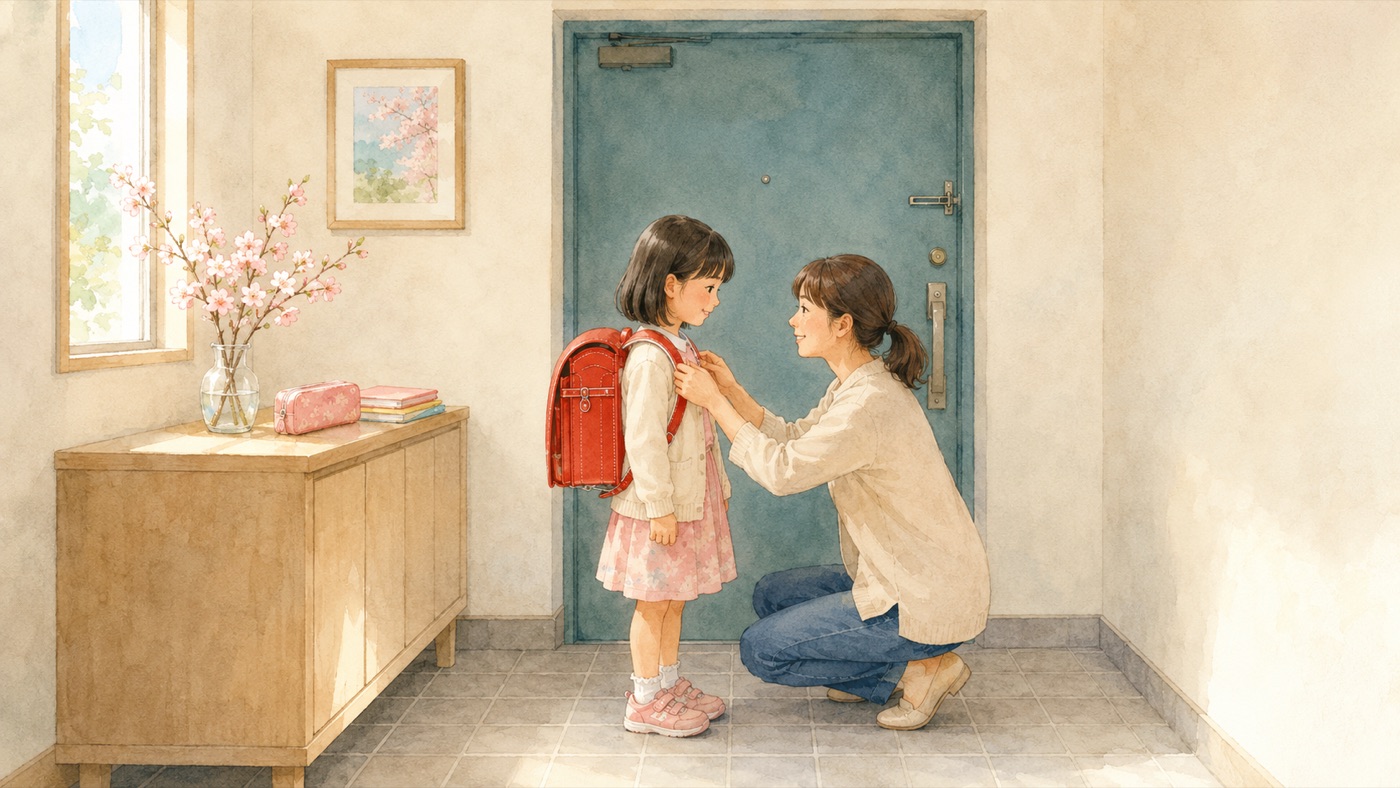
Getting a child ready for first grade in Japan is a longer project than it looks. There's the randoseru to buy as much as a year ahead, a detailed supply list you don't receive until the winter before school starts, a small mountain of items to label — down to individual counting sticks — and, for families who qualify, financial help toward the bill. Here's the whole picture, laid out in the order it actually happens, so nothing sneaks up on you.
The Prep Timeline
The confusing thing about preparing for first grade is that it happens in two very separate waves. The randoseru — the firm-sided backpack every child carries — is bought early, often a full year before school starts. Almost everything else waits until the winter right before enrollment, because the school hands you an exact list and you don't want to guess ahead of it.
Here's the rough shape of the year before your child starts school:
- Spring to early summer (about a year ahead): the randoseru rush, known as ran-katsu. Popular models sell out by early summer.
- Autumn: the pre-enrollment health checkup (就学時健診), and the window to apply for cost assistance if you need it (more on that below).
- January to February: the school's information session (入学説明会), where you finally get the supply list — and often buy some standardized items on the spot.
- February to March: gather the rest of the supplies, then label everything.
- April: the entrance ceremony, and the first day.
The Randoseru
The randoseru is the sturdy, boxy backpack that Japanese children carry through all six years of elementary school. It isn't written into any law, but it's so close to universal that most children have one, and schools are built around the assumption. A handful of areas are relaxing the custom, so it's worth checking whether your school actually requires it — but in most places, you'll be buying one.
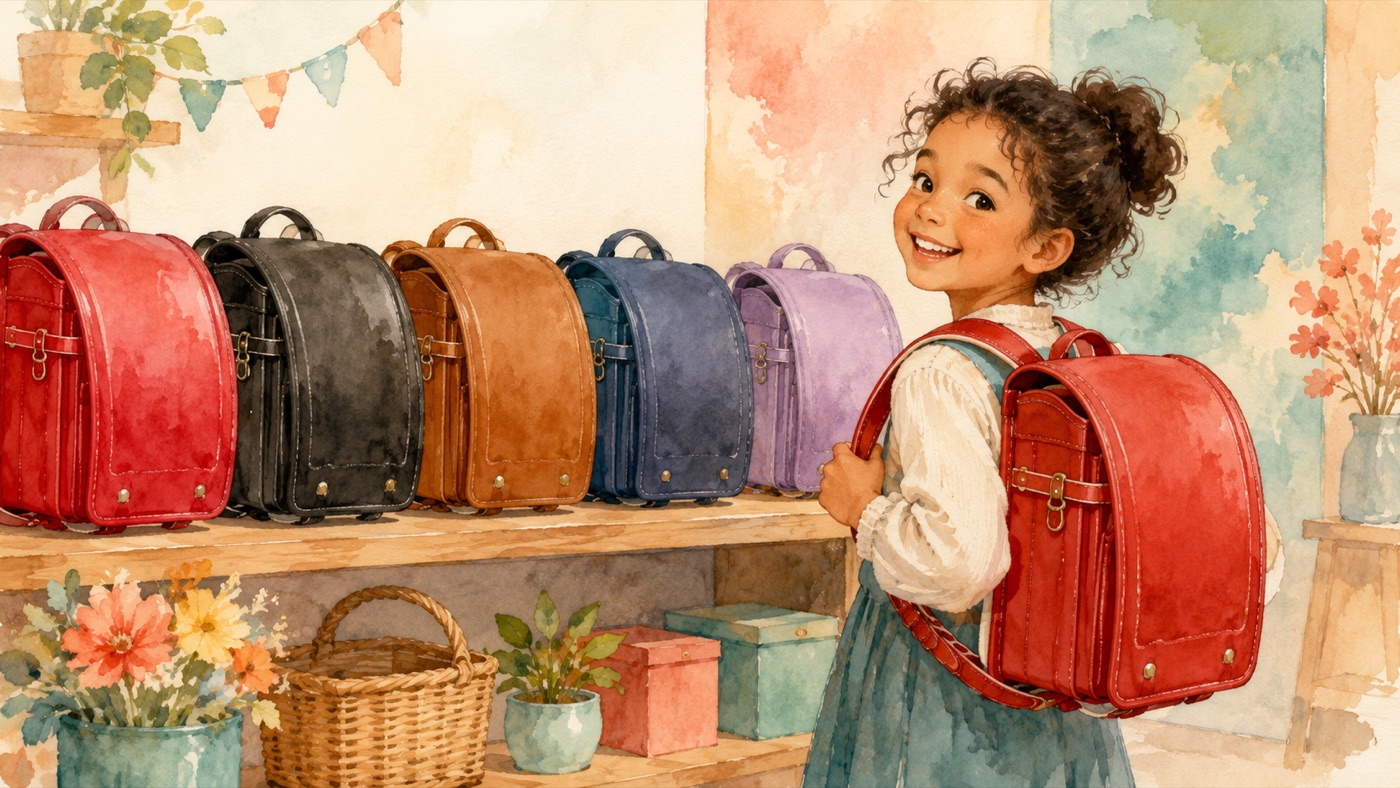
Two things surprise newcomers: the price and the timing. A randoseru commonly runs around 60,000 yen, with the most popular models landing in the 60,000–80,000 range; simpler ones can be found for much less, and premium ones cost more. And people shop startlingly early — many families start the hunt in the spring a full year before enrollment, because sought-after colors and makers sell out by early summer. If you want a specific look, don't leave it to the winter. If you're relaxed about it, plenty of perfectly good options remain available later and closer to the season.
Wait for the School's List
Here's the single most useful thing to know: don't buy the small supplies early. Sometime between January and February, the school holds an information session (入学説明会) and hands out a precise list of what to bring. Schools are specific — a particular size of tool box, notebooks with a set number of lines or squares, a bag of exact dimensions — and some items are ordered or bought right there so the whole class has the same thing. Buy ahead and you risk getting the wrong version.
The session is run in Japanese, and it moves quickly. If following it will be hard, ask the school in advance whether they can help, and don't be shy about checking the list item by item afterward with another parent or the school office. This session pairs with the paperwork side of starting school, which we cover in how to enroll in a Japanese public school.
What's on the List
Every school's list differs, but a first-grader's kit almost always includes some version of the following:
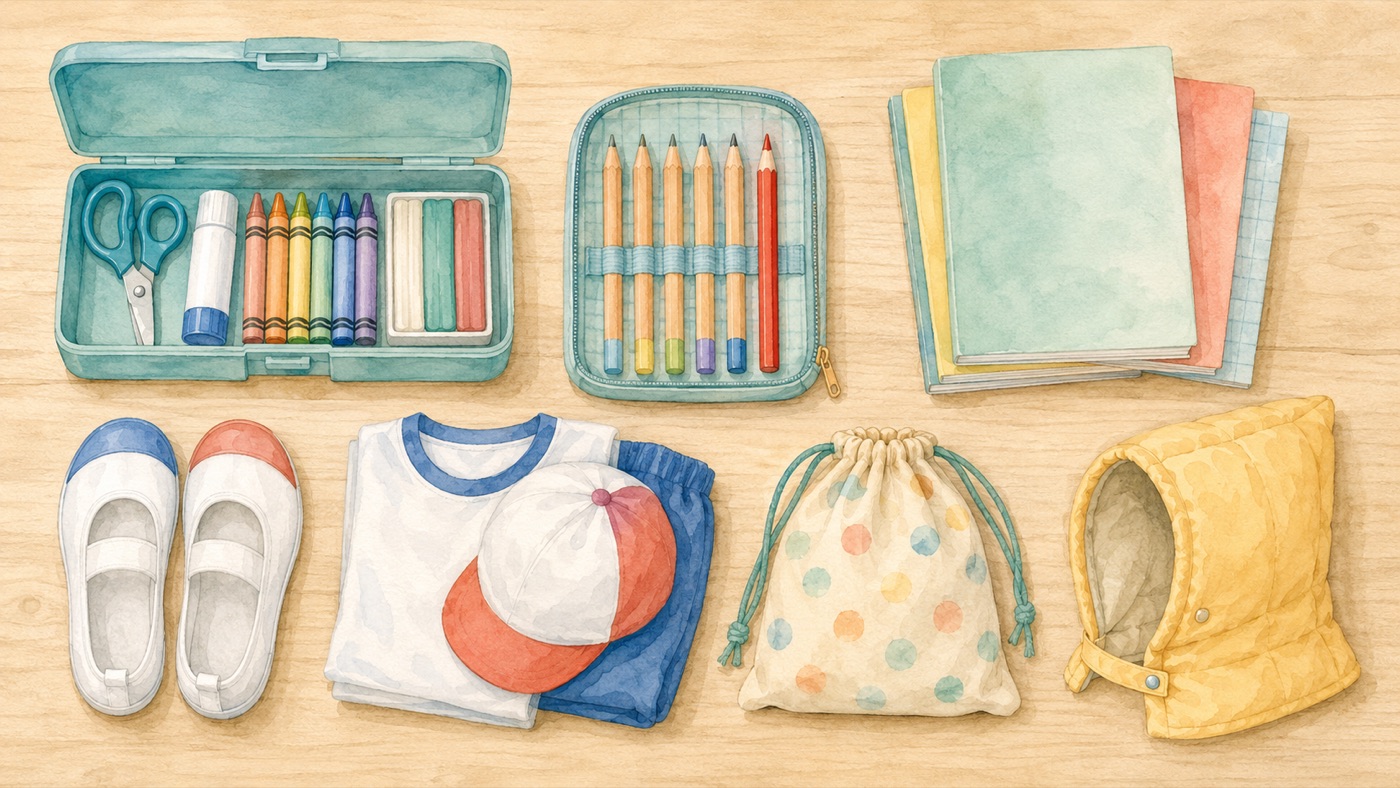
- Stationery. A simple pencil case with several soft pencils — usually 2B, because the soft lead is easier for small hands — plus a red pencil, an eraser, a writing board (下敷き), and a short ruler.
- The tool box (お道具箱). A shallow box kept at school, holding scissors, glue, crayons or colored pencils, and modeling clay with its board. This is often the standardized item bought through the school.
- Notebooks and the home–school notebook. Subject notebooks in the school's specified ruling, plus the daily communication notebook.
- PE kit. Gym clothes, a reversible red-and-white cap (赤白帽), and a bag to carry them.
- Lunch things. Usually a napkin or placemat, a cup, a mask, and a drawstring bag; the serving smock is often shared and rotated by the class. See our guide to school lunch (給食).
- Indoor shoes (上履き) and their bag, worn inside the building.
- Safety and emergency items. A personal safety alarm (防犯ブザー) for the walk to school, and often a padded disaster hood (防災頭巾) that doubles as a seat cushion.
A few things — a melodica (鍵盤ハーモニカ) most commonly, and later on a paint set, recorder, and calligraphy set — are usually ordered through the school when they're needed rather than bought up front for day one.
Bags and the Handmade Question
Japanese schools ask children to carry a surprising number of separate cloth bags: one for indoor shoes, one for PE clothes, a drawstring one for lunch things, and a flat tote (often called a lesson bag) for library books and odds and ends. Sometimes the list specifies exact sizes so they fit a desk hook or locker.
You may hear that these are supposed to be handmade, and some families do sew them. To be clear: store-bought is completely fine. If a size is specified and you can't find it ready-made, that's the one case where sewing — or asking someone to — becomes the simple path. Otherwise, buy them.
Label Every Last Piece
Then comes the part that defeats even Japanese parents: everything gets your child's name on it. Not just the backpack and shoes — every pencil, every crayon, and, most notoriously, every tiny piece of the counting set (算数セット) used in math, which can mean writing a name on dozens of miniature sticks and blocks. Name stickers and a name stamp are what keep this from taking a whole weekend. We cover the tools and the culture behind it in our guide to labeling everything.
Help With the Cost
Add the randoseru to the supplies and the bill for starting school is real. If money is tight, there is a support system for exactly that: school-cost assistance (就学援助, shūgaku enjo), run by every municipal board of education for families whose income falls below a set line. It's open to residents regardless of nationality.
The part that matters most here is the new-entrant supply allowance (新入学学用品費), which helps cover the randoseru and first-year supplies. The national rate behind it rose in 2026 to ¥64,300 for a child starting elementary school, though what your own municipality pays is its own decision. Many municipalities now pay it before enrollment, in the spring rather than after school starts, so it lands when you're actually buying things. Applications often open the autumn or winter before enrollment, so ask the board of education early — our guide to help with school costs covers the timing in detail. For the wider picture of allowances for raising children here, see our overview of parenting benefits in Japan.
Japanese Vocabulary
| Japanese | Reading | Meaning |
|---|---|---|
| 入学準備 | nyūgaku junbi | Getting ready for the start of elementary school |
| 入学説明会 | nyūgaku setsumeikai | The winter information session where you get the supply list |
| ランドセル | randoseru | The firm-sided backpack carried through all six years |
| ラン活 | ran-katsu | The early "randoseru hunt," often a year ahead |
| 学用品 | gakuyōhin | School supplies |
| お道具箱 | o-dōgu-bako | The tool box of stationery kept at the child's desk |
| 上履き | uwabaki | Indoor shoes worn inside the school building |
| 体操服 | taisōfuku | Gym clothes for PE, with a reversible red-and-white cap |
| 防犯ブザー | bōhan buzā | A personal safety alarm carried on the way to school |
| 防災頭巾 | bōsai zukin | A padded hood for earthquakes that doubles as a seat cushion |
| 算数セット | sansū setto | The math kit of small counting pieces — each one gets labeled |
| 就学援助 | shūgaku enjo | Municipal financial assistance with school costs, income-based |
| 新入学学用品費 | shin-nyūgaku gakuyōhin-hi | The new-entrant supply allowance within 就学援助 |