
Written and reviewed by Susumu
Born and raised in Japan · Checked against Japanese law and ministry guidance
Public school charges no tuition, but lunch, supplies and trips still cost money. Every city in Japan runs a system that helps families who are below its income line, and nationality is not part of the test. What it covers, how to find out whether your household qualifies, and why the month you ask changes what you get.
Affiliate Disclosure: This article contains affiliate links. If you click a link and make a purchase, we may earn a small commission at no extra cost to you. We only recommend products we genuinely believe are helpful. See our Terms of Use for full details.
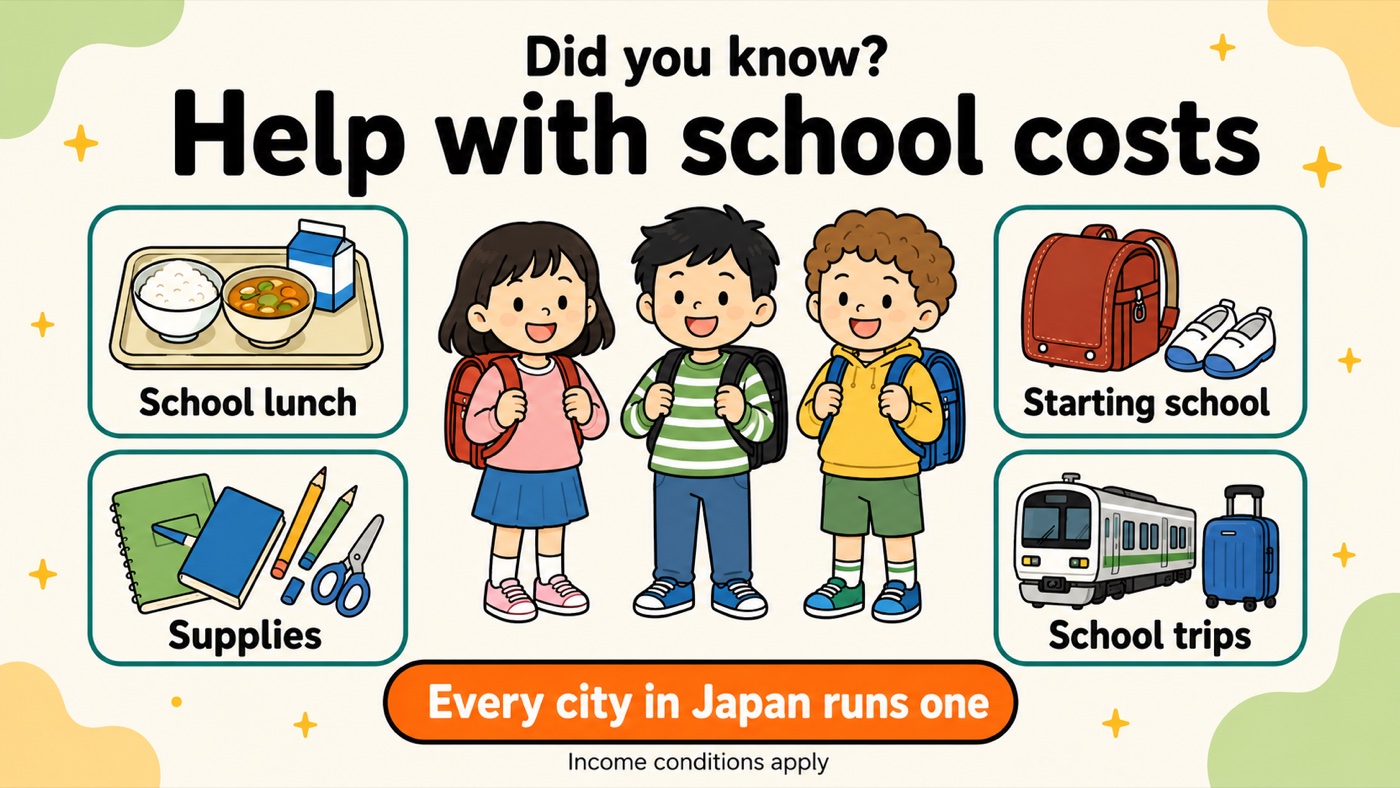
The short version
- It is called 就学援助 (shūgaku enjo), and every city and town in Japan must run one.
- It helps with school lunch, supplies, trips and more, for families whose income is below a line the city sets.
- Nationality is not part of the test, and this is help, not a loan — there is nothing to pay back. Ask the school office for the form; that commits you to nothing.
What This Is
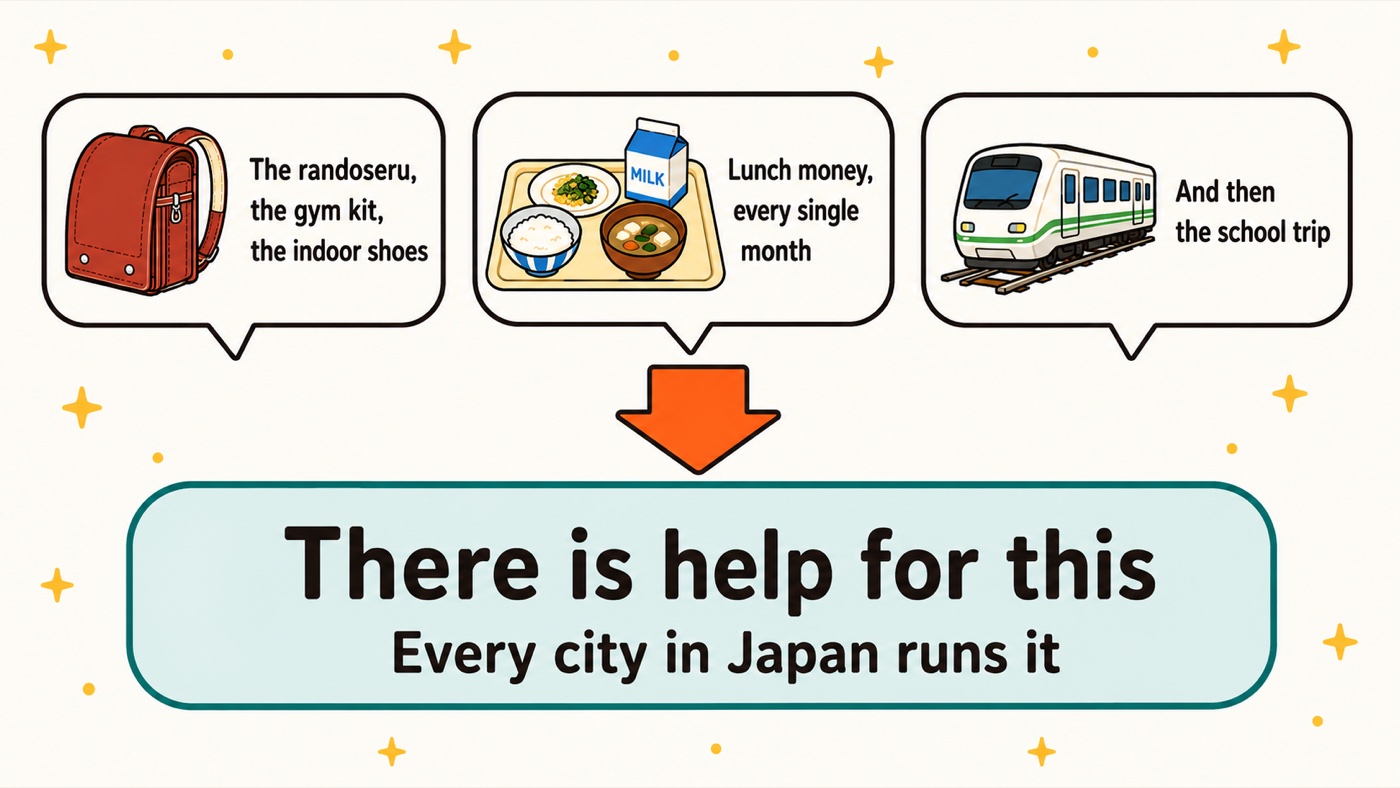
Tuition and textbooks at a public school are free for everyone. Everything else is not — lunch every month, notebooks, a recorder, a gym uniform, the bus for a field trip. 就学援助 is the system that helps families pay for that second list.
National law requires every city, ward and town to help families who are struggling with school costs. Each one runs its own version, but none of them can decide to skip it, and nobody at the school is doing you a favor by handing you the form.
Nor is it a rare arrangement. About 1.17 million children were covered in the 2024 school year, so it is nothing unusual to ask about, and nobody at the school will treat it as such.
It is means-tested, though, and the great majority of households do not qualify. Think of it as something to check rather than something to count on — worth ten minutes of your time to find out, and not worth building a budget around until you have the letter.
What It Pays For
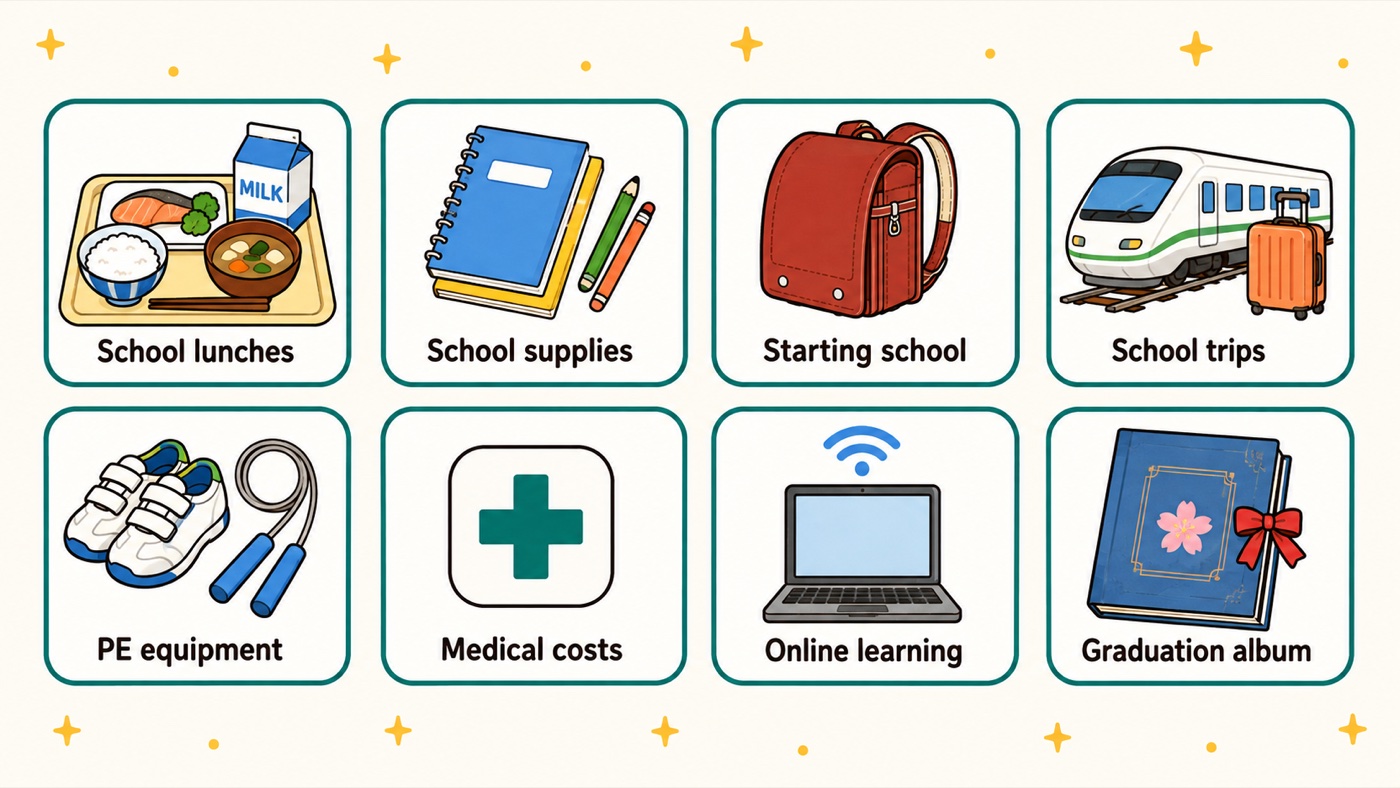
The national list runs to fourteen items. Alongside the eight above it also covers getting to school, off-site activities, club activities, student council fees, PTA dues, and the graduation album. Your city picks its own list, usually from the same set.
Two are worth knowing about before the rest:
- School lunch is the cost families feel every month. Our guide to how kyūshoku works covers what it normally runs to.
- Starting school is the single biggest payment. It exists to offset the randoseru and the first-year supplies, and the national rate for it went up in 2026 — to ¥64,300 for a child entering elementary school, and ¥81,000 for junior high. What your own city pays is its own decision, so treat these as the scale rather than a promise. Our guide to getting ready for first grade covers what that money is for.
Why Cities Differ
Compare notes with a friend in the next city and the rules will not match. There is a reason for that, and it explains most of what follows.
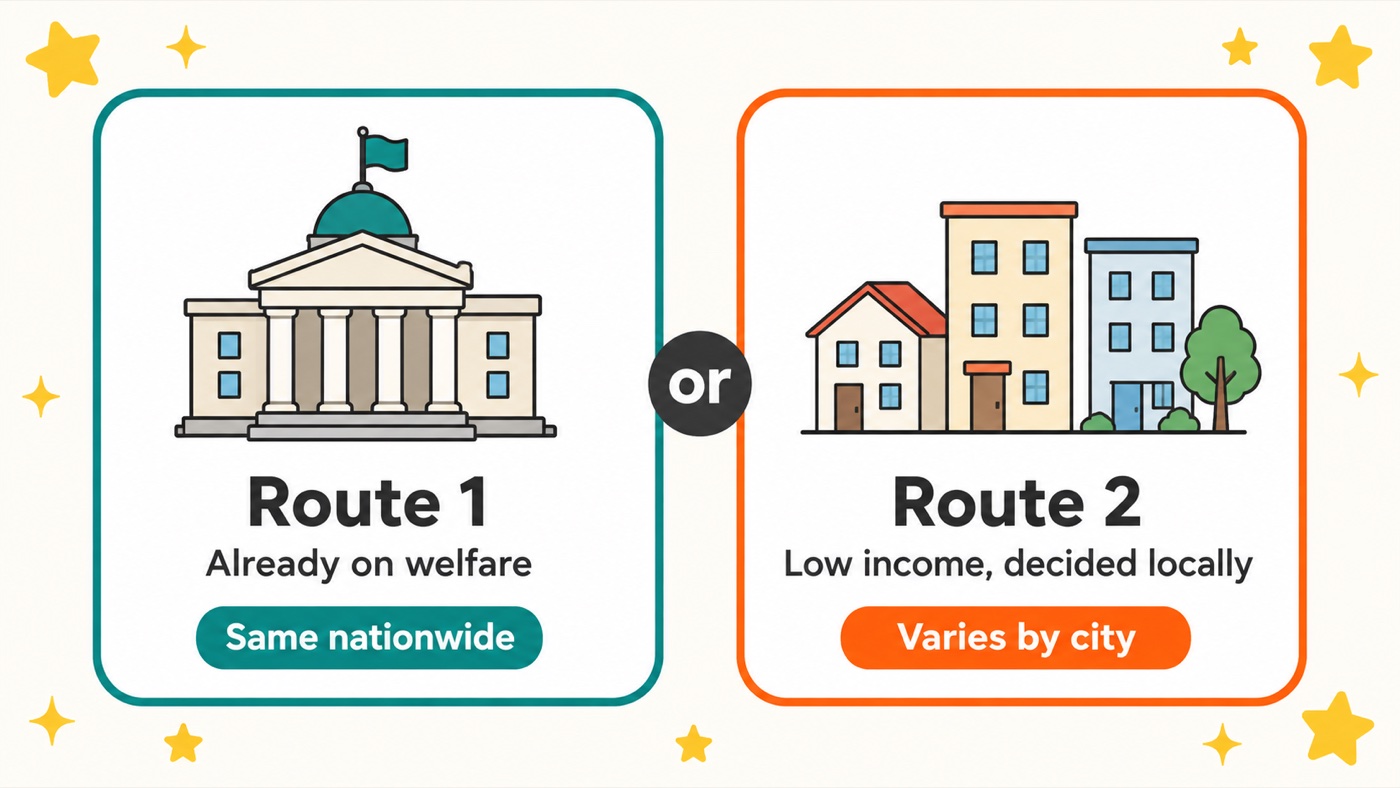
- Route 1 — 要保護 (yōhogo). Households already receiving public assistance. The national government pays half, so this route looks much the same everywhere. About 80,000 children.
- Route 2 — 準要保護 (jun-yōhogo). Households the city judges to be in similar difficulty. About 1.09 million children — so this is almost certainly the one that concerns you.
Until 2005, the national government helped pay for Route 2 as well. That funding was moved into general local budgets, and since then each city has paid for Route 2 out of its own pocket and written its own rules.
So the income line, the covered items, the amounts and the deadlines all come from your city, and they follow from that one funding change rather than from anything untidy. It also means no article can hand you your own city's numbers. This one included.
Can Your Family Apply?
The tests cities publish are about living there and about the household's income. Nationality does not appear among them.
There is a stronger sign than that. The education ministry instructs city halls to tell families from overseas about this system — through their newsletters, websites and school briefings, and in the languages people in the area actually speak. Whether every city has got round to it is another matter, but the instruction exists, which makes this a fair thing to ask for:
就学援助の案内は、外国語版がありますか。
Shūgaku enjo no annai wa, gaikokugo-ban ga arimasu ka?
Is there a version of the school assistance information in another language?
On income there is no national figure to quote, but the tests tend to take one of three forms, and you will recognize yours on the city's page:
- A multiple of the welfare standard. The most common one. Your income is compared to the public assistance level for a household of your size, multiplied by a number the city chooses. In the ministry's survey, the largest group of cities set that number between 1.2 and 1.3.
- Already receiving certain benefits. The single-parent allowance (児童扶養手当, jidō fuyō teate) usually qualifies a household on its own.
- Something changed this year. Job loss, illness or separation during the year are common reasons cities accept.
Apply even if you think you earn too much. This is advice the cities themselves print. The decision is based on income after deductions, not the number on your payslip, and households who assumed they were over the line often are not.
When to Ask
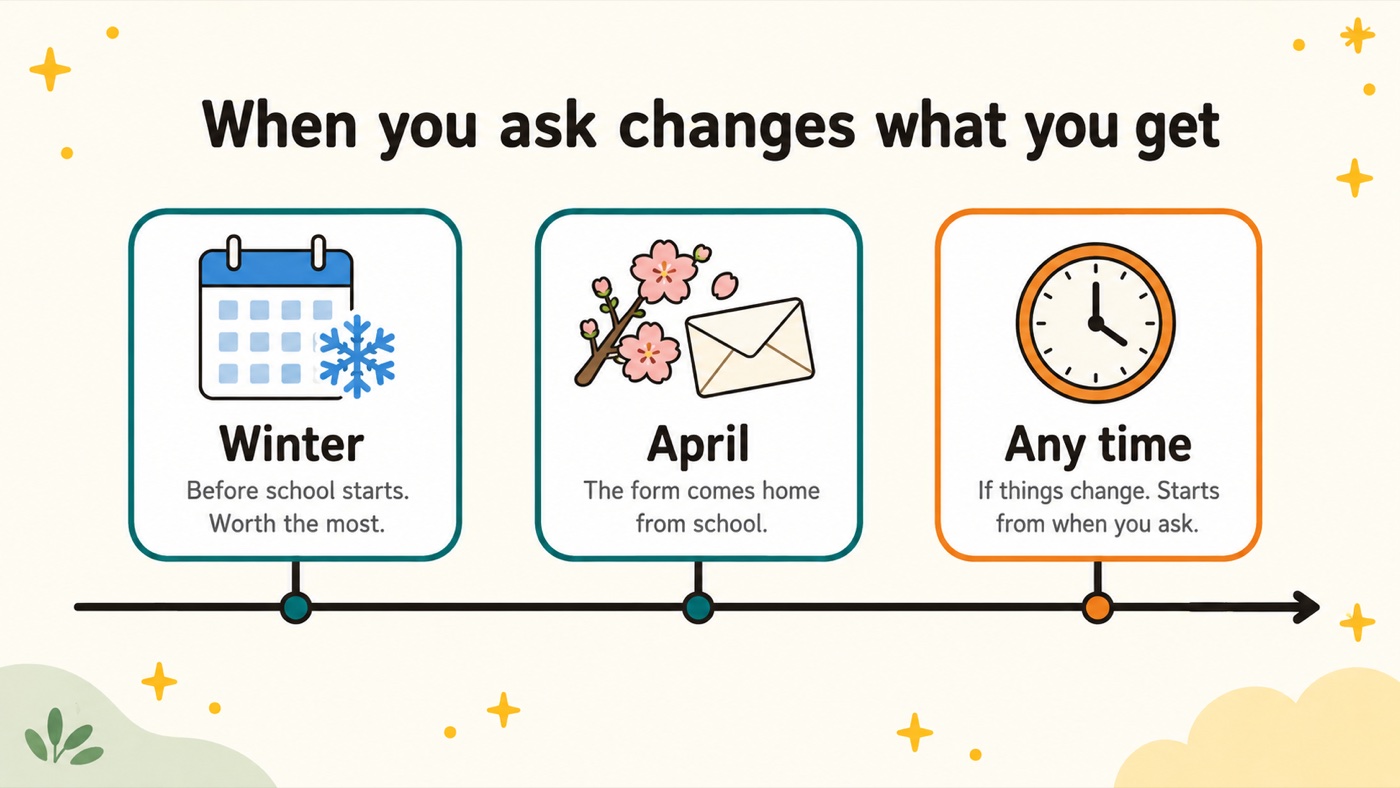
Two families in the same circumstances can end up with different amounts, purely because of when they applied. This is the part to remember if you remember nothing else.
- Before your child starts school. Many cities now pay the starting-school money in March, before the first day, so it arrives while you are still buying things. Applications for it usually open in the winter and are announced at the pre-enrollment briefing (入学説明会, nyūgaku setsumeikai). Miss it and the same money tends to arrive later in the first year instead.
- In April. The main form comes home in the first-week paperwork, mixed in with everything else, and the deadline usually falls a few weeks later in the spring. Schools often post the date on their own website as it approaches, so that is a place to check if the paper has gone missing. Cities generally run further rounds afterward, but this first one is the one that covers the whole year.
- Any time during the year. If your situation changes, you can still apply. But approval usually starts from around the date you applied rather than being backdated to April — so a month of waiting is a month of help you do not get.
You have not missed your chance if it is already October. But the earlier application is almost always worth more, and the payment before enrollment is the one to catch.
How to Apply
The process is duller than the subject sounds. In most places the counter is the school, not city hall.
- Ask the school for the form. It also comes home in the April packet and is handed out at the pre-enrollment briefing. The board of education has it too.
- Attach what it asks for. Usually proof of household income and your bank details, often a photocopy of the passbook page.
- Hand it back to the school. Or to the board of education, if your city's form says so.
- Wait for the letter. The decision arrives by mail, usually a month or two after you apply.
- Expect the money in installments. Most cities pay three or four times across the school year rather than in one lump — commonly around July, December and March — with a notice sent shortly before each transfer. Some items, lunch in particular, are simply taken off what the school collects instead.
If asking in person is easier than reading your way there, one sentence at the school office does it:
就学援助の申請書をいただけますか。
Shūgaku enjo no shinseisho o itadakemasu ka?
Could I have an application form for the school cost assistance?
Taking the form does not commit you to anything. School offices hand these out every day.
Two things families get wrong, both of which cost money:
- You do not pay it back. This is not a loan and not a student loan of the kind Japan calls 奨学金 (shōgakukin). City leaflets print 返済不要 (hensai fuyō) — no repayment — in large letters for exactly this reason.
- Approval does not roll over. Most cities ask you to apply again every year, even if you were approved last year. Your circumstances are reassessed each time, so being approved once is no guarantee of the next year, and being turned down once does not settle anything either.
Finding Your Own City's Rules
Your city's page is the one that actually governs your family, and it is easier to find than most people expect. Search your city or ward name in Japanese, a space, then 就学援助:
○○市 就学援助
Put your own city where ○○市 is — 渋谷区, 横浜市, 高槻市
Look for four things: the application period, the list of covered items, the documents to attach, and whether there is a payment before enrollment. The education ministry also keeps a page linking to the right contact for every municipality, and publishes a short leaflet about the system in English.
One caution. Do not take another city's figures to your own city hall. Those amounts are lawful local decisions, and a neighboring city paying more is not something yours can be asked to match.
For the wider picture, our guide to what public elementary school costs lays out the whole year, and our guide to enrolling in a public school covers the step before this one.
Japanese Vocabulary
These are the words on the form and on your city's page:
| Japanese | Reading | Meaning |
|---|---|---|
| 就学援助 | shūgaku enjo | Help with school costs |
| 要保護 | yōhogo | Route 1 — households already on public assistance |
| 準要保護 | jun-yōhogo | Route 2 — households the city judges to be in similar difficulty |
| 認定基準 | nintei kijun | The criteria your city uses to decide |
| 新入学児童生徒学用品費 | shin-nyūgaku jidō seito gakuyōhin-hi | The starting-school payment, the largest single item |
| 申請書 | shinseisho | Application form |
| 入学説明会 | nyūgaku setsumeikai | The pre-enrollment briefing, where the early payment is announced |
| 教育委員会 | kyōiku iinkai | The city's board of education, which decides and pays |
| 返済不要 | hensai fuyō | No repayment required — printed on leaflets to make clear this is not a loan |
This guide describes the national framework and the shape of the local rules. Criteria, amounts, deadlines and covered items are set by each municipality and change from year to year — confirm the current terms with your school or board of education before relying on anything here.