
Written and reviewed by Susumu
Born and raised in Japan · Checked against Japanese law and ministry guidance
Public elementary school has no tuition, but materials, dues, and trips still come home in envelopes. What the school actually collects each year — and why most of that ballpark ¥370,000-a-year average is cram school, not the school's bill.
Affiliate Disclosure: This article contains affiliate links. If you click a link and make a purchase, we may earn a small commission at no extra cost to you. We only recommend products we genuinely believe are helpful. See our Terms of Use for full details.

Public elementary school in Japan is often described as free, and in the way that matters most, it is: there is no tuition, and the government-approved textbooks cost nothing. But money still comes home in envelopes through the year — for materials, for a field trip, and once or twice for something larger like the Grade 6 school trip. None of it is a surprise if you know the shape of the year in advance. This guide lays out what the school actually collects, what the national figures do and do not tell you, and where to turn if the bill is hard.
What "Free" Actually Covers
Two things are genuinely free at a public elementary school: tuition, and the government-approved textbooks handed out through the school. That much is national, and it does not depend on your income or your address.
Everything else your child uses through the year can carry a cost — workbooks and notebooks, art and craft materials, a swimming cap, a recorder, the bus for a field trip. These are collected by the school, usually in monthly amounts, and the total is modest next to private school but real enough to plan for. "Free public school" describes the tuition, not the yearly budget.
The Big Number, and the Smaller One That Matters
Every couple of years the education ministry (MEXT) surveys what families actually spend, and one number gets quoted everywhere: on average, roughly ¥370,000 a year for a child in public elementary school. That is a national average, a round figure that almost no family's total lands on exactly, and it is easy to read as the school's bill. It is not.
The survey splits that total three ways, and the split is the point:
- Out-of-school spending — cram school, tutoring, lessons, home study — is the largest part by far, around 70% of the total. This is money families choose to spend outside the school, and it varies enormously from one household to the next.
- School lunch is roughly another tenth — and from April 2026 a national subsidy covers most of it (more below).
- What the school itself collects — materials, dues, trips — is the smallest slice of the three.
So most of that headline figure is optional out-of-school spending, not a bill from the school. What the school actually collects is far less, and it is the part worth planning for. Treat every figure here as a national average and a rough guide, not a quote for your child. A school's own notice is the only number that counts.
What the School Collects
So what are the envelopes actually for? The school's own collections fall into a handful of familiar categories. The amounts differ by school, by grade, and from year to year, so treat this as a map of what to expect rather than a price list:
- Books, workbooks, and craft or lab materials — usually the largest of the school's own costs.
- Commuting items — this is where the randoseru and any school-designated clothing sit, which is why it adds up to more than transport alone.
- School dues — class and student-council costs, and usually PTA membership; whether you pay, and how much, depends on the local PTA, a point our guide to the PTA covers in full.
- Field trips and off-campus learning.
- Clubs, sports day, and school performances.
- Entrance-time and other one-off items.
Materials and commuting items make up most of it; the rest is spread thinly across trips and events. These categories come from MEXT's national survey, but the yen behind each one is a national average, and your own school's notices will not match it item for item.

Lunch, Field Trips, and the Grade 6 Trip
Lunch used to be the steadiest cost of the year, collected month by month. That changed in April 2026, when the national government began covering the food cost of public elementary lunch at a standard ¥5,200 per child a month, with no income limit and nothing for parents to apply for. For most families that makes lunch effectively free. Where a school's actual cost runs above ¥5,200 (some do, using local ingredients), a small balance may still be collected. Our guide to school lunch covers how it is billed and what the meal includes.
Events are where the year turns uneven. Watching an event is normally free for parents; taking part can cost money. A field trip may ask for a lunch from home, transport, and an admission fee. Sports day and school performances rarely carry a set national fee, but a school may ask you to prepare clothing or materials, and photographs are often offered as a separate purchase.
The largest event bill comes near the end. Many schools run an overnight outdoor activity around Grade 5 and a school trip (修学旅行) in Grade 6, and the trip in particular can run to tens of thousands of yen once transport, a night or two of lodging, meals, and admissions are added up. Schools usually see it coming and collect the money over several months, sometimes across the whole year, rather than in one notice. Our overview of elementary school in Japan gives the typical range and timing. Keep the paid notice afterward — it makes an unfamiliar line on a bank statement easy to place later.
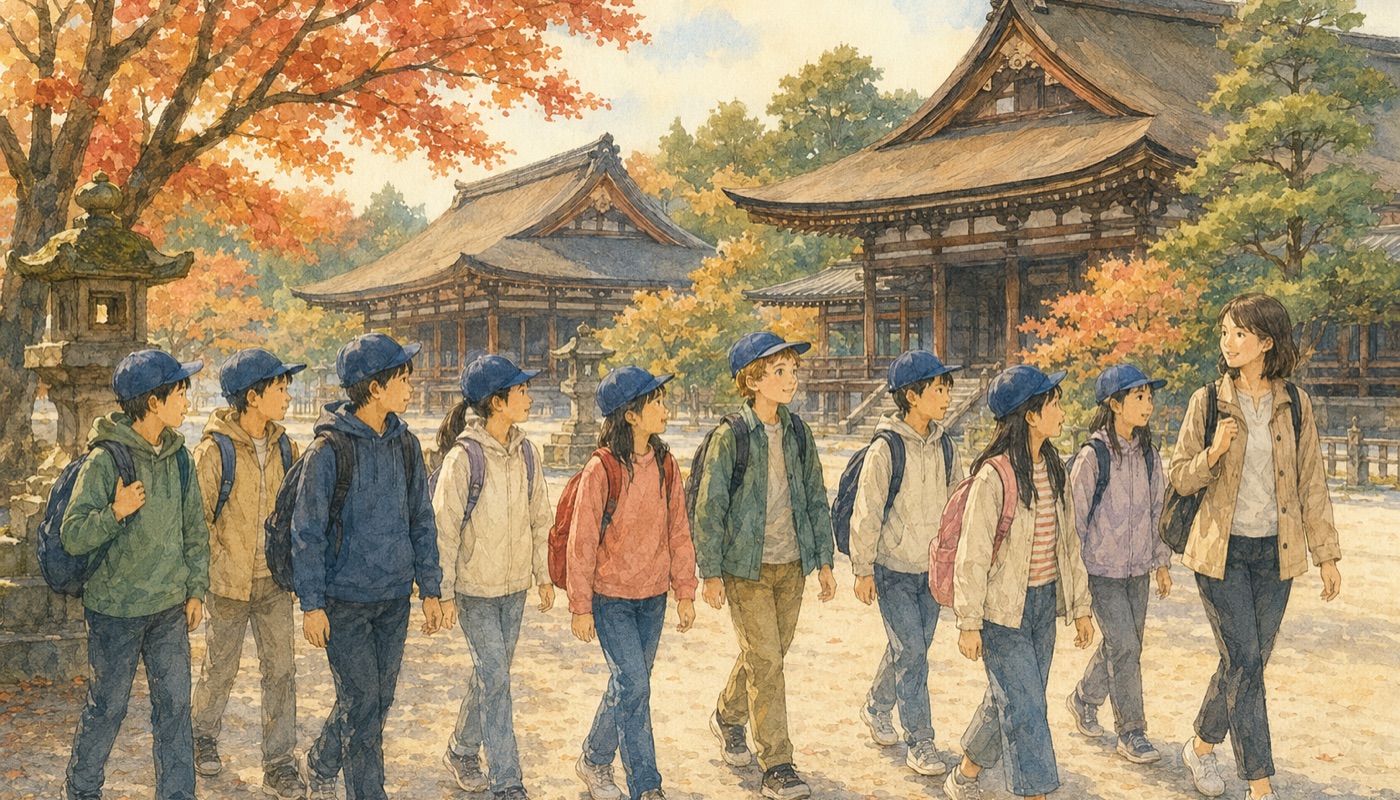
When the school calendar or the first payment notice arrives, it is worth marking the likely one-off costs in advance: field trips and facility visits, the Grade 5 overnight, the Grade 6 trip, materials or clothing for a performance, optional photographs, and any payment collected outside the usual monthly amount. That is a planning list, not a national schedule — your school may fold several of these together or not charge for some at all.
Why Two Families Pay Different Amounts
There is no single price list for public elementary school in Japan, and two families in different cities can pay noticeably different amounts for what looks like the same year. The amount moves with:
- the municipality and its board of education, which set lunch fees and any subsidy;
- the school and its district;
- your child's grade — some costs, like the Grade 6 trip, land only once;
- the destination and transport for a given trip;
- local fee reductions or free-lunch policies; and
- whether a payment is required, optional, or collected by a separate body such as the PTA.
A city may publish its own figures for lunch, materials, or trips. Those are worth reading if you live there, but they are not a national standard. For your own child, the latest notice from the school and the current municipal website are the only sources that settle the question.
If the Bill Is Hard
Every municipal board of education runs a system of help with school costs — 就学援助 (shūgaku enjo) — for households whose income falls below a line the municipality sets. Depending on the local rules it can go toward supplies, lunch, field trips, and the school trip, and it is open to residents regardless of nationality.
More than one child in eight in Japan's public elementary and junior high schools is covered by it. Our guide to help with school costs sets out how the system is built, what it pays for, and why applying before your child starts can be worth more than applying afterward.
It is not automatic. Each municipality sets its own income test, application window, required documents, and covered costs, so the place to start is the local board of education or city office. The single largest piece of help arrives at enrollment, through the new-entrant supply allowance that offsets the randoseru and first-year supplies; our guide to getting ready for first grade covers that part in detail. Until an application is approved, budget for the full amount.
Questions to Ask the School
- Which payments should we expect this year, and roughly when?
- Are lunch, materials, and trips billed separately or together?
- Which grades have an overnight activity or a school trip?
- When is the school-trip money collected, and over how many months?
- Are there lunch subsidies or fee reductions in this municipality?
- Where can I read the current fee information in Japanese?
If you want to raise it with the office directly, one plain question opens the whole subject:
今年、学校で集めるお金はどれくらいですか?
Kotoshi, gakkō de atsumeru okane wa dore kurai desu ka?
About how much will the school collect this year?
Japanese Vocabulary
These are the terms that appear on payment notices and in the ministry's survey:
| Japanese | Reading | Meaning |
|---|---|---|
| 学習費総額 | gakushū-hi sōgaku | Total yearly spending per child in the survey |
| 学校教育費 | gakkō kyōiku-hi | School education costs — what the school collects |
| 学校給食費 | gakkō kyūshoku-hi | School lunch fee |
| 学校外活動費 | gakkōgai katsudō-hi | Out-of-school costs — juku, lessons, home study |
| 学校納付金 | gakkō nōfukin | Dues the school collects, including PTA |
| 集金袋 | shūkin-bukuro | The envelope used to send collected money to school |